Decaffeinated Coffee Market: Tanzania vs Top 5 Major Economies in 2027 (Africa)
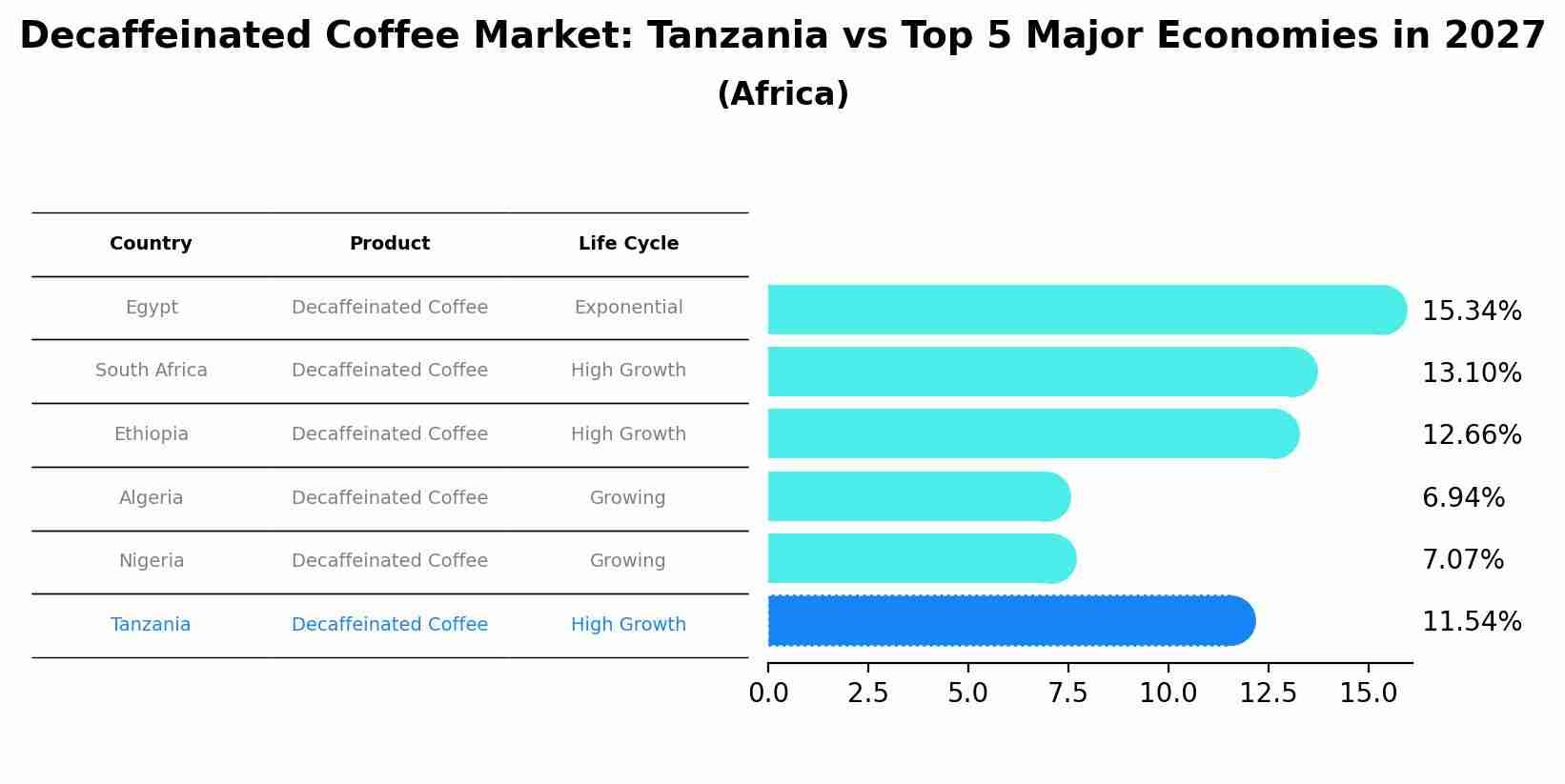
Tanzania's Decaffeinated Coffee market is anticipated to experience a high growth rate of 11.54% by 2027, reflecting trends observed in the largest economy Egypt, followed by South Africa, Ethiopia, Algeria and Nigeria.
Tanzania Decaffeinated Coffee Market Overview
The Tanzania Decaffeinated Coffee Market is witnessing steady growth driven by increasing consumer awareness about health benefits associated with decaffeinated coffee. Consumers are increasingly seeking a healthier alternative to regular coffee while still enjoying the rich flavors and aromas of Tanzanian coffee beans. The market is also benefiting from the rising trend of specialty coffee consumption globally, with Tanzania`s unique coffee profiles gaining popularity among discerning coffee enthusiasts. Key players in the market are focusing on expanding their product offerings and enhancing their decaffeination processes to meet the growing demand for high-quality decaffeinated coffee. Additionally, sustainable practices in coffee production are becoming a prominent factor influencing consumer choices, further driving the demand for ethically sourced decaffeinated coffee in Tanzania.
Tanzania Decaffeinated Coffee Market Trends
Currently, in the Tanzania Decaffeinated Coffee Market, there is a growing demand for high-quality decaffeinated coffee due to increasing health consciousness among consumers. The market is witnessing a trend towards sustainable and ethically sourced decaffeinated coffee products, as consumers are placing more importance on the environmental and social impact of their purchases. Additionally, there is a shift towards innovative decaffeination methods that preserve the flavor profile of the coffee beans, such as the Swiss Water Process and carbon dioxide extraction. As global awareness of the negative effects of caffeine consumption grows, the Tanzania Decaffeinated Coffee Market is expected to continue expanding, with opportunities for premium and specialty decaffeinated coffee products to gain traction among discerning consumers.
Tanzania Decaffeinated Coffee Market Challenges
In the Tanzania Decaffeinated Coffee Market, some challenges include limited awareness and understanding of the decaffeination process among consumers, leading to lower demand for decaffeinated coffee compared to regular coffee. Additionally, the high cost associated with decaffeination processes and certification for organic decaffeinated coffee may hinder the growth of this market segment. Supply chain issues, such as the availability of quality decaffeinated coffee beans and the lack of specialized decaffeination facilities in Tanzania, also pose challenges. Furthermore, competition from other coffee-producing countries that have established decaffeination facilities and a stronger presence in the global decaffeinated coffee market presents a barrier for Tanzanian decaffeinated coffee producers to expand their market share.
Tanzania Decaffeinated Coffee Market Investment Opportunities
In the Tanzania Decaffeinated Coffee Market, there are promising investment opportunities for companies involved in the decaffeination process, as well as those focusing on marketing and distributing decaffeinated coffee products. With an increasing global trend towards healthier lifestyles and a growing demand for specialty coffee products, there is a potential for significant growth in the decaffeinated coffee segment. Investors could consider establishing or partnering with coffee processing facilities that offer decaffeination services, investing in sustainable and environmentally friendly decaffeination technologies, or launching marketing campaigns to promote Tanzanian decaffeinated coffee to international markets. By capitalizing on the country`s reputation for high-quality coffee beans and meeting the rising consumer demand for decaffeinated options, investors can tap into a niche market with growth potential.
Tanzania Decaffeinated Coffee Market Government Policy
The Tanzanian government has implemented policies to promote the growth and sustainability of the decaffeinated coffee market. This includes the provision of financial support and technical assistance to coffee farmers and processors, as well as the establishment of quality standards and certification programs to ensure product integrity. Additionally, the government has imposed regulations to protect the environment and promote sustainable farming practices within the industry. The Tanzanian Coffee Board plays a key role in overseeing and enforcing these policies to ensure compliance and drive the growth of the decaffeinated coffee market in Tanzania.
Tanzania Decaffeinated Coffee Market Future Outlook
The Tanzania Decaffeinated Coffee Market is expected to witness steady growth in the coming years due to increasing consumer awareness about the benefits of decaffeinated coffee. The global trend towards health and wellness is driving demand for decaffeinated coffee products, and Tanzania`s reputation for producing high-quality coffee beans will further boost market growth. Additionally, as more consumers seek sustainable and ethically sourced products, Tanzanian coffee producers are likely to benefit from this growing preference. With advancements in decaffeination technology and a focus on maintaining the rich flavors of Tanzanian coffee beans during the decaffeination process, the Tanzania Decaffeinated Coffee Market is poised for expansion in the foreseeable future. However, market players will need to address potential challenges such as fluctuating coffee prices and competition from other coffee-producing countries to capitalize on emerging opportunities.
Key Highlights of the Report:
- Tanzania Decaffeinated Coffee Market Outlook
- Market Size of Tanzania Decaffeinated Coffee Market, 2024
- Forecast of Tanzania Decaffeinated Coffee Market, 2031
- Historical Data and Forecast of Tanzania Decaffeinated Coffee Revenues & Volume for the Period 2021 - 2031
- Tanzania Decaffeinated Coffee Market Trend Evolution
- Tanzania Decaffeinated Coffee Market Drivers and Challenges
- Tanzania Decaffeinated Coffee Price Trends
- Tanzania Decaffeinated Coffee Porter's Five Forces
- Tanzania Decaffeinated Coffee Industry Life Cycle
- Historical Data and Forecast of Tanzania Decaffeinated Coffee Market Revenues & Volume By Product for the Period 2021 - 2031
- Historical Data and Forecast of Tanzania Decaffeinated Coffee Market Revenues & Volume By Roasted for the Period 2021 - 2031
- Historical Data and Forecast of Tanzania Decaffeinated Coffee Market Revenues & Volume By Raw for the Period 2021 - 2031
- Historical Data and Forecast of Tanzania Decaffeinated Coffee Market Revenues & Volume By Species for the Period 2021 - 2031
- Historical Data and Forecast of Tanzania Decaffeinated Coffee Market Revenues & Volume By Arabica for the Period 2021 - 2031
- Historical Data and Forecast of Tanzania Decaffeinated Coffee Market Revenues & Volume By Robusta for the Period 2021 - 2031
- Historical Data and Forecast of Tanzania Decaffeinated Coffee Market Revenues & Volume By Distribution Channel for the Period 2021 - 2031
- Historical Data and Forecast of Tanzania Decaffeinated Coffee Market Revenues & Volume By Online for the Period 2021 - 2031
- Historical Data and Forecast of Tanzania Decaffeinated Coffee Market Revenues & Volume By Offline for the Period 2021 - 2031
- Tanzania Decaffeinated Coffee Import Export Trade Statistics
- Market Opportunity Assessment By Product
- Market Opportunity Assessment By Species
- Market Opportunity Assessment By Distribution Channel
- Tanzania Decaffeinated Coffee Top Companies Market Share
- Tanzania Decaffeinated Coffee Competitive Benchmarking By Technical and Operational Parameters
- Tanzania Decaffeinated Coffee Company Profiles
- Tanzania Decaffeinated Coffee Key Strategic Recommendations






































