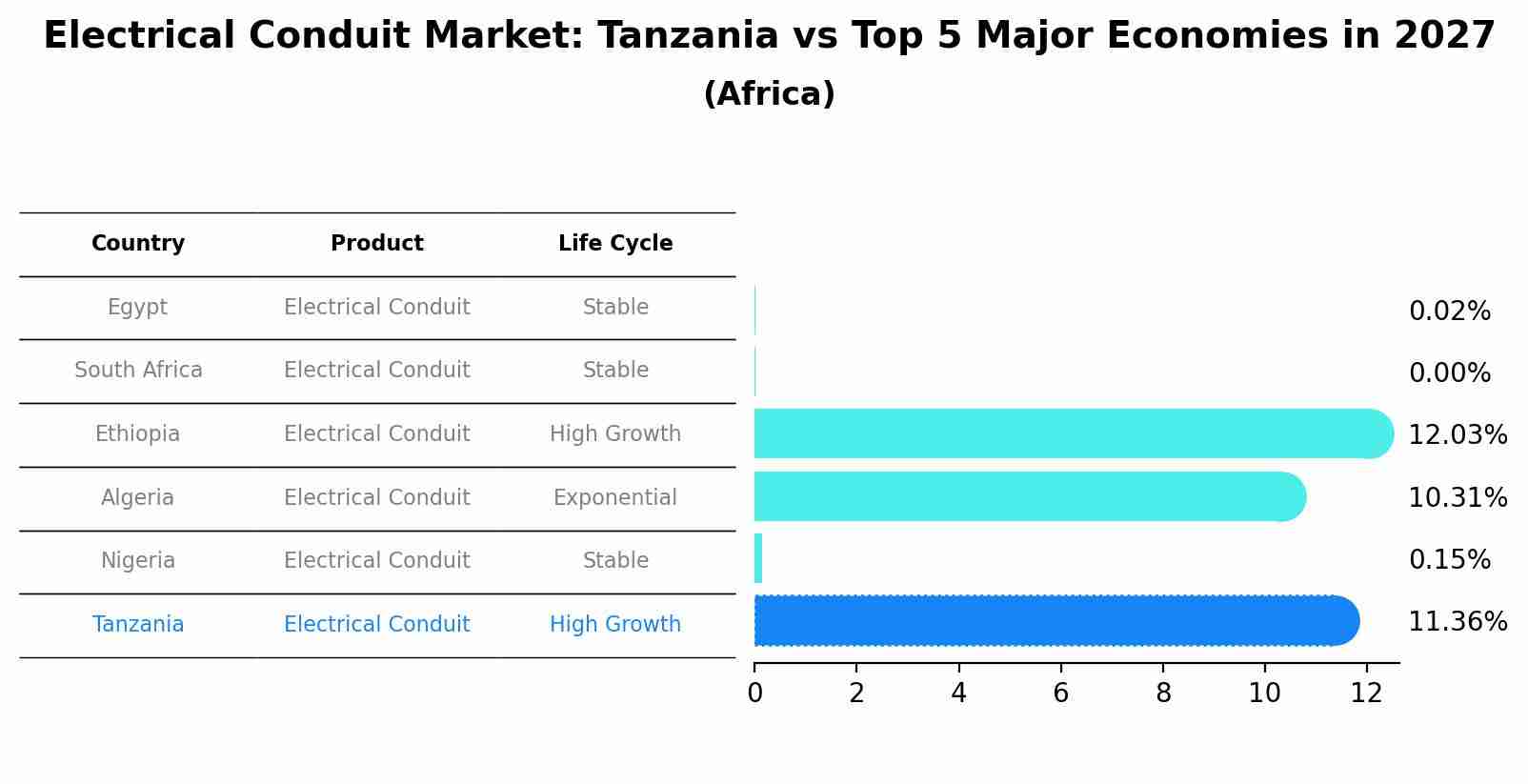
Electrical Conduit Market: Tanzania vs Top 5 Major Economies in 2027 (Africa)
By 2027, the Electrical Conduit market in Tanzania is anticipated to reach a growth rate of 11.36%, as part of an increasingly competitive Africa region, where Egypt remains at the forefront, supported by South Africa, Ethiopia, Algeria and Nigeria, driving innovations and market adoption across sectors.
Tanzania Electrical Conduit Market Overview
The Tanzania Electrical Conduit Market is witnessing steady growth driven by increasing construction activities, urbanization, and infrastructural developments in the country. Electrical conduits are essential components used for protecting and routing electrical wiring in buildings, ensuring safety and proper functioning of electrical systems. The market is characterized by the presence of both local and international manufacturers offering a range of products such as rigid metal conduits, PVC conduits, and flexible conduits to meet diverse consumer needs. With the government`s focus on improving access to electricity and modernizing infrastructure, the demand for electrical conduits is expected to rise further, presenting opportunities for market expansion and innovation in Tanzania. Key players in the market include local companies like Tanzania Electric Supply Company (TANESCO) and international brands like Legrand and Schneider Electric.
Tanzania Electrical Conduit Market Trends
The Tanzania Electrical Conduit Market is experiencing a shift towards more sustainable and durable materials, with a growing preference for products that are corrosion-resistant and environmentally friendly. PVC conduits are gaining popularity due to their cost-effectiveness and ease of installation, while steel conduits remain in demand for their strength and durability. Additionally, there is a rising emphasis on safety standards and compliance regulations, driving the market towards products that meet international quality standards. The market is also witnessing a trend towards customization and innovation, with manufacturers offering a wide range of sizes, colors, and features to cater to diverse customer needs. Overall, the Tanzania Electrical Conduit Market is evolving to meet the growing demand for reliable and efficient electrical infrastructure solutions.
Tanzania Electrical Conduit Market Challenges
In the Tanzania Electrical Conduit Market, some of the key challenges faced include inconsistent government regulations and standards, which can lead to confusion and inefficiencies in the industry. Lack of awareness and education among consumers and installers about the importance of using quality electrical conduits can also be a hurdle. Additionally, the presence of counterfeit or substandard products in the market poses a threat to both consumer safety and the reputation of legitimate manufacturers. Limited access to financing for small and medium-sized enterprises operating in the electrical conduit sector can hinder growth and innovation. Addressing these challenges will require collaboration between industry stakeholders, government bodies, and regulatory agencies to ensure a safe and thriving market for electrical conduits in Tanzania.
Tanzania Electrical Conduit Market Investment Opportunities
The Tanzania Electrical Conduit Market presents several investment opportunities for both local and international investors. With the country`s growing infrastructure development and increasing emphasis on electrification projects, there is a rising demand for electrical conduits to protect and route wiring in buildings and other structures. Investing in manufacturing facilities to produce electrical conduits locally can be a lucrative opportunity, as it can cater to the domestic market as well as neighboring countries. Additionally, investing in distribution and retail networks for electrical conduit products can also be profitable, considering the ongoing construction activities in Tanzania. Partnering with local construction companies and electrical contractors to provide a complete solution for electrical conduit installations can further enhance the investment potential in this market.
Tanzania Electrical Conduit Market Government Policy
The government of Tanzania has implemented policies to regulate the Electrical Conduit Market, aiming to ensure safety, quality, and standardization of products. The Tanzania Bureau of Standards (TBS) is responsible for setting standards and conducting product certification to guarantee compliance with regulations and promote consumer protection. Additionally, the government has introduced measures to encourage local manufacturing and reduce reliance on imports, such as offering incentives to domestic producers and imposing tariffs on foreign products. These policies aim to stimulate growth in the Electrical Conduit Market, enhance competitiveness, and contribute to the overall development of the electrical industry in Tanzania.
Tanzania Electrical Conduit Market Future Outlook
The Tanzania Electrical Conduit Market is expected to experience steady growth in the coming years due to increasing urbanization, infrastructure development, and investments in the construction sector. The demand for electrical conduits is likely to rise with the expansion of residential, commercial, and industrial projects across the country. Additionally, the government`s focus on improving access to electricity and enhancing the overall energy infrastructure will further drive the market growth. Technological advancements in the electrical conduit industry, such as the introduction of durable and cost-effective materials, are also expected to fuel market expansion. Overall, the Tanzania Electrical Conduit Market presents promising opportunities for manufacturers and suppliers as the country continues to modernize and expand its electrical infrastructure.
Key Highlights of the Report:
- Tanzania Electrical Conduit Market Outlook
- Market Size of Tanzania Electrical Conduit Market, 2021
- Forecast of Tanzania Electrical Conduit Market, 2031
- Historical Data and Forecast of Tanzania Electrical Conduit Revenues & Volume for the Period 2018 - 2031
- Tanzania Electrical Conduit Market Trend Evolution
- Tanzania Electrical Conduit Market Drivers and Challenges
- Tanzania Electrical Conduit Price Trends
- Tanzania Electrical Conduit Porter's Five Forces
- Tanzania Electrical Conduit Industry Life Cycle
- Historical Data and Forecast of Tanzania Electrical Conduit Market Revenues & Volume By Type for the Period 2018 - 2031
- Historical Data and Forecast of Tanzania Electrical Conduit Market Revenues & Volume By Rigid for the Period 2018 - 2031
- Historical Data and Forecast of Tanzania Electrical Conduit Market Revenues & Volume By Flexible for the Period 2018 - 2031
- Historical Data and Forecast of Tanzania Electrical Conduit Market Revenues & Volume By Material for the Period 2018 - 2031
- Historical Data and Forecast of Tanzania Electrical Conduit Market Revenues & Volume By Metallic for the Period 2018 - 2031
- Historical Data and Forecast of Tanzania Electrical Conduit Market Revenues & Volume By Non-metallic for the Period 2018 - 2031
- Historical Data and Forecast of Tanzania Electrical Conduit Market Revenues & Volume By End-Use Industry for the Period 2018 - 2031
- Historical Data and Forecast of Tanzania Electrical Conduit Market Revenues & Volume By Building & Construction for the Period 2018 - 2031
- Historical Data and Forecast of Tanzania Electrical Conduit Market Revenues & Volume By Industrial Manufacturing for the Period 2018 - 2031
- Historical Data and Forecast of Tanzania Electrical Conduit Market Revenues & Volume By IT & Telecommunication for the Period 2018 - 2031
- Historical Data and Forecast of Tanzania Electrical Conduit Market Revenues & Volume By Oil & Gas for the Period 2018 - 2031
- Historical Data and Forecast of Tanzania Electrical Conduit Market Revenues & Volume By Energy & Utility for the Period 2018 - 2031
- Historical Data and Forecast of Tanzania Electrical Conduit Market Revenues & Volume By Others for the Period 2018 - 2031
- Tanzania Electrical Conduit Import Export Trade Statistics
- Market Opportunity Assessment By Type
- Market Opportunity Assessment By Material
- Market Opportunity Assessment By End-Use Industry
- Tanzania Electrical Conduit Top Companies Market Share
- Tanzania Electrical Conduit Competitive Benchmarking By Technical and Operational Parameters
- Tanzania Electrical Conduit Company Profiles
- Tanzania Electrical Conduit Key Strategic Recommendations






































