Tanzania Ent Disorder Treatment Market Size, Share & Growth Rate
The Tanzania Ent Disorder Treatment Market was estimated at USD 610 Million in 2025 and is projected to reach USD 896 Million by 2032, growing at a CAGR of 5.6% from 2026 to 2032. This upward trajectory is significantly fueled by an increased prevalence of ENT disorders, alongside expanding healthcare infrastructure and greater public awareness regarding these conditions. As access to specialized treatments improves, the demand for innovative and effective treatment options is expected to grow correspondingly.
Tanzania Ent Disorder Treatment Market Year-wise Growth Rate and Key Drivers
This graph highlights how the Tanzania Ent Disorder Treatment Market has steadily grown over the years, supported by major growth factors.
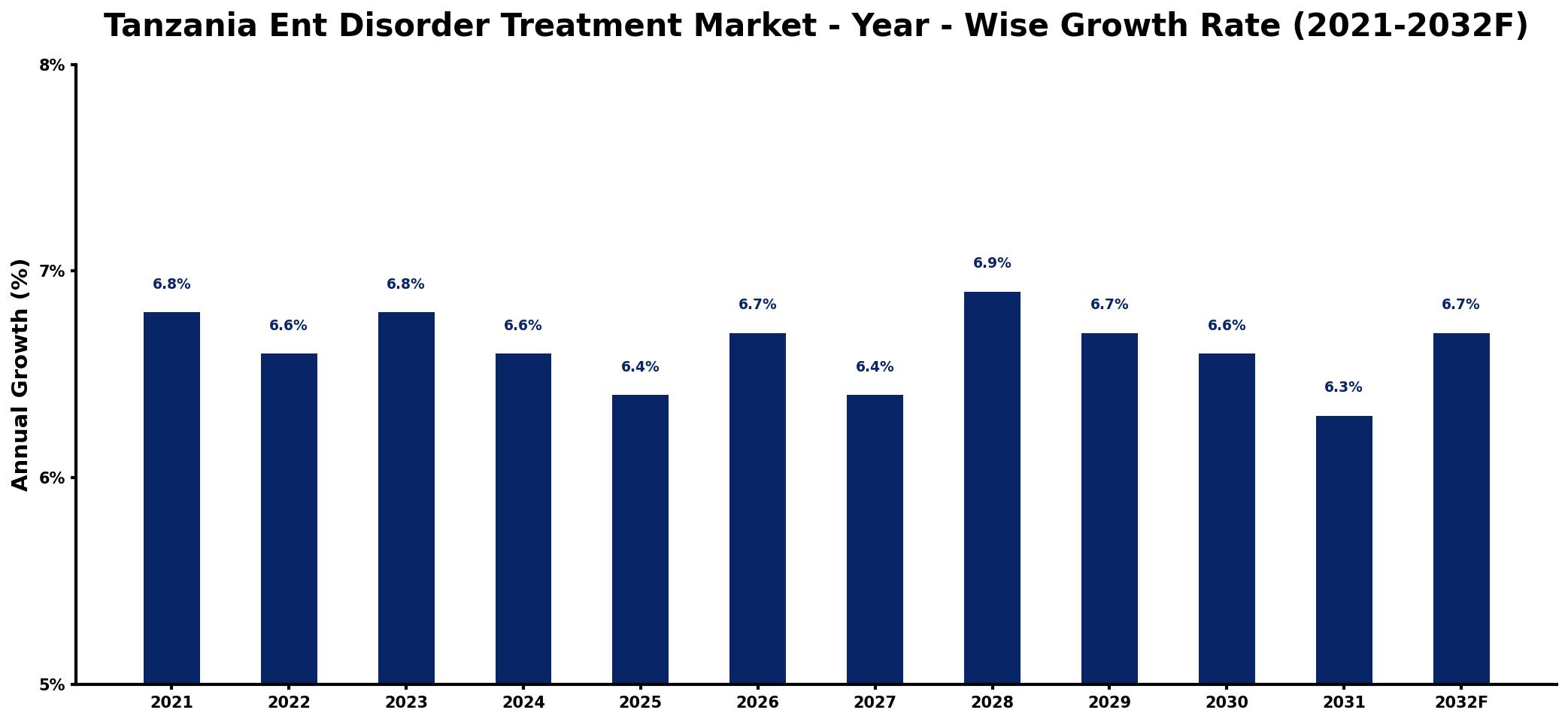
The table below presents the year‑wise growth rates along with the key drivers influencing the market
| Year | Growth Rate | Major Drivers |
| 2021 | 6.8% | expanding healthcare application demand |
| 2022 | 6.6% | enhanced product quality standards |
| 2023 | 6.8% | expansion of telehealth services |
| 2024 | 6.6% | rising prevalence of anxiety cases |
| 2025 | 6.4% | enhanced training for healthcare professionals |
| 2026 | 6.7% | increased overall sector activity |
| 2027 | 6.4% | increased public health campaigns |
| 2028 | 6.9% | greater acceptance of therapy options |
| 2029 | 6.7% | strengthening underlying market demand |
| 2030 | 6.6% | stronger distribution network expansion |
| 2031 | 6.3% | strengthening international trade flows |
| 2032 | 6.7% | growing collaboration among stakeholders |
Note: Market size estimations and growth projections presented in this report are based on 6Wresearch's proprietary forecasting methodology, utilizing the latest available industry data, government publications, and primary research inputs.
Tanzania Ent Disorder Treatment Market Synopsis
The strongest force shaping the Tanzania ENT disorder treatment market is the increasing awareness and understanding of ear, nose, and throat disorders among the population. With a focus on early diagnosis and treatment, more patients are seeking care, driving market expansion. Furthermore, the enhanced healthcare infrastructure facilitates access to specialized services, leading to improved patient outcomes.
A growing trend towards minimally invasive procedures is also influencing the market dynamics. Patients are gravitating towards treatments that promise quicker recovery and reduced complications, prompting healthcare providers to adapt and innovate. This shift towards advanced technological solutions is likely to reshape treatment methodologies in the coming years.
Tanzania Ent Disorder Treatment Market Key Takeaways
- Significant growth forecasted, with an estimated market size of USD 896 Million by 2032.
- Minimally invasive procedures are gaining popularity among patients seeking faster recoveries.
- Telemedicine is increasingly being adopted, especially in underserved rural areas.
- Government policies aimed at improving healthcare access and affordability are shaping the market positively.
- Investment opportunities exist in specialized ENT clinics and training programs for healthcare professionals.
Evaluation of Restraints in Tanzania Ent Disorder Treatment Market
Despite the promising growth potential of the Tanzania ENT disorder treatment market, several restraints pose significant challenges. Limited access to specialized healthcare services in remote regions often results in delayed diagnosis and treatment, ultimately compromising patient care. The shortage of trained ENT professionals and insufficient healthcare infrastructure further exacerbates this issue. Additionally, affordability concerns and a general lack of awareness about ENT disorders hinder many individuals from seeking necessary medical interventions. To truly enhance healthcare delivery, addressing these systemic barriers will be essential.
Tanzania Ent Disorder Treatment Market Trends
Current trends in the Tanzania ENT disorder treatment market reflect a significant shift towards patient-centered care. The demand for advanced diagnostic tools and innovative treatment options is on the rise, driven by an informed patient population. Moreover, the integration of telemedicine is emerging as a valuable resource, particularly in rural areas where access to specialists is limited. This trend not only enhances the overall treatment experience but also aids in the continuity of care for patients with chronic ENT conditions.
Tanzania Ent Disorder Treatment Market Opportunities
The Tanzania ENT disorder treatment market presents a wealth of investment opportunities. With a burgeoning demand for specialized healthcare services, entrepreneurs can explore avenues for establishing ENT clinics and investing in state-of-the-art medical equipment. Furthermore, partnerships with existing healthcare providers could enhance service offerings and broaden access to quality care. Training programs aimed at cultivating more ENT specialists are also critical for addressing workforce shortages, ultimately contributing to improved healthcare outcomes across the region.
Government Initiatives in the Tanzania Ent Disorder Treatment Market
The Tanzanian government is proactively implementing policies to improve the ENT disorder treatment market. Initiatives include providing free healthcare services at public facilities and establishing the Tanzania Food and Drug Authority (TFDA) to ensure the safety and efficacy of medical products. Additionally, the National Health Insurance Fund (NHIF) aims to broaden healthcare access, while public-private partnerships are encouraged to enhance the quality of medical services. These efforts reflect a commitment to advancing healthcare availability and affordability in the ENT sector.
Future Insights of the Tanzania Ent Disorder Treatment Market
Looking ahead to 2026-2032, the Tanzania ENT disorder treatment market is anticipated to continue its growth trajectory. Factors such as an aging population, a rising incidence of allergies, and increased pollution levels are expected to drive demand for ENT services. Advances in technology and treatment modalities will further support market expansion, while ongoing government initiatives aimed at enhancing healthcare infrastructure will play a vital role in shaping the future landscape. The market is set to evolve into a more integrated and efficient ecosystem, addressing the needs of a growing patient demographic.
Tanzania Ent Disorder Treatment Market Latest Developments (2025 - 2026)
Recent developments in the Tanzania ENT disorder treatment market highlight a focus on innovation and improved patient care. There has been a notable increase in the establishment of specialized clinics aimed at providing comprehensive ENT services. Technological advancements in diagnostic tools are being adopted to enhance early detection and treatment efficacy. Moreover, collaborative efforts between public and private sectors are fostering a supportive environment for investments in healthcare, ultimately benefiting the population.
Tanzania Ent Disorder Treatment Market - Key Attractiveness of the Report
- 10 Years of Market Numbers
- Historical Data Starting from 2022 to 2025
- Base Year: 2025
- Forecast Data until 2032
- Key Performance Indicators Impacting the Market
- Major Upcoming Developments and Projects
Key Highlights of the Report:
- Tanzania Ent Disorder Treatment Market Outlook
- Market Size of Tanzania Ent Disorder Treatment Market, 2025
- Forecast of Tanzania Ent Disorder Treatment Market, 2032
- Historical Data and Forecast of Tanzania Ent Disorder Treatment Revenues & Volume for the Period 2022-2032F
- Tanzania Ent Disorder Treatment Market Trend Evolution
- Tanzania Ent Disorder Treatment Market Drivers and Challenges
- Tanzania Ent Disorder Treatment Price Trends
- Tanzania Ent Disorder Treatment Porter's Five Forces
- Tanzania Ent Disorder Treatment Industry Life Cycle
- Historical Data and Forecast of Tanzania Ent Disorder Treatment Market Revenues & Volume By Devices for the Period 2022-2032F
- Historical Data and Forecast of Tanzania Ent Disorder Treatment Market Revenues & Volume By Hearing Aid Devices for the Period 2022-2032F
- Historical Data and Forecast of Tanzania Ent Disorder Treatment Market Revenues & Volume By Voice Prostheses for the Period 2022-2032F
- Historical Data and Forecast of Tanzania Ent Disorder Treatment Market Revenues & Volume By Nasal Splints for the Period 2022-2032F
- Historical Data and Forecast of Tanzania Ent Disorder Treatment Market Revenues & Volume By Hearing Implants for the Period 2022-2032F
- Historical Data and Forecast of Tanzania Ent Disorder Treatment Market Revenues & Volume By Others for the Period 2022-2032F
- Historical Data and Forecast of Tanzania Ent Disorder Treatment Market Revenues & Volume By Drugs for the Period 2022-2032F
- Historical Data and Forecast of Tanzania Ent Disorder Treatment Market Revenues & Volume By Antibiotics for the Period 2022-2032F
- Historical Data and Forecast of Tanzania Ent Disorder Treatment Market Revenues & Volume By Antihistamines for the Period 2022-2032F
- Historical Data and Forecast of Tanzania Ent Disorder Treatment Market Revenues & Volume By Steroids for the Period 2022-2032F
- Historical Data and Forecast of Tanzania Ent Disorder Treatment Market Revenues & Volume By Anti-inflammatory Drugs for the Period 2022-2032F
- Historical Data and Forecast of Tanzania Ent Disorder Treatment Market Revenues & Volume By Others for the Period 2022-2032F
- Historical Data and Forecast of Tanzania Ent Disorder Treatment Market Revenues & Volume By Organ Type for the Period 2022-2032F
- Historical Data and Forecast of Tanzania Ent Disorder Treatment Market Revenues & Volume By Ears for the Period 2022-2032F
- Historical Data and Forecast of Tanzania Ent Disorder Treatment Market Revenues & Volume By Nose for the Period 2022-2032F
- Historical Data and Forecast of Tanzania Ent Disorder Treatment Market Revenues & Volume By Throat for the Period 2022-2032F
- Historical Data and Forecast of Tanzania Ent Disorder Treatment Market Revenues & Volume By End User for the Period 2022-2032F
- Historical Data and Forecast of Tanzania Ent Disorder Treatment Market Revenues & Volume By Hospital for the Period 2022-2032F
- Historical Data and Forecast of Tanzania Ent Disorder Treatment Market Revenues & Volume By Clinics for the Period 2022-2032F
- Historical Data and Forecast of Tanzania Ent Disorder Treatment Market Revenues & Volume By Ambulatory Surgical Centers for the Period 2022-2032F
- Historical Data and Forecast of Tanzania Ent Disorder Treatment Market Revenues & Volume By Home Care Settings for the Period 2022-2032F
- Historical Data and Forecast of Tanzania Ent Disorder Treatment Market Revenues & Volume By Others for the Period 2022-2032F
- Tanzania Ent Disorder Treatment Import Export Trade Statistics
- Market Opportunity Assessment By Devices
- Market Opportunity Assessment By Drugs
- Market Opportunity Assessment By Organ Type
- Market Opportunity Assessment By End User
- Tanzania Ent Disorder Treatment Top Companies Market Share
- Tanzania Ent Disorder Treatment Competitive Benchmarking By Technical and Operational Parameters
- Tanzania Ent Disorder Treatment Company Profiles
- Tanzania Ent Disorder Treatment Key Strategic Recommendations






































