Tanzania Food Dehydrators Market Size, Share & Growth Rate
The Tanzania Food Dehydrators Market was estimated at USD 223 Million in 2025 and is projected to reach USD 295 Million by 2032, growing at a CAGR of 4.1% from 2026 to 2032. This growth is primarily fueled by an increasing adoption of food preservation methods among local farmers and food processors, who recognize the long-term benefits of extending the shelf life of perishable goods. Furthermore, consumer awareness around the nutritional advantages of dehydrated foods is playing a significant role in shaping this market's promising trajectory.
Tanzania Food Dehydrators Market Year-wise Growth Rate and Key Drivers
This graph highlights how the Tanzania Food Dehydrators Market has steadily grown over the years, supported by major growth factors.
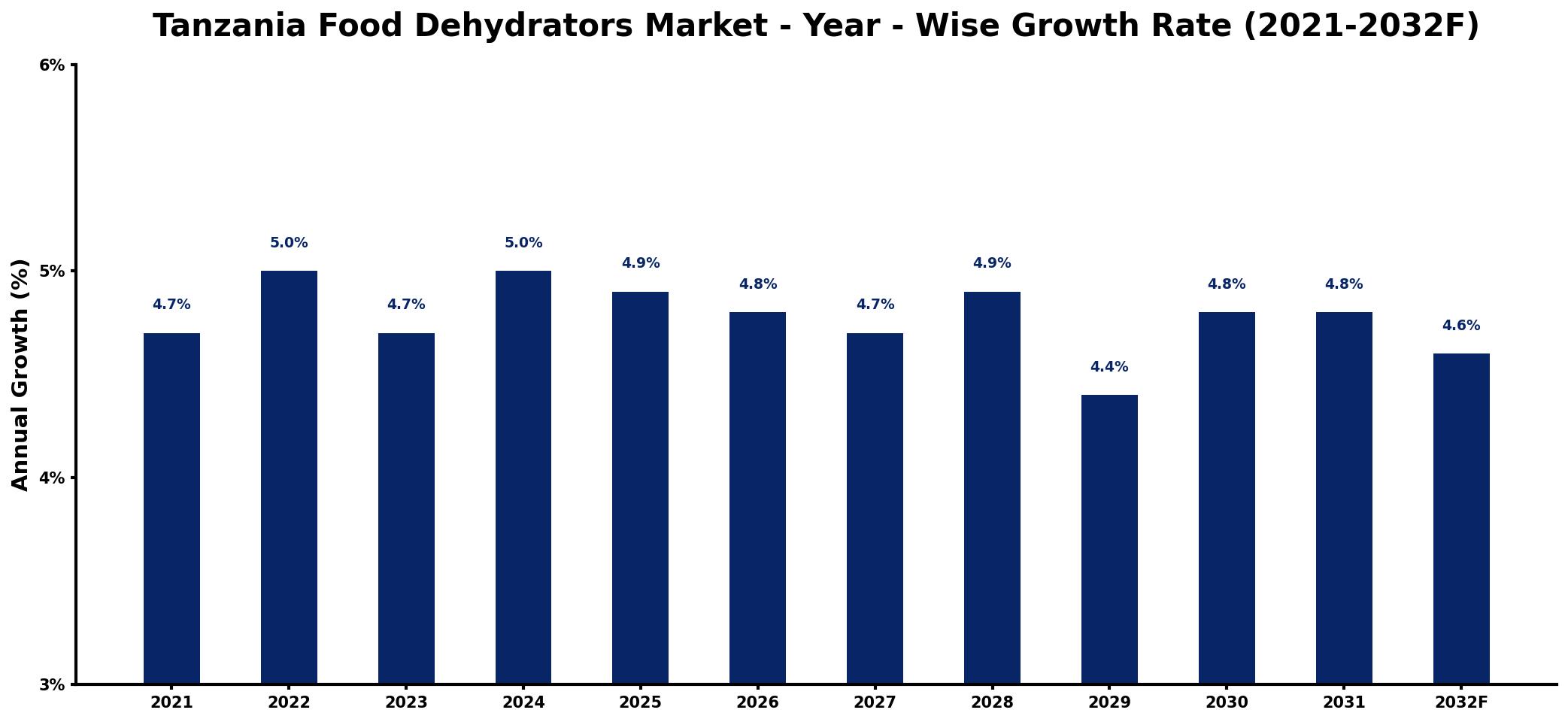
The table below presents the year‑wise growth rates along with the key drivers influencing the market
| Year | Growth Rate | Major Drivers |
| 2021 | 4.7% | Rising health consciousness among consumers |
| 2022 | 5.0% | Growing popularity of home preservation |
| 2023 | 4.7% | Increased investment in technology |
| 2024 | 5.0% | Expansion of retail distribution channels |
| 2025 | 4.9% | Surge in organic product demand |
| 2026 | 4.8% | Enhancements in energy efficiency standards |
| 2027 | 4.7% | Growing awareness of sustainability practices |
| 2028 | 4.9% | Increased export opportunities for products |
| 2029 | 4.4% | Adoption of innovative preservation methods |
| 2030 | 4.8% | Rising interest in culinary experimentation |
| 2031 | 4.8% | Strengthening local agricultural supply chains |
| 2032 | 4.6% | Emerging trends in healthy snacking |
Note: Market size estimations and growth projections presented in this report are based on 6Wresearch's proprietary forecasting methodology, utilizing the latest available industry data, government publications, and primary research inputs.
Tanzania Food Dehydrators Market Synopsis
Recently, the market has been witnessing a surge in interest, largely due to enhanced agricultural practices and growing food security concerns. However, the road ahead is marked by the need for greater accessibility and education about food dehydration technologies, particularly among small-scale producers.
As the market evolves, consumer preferences are shifting towards compact, energy-efficient dehydrators that cater to both home users and small-scale producers. The continued emphasis on sustainability and convenience will drive product innovation and diversification in the years to come.
Tanzania Food Dehydrators Market Key Takeaways
- The Tanzania Food Dehydrators Market is poised for significant growth, driven by increased demand for food preservation solutions.
- Compact and energy-efficient models are becoming increasingly popular among consumers.
- Government initiatives are fostering a supportive environment for market expansion and technology adoption.
- Challenges include limited awareness and inadequate infrastructure, particularly in rural areas.
- Investment opportunities abound, especially through partnerships with local agricultural producers.
Evaluation of Restraints in Tanzania Food Dehydrators Market
Despite the promising growth potential, the Tanzania Food Dehydrators Market is hindered by several constraints. A significant challenge lies in the limited awareness and understanding of food dehydration technology among small-scale farmers and processors. Additionally, inadequate infrastructure, particularly concerning electricity supply in rural areas, poses a barrier to the widespread adoption of these technologies. Financial access for investing in modern dehydrators is also a critical issue, as many local businesses struggle to acquire the necessary capital. Addressing these restraints is vital for unlocking the full potential of this burgeoning market.
Tanzania Food Dehydrators Market Trends
Current trends indicate a rising consumer preference for dehydrators equipped with advanced features such as adjustable temperature controls and increased capacity through multiple trays. The market is also witnessing a growing interest in eco-friendly models that prioritize energy efficiency and minimal waste production. As consumers increasingly demand versatility and convenience, manufacturers are focusing on product innovation that aligns with these evolving preferences.
Tanzania Food Dehydrators Market Opportunities
Investors should note the substantial opportunities available in the Tanzania Food Dehydrators Market. The growing trend towards healthy snacking options and the need to reduce food waste present lucrative avenues for investment. Partnerships with local farmers for the sourcing of fresh produce for dehydration can enhance product offerings and contribute to overall market growth. Furthermore, as consumers become more educated about the nutritional advantages of dried foods, the demand for high-quality dehydrators will likely rise, fostering a favorable environment for potential investors.
Government Initiatives in the Tanzania Food Dehydrators Market
The Tanzanian government has implemented several initiatives to bolster the food dehydrators market. Notably, the National Food Security Policy promotes post-harvest technologies, including food dehydration, as a means to enhance food security. Additionally, the Agricultural Sector Development Program (ASDP) offers support and incentives to farmers and agribusinesses, particularly those focusing on food processing and preservation. The Tanzania Food and Drugs Authority (TFDA) plays a crucial regulatory role, ensuring that safety standards for dehydrators meet consumer protection requirements. These initiatives collectively aim to stimulate market growth and encourage innovation in food preservation.
Future Insights of the Tanzania Food Dehydrators Market
Looking ahead to 2026-2032, the Tanzania Food Dehydrators Market is expected to continue its upward trajectory, driven by increased consumer awareness of food preservation techniques and a rising demand for convenient snacking options. The focus on reducing food waste and improving food security will further propel the need for effective dehydration solutions. With favorable agricultural conditions and an emphasis on local food production, the market stands to benefit from innovations in energy-efficient and advanced drying technologies, ensuring sustained growth in the coming years.
Tanzania Food Dehydrators Market Latest Developments (2025 - 2026)
In recent months, the Tanzania Food Dehydrators Market has seen a wave of innovations aimed at enhancing product efficiency and consumer appeal. Several manufacturers are ramping up production of energy-efficient dehydrators, in response to the growing demand for sustainable solutions. Additionally, initiatives are underway to educate small-scale farmers about the advantages of food dehydration technology, enhancing the accessibility and adoption of such solutions across rural regions.
Tanzania Food Dehydrators Market - Key Attractiveness of the Report
- 10 Years of Market Numbers
- Historical Data Starting from 2022 to 2025
- Base Year: 2025
- Forecast Data until 2032
- Key Performance Indicators Impacting the Market
- Major Upcoming Developments and Projects
Key Highlights of the Report:
- Tanzania Food Dehydrators Market Outlook
- Market Size of Tanzania Food Dehydrators Market, 2025
- Forecast of Tanzania Food Dehydrators Market, 2032
- Historical Data and Forecast of Tanzania Food Dehydrators Revenues & Volume for the Period 2022-2032F
- Tanzania Food Dehydrators Market Trend Evolution
- Tanzania Food Dehydrators Market Drivers and Challenges
- Tanzania Food Dehydrators Price Trends
- Tanzania Food Dehydrators Porter's Five Forces
- Tanzania Food Dehydrators Industry Life Cycle
- Historical Data and Forecast of Tanzania Food Dehydrators Market Revenues & Volume By Technology for the Period 2022-2032F
- Historical Data and Forecast of Tanzania Food Dehydrators Market Revenues & Volume By Vertical Flow for the Period 2022-2032F
- Historical Data and Forecast of Tanzania Food Dehydrators Market Revenues & Volume By Horizontal Flow for the Period 2022-2032F
- Historical Data and Forecast of Tanzania Food Dehydrators Market Revenues & Volume By End-Use for the Period 2022-2032F
- Historical Data and Forecast of Tanzania Food Dehydrators Market Revenues & Volume By Industrial for the Period 2022-2032F
- Historical Data and Forecast of Tanzania Food Dehydrators Market Revenues & Volume By Commercial for the Period 2022-2032F
- Historical Data and Forecast of Tanzania Food Dehydrators Market Revenues & Volume By Residential for the Period 2022-2032F
- Historical Data and Forecast of Tanzania Food Dehydrators Market Revenues & Volume By Others for the Period 2022-2032F
- Historical Data and Forecast of Tanzania Food Dehydrators Market Revenues & Volume By Energy Source for the Period 2022-2032F
- Historical Data and Forecast of Tanzania Food Dehydrators Market Revenues & Volume By Electricity for the Period 2022-2032F
- Historical Data and Forecast of Tanzania Food Dehydrators Market Revenues & Volume By Biofuel for the Period 2022-2032F
- Historical Data and Forecast of Tanzania Food Dehydrators Market Revenues & Volume By Solar for the Period 2022-2032F
- Historical Data and Forecast of Tanzania Food Dehydrators Market Revenues & Volume By Others for the Period 2022-2032F
- Tanzania Food Dehydrators Import Export Trade Statistics
- Market Opportunity Assessment By Technology
- Market Opportunity Assessment By End-Use
- Market Opportunity Assessment By Energy Source
- Tanzania Food Dehydrators Top Companies Market Share
- Tanzania Food Dehydrators Competitive Benchmarking By Technical and Operational Parameters
- Tanzania Food Dehydrators Company Profiles
- Tanzania Food Dehydrators Key Strategic Recommendations






































