Tanzania Gambling Market Summary
The tanzania gambling market was estimated at USD 422 Million in 2025 and is projected to reach USD 596 Million by 2032, growing at a CAGR of 5.7% from 2026 to 2032.
Tanzania Gambling Market Year-wise Growth Rate and Key Drivers
This graph highlights how the Tanzania Gambling Market has steadily grown over the past five years, supported by major growth factors.
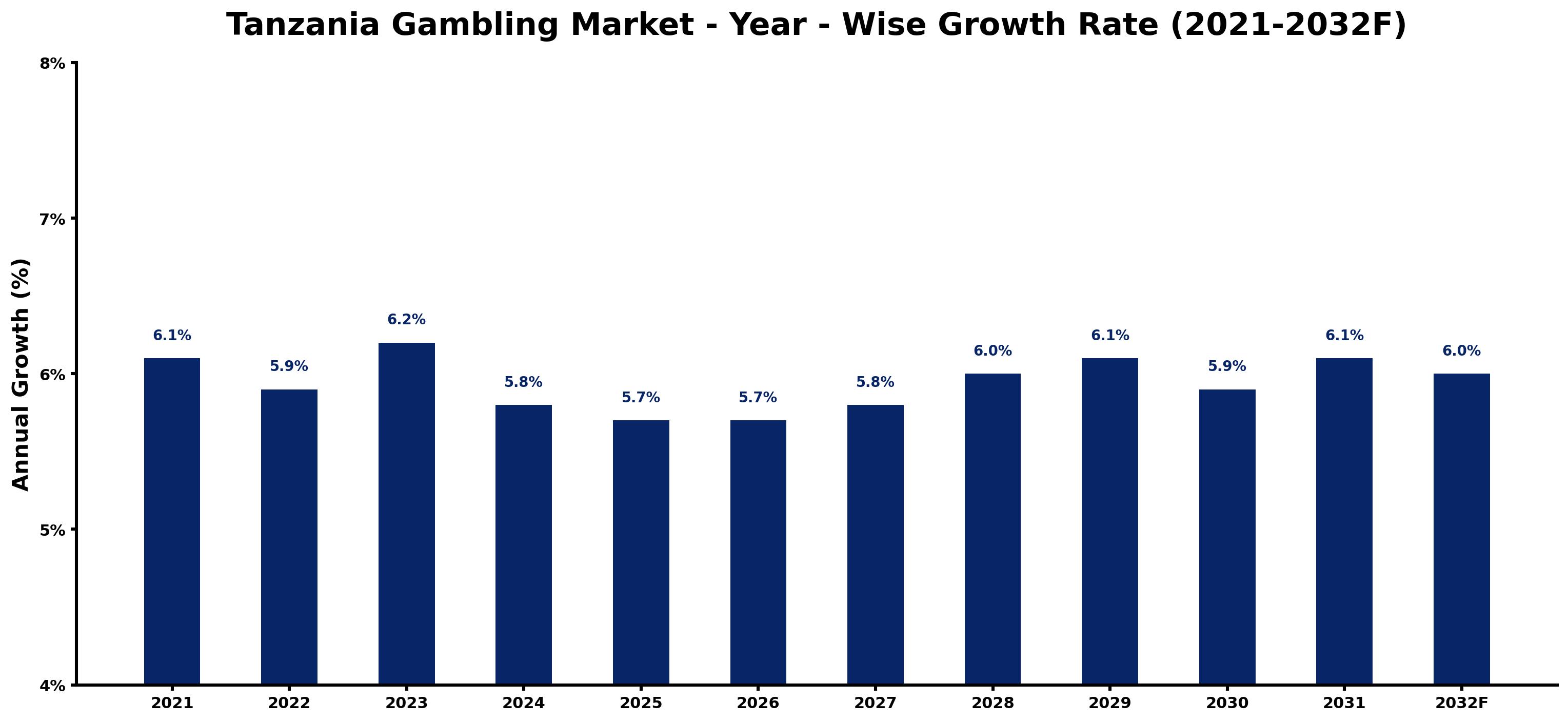
The table below presents the year wise growth rates along with the key drivers influencing the market
| Year | Growth Rate | Major Drivers |
| 2021 | 6.1% | Tanzania's online gambling sector began attracting attention due to emerging smartphone adoption. |
| 2022 | 5.9% | Local operators introduced various betting platforms catering to younger, tech-savvy audiences. |
| 2023 | 6.2% | International partnerships formed, enhancing service offerings and market accessibility for gamblers. |
| 2024 | 5.8% | Growing tourism numbers provided new opportunities for physical betting establishments in urban areas. |
| 2025 | 5.7% | Increased disposable income among the population encouraged higher spending on recreational gambling activities. |
| 2026 | 5.7% | Technological innovations in mobile banking simplified transactions for online betting participants. |
| 2027 | 5.8% | Cultural acceptance of gambling evolved, leading to more public discussions and marketing opportunities. |
| 2028 | 6.0% | Local sports leagues saw sponsorship from gambling companies, boosting visibility and consumer interest. |
| 2029 | 6.1% | Regulatory frameworks became more structured, fostering investor confidence in the gambling landscape. |
| 2030 | 5.9% | Advancements in user experience design improved customer engagement across online gambling platforms. |
| 2031 | 6.1% | Expanded internet infrastructure made remote gambling more accessible in rural Tanzanian regions. |
| 2032 | 6.0% | Emerging trends in gamification attracted a younger demographic to traditional gambling activities. |
Note - Market size estimations and growth projections presented in this report are based on 6Wresearch's advanced forecasting approach, validated with industry datasets as of June 2026.
Tanzania Gambling Market Synopsis
The Tanzania Gambling Market is projected to reach 5.7% and witness significant growth during the forecast period (2026-2032). With a current valuation anticipated at approximately US$ 8.6 million by 2026, the market is expected to register a compound annual growth rate (CAGR) of 10.2%. This growth trajectory is primarily driven by a surge in gaming activities and an increasing appetite for online casinos within the nation.
Tanzania Gambling Market Growth Drivers
Several factors are propelling the expansion of the Tanzania gambling market. Notably, the rise in popular gaming activities across various demographics is a significant contributor. Furthermore, the demand for online gaming platforms has escalated, particularly among younger populations who are increasingly tech-savvy. The following elements are integral to the market's growth:
- The proliferation of gaming activities has attracted a broader audience, enhancing participation rates and revenue generation.
- The popularity of mobile gaming applications has surged, providing accessible options for users and encouraging daily engagement.
- Technological advancements are enabling innovative gaming solutions, enhancing user experience and operational efficiency.
- Strategic partnerships and promotional campaigns initiated by market participants are facilitating increased visibility and market penetration.
- The legal framework supporting sports betting has created an environment conducive to investment and development in the sector.
Tanzania Gambling Market Trends and Opportunities
The Tanzania gambling market is observing transformative trends that present ample opportunities for stakeholders. A significant trend includes the integration of advanced technology, such as mobile apps and live gaming experiences, which enhance user engagement. Additionally, the increasing inclination towards social gaming and the gamification of betting experiences are reshaping market dynamics. Key opportunities in the market encompass:
- The expansion of legalized gambling options, particularly sports betting, fostering a competitive landscape.
- The emergence of online casinos catering to local tastes and preferences, which can capture a significant market share.
- The exploration of alternative revenue streams through collaborations with entertainment and hospitality sectors.
- The potential for regulatory advancements that could establish clearer frameworks for online gambling operations.
- The growth in digital payment solutions facilitating seamless transactions for bettors, thereby enhancing customer satisfaction.
Tanzania Gambling Market Challenges and Restraints
While the Tanzania gambling market exhibits promising growth potential, it faces several challenges that could hinder its progress. Regulatory uncertainties remain a critical concern, as inconsistent policies may deter investment. Additional challenges include:
- The risk of gambling addiction may provoke public backlash and lead to calls for stricter regulations.
- Infrastructure constraints, especially in rural areas, could limit the reach of online and mobile gaming solutions.
- The presence of unregulated and illegal betting activities poses competition to established operators and undermines market integrity.
- Cultural attitudes towards gambling can influence participation rates and acceptance within society.
- The need for ongoing education about responsible gambling practices to mitigate social risks associated with increased gambling prevalence.
Tanzania Gambling Market Government Investment and Initiatives
Government initiatives and public investment play a pivotal role in shaping the Tanzania gambling market. Authorities are increasingly recognizing the economic benefits of regulated gambling activities and are undertaking measures to create a favorable business environment. Key initiatives include:
- Efforts to legalize and regulate various forms of gambling, particularly sports betting, to attract local and foreign investment.
- Implementation of responsible gambling campaigns aimed at educating the public on the risks associated with gambling.
- Investment in technology infrastructure to support online gambling operations, enhancing access and engagement among users.
- Development of policies that ensure fair play and consumer protection, enhancing trust in the gambling ecosystem.
- Collaboration with international organizations to align local regulations with global best practices in the gambling industry.
Tanzania Gambling Market Latest Developments (May 2025 - June 2026)
The period between May 2025 and June 2026 has seen noteworthy developments in the Tanzania gambling market. Regulatory adjustments have been a focal point, with authorities seeking to streamline the licensing process for online gambling operators. Additionally, there has been an uptick in promotional activities aimed at increasing public awareness of legal betting options. The government is also pursuing collaborations with private sectors to enhance technology adoption in the gambling industry, paving the way for innovative solutions that improve accessibility and user experience.
Tanzania Gambling Market - Key Attractiveness of the Report
- 10 Years of Market Numbers
- Historical Data Starting from 2022 to 2025
- Base Year: 2025
- Forecast Data until 2032
- Key Performance Indicators Impacting the Market
- Major Upcoming Developments and Projects
Key Highlights of the Report:
- Tanzania Gambling Market Outlook
- Market Size of Tanzania Gambling Market, 2025
- Forecast of Tanzania Gambling Market, 2032F
- Historical Data and Forecast of Tanzania Gambling Revenues & Volume for the Period 2022-2032F
- Tanzania Gambling Market Trend Evolution
- Tanzania Gambling Market Drivers and Challenges
- Tanzania Gambling Price Trends
- Tanzania Gambling Porter's Five Forces
- Tanzania Gambling Industry Life Cycle
- Historical Data and Forecast of Tanzania Gambling Market Revenues & Volume By Product Type for the Period 2022-2032F
- Historical Data and Forecast of Tanzania Gambling Market Revenues & Volume By Betting for the Period 2022-2032F
- Historical Data and Forecast of Tanzania Gambling Market Revenues & Volume By Casino for the Period 2022-2032F
- Historical Data and Forecast of Tanzania Gambling Market Revenues & Volume By Lottery for the Period 2022-2032F
- Historical Data and Forecast of Tanzania Gambling Market Revenues & Volume By Others for the Period 2022-2032F
- Historical Data and Forecast of Tanzania Gambling Market Revenues & Volume By Channel Type for the Period 2022-2032F
- Historical Data and Forecast of Tanzania Gambling Market Revenues & Volume By Offline for the Period 2022-2032F
- Historical Data and Forecast of Tanzania Gambling Market Revenues & Volume By Online for the Period 2022-2032F
- Historical Data and Forecast of Tanzania Gambling Market Revenues & Volume By Virtual Reality VR for the Period 2022-2032F
- Historical Data and Forecast of Tanzania Gambling Market Revenues & Volume By Platform for the Period 2022-2032F
- Historical Data and Forecast of Tanzania Gambling Market Revenues & Volume By Land-Based for the Period 2022-2032F
- Historical Data and Forecast of Tanzania Gambling Market Revenues & Volume By Online for the Period 2022-2032F
- Tanzania Gambling Import Export Trade Statistics
- Market Opportunity Assessment By Product Type
- Market Opportunity Assessment By Channel Type
- Market Opportunity Assessment By Platform
- Tanzania Gambling Top Companies Market Share
- Tanzania Gambling Competitive Benchmarking By Technical and Operational Parameters
- Tanzania Gambling Company Profiles
- Tanzania Gambling Key Strategic Recommendations






































