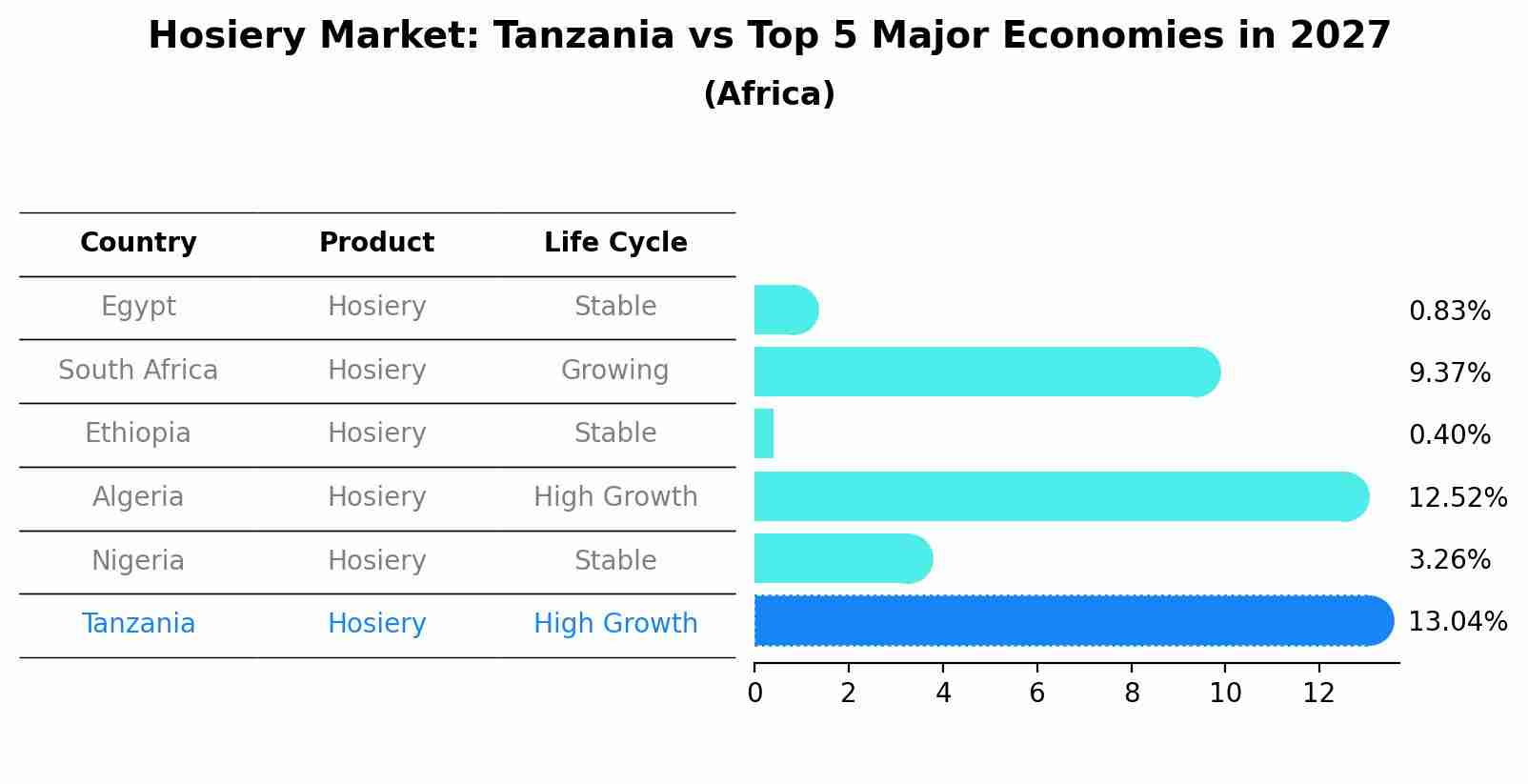
Hosiery Market: Tanzania vs Top 5 Major Economies in 2027 (Africa)
By 2027, Tanzania's Hosiery market is forecasted to achieve a high growth rate of 13.04%, with Egypt leading the Africa region, followed by South Africa, Ethiopia, Algeria and Nigeria.
Tanzania Hosiery Market Overview
The Tanzania hosiery market is characterized by a growing demand for various types of legwear products such as socks, stockings, and tights. The market is driven by factors like increasing disposable income, changing fashion trends, and a growing awareness of personal grooming. Local manufacturers and international brands compete in this sector, offering a wide range of products catering to different consumer preferences. The market is witnessing a shift towards more sustainable and eco-friendly hosiery options, reflecting global trends towards responsible consumption. Retail outlets, online platforms, and specialty stores are the main distribution channels for hosiery products in Tanzania. As the market continues to evolve, there is a scope for innovation, product diversification, and strategic marketing initiatives to capitalize on the growing consumer base.
Tanzania Hosiery Market Trends
In the Tanzania hosiery market, there is a growing demand for sustainable and eco-friendly materials, such as organic cotton and bamboo fibers, as consumers become more environmentally conscious. Additionally, there is a rising preference for locally-made hosiery products, supporting domestic manufacturers and promoting economic growth within the country. Fashion-forward designs and patterns are also gaining popularity among younger consumers, driving the market towards more innovative and creative hosiery options. E-commerce platforms are playing a significant role in expanding the reach of hosiery brands to a wider customer base, offering convenience and accessibility for consumers across Tanzania. Overall, the Tanzania hosiery market is witnessing a shift towards sustainability, local production, and fashion-forward styles, catering to the evolving preferences of consumers in the region.
Tanzania Hosiery Market Challenges
The Tanzania hosiery market faces several challenges, including a lack of awareness and understanding of hosiery products among consumers, leading to low demand. Additionally, the market is highly competitive with both domestic and international brands vying for market share. Limited access to distribution channels and retail outlets also hinders the growth of the hosiery market in Tanzania. Infrastructure and logistical challenges further impact the availability of hosiery products in remote areas. Moreover, price sensitivity among consumers and fluctuating economic conditions present challenges for hosiery manufacturers and retailers in setting competitive pricing strategies. Overall, addressing these challenges through targeted marketing initiatives, expanding distribution networks, and improving product accessibility are key for the growth of the Tanzania hosiery market.
Tanzania Hosiery Market Investment Opportunities
The Tanzania hosiery market presents promising investment opportunities due to the growing demand for socks, stockings, and other legwear products in the country. With a population of over 60 million people and a rising middle class, there is a significant consumer base for hosiery products. Investors can explore opportunities in manufacturing hosiery locally to cater to the domestic market, as well as exporting to neighboring countries in East Africa. Additionally, investing in retail outlets and e-commerce platforms specializing in hosiery products can capture a larger market share. Collaborating with local textile manufacturers to source quality materials can also be a viable investment strategy in the Tanzania hosiery market. Overall, with the increasing focus on fashion and style among consumers, the hosiery market in Tanzania offers potential for growth and profitability for investors.
Tanzania Hosiery Market Government Policy
The Tanzania government has implemented various policies that affect the hosiery market in the country. These include import tariffs and regulations on hosiery products to protect domestic industries, as well as trade agreements with neighboring countries that may impact import and export activities. Additionally, the government has been focusing on promoting local manufacturing through incentives and subsidies to boost the domestic hosiery industry. Compliance with labor laws and regulations is also a key aspect of government policy in the hosiery market to ensure fair working conditions and wages for employees in the sector. Overall, government policies in Tanzania aim to create a conducive environment for the growth and development of the hosiery market while safeguarding the interests of local producers and workers.
Tanzania Hosiery Market Future Outlook
The Tanzania hosiery market is poised for steady growth in the coming years, driven by increasing disposable income, changing fashion trends, and a growing awareness of personal grooming. With a rising middle-class population and a shift towards western fashion influences, there is a growing demand for a variety of hosiery products such as socks, stockings, and leggings. Additionally, the expanding retail sector and the proliferation of e-commerce platforms are expected to further boost market accessibility and consumer reach. To capitalize on these opportunities, hosiery manufacturers and retailers in Tanzania should focus on product innovation, quality, and affordable pricing strategies to cater to the evolving consumer preferences and capture a larger market share. Overall, the outlook for the Tanzania hosiery market appears promising, with ample scope for growth and expansion in the foreseeable future.
Key Highlights of the Report:
- Tanzania Hosiery Market Outlook
- Market Size of Tanzania Hosiery Market, 2024
- Forecast of Tanzania Hosiery Market, 2031
- Historical Data and Forecast of Tanzania Hosiery Revenues & Volume for the Period 2021 - 2031
- Tanzania Hosiery Market Trend Evolution
- Tanzania Hosiery Market Drivers and Challenges
- Tanzania Hosiery Price Trends
- Tanzania Hosiery Porter's Five Forces
- Tanzania Hosiery Industry Life Cycle
- Historical Data and Forecast of Tanzania Hosiery Market Revenues & Volume By End-User for the Period 2021 - 2031
- Historical Data and Forecast of Tanzania Hosiery Market Revenues & Volume By Men for the Period 2021 - 2031
- Historical Data and Forecast of Tanzania Hosiery Market Revenues & Volume By Women for the Period 2021 - 2031
- Historical Data and Forecast of Tanzania Hosiery Market Revenues & Volume By Distribution Channel for the Period 2021 - 2031
- Historical Data and Forecast of Tanzania Hosiery Market Revenues & Volume By Offline for the Period 2021 - 2031
- Historical Data and Forecast of Tanzania Hosiery Market Revenues & Volume By Online for the Period 2021 - 2031
- Tanzania Hosiery Import Export Trade Statistics
- Market Opportunity Assessment By End-User
- Market Opportunity Assessment By Distribution Channel
- Tanzania Hosiery Top Companies Market Share
- Tanzania Hosiery Competitive Benchmarking By Technical and Operational Parameters
- Tanzania Hosiery Company Profiles
- Tanzania Hosiery Key Strategic Recommendations






































