Tanzania Human Combination Vaccines Market Size, Share & Growth Rate
The Tanzania Human Combination Vaccines Market was estimated at USD 380 Million in 2025 and is projected to reach USD 532 Million by 2032, growing at a CAGR of 4.9% from 2026 to 2032. This growth trajectory is largely driven by heightened public awareness of vaccine benefits and government efforts to enhance immunization rates. Additionally, the rising prevalence of infectious diseases calls for comprehensive vaccination strategies, thereby bolstering the demand for combination vaccines that offer multi-disease protection in a single administration.
Tanzania Human Combination Vaccines Market Year-wise Growth Rate and Key Drivers
This graph highlights how the Tanzania Human Combination Vaccines Market has steadily grown over the years, supported by major growth factors.
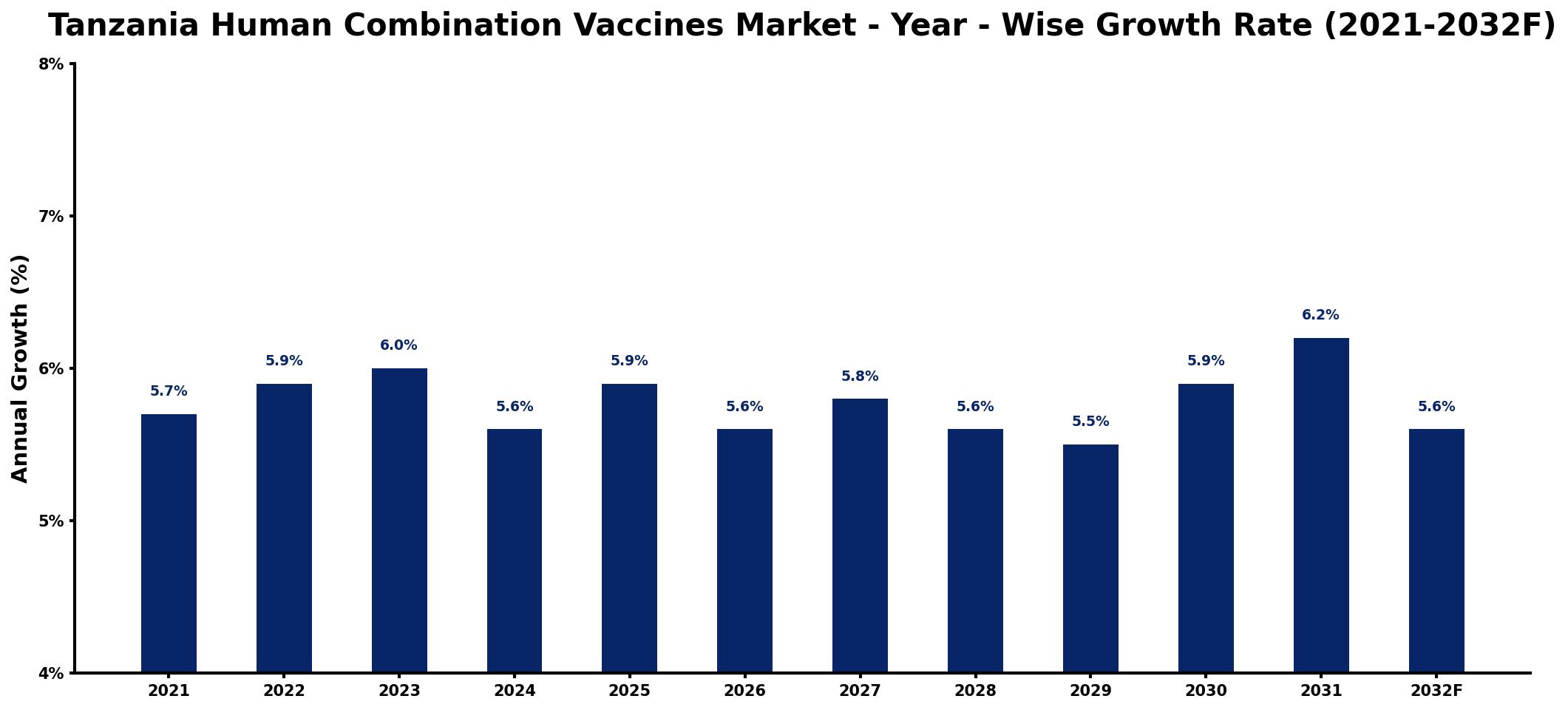
The table below presents the year‑wise growth rates along with the key drivers influencing the market
| Year | Growth Rate | Major Drivers |
| 2021 | 5.7% | Increase in healthcare investments |
| 2022 | 5.9% | Growing public health awareness |
| 2023 | 6.0% | Rising demand for preventive care |
| 2024 | 5.6% | Expansion of healthcare infrastructure |
| 2025 | 5.9% | Increased funding for research |
| 2026 | 5.6% | Improved access to healthcare services |
| 2027 | 5.8% | rising procurement volume requirements |
| 2028 | 5.6% | Emergence of innovative delivery methods |
| 2029 | 5.5% | Enhanced collaboration between stakeholders |
| 2030 | 5.9% | Focus on disease outbreak preparedness |
| 2031 | 6.2% | Strengthened global health partnerships |
| 2032 | 5.6% | Increased emphasis on community health |
Note: Market size estimations and growth projections presented in this report are based on 6Wresearch's proprietary forecasting methodology, utilizing the latest available industry data, government publications, and primary research inputs.
Tanzania Human Combination Vaccines Market Synopsis
Recent momentum in the Tanzania Human Combination Vaccines Market underscores an increasing commitment to public health initiatives, particularly in immunization. The trend shows promise for sustained growth as the government and healthcare entities emphasize vaccination as a primary strategy against disease outbreaks.
Looking ahead, the market is poised for continued evolution, driven by the introduction of innovative combination vaccines and improved healthcare infrastructures. However, tackling existing barriers such as logistical challenges and regional disparities in vaccine access will be critical to achieving the desired coverage levels.
Tanzania Human Combination Vaccines Market Key Takeaways
- The market is fueled by increased awareness and government initiatives promoting vaccination.
- Combination vaccines are becoming more popular due to their convenience and efficacy.
- Mobile clinics and outreach programs are enhancing vaccine accessibility in remote regions.
- Public-private partnerships are key to advancing immunization campaigns and education.
- Challenges remain, particularly in logistics and public awareness, which need addressing for growth.
Evaluation of Restraints in Tanzania Human Combination Vaccines Market
Despite the positive growth outlook, the Tanzania Human Combination Vaccines Market faces significant restraints that may impede progress. Limited healthcare access in rural and underserved areas complicates the outreach necessary for effective vaccination campaigns. The inadequate infrastructure for vaccine storage and distribution complicates the maintenance of the cold chain, posing risks to vaccine integrity. Moreover, educational gaps about vaccine benefits can lead to hesitancy among certain communities, stalling wider acceptance. Addressing these systemic issues will require cohesive efforts from governmental bodies, healthcare providers, and community organizations to ensure vaccines reach those in need.
Tanzania Human Combination Vaccines Market Trends
Several notable trends are shaping the Tanzania Human Combination Vaccines Market. There is a discernible shift towards the introduction of new combination vaccines, which aim to streamline immunization processes by combining multiple protections into a single shot. This not only improves compliance but also enhances public health outcomes. Furthermore, efforts to extend vaccine access to remote regions via innovative delivery methods, including mobile clinics, reflect a growing emphasis on equity in healthcare. Public-private collaborations are becoming increasingly prominent, serving to amplify awareness and drive comprehensive vaccination efforts.
Tanzania Human Combination Vaccines Market Opportunities
Investment opportunities within the Tanzania Human Combination Vaccines Market are abundant. Strategic partnerships with local healthcare providers can significantly improve distribution networks, enhancing access to vaccines. There is also considerable potential in research and development focused on creating new vaccines that cater to local health needs. Additionally, expanding manufacturing capacities to keep pace with rising demand presents a viable path for growth. Investments in educational initiatives aimed at promoting vaccination importance will also be crucial for fostering acceptance and driving long-term market expansion.
Government Initiatives in the Tanzania Human Combination Vaccines Market
The Tanzanian government has rolled out a series of initiatives aimed at enhancing vaccination coverage across the nation. Central to these efforts is the National Immunization Program, which provides free access to vaccines, including key combination vaccines, for children under five. Collaborations with international organizations, such as Gavi, bolster these initiatives, ensuring sustained funding and support for vaccination campaigns. Regulatory frameworks established by the Tanzania Food and Drug Authority (TFDA) further emphasize safety, quality, and efficacy of vaccines, reinforcing the government's commitment to public health.
Future Insights of the Tanzania Human Combination Vaccines Market
Looking towards 2026-2032, the Tanzania Human Combination Vaccines Market is expected to maintain a positive growth trajectory, fueled by government initiatives and an increasing public understanding of vaccination's role in health. The anticipated introduction of novel combination vaccines is likely to catalyze market expansion by addressing multiple health concerns efficiently. However, the success of these initiatives will hinge on overcoming challenges related to vaccine distribution and public hesitancy. Overall, the market holds promising prospects for those focused on enhancing public health outcomes.
Tanzania Human Combination Vaccines Market Latest Developments (2025 - 2026)
Recent developments in the Tanzania Human Combination Vaccines Market have shown a marked increase in collaborative efforts between government agencies and healthcare providers to improve vaccination outreach. New strategies for mobile vaccination clinics have been introduced, focusing on underserved populations. Furthermore, initiatives aimed at raising public awareness about vaccination benefits are gaining traction, contributing to an environment that is increasingly supportive of immunization campaigns.
Tanzania Human Combination Vaccines Market - Key Attractiveness of the Report
- 10 Years of Market Numbers
- Historical Data Starting from 2022 to 2025
- Base Year: 2025
- Forecast Data until 2032
- Key Performance Indicators Impacting the Market
- Major Upcoming Developments and Projects
Key Highlights of the Report:
- Tanzania Human Combination Vaccines Market Outlook
- Market Size of Tanzania Human Combination Vaccines Market, 2025
- Forecast of Tanzania Human Combination Vaccines Market, 2032
- Historical Data and Forecast of Tanzania Human Combination Vaccines Revenues & Volume for the Period 2022-2032F
- Tanzania Human Combination Vaccines Market Trend Evolution
- Tanzania Human Combination Vaccines Market Drivers and Challenges
- Tanzania Human Combination Vaccines Price Trends
- Tanzania Human Combination Vaccines Porter's Five Forces
- Tanzania Human Combination Vaccines Industry Life Cycle
- Historical Data and Forecast of Tanzania Human Combination Vaccines Market Revenues & Volume By Product Type for the Period 2022-2032F
- Historical Data and Forecast of Tanzania Human Combination Vaccines Market Revenues & Volume By Inactivated Vaccine for the Period 2022-2032F
- Historical Data and Forecast of Tanzania Human Combination Vaccines Market Revenues & Volume By Live Attenuated Vaccine for the Period 2022-2032F
- Historical Data and Forecast of Tanzania Human Combination Vaccines Market Revenues & Volume By Age Group for the Period 2022-2032F
- Historical Data and Forecast of Tanzania Human Combination Vaccines Market Revenues & Volume By Children for the Period 2022-2032F
- Historical Data and Forecast of Tanzania Human Combination Vaccines Market Revenues & Volume By Adults for the Period 2022-2032F
- Historical Data and Forecast of Tanzania Human Combination Vaccines Market Revenues & Volume By Combination Type for the Period 2022-2032F
- Historical Data and Forecast of Tanzania Human Combination Vaccines Market Revenues & Volume By Dtap/IPV/HEP B for the Period 2022-2032F
- Historical Data and Forecast of Tanzania Human Combination Vaccines Market Revenues & Volume By Dtap/HIB/IPV for the Period 2022-2032F
- Historical Data and Forecast of Tanzania Human Combination Vaccines Market Revenues & Volume By MMR II for the Period 2022-2032F
- Historical Data and Forecast of Tanzania Human Combination Vaccines Market Revenues & Volume By HEP B-HIB for the Period 2022-2032F
- Historical Data and Forecast of Tanzania Human Combination Vaccines Market Revenues & Volume By Others for the Period 2022-2032F
- Historical Data and Forecast of Tanzania Human Combination Vaccines Market Revenues & Volume By Distribution Channel for the Period 2022-2032F
- Historical Data and Forecast of Tanzania Human Combination Vaccines Market Revenues & Volume By Hospital Pharmacies for the Period 2022-2032F
- Historical Data and Forecast of Tanzania Human Combination Vaccines Market Revenues & Volume By Retailer Pharmacies for the Period 2022-2032F
- Historical Data and Forecast of Tanzania Human Combination Vaccines Market Revenues & Volume By Online Pharmacies for the Period 2022-2032F
- Tanzania Human Combination Vaccines Import Export Trade Statistics
- Market Opportunity Assessment By Product Type
- Market Opportunity Assessment By Age Group
- Market Opportunity Assessment By Combination Type
- Market Opportunity Assessment By Distribution Channel
- Tanzania Human Combination Vaccines Top Companies Market Share
- Tanzania Human Combination Vaccines Competitive Benchmarking By Technical and Operational Parameters
- Tanzania Human Combination Vaccines Company Profiles
- Tanzania Human Combination Vaccines Key Strategic Recommendations






































