Tanzania Industrial Flooring Market Size, Share & Growth Rate
The Tanzania Industrial Flooring Market was estimated at USD 249 Million in 2025 and is projected to reach USD 272 Million by 2032, growing at a CAGR of 1.3% from 2026 to 2032. This growth trajectory is spurred by the increasing demand for durable and easy-to-maintain flooring solutions across a variety of sectors, including manufacturing, warehousing, and healthcare. As industries continue to expand and modernize, the need for high-performance flooring that meets stringent safety and hygiene standards becomes paramount.
Tanzania Industrial Flooring Market Year-wise Growth Rate and Key Drivers
This graph highlights how the Tanzania Industrial Flooring Market has steadily grown over the years, supported by major growth factors.
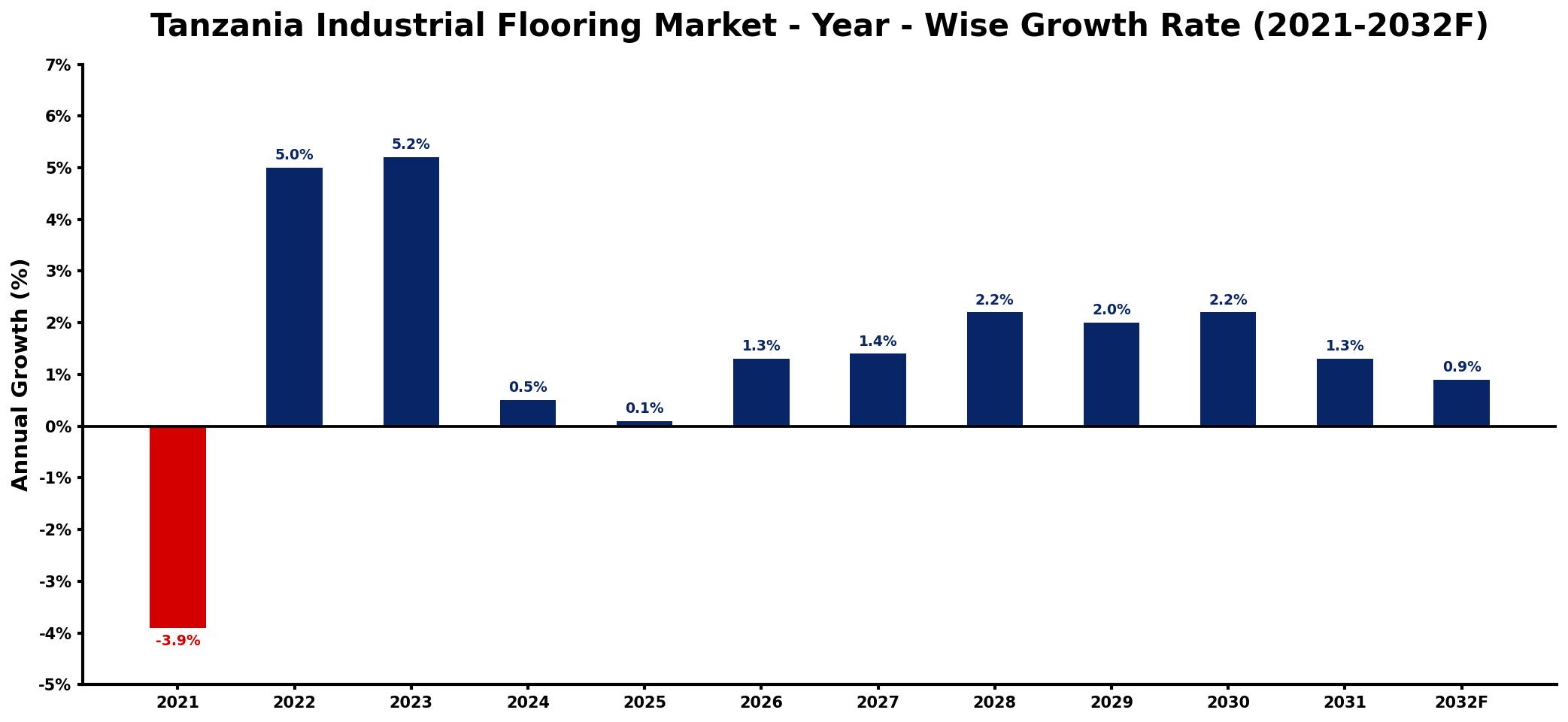
The table below presents the year‑wise growth rates along with the key drivers influencing the market
| Year | Growth Rate | Major Drivers |
| 2021 | -3.9% | decrease in infrastructure investments |
| 2022 | 5.0% | rise in construction activities |
| 2023 | 5.2% | expansion of manufacturing sector |
| 2024 | 0.5% | increased demand for warehouses |
| 2025 | 0.1% | growth in retail sector |
| 2026 | 1.3% | boost in logistics operations |
| 2027 | 1.4% | development of commercial spaces |
| 2028 | 2.2% | surge in export activities |
| 2029 | 2.0% | enhanced urban development projects |
| 2030 | 2.2% | increase in tourism facilities |
| 2031 | 1.3% | increased overall sector activity |
| 2032 | 0.9% | increased capital investment inflows |
Note: Market size estimations and growth projections presented in this report are based on 6Wresearch's proprietary forecasting methodology, utilizing the latest available industry data, government publications, and primary research inputs.
Tanzania Industrial Flooring Market Synopsis
Recent developments in Tanzanias industrial flooring sector indicate a significant shift towards more sustainable and innovative flooring solutions. Businesses are increasingly recognizing the critical role that quality flooring plays in operational efficiency and employee safety.
The market encompasses a diverse range of products, including epoxy coatings, concrete sealants, and anti-slip flooring systems designed for rigorous industrial settings. This focus on specialized solutions is driving the evolution of the industrial flooring landscape in Tanzania.
Tanzania Industrial Flooring Market Key Takeaways
- The market is projected to grow at a CAGR of 1.3% from 2026 to 2032, reflecting steady demand.
- Durability and hygiene remain the primary drivers for growth in the industrial flooring sector.
- Government policies are fostering local production and innovation in flooring materials.
- Customization and sustainability are emerging as key trends influencing consumer preferences.
- Competition with imported materials is shaping the pricing and availability of local products.
Evaluation of Restraints in Tanzania Industrial Flooring Market
Despite the promising growth outlook, the Tanzania Industrial Flooring Market faces several restraints that could hinder its full potential. One significant challenge is the ongoing need for enhancements in the durability of flooring materials to meet evolving industrial demands. Furthermore, strict regulatory compliance with safety and hygiene standards adds complexity for manufacturers. The customization requirements for specific industrial applications often lead to longer lead times and higher costs, which can deter potential clients. Lastly, the influx of imported flooring materials presents competitive pressure on local manufacturers, potentially impacting market share and pricing strategies.
Tanzania Industrial Flooring Market Trends
A clear trend in the Tanzania Industrial Flooring Market is the shift towards eco-friendly materials and practices. Manufacturers are increasingly focusing on sustainable product offerings that minimize environmental impact while delivering high performance. Another noteworthy trend is the integration of advanced technologies, such as anti-slip innovations and self-leveling compounds, which enhance the functionality and safety of flooring solutions in demanding environments. The adoption of smart flooring technologies that monitor usage and wear is also starting to gain traction.
Tanzania Industrial Flooring Market Opportunities
The expanding manufacturing and logistics sectors in Tanzania present lucrative growth opportunities for industrial flooring solutions. Companies looking to enhance their operational efficiency and safety protocols are increasingly seeking out advanced flooring options. Additionally, the growing focus on sustainable development opens doors for manufacturers to innovate and offer eco-conscious products. With government incentives in place, there is a clear path for local firms to capitalize on these opportunities, positioning themselves favorably in a competitive landscape.
Government Initiatives in the Tanzania Industrial Flooring Market
The Tanzanian government has implemented several initiatives to promote the growth of the industrial flooring market. Key policies include financial incentives aimed at local manufacturers, designed to stimulate domestic production and innovation. Additionally, efforts to reduce import duties on raw materials are fostering a more favorable environment for local businesses. Research and development support for advanced flooring technologies is also a priority, further enhancing the potential for growth and improved product offerings within the market.
Future Insights of the Tanzania Industrial Flooring Market
Looking ahead to 2026-2032, the Tanzania Industrial Flooring Market is poised for a period of gradual but steady growth. As industries continue to modernize and emphasize safety and sustainability, demand for advanced flooring solutions will only increase. The successful adoption of local innovations and government support for domestic production will likely further strengthen market positions. Ultimately, companies that adapt to emerging trends and consumer preferences will thrive in this evolving landscape.
Tanzania Industrial Flooring Market Latest Developments (2025 - 2026)
In recent months, industry stakeholders have observed a notable uptick in the development and launch of eco-friendly flooring solutions. Manufacturers are actively investing in research and development to enhance the functionality and longevity of their products. Additionally, collaboration between government bodies and private enterprises is becoming increasingly common, aimed at fostering innovation and compliance with safety standards. The competitive landscape continues to evolve, with a focus on improving supply chains and addressing customer demands for customizable flooring solutions.
Tanzania Industrial Flooring Market - Key Attractiveness of the Report
- 10 Years of Market Numbers
- Historical Data Starting from 2022 to 2025
- Base Year: 2025
- Forecast Data until 2032
- Key Performance Indicators Impacting the Market
- Major Upcoming Developments and Projects
Key Highlights of the Report:
- Tanzania Industrial Flooring Market Outlook
- Market Size of Tanzania Industrial Flooring Market, 2025
- Forecast of Tanzania Industrial Flooring Market, 2032
- Historical Data and Forecast of Tanzania Industrial Flooring Revenues & Volume for the Period 2022-2032F
- Tanzania Industrial Flooring Market Trend Evolution
- Tanzania Industrial Flooring Market Drivers and Challenges
- Tanzania Industrial Flooring Price Trends
- Tanzania Industrial Flooring Porter's Five Forces
- Tanzania Industrial Flooring Industry Life Cycle
- Historical Data and Forecast of Tanzania Industrial Flooring Market Revenues & Volume By End User Industry for the Period 2022-2032F
- Historical Data and Forecast of Tanzania Industrial Flooring Market Revenues & Volume By Chemical for the Period 2022-2032F
- Historical Data and Forecast of Tanzania Industrial Flooring Market Revenues & Volume By Food and Beverages for the Period 2022-2032F
- Historical Data and Forecast of Tanzania Industrial Flooring Market Revenues & Volume By Healthcare for the Period 2022-2032F
- Historical Data and Forecast of Tanzania Industrial Flooring Market Revenues & Volume By Transportation and Aviation for the Period 2022-2032F
- Historical Data and Forecast of Tanzania Industrial Flooring Market Revenues & Volume By Others for the Period 2022-2032F
- Historical Data and Forecast of Tanzania Industrial Flooring Market Revenues & Volume By Thickness for the Period 2022-2032F
- Historical Data and Forecast of Tanzania Industrial Flooring Market Revenues & Volume By Light duty for the Period 2022-2032F
- Historical Data and Forecast of Tanzania Industrial Flooring Market Revenues & Volume By Medium Duty for the Period 2022-2032F
- Historical Data and Forecast of Tanzania Industrial Flooring Market Revenues & Volume By Heavy Duty for the Period 2022-2032F
- Historical Data and Forecast of Tanzania Industrial Flooring Market Revenues & Volume By Material Type for the Period 2022-2032F
- Historical Data and Forecast of Tanzania Industrial Flooring Market Revenues & Volume By Epoxy for the Period 2022-2032F
- Historical Data and Forecast of Tanzania Industrial Flooring Market Revenues & Volume By Polyaspartic for the Period 2022-2032F
- Historical Data and Forecast of Tanzania Industrial Flooring Market Revenues & Volume By Polyurethane for the Period 2022-2032F
- Historical Data and Forecast of Tanzania Industrial Flooring Market Revenues & Volume By Anhydrite for the Period 2022-2032F
- Historical Data and Forecast of Tanzania Industrial Flooring Market Revenues & Volume By Others for the Period 2022-2032F
- Tanzania Industrial Flooring Import Export Trade Statistics
- Market Opportunity Assessment By End User Industry
- Market Opportunity Assessment By Thickness
- Market Opportunity Assessment By Material Type
- Tanzania Industrial Flooring Top Companies Market Share
- Tanzania Industrial Flooring Competitive Benchmarking By Technical and Operational Parameters
- Tanzania Industrial Flooring Company Profiles
- Tanzania Industrial Flooring Key Strategic Recommendations






































