Tanzania Laboratory Freezers Market: Top 5 Importing Countries and Market Competition (HHI) Analysis
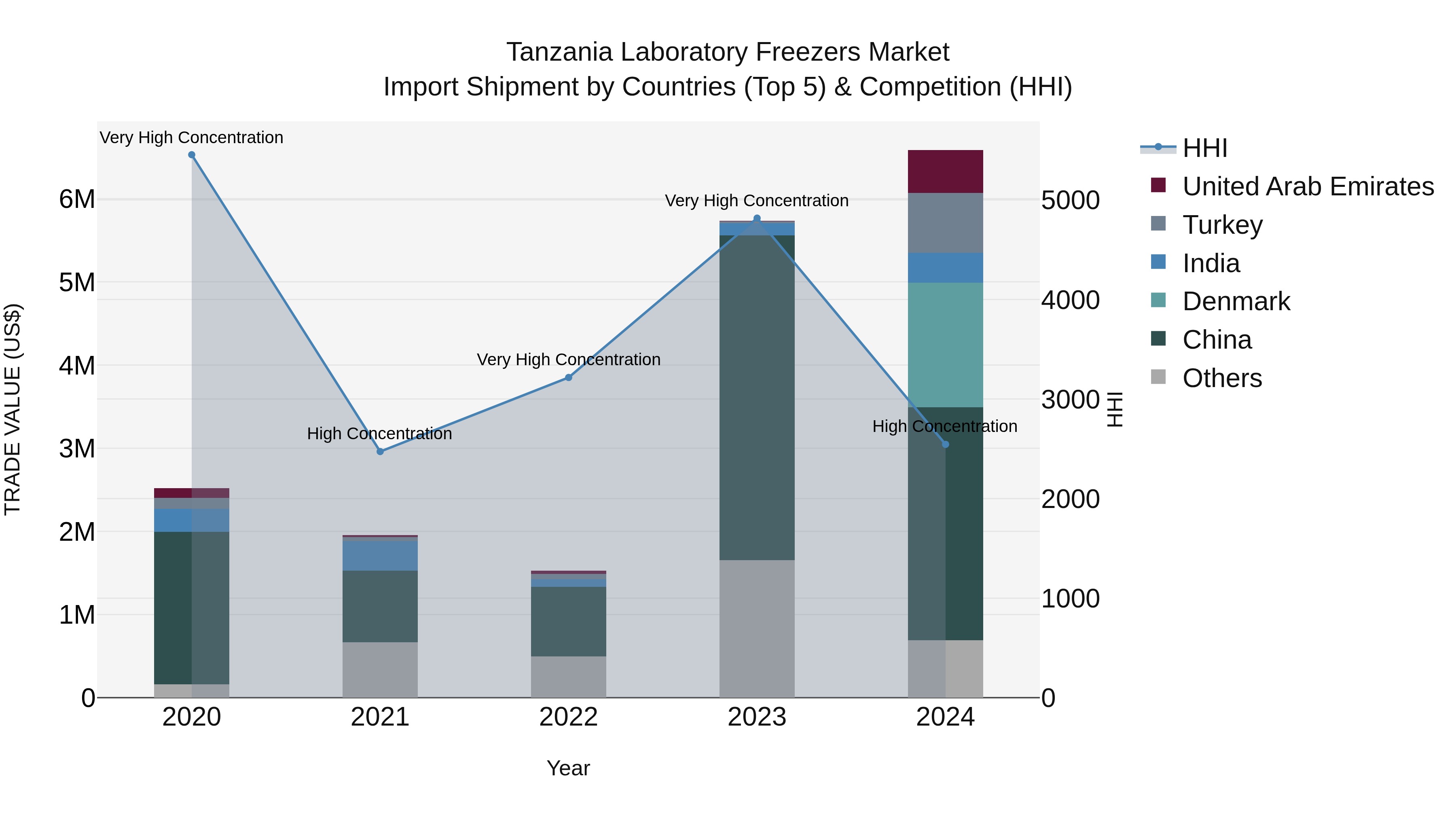
The Tanzania laboratory freezers import market saw a significant increase in concentration in 2024, with top exporting countries being China, Denmark, Turkey, United Arab Emirates, and India. The high Herfindahl-Hirschman Index (HHI) in 2023 continued into 2024, indicating a competitive market. The compound annual growth rate (CAGR) from 2020 to 2024 was an impressive 27.17%, with a notable growth rate of 14.86% from 2023 to 2024. This data suggests a robust and growing demand for laboratory freezers in Tanzania, with key players from various countries contributing to the market`s expansion.
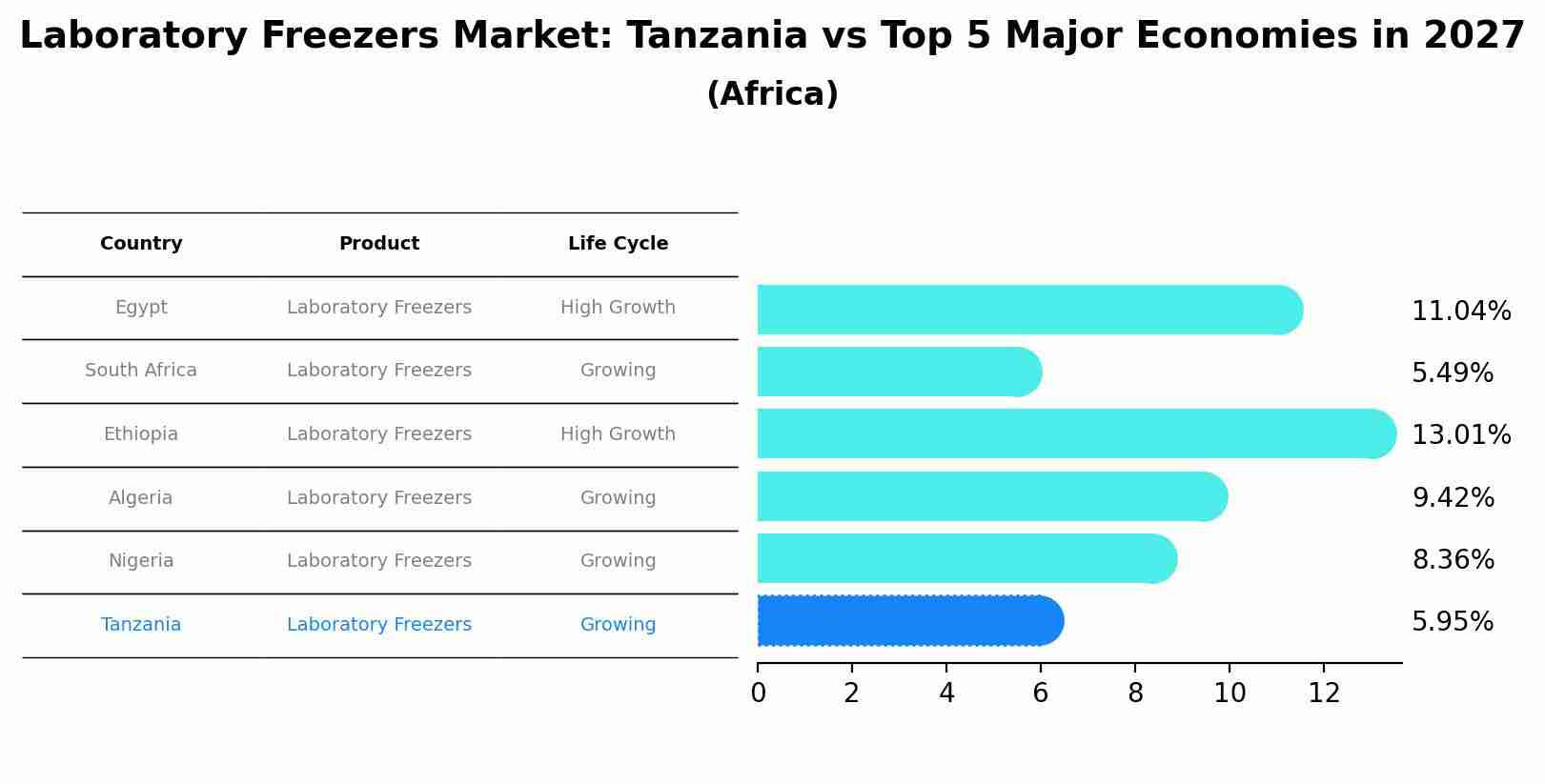
Laboratory Freezers Market: Tanzania vs Top 5 Major Economies in 2027 (Africa)
By 2027, the Laboratory Freezers market in Tanzania is anticipated to reach a growth rate of 5.95%, as part of an increasingly competitive Africa region, where Egypt remains at the forefront, supported by South Africa, Ethiopia, Algeria and Nigeria, driving innovations and market adoption across sectors.
Tanzania Laboratory Freezers Market Overview
In Tanzania, the laboratory freezers market is driven by the demand for storage solutions that maintain precise temperatures for biological samples, vaccines, and reagents. Growth is influenced by advancements in energy efficiency and storage capacity.
Drivers of the market
Cold storage solutions are critical in preserving biological samples and pharmaceuticals. The market in Tanzania is driven by healthcare expansion, vaccine storage requirements, and research applications demanding reliable freezer technology.
Challenges of the market
The Tanzania laboratory freezers market faces challenges associated with unreliable power supply and inadequate storage infrastructure, compromising the integrity and longevity of biological samples and pharmaceutical products. Limited availability of energy-efficient models and sustainable cooling solutions further impedes the scalability and operational resilience of healthcare and research institutions relying on cold storage facilities.
Government Policy of the market
Government policies in Tanzania for the laboratory freezers market emphasize the importance of preserving biological and pharmaceutical samples under controlled temperatures. These policies mandate compliance with international standards for freezer performance, safety, and energy efficiency. The government encourages investment in renewable energy solutions to power freezers and supports capacity-building initiatives for local manufacturing and servicing of freezer equipment, ensuring reliable storage solutions across healthcare, research, and industrial sectors.
Key Highlights of the Report:
- Tanzania Laboratory Freezers Market Outlook
- Market Size of Tanzania Laboratory Freezers Market, 2024
- Forecast of Tanzania Laboratory Freezers Market, 2031
- Historical Data and Forecast of Tanzania Laboratory Freezers Revenues & Volume for the Period 2021-2031
- Tanzania Laboratory Freezers Market Trend Evolution
- Tanzania Laboratory Freezers Market Drivers and Challenges
- Tanzania Laboratory Freezers Price Trends
- Tanzania Laboratory Freezers Porter`s Five Forces
- Tanzania Laboratory Freezers Industry Life Cycle
- Historical Data and Forecast of Tanzania Laboratory Freezers Market Revenues & Volume By Product Type for the Period 2021-2031
- Historical Data and Forecast of Tanzania Laboratory Freezers Market Revenues & Volume By Cryopreservation Systems for the Period 2021-2031
- Historical Data and Forecast of Tanzania Laboratory Freezers Market Revenues & Volume By Refrigerators for the Period 2021-2031
- Historical Data and Forecast of Tanzania Laboratory Freezers Market Revenues & Volume By Freezers for the Period 2021-2031
- Historical Data and Forecast of Tanzania Laboratory Freezers Market Revenues & Volume By End User for the Period 2021-2031
- Historical Data and Forecast of Tanzania Laboratory Freezers Market Revenues & Volume By Blood Banks for the Period 2021-2031
- Historical Data and Forecast of Tanzania Laboratory Freezers Market Revenues & Volume By Pharmaceutical & Biotechnology Companies for the Period 2021-2031
- Historical Data and Forecast of Tanzania Laboratory Freezers Market Revenues & Volume By Academic & Research Institutes for the Period 2021-2031
- Historical Data and Forecast of Tanzania Laboratory Freezers Market Revenues & Volume By Medical Laboratories for the Period 2021-2031
- Historical Data and Forecast of Tanzania Laboratory Freezers Market Revenues & Volume By Hospitals for the Period 2021-2031
- Historical Data and Forecast of Tanzania Laboratory Freezers Market Revenues & Volume By Pharmacies for the Period 2021-2031
- Tanzania Laboratory Freezers Import Export Trade Statistics
- Market Opportunity Assessment By Product Type
- Market Opportunity Assessment By End User
- Tanzania Laboratory Freezers Top Companies Market Share
- Tanzania Laboratory Freezers Competitive Benchmarking By Technical and Operational Parameters
- Tanzania Laboratory Freezers Company Profiles
- Tanzania Laboratory Freezers Key Strategic Recommendations






































