Tanzania Mobile Device Management Market Size, Share & Growth Rate
The Tanzania Mobile Device Management Market was estimated at USD 373 Million in 2025 and is projected to reach USD 653 Million by 2032, growing at a CAGR of 8.3% from 2026 to 2032. This upward trajectory is fueled by the accelerating smartphone penetration and the increasing necessity for businesses to manage mobile workforces efficiently. As more organizations adopt flexible work models, the demand for robust MDM solutions is expected to surge, addressing security, compliance, and productivity challenges.
Tanzania Mobile Device Management Market Year-wise Growth Rate and Key Drivers
This graph highlights how the Tanzania Mobile Device Management Market has steadily grown over the years, supported by major growth factors.
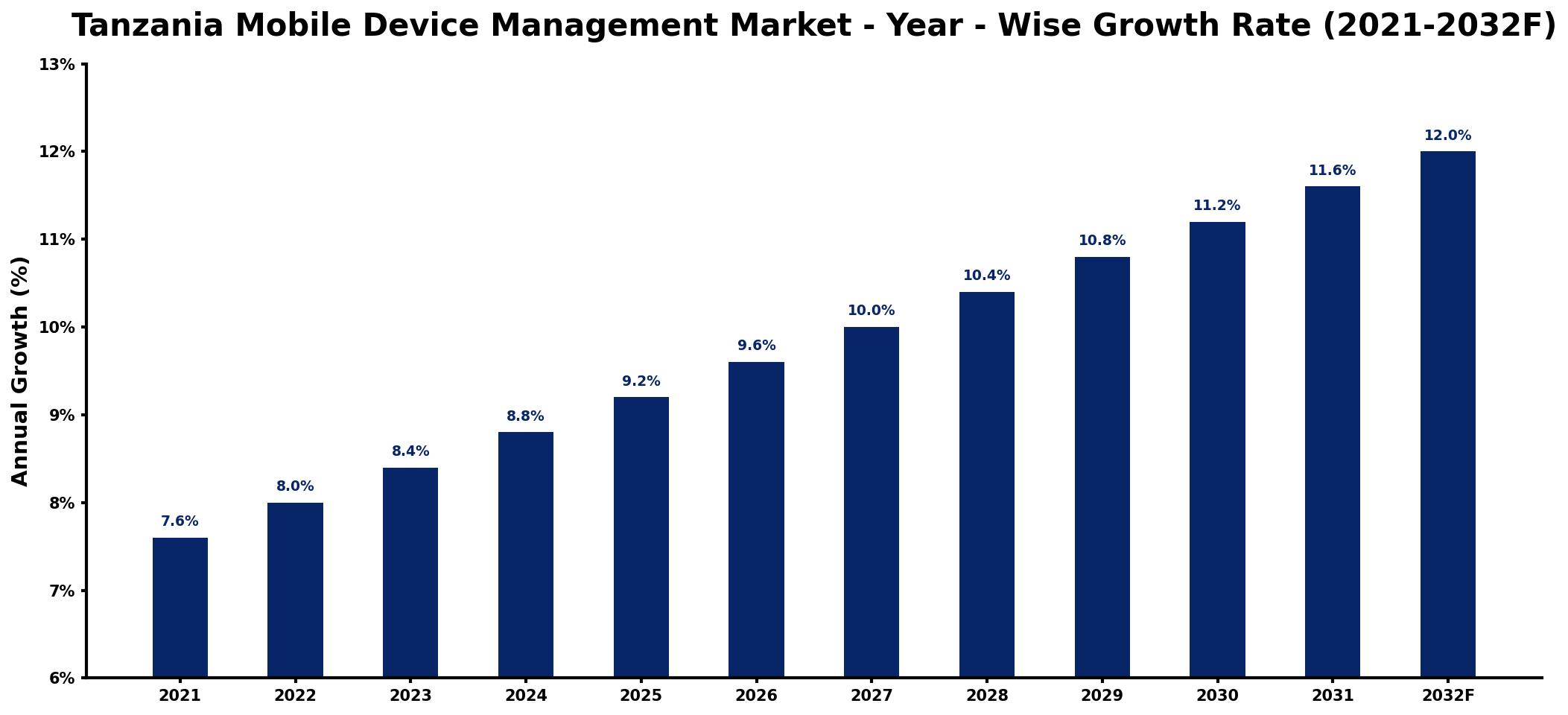
The table below presents the year‑wise growth rates along with the key drivers influencing the market
| Year | Growth Rate | Major Drivers |
| 2021 | 7.6% | increased adoption of remote work |
| 2022 | 8.0% | growth in cloud computing services |
| 2023 | 8.4% | rising demand for cybersecurity solutions |
| 2024 | 8.8% | increased pharmaceutical industry usage |
| 2025 | 9.2% | investments in digital transformation initiatives |
| 2026 | 9.6% | enhanced focus on regulatory compliance |
| 2027 | 10.0% | rising infrastructure development spending |
| 2028 | 10.4% | surge in e-commerce transactions |
| 2029 | 10.8% | increased integration of IoT technologies |
| 2030 | 11.2% | development of smart city projects |
| 2031 | 11.6% | higher consumer expectations for connectivity |
| 2032 | 12.0% | advancements in artificial intelligence applications |
Note: Market size estimations and growth projections presented in this report are based on 6Wresearch's proprietary forecasting methodology, utilizing the latest available industry data, government publications, and primary research inputs.
Tanzania Mobile Device Management Market Synopsis
The recent momentum in the Tanzania Mobile Device Management Market has been characterized by a rapid increase in smartphone usage and a growing mobile workforce. This progress signifies an important evolution toward centralized management and security of devices and data. Looking ahead, the market is transitioning towards cloud-based solutions, aligning with the demand for scalability and flexibility.
As businesses increasingly recognize the significance of safeguarding sensitive information, MDM solutions are now seen as essential tools for operational efficiency. The integration of advanced security features and compliance management in these solutions further emphasizes their critical role in todays mobile-driven business landscape in Tanzania.
Tanzania Mobile Device Management Market Key Takeaways
- The market is witnessing a significant shift toward cloud-based MDM solutions.
- Security and compliance are top priorities driving MDM adoption among organizations.
- Investments in training and support services for MDM users present valuable opportunities.
- Integration with other enterprise mobility management tools enhances overall efficiency.
- Small and medium enterprises represent a growing segment for MDM solutions.
Evaluation of Restraints in Tanzania Mobile Device Management Market
Despite the positive growth outlook, the Tanzania Mobile Device Management Market faces notable challenges that may hinder its potential. A key issue is the limited awareness and understanding of MDM solutions among small and medium enterprises, which often leads to underutilization or avoidance of available technologies. Additionally, a shortage of skilled IT professionals complicates the effective implementation and ongoing management of these solutions. Concerns surrounding data security and compliance further exacerbate hesitancy among businesses striving to navigate local regulatory frameworks. Addressing these issues will be pivotal for unlocking the market's full potential and fostering widespread adoption.
Tanzania Mobile Device Management Market Trends
A significant trend within the Tanzania Mobile Device Management Market is the growing preference for cloud-based solutions. This shift is driven by the demand for flexibility and cost-effectiveness, allowing businesses to manage devices remotely without heavy infrastructure investments. Furthermore, as companies increasingly prioritize security, there's a marked trend toward integrating advanced cybersecurity features within MDM solutions to safeguard sensitive data. The blending of MDM with other enterprise mobility management tools is becoming common, streamlining mobile device management processes and enhancing operational efficiency.
Tanzania Mobile Device Management Market Opportunities
The Tanzania Mobile Device Management Market is ripe with investment opportunities. The rise in smartphone adoption signifies a crucial opening for MDM software development and consulting services aimed at implementation. Collaborating with telecom operators to deliver tailored MDM solutions can enhance market penetration. Additionally, as the need for user training and ongoing support grows, there is a substantial opportunity for businesses to develop service offerings that address these demands, thus ensuring a secure and efficient mobile technology environment.
Government Initiatives in the Tanzania Mobile Device Management Market
The Tanzanian government has implemented several initiatives to regulate the Mobile Device Management market, emphasizing data security and consumer protection. The Electronic and Postal Communications Act (EPOCA) plays a critical role in governing telecommunications practices, ensuring that service providers maintain high standards for data privacy. The Tanzania Communications Regulatory Authority (TCRA) also sets comprehensive regulations to oversee device management and data protection. Furthermore, the government encourages local manufacturing of mobile devices through various incentives, creating a more robust domestic industry and supporting the MDM ecosystem.
Future Insights of the Tanzania Mobile Device Management Market
Looking ahead to 2026-2032, the Tanzania Mobile Device Management Market is positioned for substantial expansion. As digital transformation accelerates across sectors, organizations will increasingly seek efficient and secure ways to manage their mobile devices. Innovations such as data encryption, remote device tracking, and application management will be in high demand. Moreover, the focus on enhancing productivity while ensuring compliance will continue to shape the evolution of the MDM landscape, attracting both local and international solution providers keen to capitalize on emerging opportunities.
Tanzania Mobile Device Management Market Latest Developments (2025 - 2026)
Recent developments in the Tanzania Mobile Device Management Market have indicated a stronger move towards integrated solutions that enhance user experience and operational efficiency. Several initiatives have been launched focusing on improving cybersecurity measures within mobile device management frameworks. Additionally, training programs targeting the enhancement of IT skills in MDM implementation have emerged, reflecting a commitment to overcoming workforce challenges and ensuring a better-equipped talent pool for future market needs.
Tanzania Mobile Device Management Market - Key Attractiveness of the Report
- 10 Years of Market Numbers
- Historical Data Starting from 2022 to 2025
- Base Year: 2025
- Forecast Data until 2032
- Key Performance Indicators Impacting the Market
- Major Upcoming Developments and Projects
Key Highlights of the Report:
- Tanzania Mobile Device Management Market Outlook
- Market Size of Tanzania Mobile Device Management Market, 2025
- Forecast of Tanzania Mobile Device Management Market, 2032
- Historical Data and Forecast of Tanzania Mobile Device Management Revenues & Volume for the Period 2022-2032F
- Tanzania Mobile Device Management Market Trend Evolution
- Tanzania Mobile Device Management Market Drivers and Challenges
- Tanzania Mobile Device Management Price Trends
- Tanzania Mobile Device Management Porter's Five Forces
- Tanzania Mobile Device Management Industry Life Cycle
- Historical Data and Forecast of Tanzania Mobile Device Management Market Revenues & Volume By Component for the Period 2022-2032F
- Historical Data and Forecast of Tanzania Mobile Device Management Market Revenues & Volume By Solution (Device management, Application Management, Security Management, Other solutions) for the Period 2022-2032F
- Historical Data and Forecast of Tanzania Mobile Device Management Market Revenues & Volume By Services (Professional services, Managed services) for the Period 2022-2032F
- Historical Data and Forecast of Tanzania Mobile Device Management Market Revenues & Volume By Deployment Mode for the Period 2022-2032F
- Historical Data and Forecast of Tanzania Mobile Device Management Market Revenues & Volume By On-Premises for the Period 2022-2032F
- Historical Data and Forecast of Tanzania Mobile Device Management Market Revenues & Volume By Cloud for the Period 2022-2032F
- Historical Data and Forecast of Tanzania Mobile Device Management Market Revenues & Volume By Operating System for the Period 2022-2032F
- Historical Data and Forecast of Tanzania Mobile Device Management Market Revenues & Volume By iOS for the Period 2022-2032F
- Historical Data and Forecast of Tanzania Mobile Device Management Market Revenues & Volume By Android for the Period 2022-2032F
- Historical Data and Forecast of Tanzania Mobile Device Management Market Revenues & Volume By Windows for the Period 2022-2032F
- Historical Data and Forecast of Tanzania Mobile Device Management Market Revenues & Volume By MacOS for the Period 2022-2032F
- Historical Data and Forecast of Tanzania Mobile Device Management Market Revenues & Volume By Other Operating systems for the Period 2022-2032F
- Historical Data and Forecast of Tanzania Mobile Device Management Market Revenues & Volume By Organisation Size for the Period 2022-2032F
- Historical Data and Forecast of Tanzania Mobile Device Management Market Revenues & Volume By Small and Medium Enterprises for the Period 2022-2032F
- Historical Data and Forecast of Tanzania Mobile Device Management Market Revenues & Volume By Large Enterprises for the Period 2022-2032F
- Historical Data and Forecast of Tanzania Mobile Device Management Market Revenues & Volume By Vertical for the Period 2022-2032F
- Historical Data and Forecast of Tanzania Mobile Device Management Market Revenues & Volume By Banking, Financial Services and Insurance for the Period 2022-2032F
- Historical Data and Forecast of Tanzania Mobile Device Management Market Revenues & Volume By Telecom for the Period 2022-2032F
- Historical Data and Forecast of Tanzania Mobile Device Management Market Revenues & Volume By Retail for the Period 2022-2032F
- Historical Data and Forecast of Tanzania Mobile Device Management Market Revenues & Volume By Healthcare for the Period 2022-2032F
- Historical Data and Forecast of Tanzania Mobile Device Management Market Revenues & Volume By Education for the Period 2022-2032F
- Historical Data and Forecast of Tanzania Mobile Device Management Market Revenues & Volume By Transport and Logistics for the Period 2022-2032F
- Historical Data and Forecast of Tanzania Mobile Device Management Market Revenues & Volume By Government and Public Sector for the Period 2022-2032F
- Historical Data and Forecast of Tanzania Mobile Device Management Market Revenues & Volume By Manufacturing and Automotive for the Period 2022-2032F
- Tanzania Mobile Device Management Import Export Trade Statistics
- Market Opportunity Assessment By Component
- Market Opportunity Assessment By Deployment Mode
- Market Opportunity Assessment By Operating System
- Market Opportunity Assessment By Organisation Size
- Market Opportunity Assessment By Vertical
- Tanzania Mobile Device Management Top Companies Market Share
- Tanzania Mobile Device Management Competitive Benchmarking By Technical and Operational Parameters
- Tanzania Mobile Device Management Company Profiles
- Tanzania Mobile Device Management Key Strategic Recommendations






































