Tanzania Mobile Security Market Size & Growth Rate (2026-2032)
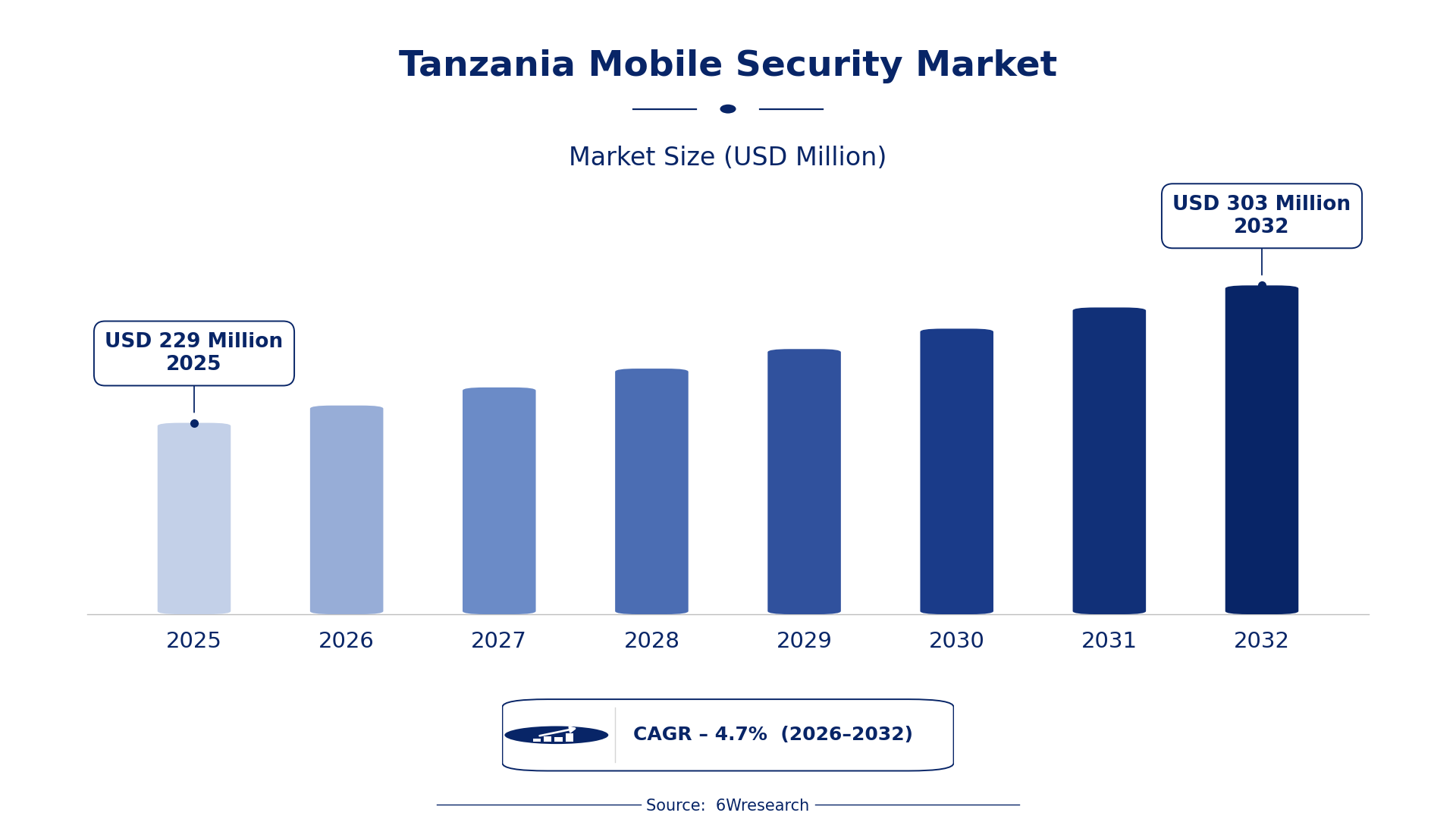
The Tanzania Mobile Security Market was estimated at USD 229 Million in 2025 and is projected to reach USD 303 Million by 2032, growing at a CAGR of 4.7% from 2026 to 2032.
Tanzania Mobile Security Market Synopsis
The Tanzania mobile security market has shifted from its nascent stage to a burgeoning domain, driven by a surge in smartphone adoption and digital transactions. As consumers increasingly rely on mobile platforms, the imperative for robust security solutions has escalated.
With mobile transactions becoming ubiquitous, the threat landscape is evolving. Security providers are now tailoring advanced solutions, like encryption tools and mobile device management systems, specifically for the Tanzanian market. This focus on enhancing security measures is not just a trend; it's a necessity.
Tanzania Mobile Security Market Year-wise Growth Rate and Key Drivers
This graph illustrates the annual growth rates of the Tanzania Mobile Security Market from 2021 to 2032, highlighting a steady upward trajectory and projected expansion over the forecast period.
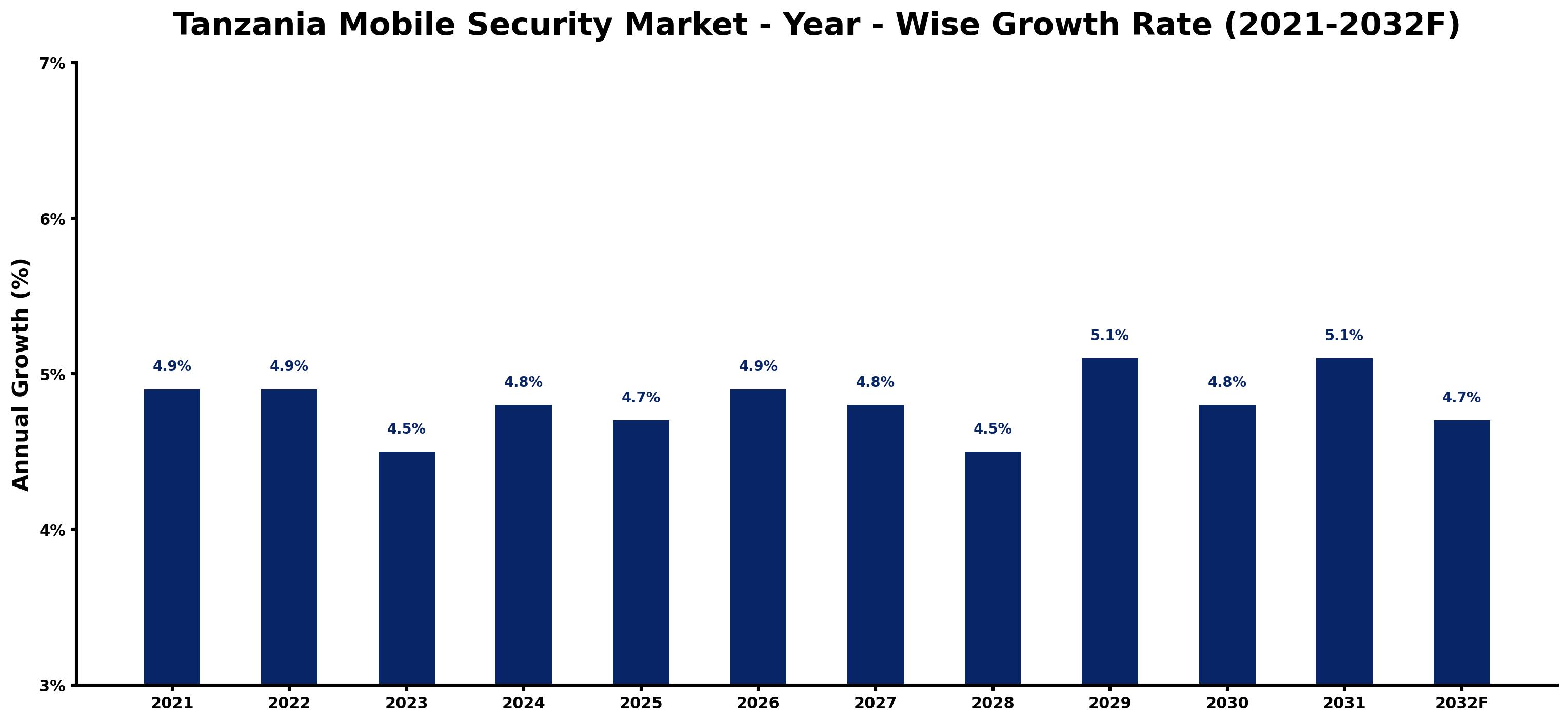
The table below presents the year‑wise growth rates along with the key drivers influencing the market
| Year | Growth Rate | Major Drivers |
| 2021 | 4.9% | GSMA's initiative for mobile identity verification launched. |
| 2022 | 4.9% | Increased mobile fraud incidents prompted enhanced security measures. |
| 2023 | 4.5% | NIDA partnered for biometric verification in mobile services. |
| 2024 | 4.8% | Government supporting cybersecurity training for tech professionals. |
| 2025 | 4.7% | Adoption of mobile payment systems increased security demand. |
| 2026 | 4.9% | Tanzanian banks mandated two-factor authentication for transactions. |
| 2027 | 4.8% | Growing e-commerce driving investment in mobile security solutions. |
| 2028 | 4.5% | Cybersecurity awareness campaigns boosted consumer demand for protection. |
| 2029 | 5.1% | Launch of 5G networks necessitated advanced mobile security protocols. |
| 2030 | 4.8% | Collaboration with international firms improved local security technologies. |
| 2031 | 5.1% | Rising internet penetration led to greater mobile security needs. |
| 2032 | 4.7% | New data protection regulations increased compliance-driven investments. |
Note: Market size estimations and growth projections presented in this report are based on 6Wresearch's proprietary forecasting methodology, utilizing the latest available industry data, government publications, and primary research inputs.
Tanzania Mobile Security Market Key Takeaways
Below are some of the specific key takeaways from the market, including:
- Increased smartphone penetration is a primary driver for mobile security demand in Tanzania.
- Regulatory initiatives are shaping the framework for data protection and privacy standards.
- Business awareness of mobile threats is rising, prompting investment in security measures.
- The COVID-19 pandemic has accelerated the shift towards remote working and secure mobile connectivity.
- Investment opportunities are emerging for local and international firms in mobile security solutions.
Evaluation of Restraints in Tanzania Mobile Security Market
Despite the growth trajectory, the Tanzania mobile security market faces notable challenges. A significant portion of the population remains unaware of mobile security's critical importance, resulting in low adoption rates of protective solutions. Many low-cost smartphones, prevalent in the region, often come equipped with outdated software or inadequate security features. Additionally, infrastructure limitations in certain areas hinder the effective implementation of necessary security measures. Addressing these issues demands concerted awareness campaigns and improved collaboration across sectors.
Tanzania Mobile Security Market Trends
The market is currently leaning towards integrated security platforms that cater to diverse mobile operating systems. The focus on mobile threat defense solutions, encryption, and biometric authentication is becoming increasingly pronounced. Awareness of cybersecurity threats is rising, leading both individuals and businesses to prioritize the safeguarding of sensitive data on mobile devices.
A significant trend is the shift in corporate policies that underscore comprehensive mobile security measures. Businesses are investing heavily in training and technologies that enhance data protection. This shift is driven by the increasing number of cyber threats targeting mobile platforms.
Tanzania Mobile Security Market Opportunities
The expanding mobile ecosystem in Tanzania presents numerous investment opportunities. With increasing reliance on mobile services for transactions and communication, the demand for tailored mobile security solutions is on the rise. Investors can explore avenues in developing mobile security applications, antivirus software, and encryption technologies specifically designed for Tanzanian consumers.
on top of that, establishing partnerships with local telecom operators and financial institutions can significantly enhance market penetration and service delivery.
Government Initiatives in the Tanzania Mobile Security Market
The Tanzanian government is taking decisive steps to regulate and enhance the mobile security landscape. The national regulatory framework is being strengthened to ensure compliance with emerging data protection standards. This proactive approach is crucial in fostering trust and security within the growing digital economy.
- A recently completed initiative involves the implementation of the Electronic and Postal Communications Act, which sets out legal provisions for mobile security and consumer data protection.
- Currently, the Tanzania Communications Regulatory Authority (TCRA) is working on enforcing cybersecurity standards across telecommunications to enhance market reliability.
- A planned public-private partnership is expected to launch in 2026, focusing on developing critical infrastructure to support advanced mobile security solutions.
- The National Cybersecurity Strategy is in its rollout phase, aiming to boost national capabilities against rising cyber threats.
Future Insights of the Tanzania Mobile Security Market
Looking ahead to 2026-2032, the Tanzania mobile security market is set for substantial growth. As mobile devices become more integral to daily operations for businesses and individuals alike, the urgency for comprehensive security measures will intensify. The driving forces will be heightened consumer awareness regarding cybersecurity, evolving regulatory frameworks, and an increasing reliance on mobile technology for various services.
Tanzania Mobile Security Market Latest Developments
Recent activity in the Tanzania mobile security market reveals a dynamic shift towards enhanced protective solutions. Over the past 12-14 months, several initiatives have aimed to bolster the security posture of mobile platforms across the region.
- A major technology vendor launched an innovative mobile security application in early 2025, designed to combat emerging cyber threats specifically faced by Tanzanian users.
- In Q3 2025, a leading regional operator initiated a partnership with cybersecurity firms to develop a suite of mobile threat defense solutions for enterprises.
- A national awareness campaign on mobile security was rolled out by the government in late 2025, targeting consumers and businesses alike.
- Plans are underway for a comprehensive upgrade to the digital infrastructure in the country, expected to commence in early 2026, aimed at enhancing cybersecurity capabilities.
Tanzania Mobile Security Market - Key Attractiveness of the Report
- 10 Years of Market Numbers
- Historical Data Starting from 2022 to 2025
- Base Year: 2025
- Forecast Data until 2032
- Key Performance Indicators Impacting the Market
- Major Upcoming Developments and Projects
Key Highlights of the Report:
- Tanzania Mobile Security Market Outlook
- Market Size of Tanzania Mobile Security Market, 2025
- Forecast of Tanzania Mobile Security Market, 2032
- Historical Data and Forecast of Tanzania Mobile Security Revenues & Volume for the Period 2022-2032F
- Tanzania Mobile Security Market Trend Evolution
- Tanzania Mobile Security Market Drivers and Challenges
- Tanzania Mobile Security Price Trends
- Tanzania Mobile Security Porter's Five Forces
- Tanzania Mobile Security Industry Life Cycle
- Historical Data and Forecast of Tanzania Mobile Security Market Revenues & Volume By End User for the Period 2022-2032F
- Historical Data and Forecast of Tanzania Mobile Security Market Revenues & Volume By Individual for the Period 2022-2032F
- Historical Data and Forecast of Tanzania Mobile Security Market Revenues & Volume By Enterprise (Solution (Authentication, Application Security, & Device Security), Service) for the Period 2022-2032F
- Historical Data and Forecast of Tanzania Mobile Security Market Revenues & Volume By Deployment Mode for the Period 2022-2032F
- Historical Data and Forecast of Tanzania Mobile Security Market Revenues & Volume By On-premises for the Period 2022-2032F
- Historical Data and Forecast of Tanzania Mobile Security Market Revenues & Volume By Cloud for the Period 2022-2032F
- Historical Data and Forecast of Tanzania Mobile Security Market Revenues & Volume By Organization Size for the Period 2022-2032F
- Historical Data and Forecast of Tanzania Mobile Security Market Revenues & Volume By Small and Medium-Sized Enterprises (SMEs) for the Period 2022-2032F
- Historical Data and Forecast of Tanzania Mobile Security Market Revenues & Volume By Large Enterprises for the Period 2022-2032F
- Historical Data and Forecast of Tanzania Mobile Security Market Revenues & Volume By Vertical for the Period 2022-2032F
- Historical Data and Forecast of Tanzania Mobile Security Market Revenues & Volume By BFSI for the Period 2022-2032F
- Historical Data and Forecast of Tanzania Mobile Security Market Revenues & Volume By Telecom & IT for the Period 2022-2032F
- Historical Data and Forecast of Tanzania Mobile Security Market Revenues & Volume By Retail for the Period 2022-2032F
- Historical Data and Forecast of Tanzania Mobile Security Market Revenues & Volume By Healthcare for the Period 2022-2032F
- Historical Data and Forecast of Tanzania Mobile Security Market Revenues & Volume By Government & Defense for the Period 2022-2032F
- Historical Data and Forecast of Tanzania Mobile Security Market Revenues & Volume By Manufacturing for the Period 2022-2032F
- Historical Data and Forecast of Tanzania Mobile Security Market Revenues & Volume By Others for the Period 2022-2032F
- Historical Data and Forecast of Tanzania Mobile Security Market Revenues & Volume By Operating System for the Period 2022-2032F
- Historical Data and Forecast of Tanzania Mobile Security Market Revenues & Volume By iOS for the Period 2022-2032F
- Historical Data and Forecast of Tanzania Mobile Security Market Revenues & Volume By Android for the Period 2022-2032F
- Tanzania Mobile Security Import Export Trade Statistics
- Market Opportunity Assessment By End User
- Market Opportunity Assessment By Deployment Mode
- Market Opportunity Assessment By Organization Size
- Market Opportunity Assessment By Vertical
- Market Opportunity Assessment By Operating System
- Tanzania Mobile Security Top Companies Market Share
- Tanzania Mobile Security Competitive Benchmarking By Technical and Operational Parameters
- Tanzania Mobile Security Company Profiles
- Tanzania Mobile Security Key Strategic Recommendations






































