Tanzania Peas Market Size, Share & Growth Rate
The Tanzania Peas Market was estimated at USD 633 Million in 2025 and is projected to reach USD 907 Million by 2032, growing at a CAGR of 5.3% from 2026 to 2032. This growth trajectory is primarily fueled by a burgeoning domestic demand for both fresh and processed peas, which are increasingly recognized for their health benefits. Alongside, the export opportunities, particularly to European and Middle Eastern markets, further bolster this growth, making it a pivotal segment for local farmers and agribusinesses alike.
Tanzania Peas Market Year-wise Growth Rate and Key Drivers
This graph highlights how the Tanzania Peas Market has steadily grown over the years, supported by major growth factors.
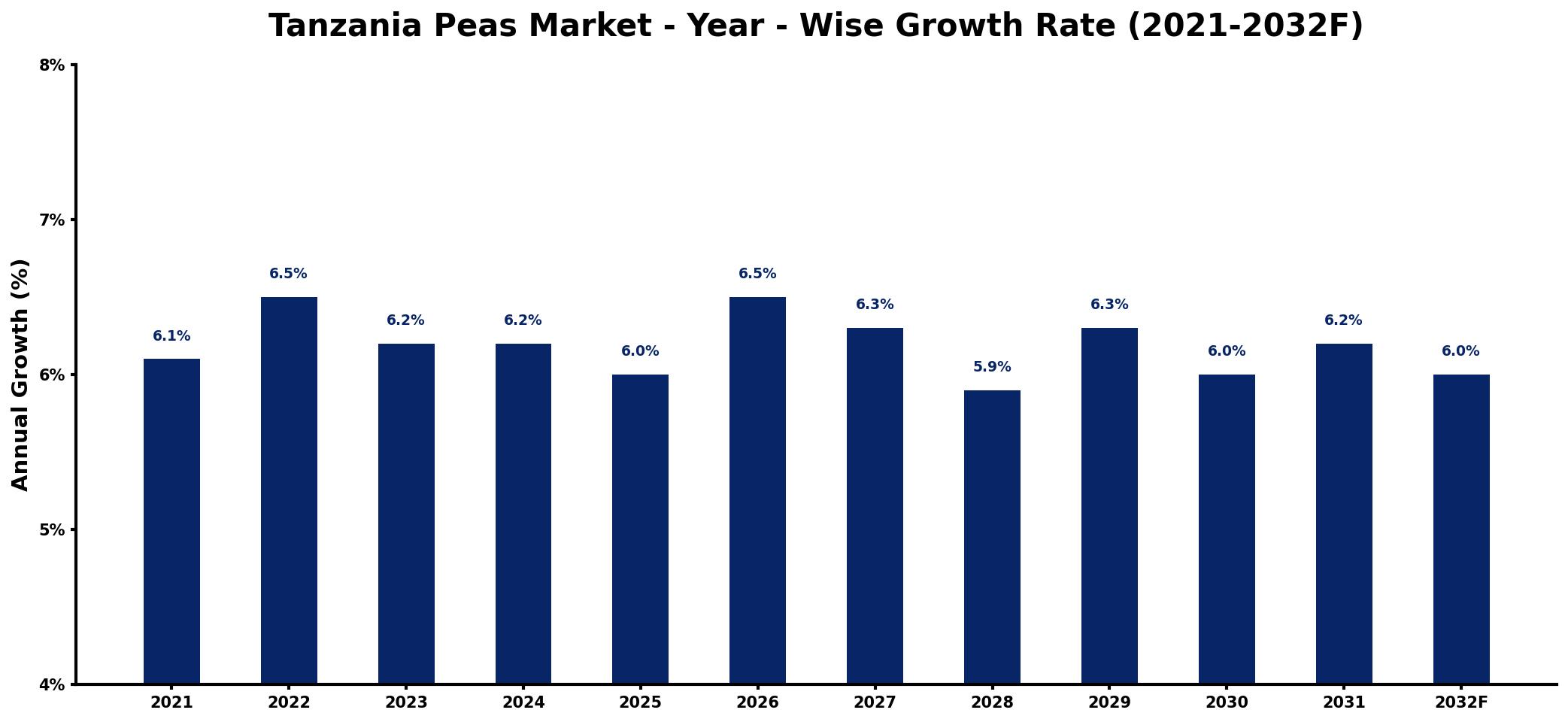
The table below presents the year‑wise growth rates along with the key drivers influencing the market
| Year | Growth Rate | Major Drivers |
| 2021 | 6.1% | Rising health consciousness among consumers |
| 2022 | 6.5% | Increased agricultural investment initiatives |
| 2023 | 6.2% | Growing popularity of plant-based diets |
| 2024 | 6.2% | Expansion of local processing facilities |
| 2025 | 6.0% | Strengthening export market opportunities |
| 2026 | 6.5% | Surge in organic farming practices |
| 2027 | 6.3% | Emerging food innovation trends |
| 2028 | 5.9% | Diversification of crop production strategies |
| 2029 | 6.3% | Enhanced supply chain efficiencies |
| 2030 | 6.0% | Growing urban population demand |
| 2031 | 6.2% | Increased consumer awareness campaigns |
| 2032 | 6.0% | Strengthened agricultural research collaboration |
Note: Market size estimations and growth projections presented in this report are based on 6Wresearch's proprietary forecasting methodology, utilizing the latest available industry data, government publications, and primary research inputs.
Tanzania Peas Market Synopsis
The strongest force currently shaping the Tanzania peas market is the rising consumer demand for healthy, plant-based protein sources. As consumers become more health-conscious, the appeal of peas, known for their high protein and fiber content, continues to grow, further stimulating market dynamics.
Moreover, the trend towards organic and sustainably sourced peas is gaining momentum. With consumers increasingly aware of the environmental impact of their food choices, there is a significant push for pesticide-free and eco-friendly farming practices, leading to a transformation within the local agricultural landscape.
Tanzania Peas Market Key Takeaways
- The market is driven by heightened consumer awareness regarding the health benefits of peas.
- There is an increasing trend towards organic and sustainably sourced peas among consumers.
- Value-added products, such as frozen peas and pea protein, are gaining traction in the market.
- Smallholder farmers are crucial players in meeting the domestic and export demand.
- Investment opportunities exist in processing facilities and modern farming techniques.
Evaluation of Restraints in Tanzania Peas Market
Despite its promising growth, the Tanzania peas market faces several real restraints that limit its potential. One of the primary challenges is the inconsistency of supply, which is heavily influenced by erratic weather patterns, adversely affecting crop yields. Additionally, inadequate infrastructure for storage and transportation results in significant post-harvest losses. Smallholder farmers often lack access to modern agricultural techniques and financial resources, which limits their productivity. Furthermore, price volatility in global markets and competition from imported peas can threaten the stability of the local market. Addressing these constraints is essential for unlocking the market's full potential.
Tanzania Peas Market Trends
Current trends in the Tanzania peas market include a surge in consumer preference for organic products, driven by heightened awareness of health and environmental issues. Producers are increasingly adopting organic farming methods to meet this demand, resulting in a shift toward sustainable agriculture. Additionally, the popularity of plant-based diets is steering the market towards innovative, value-added pea products like snacks and protein powders. There is also a growing emphasis on food safety and quality, aligning with both local and international standards.
Tanzania Peas Market Opportunities
The Tanzania peas market presents numerous growth and investment opportunities, particularly in the areas of farming operations and processing. Investing in modern agricultural technology can significantly boost production efficiency and crop quality. The establishment of processing facilities to create value-added products, such as frozen and canned peas, offers lucrative potential. Additionally, forging partnerships with international buyers for exports can capitalize on the growing global demand for healthy food options. Enhancing logistics and distribution networks will also facilitate timely product delivery, unlocking further market potential.
Government Initiatives in the Tanzania Peas Market
The Tanzanian government has actively implemented policies to enhance the peas market. These initiatives include agricultural extension services aimed at increasing productivity and providing subsidies for essential inputs like seeds and fertilizers. Furthermore, public investment in infrastructure development is crucial for improving transport and storage facilities. The government has also introduced price stabilization mechanisms to ensure fair pricing for both producers and consumers, alongside regulations promoting sustainable farming practices. Overall, these supportive policies aim to foster growth in the peas market while assisting smallholder farmers.
Future Insights of the Tanzania Peas Market
Looking ahead to 2026-2032, the future of the Tanzania peas market appears promising. The increasing global focus on healthy and sustainable food options is likely to drive continued demand for peas as a vital source of plant-based protein. Government initiatives aimed at supporting agricultural development are expected to enhance production capabilities, thus creating new export opportunities. As consumer preferences shift towards nutrition-rich foods, the market for peas is poised for steady growth, presenting exciting opportunities for stakeholders across the entire value chain.
Tanzania Peas Market Latest Developments (2025 - 2026)
In recent months, the Tanzania peas market has experienced notable shifts, reflecting broader industry trends. There has been a marked increase in investments directed towards organic farming, with local producers adapting to meet consumer demands for healthier, sustainably sourced options. New processing facilities are being established to cater to the rising popularity of value-added pea products. Additionally, collaborative efforts between farmers and government bodies to enhance infrastructure have gained momentum, aiming to minimize post-harvest losses and improve overall market efficiency.
Tanzania Peas Market - Key Attractiveness of the Report
- 10 Years of Market Numbers
- Historical Data Starting from 2022 to 2025
- Base Year: 2025
- Forecast Data until 2032
- Key Performance Indicators Impacting the Market
- Major Upcoming Developments and Projects
Key Highlights of the Report:
- Tanzania Peas Market Outlook
- Market Size of Tanzania Peas Market, 2025
- Forecast of Tanzania Peas Market, 2032
- Historical Data and Forecast of Tanzania Peas Revenues & Volume for the Period 2022-2032F
- Tanzania Peas Market Trend Evolution
- Tanzania Peas Market Drivers and Challenges
- Tanzania Peas Price Trends
- Tanzania Peas Porter's Five Forces
- Tanzania Peas Industry Life Cycle
- Historical Data and Forecast of Tanzania Peas Market Revenues & Volume By Type for the Period 2022-2032F
- Historical Data and Forecast of Tanzania Peas Market Revenues & Volume By Field Peas for the Period 2022-2032F
- Historical Data and Forecast of Tanzania Peas Market Revenues & Volume By Garden Peas for the Period 2022-2032F
- Historical Data and Forecast of Tanzania Peas Market Revenues & Volume By Others for the Period 2022-2032F
- Historical Data and Forecast of Tanzania Peas Market Revenues & Volume By Application for the Period 2022-2032F
- Historical Data and Forecast of Tanzania Peas Market Revenues & Volume By Food for the Period 2022-2032F
- Historical Data and Forecast of Tanzania Peas Market Revenues & Volume By Others for the Period 2022-2032F
- Historical Data and Forecast of Tanzania Peas Market Revenues & Volume By Distribution Channel for the Period 2022-2032F
- Historical Data and Forecast of Tanzania Peas Market Revenues & Volume By Online for the Period 2022-2032F
- Historical Data and Forecast of Tanzania Peas Market Revenues & Volume By Offline for the Period 2022-2032F
- Historical Data and Forecast of Tanzania Peas Market Revenues & Volume By Others for the Period 2022-2032F
- Tanzania Peas Import Export Trade Statistics
- Market Opportunity Assessment By Type
- Market Opportunity Assessment By Application
- Market Opportunity Assessment By Distribution Channel
- Tanzania Peas Top Companies Market Share
- Tanzania Peas Competitive Benchmarking By Technical and Operational Parameters
- Tanzania Peas Company Profiles
- Tanzania Peas Key Strategic Recommendations






































