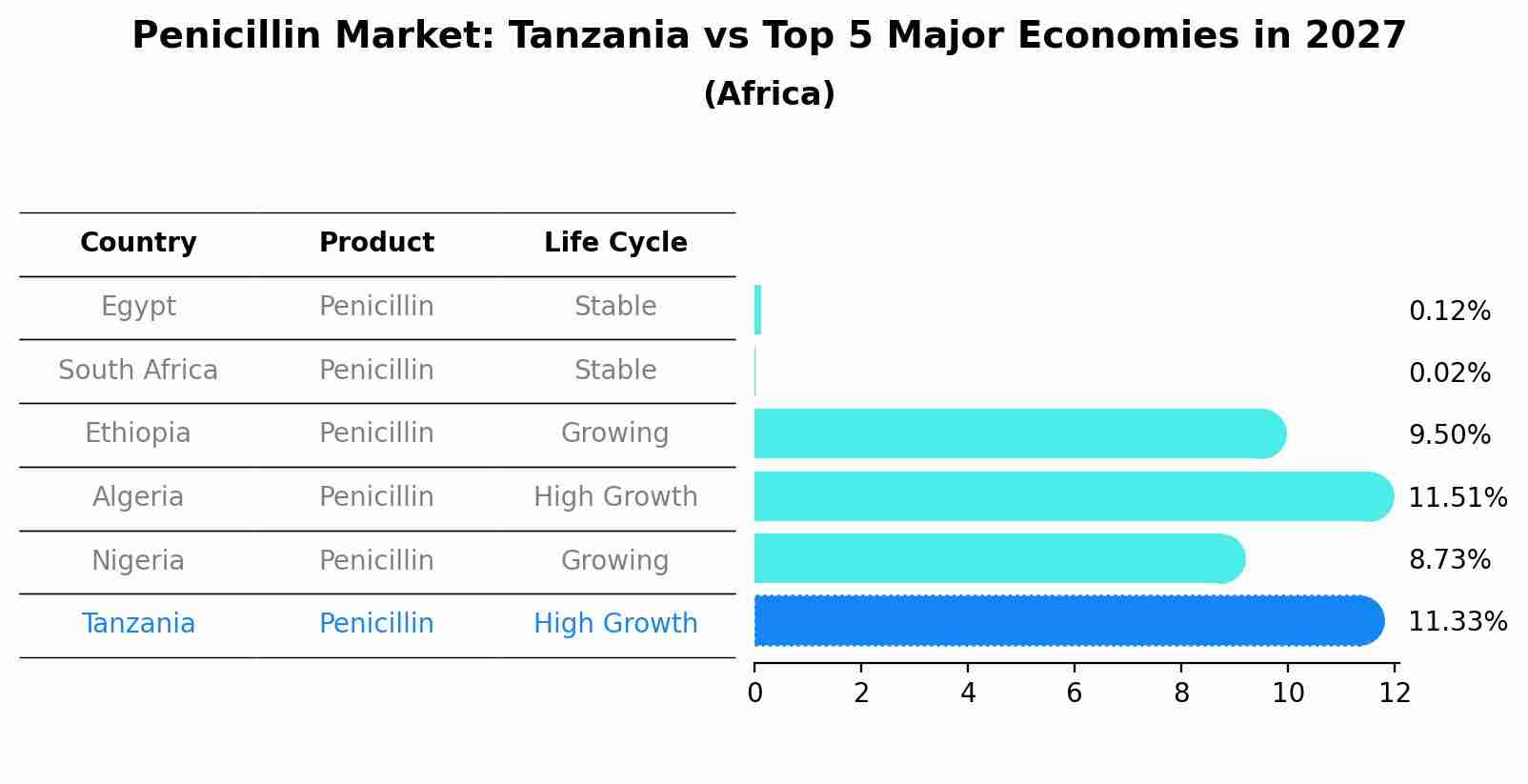
Penicillin Market: Tanzania vs Top 5 Major Economies in 2027 (Africa)
The Penicillin market in Tanzania is projected to grow at a high growth rate of 11.33% by 2027, highlighting the country's increasing focus on advanced technologies within the Africa region, where Egypt holds the dominant position, followed closely by South Africa, Ethiopia, Algeria and Nigeria, shaping overall regional demand.
Tanzania Penicillin Market Overview
The Tanzania Penicillin market is witnessing steady growth driven by increasing awareness about the effectiveness of penicillin in treating bacterial infections. The market is primarily dominated by pharmaceutical companies that manufacture and distribute penicillin-based antibiotics. Factors such as a rising incidence of infectious diseases, growing healthcare infrastructure, and government initiatives to improve access to essential medicines are contributing to the market growth. However, challenges such as counterfeit drugs, limited healthcare resources in rural areas, and a lack of stringent regulations pose obstacles to market expansion. The increasing focus on research and development activities to develop novel penicillin formulations and the rise in collaborations between local and international pharmaceutical companies are expected to drive the Tanzania Penicillin market in the coming years.
Tanzania Penicillin Market Trends
The Tanzania Penicillin market is witnessing steady growth driven by increasing awareness about the effectiveness of penicillin in treating bacterial infections. The market is also benefiting from the rising prevalence of infectious diseases in the region. Healthcare facilities are increasingly incorporating penicillin into their treatment protocols, further boosting market demand. Additionally, the government`s efforts to improve access to essential medicines, including penicillin, are expected to fuel market growth in the coming years. However, challenges such as counterfeit drugs and limited healthcare infrastructure in remote areas may hinder the market`s expansion. Overall, the Tanzania Penicillin market is poised for growth, supported by favorable market dynamics and increasing healthcare investments.
Tanzania Penicillin Market Challenges
In the Tanzania Penicillin market, several challenges are faced, including limited access to healthcare facilities in rural areas, leading to difficulties in reaching the target population with Penicillin products. Additionally, there is a lack of awareness among healthcare professionals and patients about the appropriate use of Penicillin, which can result in misuse or underutilization of these antibiotics. Supply chain inefficiencies and inadequate regulatory oversight also contribute to challenges in ensuring the availability and quality of Penicillin products in the market. Furthermore, the presence of counterfeit or substandard Penicillin products poses a significant risk to patient safety and can undermine trust in the market. Addressing these challenges will require a comprehensive approach involving stakeholders across the healthcare system to improve access, awareness, regulation, and quality control in the Tanzania Penicillin market.
Tanzania Penicillin Market Investment Opportunities
The Tanzania Penicillin Market presents promising investment opportunities due to the increasing prevalence of bacterial infections in the region, driving demand for antibiotics such as penicillin. With the healthcare sector in Tanzania witnessing growth and development, there is a growing need for essential medicines like penicillin to treat various infections. Investing in the production and distribution of penicillin in Tanzania can be lucrative, especially with the government`s focus on improving healthcare infrastructure and access to essential medicines. Additionally, collaborations with local healthcare providers and government agencies can provide a strategic advantage in navigating the market. Overall, the Tanzania Penicillin Market offers potential for investors to contribute to public health while also generating financial returns.
Tanzania Penicillin Market Government Policy
In Tanzania, the government regulates the Penicillin market through the Tanzania Food and Drugs Authority (TFDA) which oversees the registration, importation, and distribution of pharmaceutical products, including Penicillin. The government has implemented policies to ensure the quality, safety, and efficacy of Penicillin products in the market, with strict requirements for licensing and adherence to Good Manufacturing Practices (GMP). Additionally, the government may regulate the pricing of Penicillin to ensure affordability and accessibility to the general population. Importation of Penicillin is subject to approval by the TFDA, with a focus on preventing counterfeit or substandard products from entering the market. Overall, the government`s policies aim to safeguard public health by ensuring the availability of safe and effective Penicillin products in Tanzania.
Tanzania Penicillin Market Future Outlook
The Tanzania Penicillin market is poised for steady growth in the coming years due to increasing healthcare awareness, rising incidences of bacterial infections, and the expanding pharmaceutical industry in the region. The market is expected to benefit from the government`s initiatives to improve healthcare infrastructure and access to essential medicines. Additionally, the growing population, coupled with higher disposable incomes and changing lifestyles, is likely to drive the demand for penicillin-based antibiotics in Tanzania. Manufacturers in the market are focusing on launching innovative products, improving distribution networks, and investing in research and development to meet the evolving healthcare needs of the population. Overall, the Tanzania Penicillin market is anticipated to witness sustained growth opportunities and attract investments in the foreseeable future.
Key Highlights of the Report:
- Tanzania Penicillin Market Outlook
- Market Size of Tanzania Penicillin Market, 2021
- Forecast of Tanzania Penicillin Market, 2031
- Historical Data and Forecast of Tanzania Penicillin Revenues & Volume for the Period 2021 - 2031
- Tanzania Penicillin Market Trend Evolution
- Tanzania Penicillin Market Drivers and Challenges
- Tanzania Penicillin Price Trends
- Tanzania Penicillin Porter's Five Forces
- Tanzania Penicillin Industry Life Cycle
- Historical Data and Forecast of Tanzania Penicillin Market Revenues & Volume By Product for the Period 2021 - 2031
- Historical Data and Forecast of Tanzania Penicillin Market Revenues & Volume By Bulk for the Period 2021 - 2031
- Historical Data and Forecast of Tanzania Penicillin Market Revenues & Volume By Dosage for the Period 2021 - 2031
- Historical Data and Forecast of Tanzania Penicillin Market Revenues & Volume By Type for the Period 2021 - 2031
- Historical Data and Forecast of Tanzania Penicillin Market Revenues & Volume By Aminopenicillin for the Period 2021 - 2031
- Historical Data and Forecast of Tanzania Penicillin Market Revenues & Volume By Antipseudomonal Penicillin for the Period 2021 - 2031
- Historical Data and Forecast of Tanzania Penicillin Market Revenues & Volume By Beta-lactamase Inhibitor for the Period 2021 - 2031
- Historical Data and Forecast of Tanzania Penicillin Market Revenues & Volume By Natural Penicillin for the Period 2021 - 2031
- Historical Data and Forecast of Tanzania Penicillin Market Revenues & Volume By Penicillinase-resistant Penicillin for the Period 2021 - 2031
- Historical Data and Forecast of Tanzania Penicillin Market Revenues & Volume By Manufacturing Process for the Period 2021 - 2031
- Historical Data and Forecast of Tanzania Penicillin Market Revenues & Volume By Synthetic Process for the Period 2021 - 2031
- Historical Data and Forecast of Tanzania Penicillin Market Revenues & Volume By Natural Process for the Period 2021 - 2031
- Historical Data and Forecast of Tanzania Penicillin Market Revenues & Volume By Semisynthetic Process for the Period 2021 - 2031
- Historical Data and Forecast of Tanzania Penicillin Market Revenues & Volume By Mode of Delivery for the Period 2021 - 2031
- Historical Data and Forecast of Tanzania Penicillin Market Revenues & Volume By Oral for the Period 2021 - 2031
- Historical Data and Forecast of Tanzania Penicillin Market Revenues & Volume By Intramuscular for the Period 2021 - 2031
- Historical Data and Forecast of Tanzania Penicillin Market Revenues & Volume By Intravenous for the Period 2021 - 2031
- Historical Data and Forecast of Tanzania Penicillin Market Revenues & Volume By End User for the Period 2021 - 2031
- Historical Data and Forecast of Tanzania Penicillin Market Revenues & Volume By Hospitals for the Period 2021 - 2031
- Historical Data and Forecast of Tanzania Penicillin Market Revenues & Volume By Clinics for the Period 2021 - 2031
- Historical Data and Forecast of Tanzania Penicillin Market Revenues & Volume By Research Institutes for the Period 2021 - 2031
- Historical Data and Forecast of Tanzania Penicillin Market Revenues & Volume By Others for the Period 2021 - 2031
- Tanzania Penicillin Import Export Trade Statistics
- Market Opportunity Assessment By Product
- Market Opportunity Assessment By Type
- Market Opportunity Assessment By Manufacturing Process
- Market Opportunity Assessment By Mode of Delivery
- Market Opportunity Assessment By End User
- Tanzania Penicillin Top Companies Market Share
- Tanzania Penicillin Competitive Benchmarking By Technical and Operational Parameters
- Tanzania Penicillin Company Profiles
- Tanzania Penicillin Key Strategic Recommendations






































