Phosphate Market: Tanzania vs Top 5 Major Economies in 2027 (Africa)
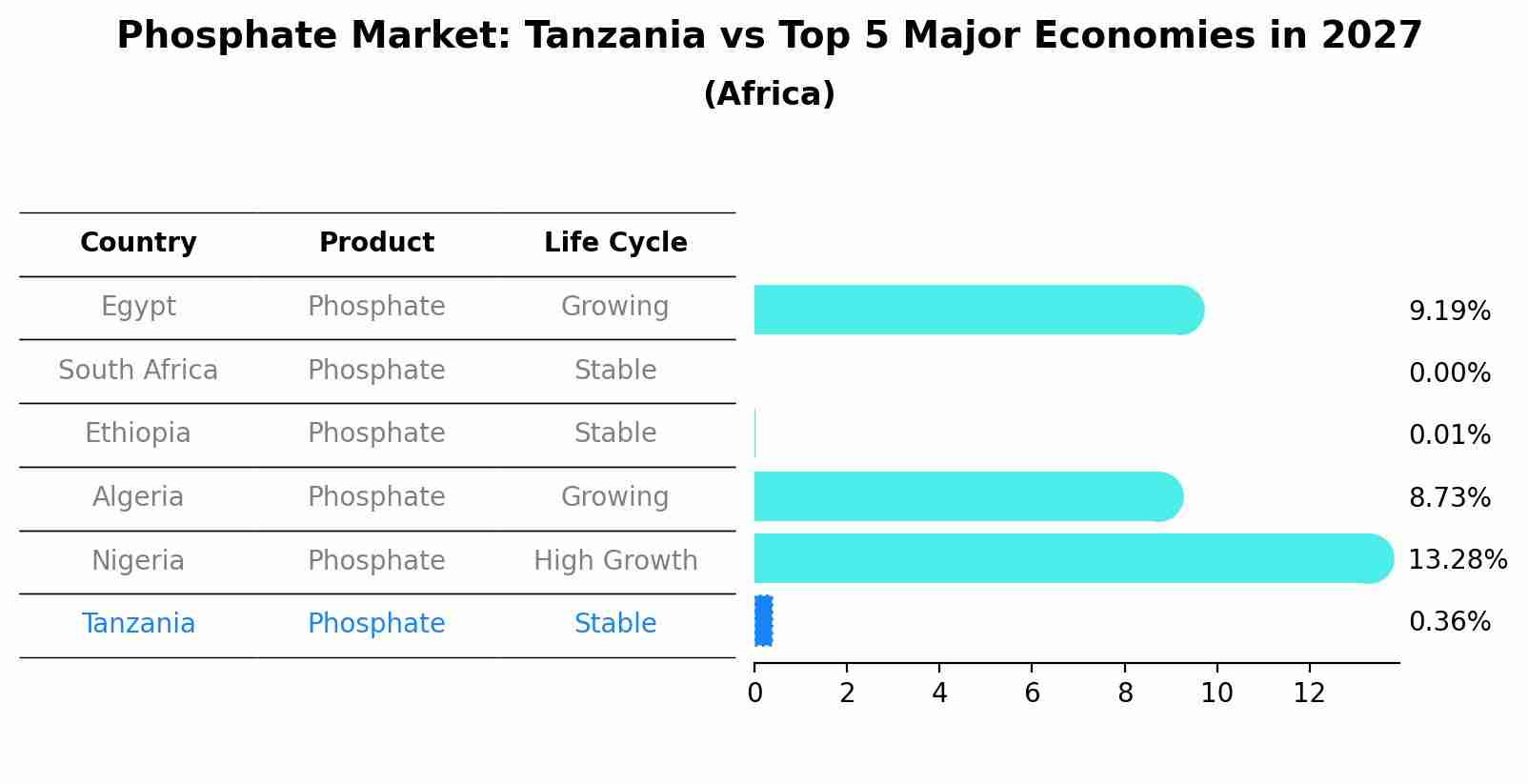
In the Africa region, the Phosphate market in Tanzania is projected to expand at a stable growth rate of 0.36% by 2027. The largest economy is Egypt, followed by South Africa, Ethiopia, Algeria and Nigeria.
Tanzania Phosphate Market Overview
The Tanzania Phosphate Market is witnessing steady growth driven by increasing demand in the agriculture sector for phosphate-based fertilizers. Tanzania possesses significant phosphate deposits, mainly located in the Minjingu Mines in the Arusha region. The country`s agricultural sector heavily relies on these phosphate fertilizers to enhance soil fertility and improve crop yields, thereby boosting food production. The government`s focus on promoting agricultural productivity through various initiatives and subsidies further supports the growth of the phosphate market in Tanzania. Additionally, the presence of local and international players in the market, along with investments in expanding production capacities, is expected to contribute to the market`s expansion in the coming years.
Tanzania Phosphate Market Trends and Opportunities
The Tanzania phosphate market is experiencing steady growth due to increased demand for fertilizers in the agriculture sector. The government`s initiatives to promote agriculture and improve food security are driving the market`s expansion. With abundant phosphate reserves in the country, there is significant opportunity for domestic production and reduced reliance on imports. Additionally, the growing awareness among farmers about the importance of balanced fertilization is boosting the demand for phosphate-based products. The market is also witnessing a trend towards sustainable and environmentally friendly phosphate mining practices to minimize ecological impact. Overall, the Tanzania phosphate market presents promising opportunities for investors and stakeholders looking to capitalize on the country`s agricultural sector growth.
Tanzania Phosphate Market Challenges
In the Tanzania Phosphate Market, significant challenges include limited infrastructure for mining and processing operations, which hinders efficient production and distribution. Additionally, fluctuating global prices and demand for phosphate-based products impact the market stability and profitability for local producers. Environmental concerns related to the impact of mining activities on land and water resources also pose challenges, requiring companies to adhere to stringent regulations and invest in sustainable practices. Furthermore, competition from international players with advanced technology and established market presence presents a barrier for local companies to expand their market share. Overall, overcoming these challenges would require strategic investments in infrastructure development, environmental management, and technological advancements to enhance competitiveness in the Tanzania Phosphate Market.
Tanzania Phosphate Market Drivers
The Tanzania Phosphate Market is primarily driven by factors such as the increasing demand for phosphate-based fertilizers in the agriculture sector to improve crop yield and quality. As agriculture remains a key sector in Tanzania`s economy, the need for efficient and effective fertilizers like phosphates is crucial to sustain agricultural productivity. Additionally, the growing population and changing dietary habits are driving the demand for food products, further boosting the use of phosphates in agricultural practices. Moreover, government initiatives to promote agricultural growth and self-sufficiency are also fueling the demand for phosphate products in the market. Overall, the Tanzania Phosphate Market is anticipated to witness steady growth due to these driving factors in the coming years.
Tanzania Phosphate Market Government Policy
The Tanzanian government has implemented various policies related to the phosphate market to promote sustainable development and ensure environmental protection. These policies include the Mining Act of 2010, which regulates the extraction and export of minerals such as phosphates to ensure transparency and accountability in the industry. Additionally, the Environmental Management Act of 2004 sets out guidelines for environmental impact assessments and mitigation measures to minimize the adverse effects of phosphate mining on the environment. The government also encourages local beneficiation of phosphates through the Mineral Policy of 2009, aimed at adding value to the mineral resources before export to increase revenues and create employment opportunities within the country. Overall, these policies aim to balance economic development with environmental conservation in the Tanzania phosphate market.
Tanzania Phosphate Market Future Outlook
The future outlook for the Tanzania Phosphate Market appears promising, driven by factors such as increasing agricultural activities, growing demand for fertilizers, and government initiatives to boost agricultural productivity. Tanzania`s rich phosphate reserves provide a strong foundation for the market`s growth potential. The country`s focus on increasing agricultural output to enhance food security is expected to drive the demand for phosphate-based fertilizers. Additionally, the government`s efforts to attract foreign investment in the mining sector and improve infrastructure are likely to support the expansion of phosphate mining and production activities in Tanzania. Overall, the Tanzania Phosphate Market is anticipated to experience steady growth in the coming years, supported by these favorable market dynamics.
Key Highlights of the Report:
- Tanzania Phosphate Market Outlook
- Market Size of Tanzania Phosphate Market, 2024
- Forecast of Tanzania Phosphate Market, 2031
- Historical Data and Forecast of Tanzania Phosphate Revenues & Volume for the Period 2021 - 2031
- Tanzania Phosphate Market Trend Evolution
- Tanzania Phosphate Market Drivers and Challenges
- Tanzania Phosphate Price Trends
- Tanzania Phosphate Porter's Five Forces
- Tanzania Phosphate Industry Life Cycle
- Historical Data and Forecast of Tanzania Phosphate Market Revenues & Volume By Type/Derivative for the Period 2021 - 2031
- Historical Data and Forecast of Tanzania Phosphate Market Revenues & Volume By Ammonium Phosphate for the Period 2021 - 2031
- Historical Data and Forecast of Tanzania Phosphate Market Revenues & Volume By Calcium Phosphate for the Period 2021 - 2031
- Historical Data and Forecast of Tanzania Phosphate Market Revenues & Volume By Phosphoric Acid for the Period 2021 - 2031
- Historical Data and Forecast of Tanzania Phosphate Market Revenues & Volume By Application for the Period 2021 - 2031
- Historical Data and Forecast of Tanzania Phosphate Market Revenues & Volume By Fertilizers for the Period 2021 - 2031
- Historical Data and Forecast of Tanzania Phosphate Market Revenues & Volume By Foods & Beverages for the Period 2021 - 2031
- Historical Data and Forecast of Tanzania Phosphate Market Revenues & Volume By Detergents for the Period 2021 - 2031
- Historical Data and Forecast of Tanzania Phosphate Market Revenues & Volume By Type of Resource for the Period 2021 - 2031
- Historical Data and Forecast of Tanzania Phosphate Market Revenues & Volume By Sedimentary Marine Deposits for the Period 2021 - 2031
- Historical Data and Forecast of Tanzania Phosphate Market Revenues & Volume By Igneous & Weathered for the Period 2021 - 2031
- Historical Data and Forecast of Tanzania Phosphate Market Revenues & Volume By Biogenic for the Period 2021 - 2031
- Tanzania Phosphate Import Export Trade Statistics
- Market Opportunity Assessment By Type/Derivative
- Market Opportunity Assessment By Application
- Market Opportunity Assessment By Type of Resource
- Tanzania Phosphate Top Companies Market Share
- Tanzania Phosphate Competitive Benchmarking By Technical and Operational Parameters
- Tanzania Phosphate Company Profiles
- Tanzania Phosphate Key Strategic Recommendations






































