Tanzania Physical Security Market Size & Growth Rate (2026-2032)
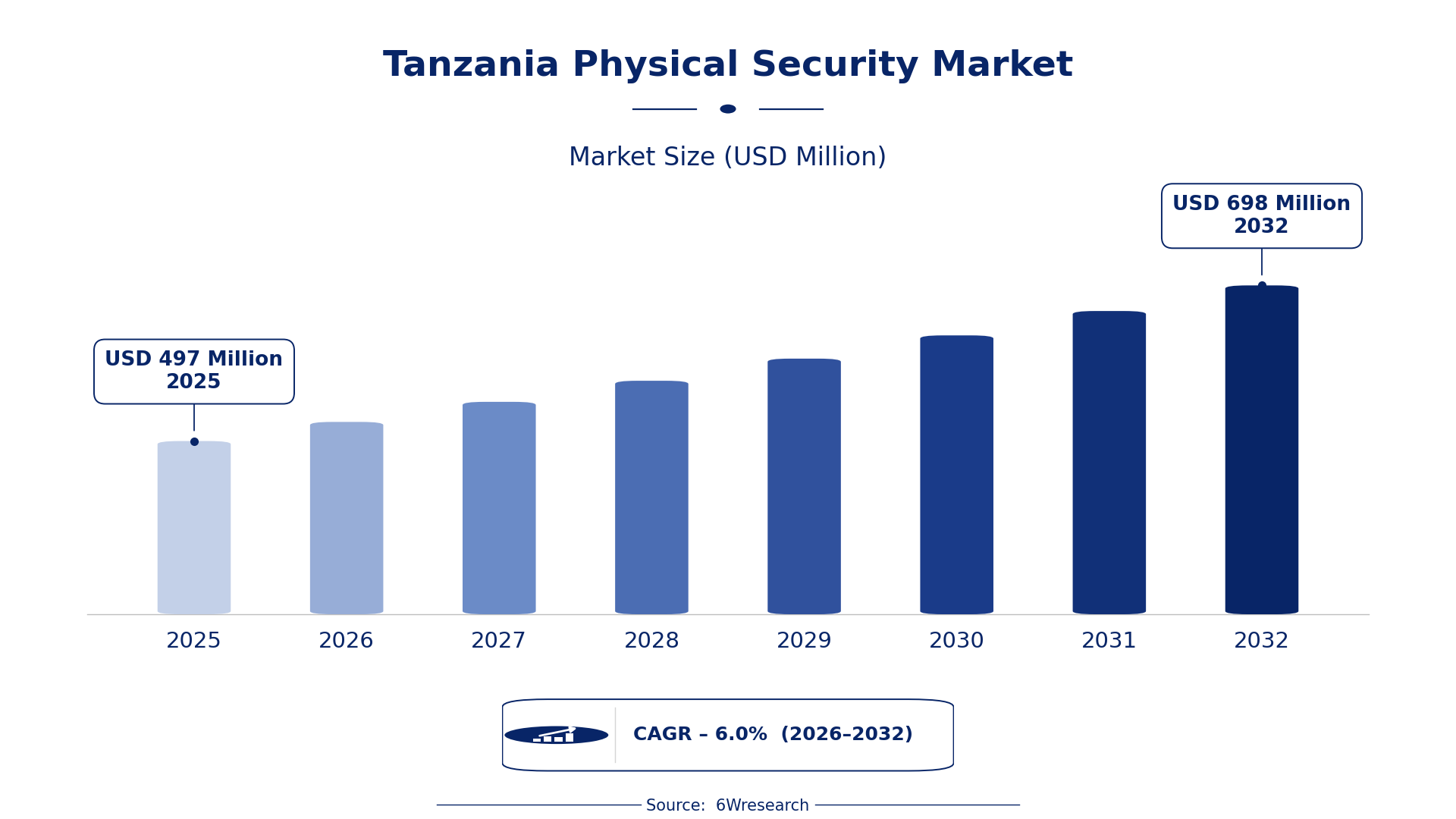
The Tanzania Physical Security Market was estimated at USD 497 Million in 2025 and is projected to reach USD 698 Million by 2032, growing at a CAGR of 6.0% from 2026 to 2032.
Tanzania Physical Security Market Synopsis
In recent years, the Tanzania Physical Security Market has gained momentum, driven by rising crime rates and an increased emphasis on asset protection across various sectors. Government bodies, businesses, and individuals are increasingly recognizing the importance of comprehensive security measures to safeguard against threats.
Investment in physical security solutions is not merely a trend; it’s a necessity. The growth of smart cities and heightened infrastructure development are pivotal factors, fostering demand for cutting-edge surveillance systems, access control, and intrusion detection technologies. The landscape is evolving rapidly, with various stakeholders vying to enhance security frameworks.
Tanzania Physical Security Market Year-wise Growth Rate and Key Drivers
This graph illustrates the annual growth rates of the Tanzania Physical Security Market from 2021 to 2032, highlighting a steady upward trajectory and projected expansion over the forecast period.
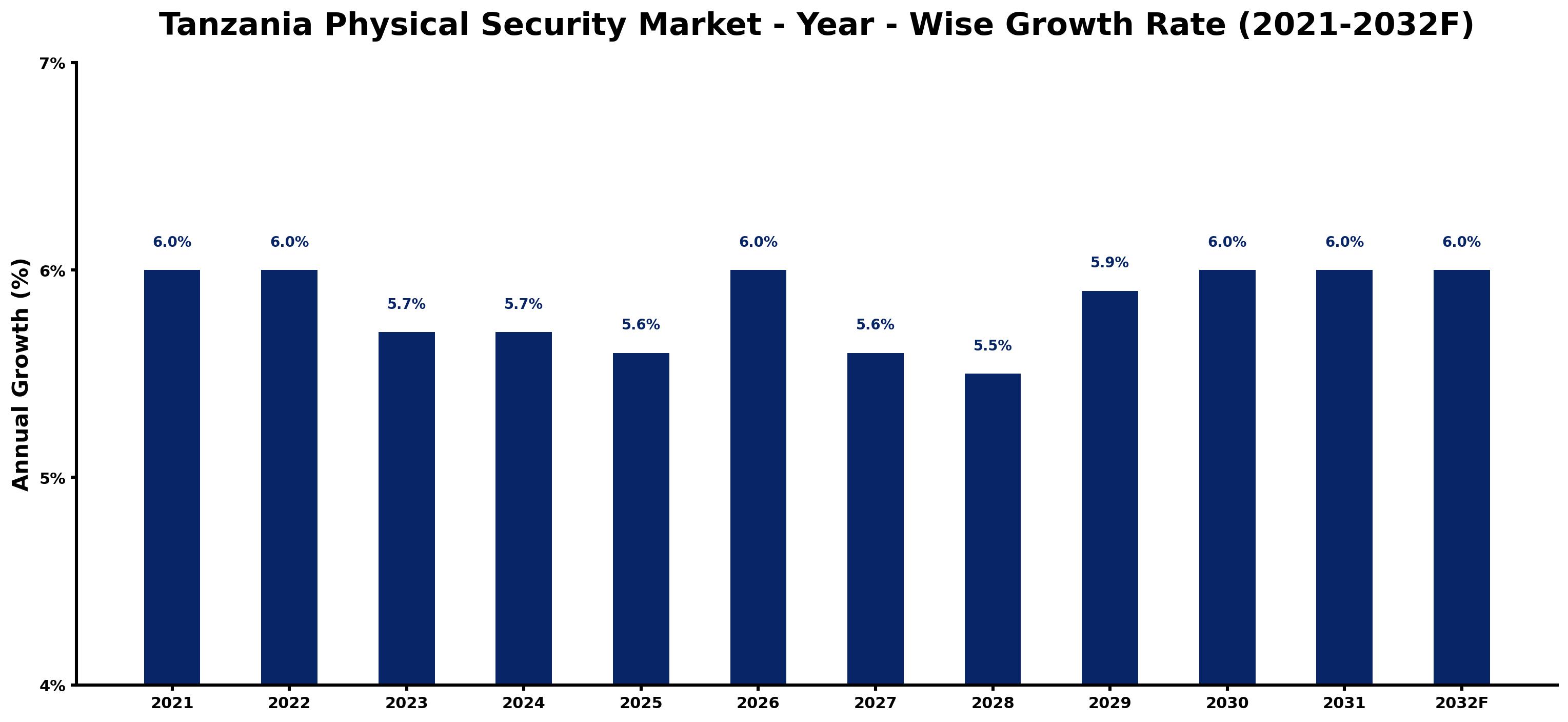
The table below presents the year‑wise growth rates along with the key drivers influencing the market
| Year | Growth Rate | Major Drivers |
| 2021 | 6.0% | Increased government focus on national security measures. |
| 2022 | 6.0% | Rising criminal activities prompting more security investments. |
| 2023 | 5.7% | Adoption of advanced surveillance technologies by businesses. |
| 2024 | 5.7% | Growing urbanization leading to higher security demands. |
| 2025 | 5.6% | Government regulations mandating improved site security protocols. |
| 2026 | 6.0% | Heightened security needs for international events and tourism. |
| 2027 | 5.6% | Enhanced border security initiatives by the Tanzanian government. |
| 2028 | 5.5% | Increase in private security firms due to demand. |
| 2029 | 5.9% | Implementation of local community safety programs. |
| 2030 | 6.0% | Supportive policies for local manufacturers of security equipment. |
| 2031 | 6.0% | Expanded training programs for security personnel nationwide. |
| 2032 | 6.0% | Increased public-private partnerships in security infrastructure. |
Note: Market size estimations and growth projections presented in this report are based on 6Wresearch's proprietary forecasting methodology, utilizing the latest available industry data, government publications, and primary research inputs.
Tanzania Physical Security Market Key Takeaways
Below are some of the specific key takeaways from the market, including:
- The market is experiencing steady growth due to heightened awareness of security needs in diverse sectors.
- Technological advancements, particularly in surveillance and access control systems, are shaping future demand.
- Public and private investment in infrastructure continues to play a crucial role in market expansion.
- Customized security solutions are increasingly being sought to meet specific industry requirements.
- Government policies and initiatives are establishing a regulatory framework that supports market development.
Evaluation of Restraints in Tanzania Physical Security Market
Despite the promising outlook, the Tanzania Physical Security Market grapples with several restraints. Inadequate infrastructure limits the deployment of modern security systems. Additionally, a lack of skilled professionals in the field exacerbates challenges in implementing cutting-edge solutions. Unreliable power supply and limited access to advanced technology further hinder effectiveness. These factors combine to create a landscape where growth is possible, yet fraught with obstacles that must be addressed for the market to reach its full potential.
Tanzania Physical Security Market Trends
Current trends indicate a pronounced shift toward integrating advanced technologies such as artificial intelligence in surveillance systems. The adoption of biometric authentication methods is gaining traction, particularly in high-security environments like banking and government facilities. There’s a rising demand for cloud-based solutions enabling remote monitoring, reflecting a broader trend toward digital transformation in physical security. The market is moving towards more sophisticated, interconnected systems to tackle the multifaceted security challenges of today.
Tanzania Physical Security Market Opportunities
Opportunities for growth within the Tanzania Physical Security Market are plentiful. The expansion of electronic security systems, including surveillance cameras and access control solutions, is a particularly lucrative area. Investors are encouraged to explore avenues in security consultancy services and integrated security solutions tailored to specific sectors. The advancing technology landscape, coupled with a growing emphasis on security awareness, positions this market as an attractive option for those seeking investment opportunities.
Government Initiatives in the Tanzania Physical Security Market
Government policies play a significant role in shaping the Tanzania Physical Security Market. Regulatory frameworks are being established to enhance the professionalism and standardization within the sector. By collaborating with international partners, the government aims to strengthen mechanisms for combating crime and ensuring public safety.
- A recent initiative includes the implementation of the Private Security Regulatory Authority Act, which aims to professionalize the private security industry.
- Currently underway is a national security policy review aimed at addressing emerging threats, including cyber-related security challenges.
- A planned public-private partnership is expected to bolster infrastructure for security technology deployment by 2026.
- The establishment of a regulatory compliance framework for the installation and operation of surveillance systems is anticipated by 2025.
- In collaboration with local tech firms, a training program designed to upskill security professionals is being rolled out to improve workforce competency.
Future Insights of the Tanzania Physical Security Market
Looking ahead to 2026-2032, the Tanzania Physical Security Market is set to expand considerably. As urbanization continues and crime rates persist, the demand for innovative security solutions will escalate. The integration of advanced technologies, including AI and enhanced biometric systems, is expected to redefine market dynamics, providing more effective protection strategies. Government initiatives aimed at improving public safety will further energize growth, making this an exciting sector for stakeholders.
Tanzania Physical Security Market Latest Developments
Over the last year, the Tanzania Physical Security Market has witnessed notable developments in technology and service offerings. Companies are increasingly focused on integrating cutting-edge solutions to meet the growing security demands.
- A major technology vendor launched a new line of advanced surveillance cameras in early 2025, designed for urban environments.
- An ongoing initiative began in mid-2025 to enhance cloud-based monitoring systems across key commercial sectors.
- By late 2025, a prominent regional operator plans to implement an integrated access control system for government buildings.
- A new partnership between local firms and international tech companies is expected to boost training for security personnel by mid-2026.
- Upcoming in 2026 is the launch of a national security audit program aimed at evaluating and upgrading existing security infrastructures.
Tanzania Physical Security Market - Key Attractiveness of the Report
- 10 Years of Market Numbers
- Historical Data Starting from 2022 to 2025
- Base Year: 2025
- Forecast Data until 2032
- Key Performance Indicators Impacting the Market
- Major Upcoming Developments and Projects
Key Highlights of the Report:
- Tanzania Physical Security Market Outlook
- Market Size of Tanzania Physical Security Market, 2025
- Forecast of Tanzania Physical Security Market, 2032
- Historical Data and Forecast of Tanzania Physical Security Revenues & Volume for the Period 2022-2032F
- Tanzania Physical Security Market Trend Evolution
- Tanzania Physical Security Market Drivers and Challenges
- Tanzania Physical Security Price Trends
- Tanzania Physical Security Porter's Five Forces
- Tanzania Physical Security Industry Life Cycle
- Historical Data and Forecast of Tanzania Physical Security Market Revenues & Volume By Component for the Period 2022-2032F
- Historical Data and Forecast of Tanzania Physical Security Market Revenues & Volume By Systems (PACS, PSIM, PIAM, Video Surveillance, Fire and Life Safety) for the Period 2022-2032F
- Historical Data and Forecast of Tanzania Physical Security Market Revenues & Volume By Services for the Period 2022-2032F
- Historical Data and Forecast of Tanzania Physical Security Market Revenues & Volume By Vertical for the Period 2022-2032F
- Historical Data and Forecast of Tanzania Physical Security Market Revenues & Volume By BFSI for the Period 2022-2032F
- Historical Data and Forecast of Tanzania Physical Security Market Revenues & Volume By Government for the Period 2022-2032F
- Historical Data and Forecast of Tanzania Physical Security Market Revenues & Volume By Retail for the Period 2022-2032F
- Historical Data and Forecast of Tanzania Physical Security Market Revenues & Volume By Transportation for the Period 2022-2032F
- Historical Data and Forecast of Tanzania Physical Security Market Revenues & Volume By Residential for the Period 2022-2032F
- Historical Data and Forecast of Tanzania Physical Security Market Revenues & Volume By Telecom and IT for the Period 2022-2032F
- Historical Data and Forecast of Tanzania Physical Security Market Revenues & Volume By Other Verticals (Healthcare, Manufacturing, Energy and Utilities, and Education). for the Period 2022-2032F
- Historical Data and Forecast of Tanzania Physical Security Market Revenues & Volume By Organization Size for the Period 2022-2032F
- Historical Data and Forecast of Tanzania Physical Security Market Revenues & Volume By SMEs for the Period 2022-2032F
- Historical Data and Forecast of Tanzania Physical Security Market Revenues & Volume By Large Enterprises for the Period 2022-2032F
- Tanzania Physical Security Import Export Trade Statistics
- Market Opportunity Assessment By Component
- Market Opportunity Assessment By Vertical
- Market Opportunity Assessment By Organization Size
- Tanzania Physical Security Top Companies Market Share
- Tanzania Physical Security Competitive Benchmarking By Technical and Operational Parameters
- Tanzania Physical Security Company Profiles
- Tanzania Physical Security Key Strategic Recommendations






































