Tanzania Ploughing and Cultivating Machinery Market Size, Share & Growth Rate
The Tanzania Ploughing and Cultivating Machinery Market was estimated at USD 282 Million in 2025 and is projected to reach USD 376 Million by 2032, growing at a CAGR of 4.2% from 2026 to 2032. This upward trajectory is primarily driven by the growing demand for mechanized farming solutions among smallholder farmers, who are increasingly recognizing the benefits of investing in advanced agricultural machinery. Government initiatives aimed at enhancing agricultural productivity and financial access for farmers further bolster this promising growth forecast.
Tanzania Ploughing and Cultivating Machinery Market Year-wise Growth Rate and Key Drivers
This graph highlights how the Tanzania Ploughing and Cultivating Machinery Market has steadily grown over the years, supported by major growth factors.
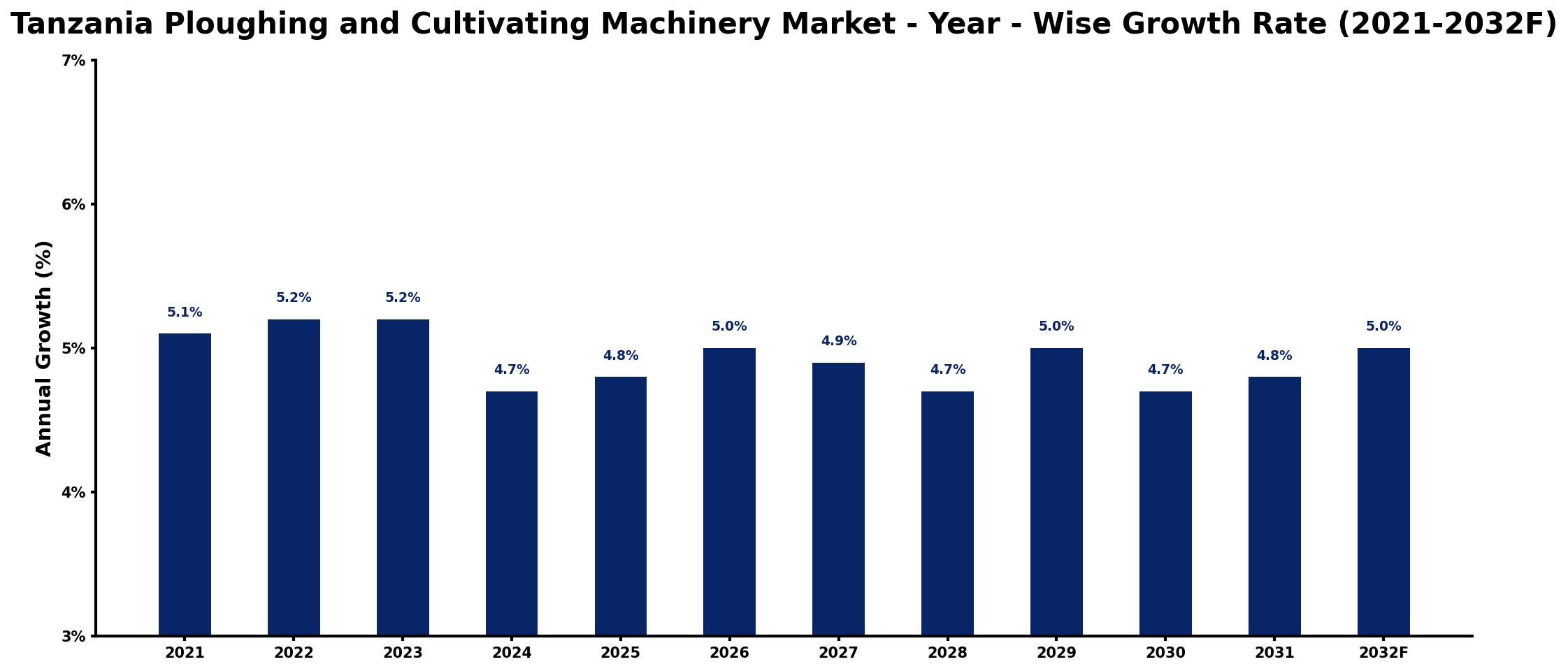
The table below presents the year‑wise growth rates along with the key drivers influencing the market
| Year | Growth Rate | Major Drivers |
| 2021 | 5.1% | Rising agricultural investment levels |
| 2022 | 5.2% | Increasing farmer technology adoption |
| 2023 | 5.2% | Expansion of export markets |
| 2024 | 4.7% | Growing demand for efficiency |
| 2025 | 4.8% | Technological advancements in agriculture |
| 2026 | 5.0% | Government support for agriculture |
| 2027 | 4.9% | Rising population food requirements |
| 2028 | 4.7% | Enhanced irrigation infrastructure projects |
| 2029 | 5.0% | Increased access to financing options |
| 2030 | 4.7% | Development of cooperative farming models |
| 2031 | 4.8% | Strengthening agricultural supply chains |
| 2032 | 5.0% | Growing interest in sustainable practices |
Note: Market size estimations and growth projections presented in this report are based on 6Wresearch's proprietary forecasting methodology, utilizing the latest available industry data, government publications, and primary research inputs.
Tanzania Ploughing and Cultivating Machinery Market Synopsis
The Tanzania ploughing and cultivating machinery market is currently on an impressive growth path, largely fueled by the transition toward modern farming practices. As the agricultural landscape evolves, the demand for efficient and reliable machinery is intensifying, with tractors and seeders leading the charge. Smallholder farmers, constituting a significant customer base, are increasingly adopting these mechanized solutions to enhance productivity and reduce labor costs.
Moreover, the influx of both local manufacturers and international brands into this market has diversified the offerings available to farmers, making it easier for them to access suitable machinery tailored to their specific needs. The combined effects of technology adoption, heightened awareness of mechanization benefits, and supportive government policies are transforming Tanzania's agricultural sector, fostering a culture of innovation and efficiency.
Tanzania Ploughing and Cultivating Machinery Market Key Takeaways
- The market is witnessing a steady rise in mechanized farming practices among smallholder farmers.
- Government initiatives are playing a crucial role in promoting the use of modern agricultural machinery.
- Technological advancements are enabling the development of more efficient and cost-effective machinery.
- Access to financing options remains a critical factor influencing machinery adoption rates.
- Investment opportunities exist in providing maintenance services and training programs for farmers.
Evaluation of Restraints in Tanzania Ploughing and Cultivating Machinery Market
Despite its growth potential, the Tanzania ploughing and cultivating machinery market faces significant restraints that could hinder its overall development. The high costs associated with acquiring and maintaining modern machinery remain a major barrier for many small-scale farmers. This is compounded by limited access to affordable financing options, which restricts their ability to invest in advanced equipment. Furthermore, inadequate infrastructure in rural areas poses logistical challenges for transporting and operating machinery effectively. The presence of counterfeit and low-quality products in the market further undermines trust among buyers, requiring concerted efforts from both government and private sectors to enhance market integrity and support farmer education.
Tanzania Ploughing and Cultivating Machinery Market Trends
Current trends in the Tanzania ploughing and cultivating machinery market indicate a strong shift towards adopting advanced technological solutions. Farmers are increasingly focused on efficiency, seeking machinery that not only boosts productivity but also minimizes manual labor. This trend is evidenced by rising investments in sophisticated equipment, such as seed drills and precision ploughs. Additionally, growing awareness among farmers about the benefits of mechanization is leading to a cultural shift where investing in modern machinery is becoming the norm rather than the exception. The market is likely to see continued innovation as technology plays a pivotal role in shaping future agricultural practices in Tanzania.
Tanzania Ploughing and Cultivating Machinery Market Opportunities
The landscape of the Tanzania ploughing and cultivating machinery market is ripe with opportunities for investors and businesses alike. With the agricultural sector's ongoing focus on mechanization, there is an increasing demand for quality equipment that meets the needs of smallholder farmers. Investment potential lies in supplying innovative machinery, along with providing essential maintenance services and spare parts. Training programs aimed at educating farmers about the operation and upkeep of machinery can also offer lucrative avenues. Furthermore, collaboration with local dealerships and distributors is crucial for maximizing market reach and efficiency, ultimately leading to a more robust agricultural framework.
Government Initiatives in the Tanzania Ploughing and Cultivating Machinery Market
The Tanzanian government has recognized the vital role of modernizing the agricultural sector in enhancing food security and improving economic growth. In response, various policies have been put in place, including tax incentives and subsidies aimed at facilitating farmers' access to modern ploughing and cultivating machinery. The government is also prioritizing the promotion of local manufacturing of agricultural equipment, coupled with educational programs designed to empower farmers with knowledge about the benefits of mechanization. These initiatives are instrumental in fostering a conducive environment for growth within the ploughing and cultivating machinery market.
Future Insights of the Tanzania Ploughing and Cultivating Machinery Market
Looking ahead to 2026-2032, the Tanzania ploughing and cultivating machinery market is positioned for steady expansion. The continuing emphasis on agricultural mechanization to meet the demands of a growing population and enhance food security will drive this growth. Advances in technology, coupled with increased farmer education and awareness, are expected to facilitate higher adoption rates of modern machinery. Market players who focus on innovation, affordability, and robust after-sales services will be best positioned to capitalize on the evolving agricultural landscape in Tanzania, ultimately contributing to a more productive agricultural economy.
Tanzania Ploughing and Cultivating Machinery Market Latest Developments (2025 - 2026)
In recent months, the Tanzania ploughing and cultivating machinery market has seen significant developments centered around enhancing the accessibility of modern agricultural solutions. New partnerships are emerging between local manufacturers and international technology providers, aimed at introducing innovative machinery tailored to local conditions. Additionally, there is a growing trend among financial institutions to develop tailored financing options specifically for smallholder farmers, making it easier for them to invest in mechanization. Training initiatives are also being ramped up, emphasizing the need for skilled operators who can maximize the benefits of this technology.
Tanzania Ploughing and Cultivating Machinery Market - Key Attractiveness of the Report
- 10 Years of Market Numbers
- Historical Data Starting from 2022 to 2025
- Base Year: 2025
- Forecast Data until 2032
- Key Performance Indicators Impacting the Market
- Major Upcoming Developments and Projects
Key Highlights of the Report:
- Tanzania Ploughing and Cultivating Machinery Market Outlook
- Market Size of Tanzania Ploughing and Cultivating Machinery Market, 2025
- Forecast of Tanzania Ploughing and Cultivating Machinery Market, 2032
- Historical Data and Forecast of Tanzania Ploughing and Cultivating Machinery Revenues & Volume for the Period 2022-2032F
- Tanzania Ploughing and Cultivating Machinery Market Trend Evolution
- Tanzania Ploughing and Cultivating Machinery Market Drivers and Challenges
- Tanzania Ploughing and Cultivating Machinery Price Trends
- Tanzania Ploughing and Cultivating Machinery Porter's Five Forces
- Tanzania Ploughing and Cultivating Machinery Industry Life Cycle
- Historical Data and Forecast of Tanzania Ploughing and Cultivating Machinery Market Revenues & Volume By Type for the Period 2022-2032F
- Historical Data and Forecast of Tanzania Ploughing and Cultivating Machinery Market Revenues & Volume By Ploughs for the Period 2022-2032F
- Historical Data and Forecast of Tanzania Ploughing and Cultivating Machinery Market Revenues & Volume By Harrows for the Period 2022-2032F
- Historical Data and Forecast of Tanzania Ploughing and Cultivating Machinery Market Revenues & Volume By Others for the Period 2022-2032F
- Historical Data and Forecast of Tanzania Ploughing and Cultivating Machinery Market Revenues & Volume By Application for the Period 2022-2032F
- Historical Data and Forecast of Tanzania Ploughing and Cultivating Machinery Market Revenues & Volume By Soil Loosening for the Period 2022-2032F
- Historical Data and Forecast of Tanzania Ploughing and Cultivating Machinery Market Revenues & Volume By Clod Size Reduction for the Period 2022-2032F
- Historical Data and Forecast of Tanzania Ploughing and Cultivating Machinery Market Revenues & Volume By Clod Sorting for the Period 2022-2032F
- Historical Data and Forecast of Tanzania Ploughing and Cultivating Machinery Market Revenues & Volume By Others for the Period 2022-2032F
- Tanzania Ploughing and Cultivating Machinery Import Export Trade Statistics
- Market Opportunity Assessment By Type
- Market Opportunity Assessment By Application
- Tanzania Ploughing and Cultivating Machinery Top Companies Market Share
- Tanzania Ploughing and Cultivating Machinery Competitive Benchmarking By Technical and Operational Parameters
- Tanzania Ploughing and Cultivating Machinery Company Profiles
- Tanzania Ploughing and Cultivating Machinery Key Strategic Recommendations






































