Tanzania Soap and detergents Market Summary
The tanzania soap and detergents market was estimated at USD 232 Million in 2025 and is projected to reach USD 313 Million by 2032, growing at a CAGR of 5.3% from 2026 to 2032.
Tanzania Soap and detergents Market Year-wise Growth Rate and Key Drivers
This graph highlights how the Tanzania Soap and detergents Market has steadily grown over the past five years, supported by major growth factors.
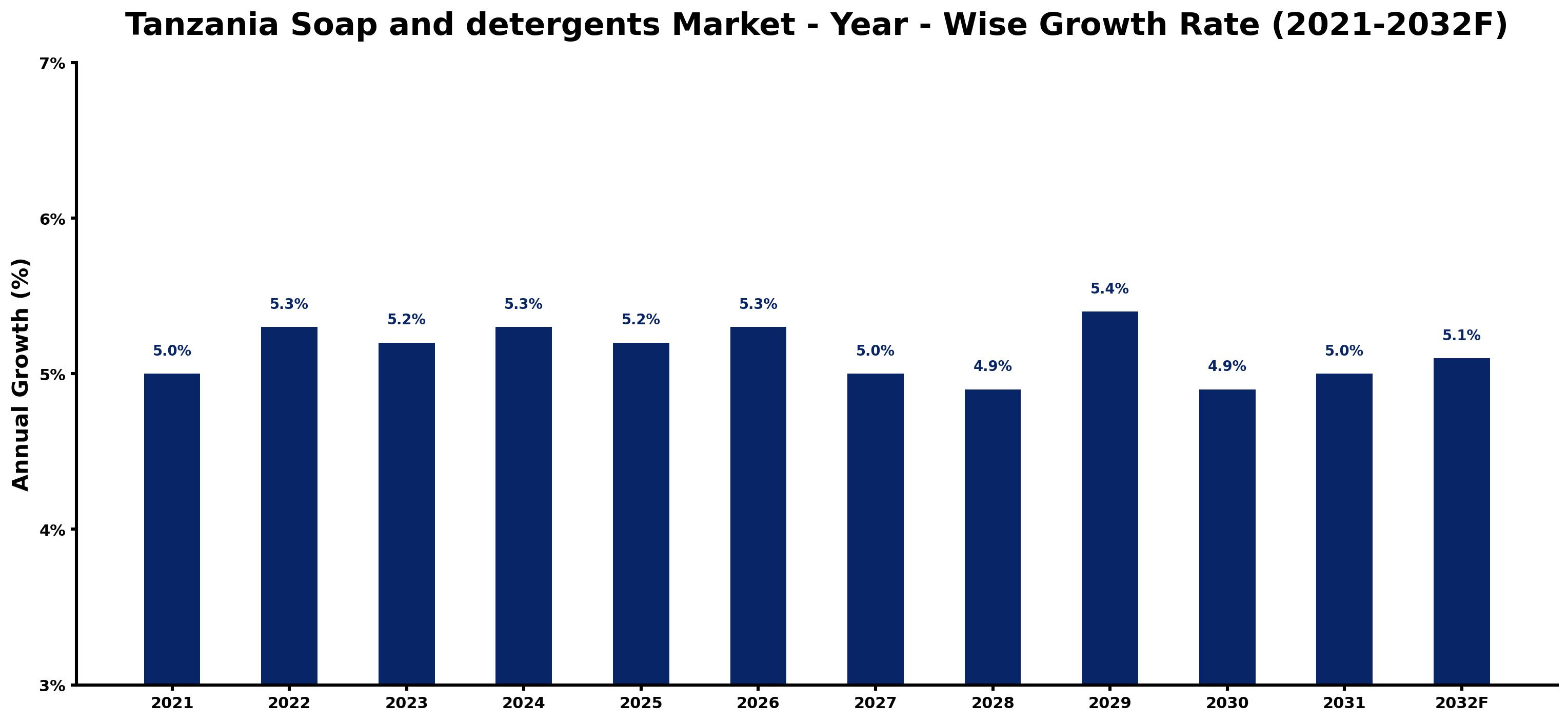
The table below presents the year wise growth rates along with the key drivers influencing the market
| Year | Growth Rate | Major Drivers |
| 2021 | 5.0% | Household preferences shift towards affordable, effective cleaning solutions in urban centers. |
| 2022 | 5.3% | Local manufacturers enhance production capabilities, tapping into regional raw materials effectively. |
| 2023 | 5.2% | Rising disposable incomes allow consumers to invest in premium soap products. |
| 2024 | 5.3% | Increased urbanization leads to heightened demand for cleaning and hygiene products. |
| 2025 | 5.2% | E-commerce platforms expand, making soap and detergent access easier for consumers. |
| 2026 | 5.3% | Young consumers prioritize eco-friendly brands, influencing market dynamics in Tanzania. |
| 2027 | 5.0% | Local soap artisans gain popularity, merging tradition with modern consumer preferences. |
| 2028 | 4.9% | Retail space growth boosts visibility for new entrants in the soap market. |
| 2029 | 5.4% | Health crises highlight sanitization needs, driving demand for antibacterial products. |
| 2030 | 4.9% | Emerging middle class seeks quality, prompting brands to innovate continuously. |
| 2031 | 5.0% | Partnerships with local farmers foster sustainable sourcing for raw materials. |
| 2032 | 5.1% | Increased competition encourages aggressive marketing strategies, transforming consumer choices. |
Note - Market size estimations and growth projections presented in this report are based on 6Wresearch's advanced forecasting approach, validated with industry datasets as of June 2026.
Tanzania Soap and detergents Market Synopsis
The Tanzania Soap and detergents Market is projected to reach 5.3% and witness significant growth during the forecast period (2026-2032). The anticipated growth trajectory is underpinned by several factors, including urbanization trends, an increase in living standards, and a burgeoning middle class that is becoming increasingly conscious of hygiene and cleanliness. The government's supportive initiatives, encompassing tax breaks for small businesses, are also expected to bolster the demand for soap and detergent products across various consumer segments. As washing machines become more prevalent in households, particularly among low-income groups, the demand for detergent powders is set to increase, further shaping the landscape of the Tanzania Soap and detergents Market.
Tanzania Soap and detergents Market Growth Drivers
A variety of elements contribute to the expansion of the Tanzania Soap and detergents Market. The increasing rate of urbanization in Tanzania has led to more households adopting modern cleaning solutions that incorporate soaps and detergents. Additionally, there is a growing awareness among consumers regarding the importance of hygiene products in daily life, driven by health campaigns and education. This awareness is prompting consumers to seek higher-quality cleaning products that cater to their specific needs.
- The rapid urbanization in Tanzania is fostering lifestyle changes that favor convenience products, including soaps and detergents.
- Improved living standards are increasing disposable income, enabling consumers to afford a wider range of cleaning products.
- The rise of a middle-class population is creating a larger market for premium and innovative soap and detergent alternatives.
- Government initiatives, including tax incentives for local manufacturers, are incentivizing the production of more affordable yet quality cleaning products.
- The growing availability and adoption of laundry machines are spurring higher demand for detergent powders, particularly in urban centers.
Tanzania Soap and detergents Market Trends and Opportunities
Recent trends indicate a shift in consumer preferences towards environmentally friendly and sustainable cleaning products. As awareness around environmental issues rises, there is a palpable shift towards biodegradable detergents and soaps that are less harmful to the environment. Additionally, manufacturers are continuously innovating their product lines to cater to evolving consumer needs, leading to the introduction of various new variants that appeal to both urban and rural demographics.
- There is an increasing demand for eco-friendly products, prompting manufacturers to develop biodegradable soaps and detergents.
- The introduction of new variants that target specific consumer problems, such as laundry detergents for sensitive skin, is becoming more common.
- Online retail platforms are starting to play a significant role in the distribution of soap and detergent products, expanding market reach.
- Promotional campaigns by various manufacturers are designed to educate consumers and highlight the benefits of their specific products.
- Emerging trends in packaging, such as refillable options, are gaining traction among environmentally conscious consumers.
Tanzania Soap and detergents Market Challenges and Restraints
Despite the promising growth prospects, the Tanzania Soap and detergents Market faces several challenges. One significant hurdle is the presence of counterfeit products that undermine consumer confidence and affect sales of legitimate brands. Additionally, fluctuating raw material prices can impact production costs, leading to price volatility in the market. Furthermore, the disparity in access to markets between urban and rural areas can limit the reach of many brands, posing a challenge in equality of access to quality cleaning products.
- The proliferation of counterfeit products is eroding consumer trust and creating an unlevel playing field for legitimate brands.
- Fluctuating raw material prices present challenges to manufacturers, affecting pricing strategies and profit margins.
- Infrastructure limitations in rural areas may hinder distribution and accessibility of products, impacting sales potential.
- Consumer price sensitivity in low-income segments could restrict the uptake of premium-priced products.
- The presence of informal markets often complicates the regulatory environment and the effectiveness of marketing strategies.
Tanzania Soap and detergents Market Government Investment and Initiatives
The Tanzanian government has been actively involved in fostering an environment conducive to the growth of the soap and detergents market through various policy initiatives and investment strategies. The administration is implementing tax breaks and incentives aimed at local manufacturers, which have been pivotal in reducing production costs and promoting competitiveness in the market. Additionally, government-sponsored awareness campaigns highlight the importance of hygiene and sanitation, thereby driving consumer demand for soap and detergents. Public spending on infrastructure improvements also plays a significant role in enhancing distribution channels, which is essential for reaching underserved areas.
Tanzania Soap and detergents Market Latest Developments (May 2025 - June 2026)
In the period from May 2025 to June 2026, the Tanzania Soap and detergents Market has witnessed several noteworthy developments that have influenced its trajectory. There has been a marked increase in product innovation, with manufacturers launching new lines that integrate natural ingredients and sustainable practices. Additionally, industry players have ramped up their marketing activities, particularly in urban areas, to capture the attention of the growing middle class. There is also an observable trend toward digital transformation, with more companies investing in e-commerce platforms to enhance consumer engagement and streamline distribution. This adaptation to changing market dynamics is indicative of the industry's responsiveness to consumer preferences and economic shifts.
Tanzania Soap and detergents Market - Key Attractiveness of the Report
- 10 Years of Market Numbers
- Historical Data Starting from 2022 to 2025
- Base Year: 2025
- Forecast Data until 2032
- Key Performance Indicators Impacting the Market
- Major Upcoming Developments and Projects
Key Highlights of the Report:
- Tanzania Soap and detergents Market Outlook
- Market Size of Tanzania Soap and detergents Market, 2025
- Forecast of Tanzania Soap and detergents Market, 2032F
- Historical Data and Forecast of Tanzania Soap and detergents Revenues & Volume for the Period 2022-2032F
- Tanzania Soap and detergents Market Trend Evolution
- Tanzania Soap and detergents Market Drivers and Challenges
- Tanzania Soap and detergents Price Trends
- Tanzania Soap and detergents Porter's Five Forces
- Tanzania Soap and detergents Industry Life Cycle
- Historical Data and Forecast of Tanzania Soap and detergents Market Revenues & Volume By Product for the Period 2022-2032F
- Historical Data and Forecast of Tanzania Soap and detergents Market Revenues & Volume By Household detergents for the Period 2022-2032F
- Historical Data and Forecast of Tanzania Soap and detergents Market Revenues & Volume By Industrial soaps & detergents for the Period 2022-2032F
- Historical Data and Forecast of Tanzania Soap and detergents Market Revenues & Volume By Household soaps for the Period 2022-2032F
- Historical Data and Forecast of Tanzania Soap and detergents Market Revenues & Volume By Others for the Period 2022-2032F
- Historical Data and Forecast of Tanzania Soap and detergents Market Revenues & Volume By Applications for the Period 2022-2032F
- Historical Data and Forecast of Tanzania Soap and detergents Market Revenues & Volume By Homecare Detergents for the Period 2022-2032F
- Historical Data and Forecast of Tanzania Soap and detergents Market Revenues & Volume By Industrial Soap and Detergent for the Period 2022-2032F
- Historical Data and Forecast of Tanzania Soap and detergents Market Revenues & Volume By Homecare Soaps for the Period 2022-2032F
- Historical Data and Forecast of Tanzania Soap and detergents Market Revenues & Volume By Others for the Period 2022-2032F
- Tanzania Soap and detergents Import Export Trade Statistics
- Market Opportunity Assessment By Product
- Market Opportunity Assessment By Applications
- Tanzania Soap and detergents Top Companies Market Share
- Tanzania Soap and detergents Competitive Benchmarking By Technical and Operational Parameters
- Tanzania Soap and detergents Company Profiles
- Tanzania Soap and detergents Key Strategic Recommendations






































