Steel Market: Tanzania vs Top 5 Major Economies in 2027 (Africa)
The Steel market in Tanzania is projected to grow at a high growth rate of 11.37% by 2027, within the Africa region led by Egypt, along with other countries like South Africa, Ethiopia, Algeria and Nigeria, collectively shaping a dynamic and evolving market environment driven by innovation and increasing adoption of emerging technologies.
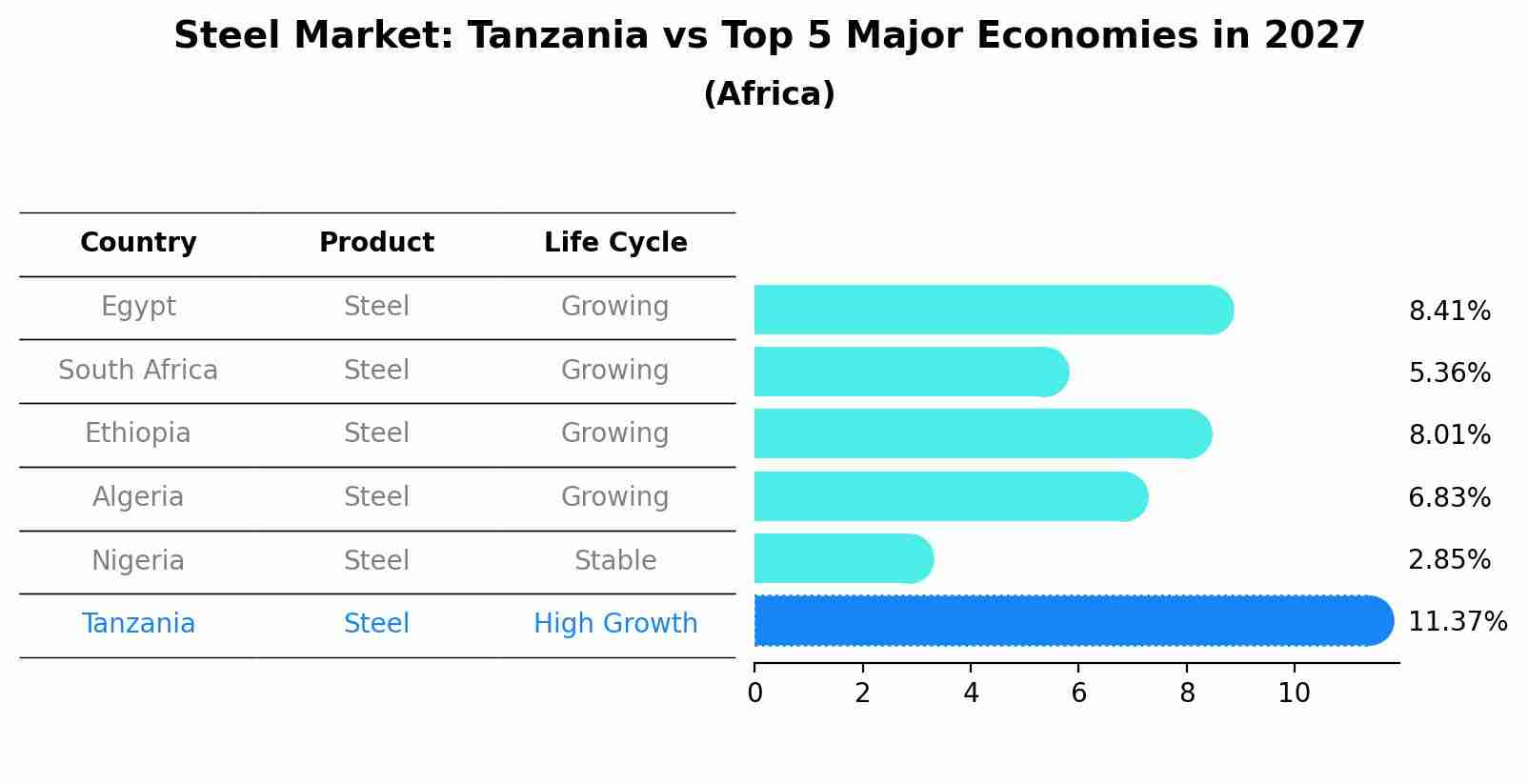
Tanzania Steel Market Growth Rate
According to 6Wresearch internal database and industry insights, the Tanzania Steel Market is projected to grow at a compound annual growth rate (CAGR) of 8.3% during the forecast period (2026–2032).
Topics Covered in the Tanzania Steel Market Report
The Tanzania Steel Market report thoroughly covers the market by types, product types, and applications. The report provides a detailed analysis of ongoing market trends, opportunities/high-growth areas, and market drivers that will help stakeholders align strategies based on current and future market dynamics.
Tanzania Steel Market Highlights
| Report Name | Tanzania Steel Market |
| Forecast period | 2026-2032 |
| CAGR | 8.3% |
| Growing Sector | Building & Construction and Automotive |
Tanzania Steel Market Synopsis
Tanzania Steel Market is expected to attain massive growth in the years to come on the back of increased demand from sectors such as construction, automotive, and infrastructure. In general, factors such as rapid urbanization and industrialization in the country are fostering higher steel consumption, particularly in building and construction activities. Apart from this, Tanzanian government’s strategic initiatives such as investments in the development of industrial zones and the enhancement of local steel production capacity, are providing a favorable environment for Tanzania Steel Market growth.
Evaluation of Growth Drivers in Tanzania Steel Market
Below are some prominent drivers and their influence on the market dynamics:
| Drivers | Primary Segments Affected | Why It Matters |
| Infrastructure Development | By Application (Building & Construction) | Proliferating infrastructure projects such as roads, bridges, and housing demand more steel products. |
| Industrial Growth | By Application (Metal Products, Automotive) | Expansion in industrial manufacturing, particularly in automotive and mechanical sectors, upsurges steel consumption. |
| Supportive Government Initiatives | By Application (Building & Construction) | Government investments in large infrastructure projects and industrial zones are accelerating the demand for steel. |
| Foreign Investments | By Types (Flat Steel, Long Steel) | The influx of foreign investments is enabling local steel plants to expand capacity and augment quality. |
| Increasing Domestic Market | By Application (Electrical Appliances, Mechanical Equipment) | Surging demand for appliances and machinery augments the demand for premium quality steel products. |
Tanzania Steel Market is projected to grow at a CAGR of 8.3% during the forecast period (2026-2032), spurred by surging demand in the construction, automotive, and domestic appliances sectors. In addition, the rapid growth in the country’s industrialization and the government’s supportive policies, such as the National Development Vision 2025, are important factors that are contributing to the growth of the domestic steel market. Apart from that, infrastructure development and the expansion of steel plants are factors that are likely to boost the market.
Evaluation of Restraints in Tanzania Steel Market
Below are some prominent restraints and their influence on the market dynamics:
| Restraints | Primary Segments Affected | What This Means |
| Increasing Raw Material Costs | By Product Type (Structural Steel, Welding Wire/Rod) | Instable costs of iron ore and scrap steel affect profit margins for local producers. |
| High Dependence on Imports | By Types (Flat Steel, Long Steel) | Dependency on imported steel products will cause unpredicted pricing. |
| Restricted Technological Advancements | By Types (Bright Steel, Iron Steel Wire) | Limited use of advanced technology in production by local manufacturers is a cause for poor quality of products produced locally. |
| Regulatory Hinderances | By Application (Building & Construction) | Strict governmental regulations regarding safety standards and environmental compliance can cause delays of construction projects. |
| Erratic Power Supply | By End User (Manufacturing, Automotive) | The scarcity of power could delay the production of steel and, therefore, disrupt the supply chain. |
Tanzania Steel Market Challenges
Tanzania Steel Market is forecast to witness considerable growth during the upcoming period. However, high raw materials cost and import charges expose steel prices to global market risks. Apart from that, absence of technology in steel manufacturing processes affects local steel manufacturing efficiency. In addition to that, issues concerning power supply and regulatory risks are concerns to manufacturers.
Tanzania Steel Market Trends
The following are the most important trends affecting Tanzania Steel Market:
- Increase in Recycling: As part of sustainability efforts, steel recycling is gaining popularity in Tanzania, which will decrease dependency on raw materials and lower production costs.
- Increase in Steel Demand in the Automotive Sector: Steel is needed to manufacture vehicles and is mostly used in their body and structure. Since the automotive industry in Tanzania is steadily growing, there will be an increasing demand for steel to produce cars.
- Increased Steel Exporting: As local production increases, Tanzania is poised to expand its steel exports, particularly to neighboring countries within East Africa and beyond.
Investment Opportunities in the Tanzania Steel Market
Some of the investment opportunities available in the Tanzania Steel Market include the following:
- Making Steel Within Tanzania: Building local steel manufacturing facilities will help decrease reliance on steel imports while creating a market to meet local demand.
- Improving Infrastructure: The government has several infrastructure projects underway that will require steel for roads, bridges, and urban development, providing steel manufacturers with significant opportunities.
- Recycling Steel: There is a growing demand for ‘green’ or eco-friendly steel due to the increasing pressure to recycle. Companies that develop recycling plants will have an opportunity to cut back on the need for raw materials and create a profitable business.
- Automotive Steel Manufacturing: The automotive sector is creating an opportunity for manufacturing specialty steels to produce materials that are required to manufacture vehicles.
Top 5 Leading Players in the Tanzania Steel Market
Below is a list of prominent companies leading the Tanzania Steel Market:
1. ArcelorMittal Tanzania
| Company Name | ArcelorMittal Tanzania |
| Established Year | 2010 |
| Headquarters | Dar es Salaam, Tanzania |
| Official Website | - |
A subsidiary of the global steel giant ArcelorMittal, the company is a key player in the Tanzanian steel market, providing a wide range of steel products for the construction and manufacturing sectors. The company’s strategic focus on local production capacity and supply chain efficiency positions it as a leader in the market.
2. Tanzania Steel Mills Limited
| Company Name | Tanzania Steel Mills Limited |
| Established Year | 2001 |
| Headquarters | Dar es Salaam, Tanzania |
| Official Website | - |
Tanzania Steel Mills is one of the leading local producers of long steel products in the country, supplying steel for construction, infrastructure, and manufacturing industries. Their focus on innovation and cost-effective solutions has helped them secure a strong foothold in the market.
3. Brahmani Steel Tanzania
| Company Name | Brahmani Steel Tanzania |
| Established Year | 2015 |
| Headquarters | Dar es Salaam, Tanzania |
| Official Website | - |
Brahmani Steel is involved in the production of high-quality long and flat steel products. The company’s products cater to the construction, automotive, and infrastructure sectors, with a focus on sustainable manufacturing practices.
4. Mwananchi Engineering and Steel Works Ltd.
| Company Name | Mwananchi Engineering and Steel Works Ltd. |
| Established Year | 1995 |
| Headquarters | Dar es Salaam, Tanzania |
| Official Website | - |
Known for manufacturing steel products such as beams, pipes, and bars, Mwananchi Engineering and Steel Works Ltd. has become a prominent player in the local market, with a strong emphasis on quality and customer satisfaction.
5. Kast Steel Limited
| Company Name | Kast Steel Limited |
| Established Year | 2008 |
| Headquarters | Dar es Salaam, Tanzania |
| Official Website | - |
Kast Steel is a leading producer of long steel products, including steel rods, rebars, and wire products. The company has established itself as a reliable supplier in Tanzania’s construction and infrastructure sectors.
Government Regulations in the Tanzania Steel Market
According to Tanzanian Government Data, they have been promoting local manufacturing, especially through its National Development Vision 2025, which focuses on enhancing capacity and reducing dependence on external sources. Apart from this, the government has been promoting infrastructure development initiatives such as road construction, bridge construction, and industrial zones, which directly boosts demand for steel products. Additionally, environmental policies promote eco-friendly manufacturing processes such as steel recycling.
Future Insights of the Tanzania Steel Market
In the future years, Tanzania Steel Market is set for tremendous expansion. This is mainly due to high demand for steel in construction, automotive, and infrastructure projects. Along with this, the market is expected to benefit from growing foreign investments, government initiatives, and the development of steel production facilities. With technological advancements and increased steel recycling, Tanzania is on track to become a regional leader in steel manufacturing, with rising export potential to neighboring countries and beyond.
Market Segmentation Analysis
The report offers a comprehensive study of the following market segments and their leading categories:
By Types – Flat Steel to Lead the Market
According to Vasu, Senior Research Analyst, 6Wresearch, flat steel is anticipated to dominate the Tanzania Steel Market share due to its wide range of applications in construction, automotive, and household products. Flat steel is particularly in demand for large-scale construction projects and automotive manufacturing.
By Application – Building & Construction to Lead the Market
Building & Construction industry is expected to pick up momentum in the upcoming years, driven by the trend of urbanization and development of infrastructure in Tanzania. Apart from this, the increase in residential and commercial building construction activities generates the demand for steel products like structural steel, beams, and rods.
Key Attractiveness of the Report
- 10 Years of Market Numbers
- Historical Data Starting from 2022 to 2025
- Base Year: 2025
- Forecast Data until 2032
- Key Performance Indicators Impacting the Market
- Major Upcoming Developments and Projects
Key Highlights of the Report:
- Tanzania Steel Market Outlook
- Market Size of Tanzania Steel Market, 2025
- Forecast of Tanzania Steel Market, 2032
- Historical Data and Forecast of Tanzania Steel Revenues & Volume for the Period 2022- 2032F
- Tanzania Steel Market Trend Evolution
- Tanzania Steel Market Drivers and Challenges
- Tanzania Steel Price Trends
- Tanzania Steel Porter's Five Forces
- Tanzania Steel Industry Life Cycle
- Historical Data and Forecast of Tanzania Steel Market Revenues & Volume By Types for the Period 2022- 2032F
- Historical Data and Forecast of Tanzania Steel Market Revenues & Volume By Flat Steel for the Period 2022- 2032F
- Historical Data and Forecast of Tanzania Steel Market Revenues & Volume By Long Steel for the Period 2022- 2032F
- Historical Data and Forecast of Tanzania Steel Market Revenues & Volume By Product Type for the Period 2022- 2032F
- Historical Data and Forecast of Tanzania Steel Market Revenues & Volume By Structural Steel for the Period 2022- 2032F
- Historical Data and Forecast of Tanzania Steel Market Revenues & Volume By Prestressing Steel for the Period 2022- 2032F
- Historical Data and Forecast of Tanzania Steel Market Revenues & Volume By Bright Steel for the Period 2022- 2032F
- Historical Data and Forecast of Tanzania Steel Market Revenues & Volume By Welding Wire/Rod for the Period 2022- 2032F
- Historical Data and Forecast of Tanzania Steel Market Revenues & Volume By Iron Steel Wire for the Period 2022- 2032F
- Historical Data and Forecast of Tanzania Steel Market Revenues & Volume By Ropes for the Period 2022- 2032F
- Historical Data and Forecast of Tanzania Steel Market Revenues & Volume By Braids for the Period 2022- 2032F
- Historical Data and Forecast of Tanzania Steel Market Revenues & Volume By Applications for the Period 2022- 2032F
- Historical Data and Forecast of Tanzania Steel Market Revenues & Volume By Building & Construction for the Period 2022- 2032F
- Historical Data and Forecast of Tanzania Steel Market Revenues & Volume By Electrical Appliances for the Period 2022- 2032F
- Historical Data and Forecast of Tanzania Steel Market Revenues & Volume By Metal Products for the Period 2022- 2032F
- Historical Data and Forecast of Tanzania Steel Market Revenues & Volume By Domestic Appliances for the Period 2022- 2032F
- Historical Data and Forecast of Tanzania Steel Market Revenues & Volume By Mechanical Equipment for the Period 2022- 2032F
- Historical Data and Forecast of Tanzania Steel Market Revenues & Volume By Automotive for the Period 2022- 2032F
- Historical Data and Forecast of Tanzania Steel Market Revenues & Volume By Others for the Period 2022- 2032F
- Tanzania Steel Import Export Trade Statistics
- Market Opportunity Assessment By Types
- Market Opportunity Assessment By Product Type
- Market Opportunity Assessment By Applications
- Tanzania Steel Top Companies Market Share
- Tanzania Steel Competitive Benchmarking By Technical and Operational Parameters
- Tanzania Steel Company Profiles
- Tanzania Steel Key Strategic Recommendations
Market Covered
The report offers a comprehensive study of the subsequent market segments:
By Type
- Flat Steel
- Long Steel
By Product Type
- Structural Steel
- Prestressing Steel
- Bright Steel
- Welding Wire/Rod
- Iron Steel Wire
- Ropes
- Braids
By Applications
- Building & Construction
- Electrical Appliances
- Metal Products
- Domestic Appliances
- Mechanical Equipment
- Automotive
- Others






































