Tanzania Television Broadcasting Market Size, Share & Growth Rate
The Tanzania Television Broadcasting Market was estimated at USD 848 Million in 2025 and is projected to reach USD 1535 Million by 2032, growing at a CAGR of 8.8% from 2026 to 2032. This growth trajectory is largely driven by the ongoing shift to digital broadcasting, which enhances viewer experiences with better picture quality and increased channel variety. Furthermore, rising disposable incomes and urbanization are fostering greater consumer engagement with television, resulting in higher demand for diverse and localized content.
Tanzania Television Broadcasting Market Year-wise Growth Rate and Key Drivers
This graph highlights how the Tanzania Television Broadcasting Market has steadily grown over the years, supported by major growth factors.
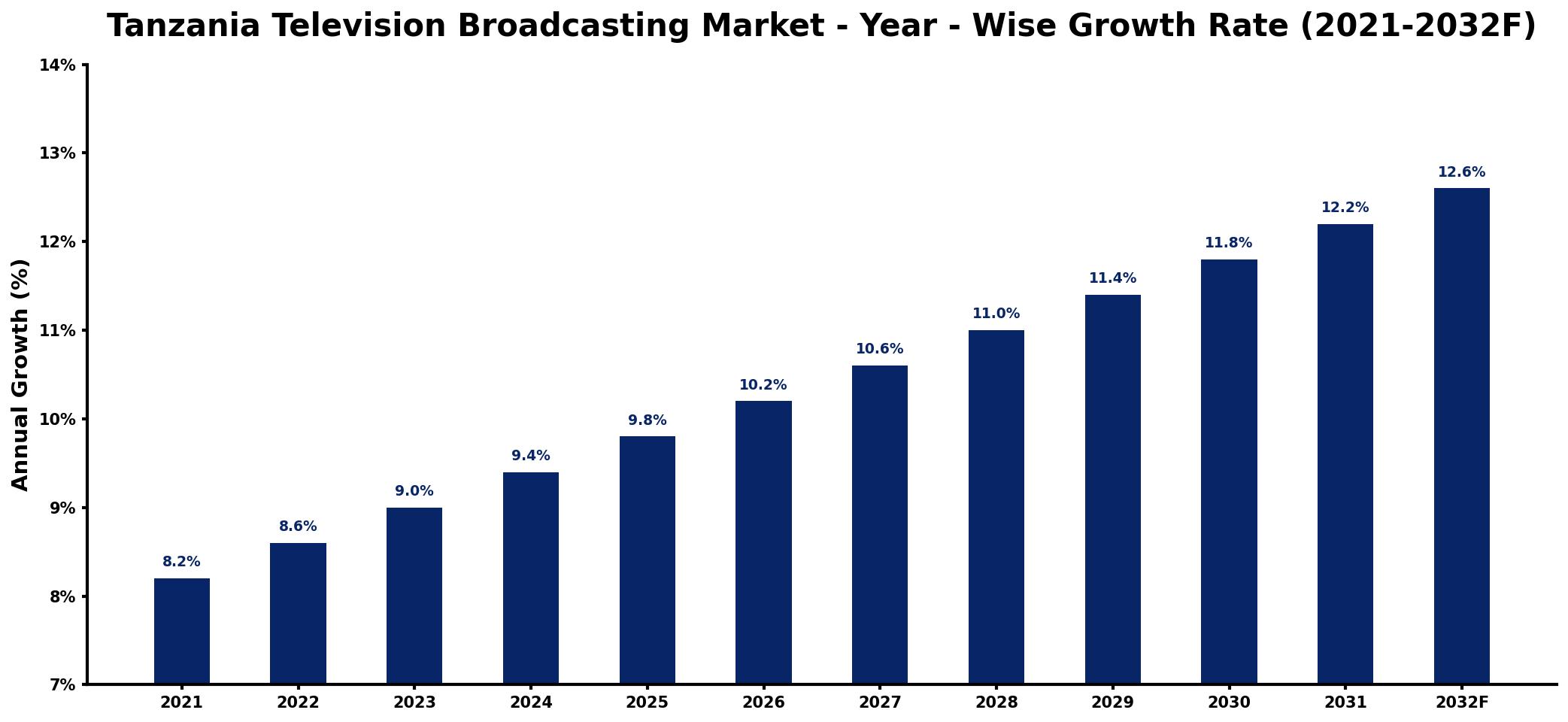
The table below presents the year‑wise growth rates along with the key drivers influencing the market
| Year | Growth Rate | Major Drivers |
| 2021 | 8.2% | Rising demand for digital content |
| 2022 | 8.6% | Increase in advertising investments |
| 2023 | 9.0% | Growing mobile internet penetration |
| 2024 | 9.4% | Expansion of local production studios |
| 2025 | 9.8% | Emerging streaming service platforms |
| 2026 | 10.2% | Increased consumer disposable income |
| 2027 | 10.6% | Development of regional content partnerships |
| 2028 | 11.0% | Surge in youth audience engagement |
| 2029 | 11.4% | rising export shipment volumes |
| 2030 | 11.8% | Boost in foreign investment interest |
| 2031 | 12.2% | Growth of interactive media experiences |
| 2032 | 12.6% | Rising popularity of original programming |
Note: Market size estimations and growth projections presented in this report are based on 6Wresearch's proprietary forecasting methodology, utilizing the latest available industry data, government publications, and primary research inputs.
Tanzania Television Broadcasting Market Synopsis
The Tanzanian television broadcasting landscape is currently thriving, marked by an increase in both local and international competition. The state-owned Tanzania Broadcasting Corporation (TBC) continues to lead, while private broadcasters are rapidly expanding their footprints. This dynamic environment fosters innovation and encourages the production of culturally relevant programming.
With the government's push for a complete digital transition, the market is evolving to meet the demands of a more discerning audience. Digital platforms are proliferating, enhancing content accessibility and prompting broadcasters to innovate in programming and technology.
Tanzania Television Broadcasting Market Key Takeaways
- The market is shifting towards digital broadcasting, improving content quality and variety.
- Local content production is on the rise, driven by audience preferences for culturally relevant programming.
- Competition is increasing, prompting broadcasters to adopt innovative strategies for viewer retention.
- Government initiatives are fostering a supportive regulatory environment for market participants.
- Investment opportunities exist in technology upgrades and localized content creation.
Evaluation of Restraints in Tanzania Television Broadcasting Market
While the Tanzania Television Broadcasting Market shows promising growth, it faces several real challenges. Limited infrastructure in rural areas often results in subpar broadcast quality, affecting viewer engagement. Additionally, the influx of foreign television networks and online streaming platforms intensifies competition, which can undermine the market share of local broadcasters. Regulatory constraints, including licensing requirements, may also hinder new entrants from navigating the market effectively. Overall, these factors can limit the pace of innovation and expansion within the industry.
Tanzania Television Broadcasting Market Trends
The Tanzania Television Broadcasting Market is currently experiencing a notable trend towards localized content creation. Broadcasters are increasingly focusing on programming that resonates with local audiences, thus reflecting Tanzania's rich culture and diverse storytelling traditions. This rise in local content is complemented by investments in digital infrastructure, aiming to deliver enhanced viewing experiences and expand reach. Moreover, as viewers lean toward streaming services, traditional broadcasters are exploring hybrid models that integrate live broadcasting with on-demand content to adapt to changing viewing preferences.
Tanzania Television Broadcasting Market Opportunities
There are abundant opportunities within the Tanzania Television Broadcasting Market for those willing to invest. The ongoing digital transformation provides avenues for improving existing broadcasting infrastructure, which is critical for delivering high-quality signal and expanding viewer access. Furthermore, the surge in demand for localized content opens doors for production houses, allowing them to create unique programming that appeals to Tanzanian audiences. With the rise of digital platforms, the potential for innovative content creation and distribution is vast, presenting lucrative prospects for investors and stakeholders alike.
Government Initiatives in the Tanzania Television Broadcasting Market
The regulatory landscape for the Tanzania Television Broadcasting Market is largely shaped by the Tanzania Communications Regulatory Authority (TCRA). This body oversees licensing, content regulations, and technical standards to ensure fair competition and consumer protection. The government promotes the broadcasting sector through various initiatives aimed at increasing access to media and enhancing local content production. Additionally, existing policies focus on the transition from analog to digital broadcasting, which is expected to significantly enhance the media landscape.
Future Insights of the Tanzania Television Broadcasting Market
Looking ahead to the period between 2026 and 2032, the Tanzania Television Broadcasting Market is anticipated to undergo significant transformation. The convergence of technological advancements and evolving consumer preferences will drive broadcasters to adopt more interactive and engaging programming strategies. As urbanization continues and disposable incomes rise, broadcasters will likely enhance their content offerings to attract a diverse audience. The ongoing shift towards digital services and the rising popularity of streaming will compel traditional broadcasters to innovate further, setting the stage for a competitive and vibrant television landscape.
Tanzania Television Broadcasting Market Latest Developments (2025 - 2026)
Recent developments in the Tanzania Television Broadcasting Market indicate a proactive approach from both public and private broadcasters towards modernization. The shift to digital broadcasting is ongoing, with several broadcasters enhancing their technical capabilities to improve service delivery. Collaboration between local production houses and broadcasters is becoming more common, facilitating the creation of engaging and culturally rich content. Furthermore, audience engagement strategies are evolving, with many broadcasters exploring interactive programming options and leveraging digital platforms to reach wider audiences.
Tanzania Television Broadcasting Market - Key Attractiveness of the Report
- 10 Years of Market Numbers
- Historical Data Starting from 2022 to 2025
- Base Year: 2025
- Forecast Data until 2032
- Key Performance Indicators Impacting the Market
- Major Upcoming Developments and Projects
Key Highlights of the Report:
- Tanzania Television Broadcasting Market Outlook
- Market Size of Tanzania Television Broadcasting Market, 2025
- Forecast of Tanzania Television Broadcasting Market, 2032
- Historical Data and Forecast of Tanzania Television Broadcasting Revenues & Volume for the Period 2022-2032F
- Tanzania Television Broadcasting Market Trend Evolution
- Tanzania Television Broadcasting Market Drivers and Challenges
- Tanzania Television Broadcasting Price Trends
- Tanzania Television Broadcasting Porter's Five Forces
- Tanzania Television Broadcasting Industry Life Cycle
- Historical Data and Forecast of Tanzania Television Broadcasting Market Revenues & Volume By Type for the Period 2022-2032F
- Historical Data and Forecast of Tanzania Television Broadcasting Market Revenues & Volume By Television Station for the Period 2022-2032F
- Historical Data and Forecast of Tanzania Television Broadcasting Market Revenues & Volume By Television Network for the Period 2022-2032F
- Historical Data and Forecast of Tanzania Television Broadcasting Market Revenues & Volume By Broadcaster Type for the Period 2022-2032F
- Historical Data and Forecast of Tanzania Television Broadcasting Market Revenues & Volume By Public for the Period 2022-2032F
- Historical Data and Forecast of Tanzania Television Broadcasting Market Revenues & Volume By Commercial for the Period 2022-2032F
- Historical Data and Forecast of Tanzania Television Broadcasting Market Revenues & Volume By Revenue Source for the Period 2022-2032F
- Historical Data and Forecast of Tanzania Television Broadcasting Market Revenues & Volume By Subscription-based for the Period 2022-2032F
- Historical Data and Forecast of Tanzania Television Broadcasting Market Revenues & Volume By Advertisement-based for the Period 2022-2032F
- Tanzania Television Broadcasting Import Export Trade Statistics
- Market Opportunity Assessment By Type
- Market Opportunity Assessment By Broadcaster Type
- Market Opportunity Assessment By Revenue Source
- Tanzania Television Broadcasting Top Companies Market Share
- Tanzania Television Broadcasting Competitive Benchmarking By Technical and Operational Parameters
- Tanzania Television Broadcasting Company Profiles
- Tanzania Television Broadcasting Key Strategic Recommendations






































