Textile Enzymes Market: Tanzania vs Top 5 Major Economies in 2027 (Africa)
Tanzania's Textile Enzymes market is anticipated to experience a high growth rate of 13.25% by 2027, reflecting trends observed in the largest economy Egypt, followed by South Africa, Ethiopia, Algeria and Nigeria.
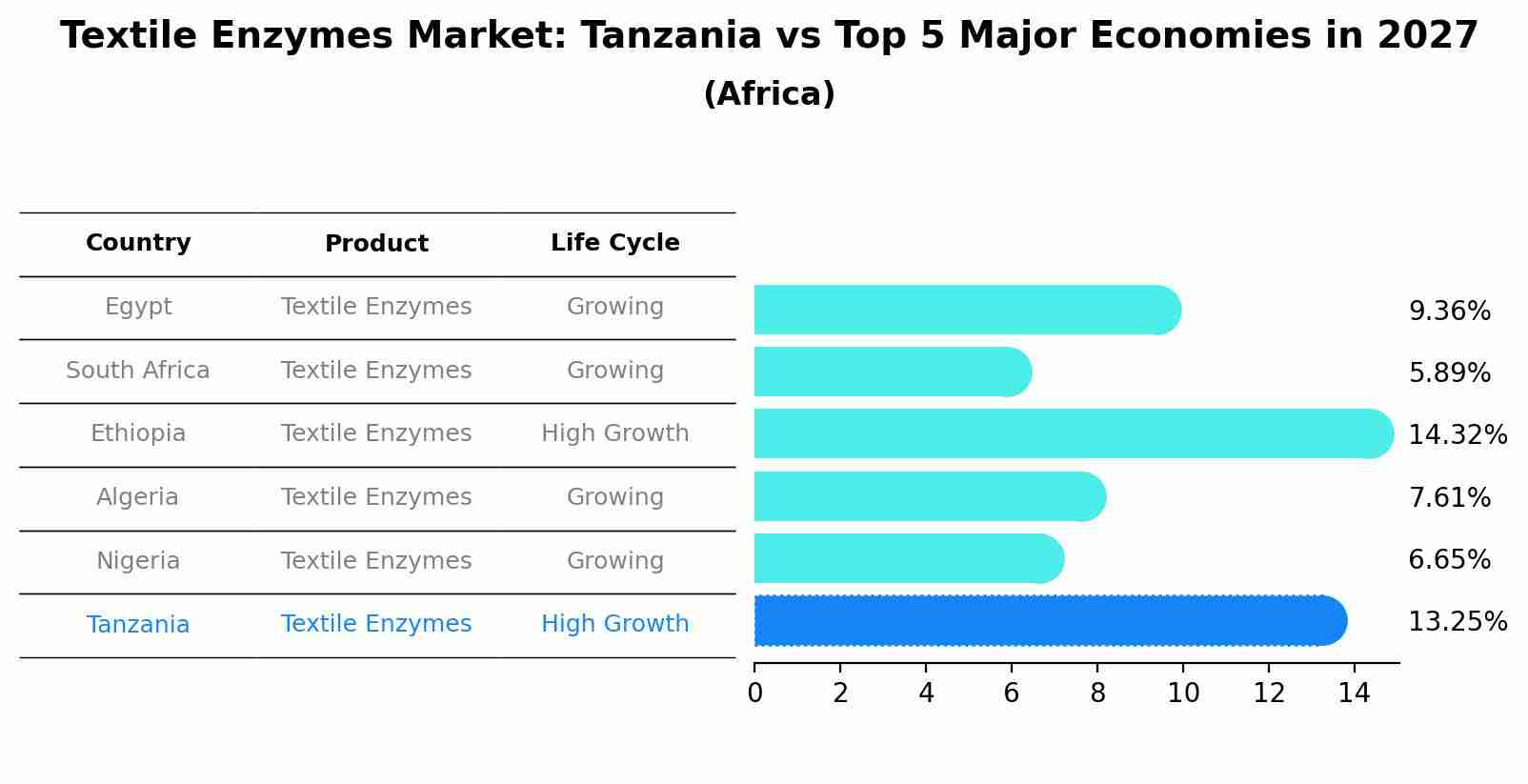
Tanzania Textile Enzymes Market Overview
The Tanzania Textile Enzymes Market is witnessing steady growth due to increasing demand for sustainable and eco-friendly textile processing solutions. Enzymes are increasingly being used in the textile industry to reduce water, energy, and chemical consumption during various processes such as desizing, bio-polishing, and finishing. The market is driven by the growing awareness among consumers and manufacturers regarding the environmental impact of traditional textile processing methods. Key players are focusing on developing advanced enzyme solutions to cater to the specific requirements of the Tanzania textile industry. Factors such as government initiatives promoting sustainable practices and the rising adoption of green technologies in the textile sector are expected to further propel the growth of the Tanzania Textile Enzymes Market in the coming years.
Tanzania Textile Enzymes Market Trends
The Tanzania Textile Enzymes Market is experiencing a shift towards sustainable production practices, with a growing demand for eco-friendly and biodegradable enzymes. Manufacturers are increasingly focusing on developing enzymes that are more efficient in reducing water and energy consumption during textile processing. Enzymes that offer improved performance in terms of fabric softening, color enhancement, and stain removal are also gaining popularity in the market. Additionally, there is a rising interest in enzymes that can help in achieving specific textile finishes and effects, catering to the evolving preferences of consumers. Overall, the market is witnessing a transition towards greener and more innovative enzyme solutions to meet the sustainability goals of the textile industry in Tanzania.
Tanzania Textile Enzymes Market Challenges
The Tanzania Textile Enzymes Market faces several challenges, including limited awareness and understanding of the benefits of using enzymes in textile processing among manufacturers. Additionally, the high cost of enzymes and the lack of technical expertise in utilizing them effectively further hinder market growth. Inconsistent supply of quality enzymes and the presence of counterfeit products also pose significant challenges for industry players. Furthermore, the regulatory environment in Tanzania may not be fully supportive of promoting the use of enzymes in textile processing, leading to slower adoption rates. Overall, overcoming these challenges will require targeted educational initiatives, collaboration between industry stakeholders, and investment in research and development to drive innovation in the Tanzania Textile Enzymes Market.
Tanzania Textile Enzymes Market Investment Opportunities
In the Tanzania Textile Enzymes Market, there are several promising investment opportunities for growth and innovation. One key opportunity lies in the increasing demand for eco-friendly and sustainable textile production processes. Investing in research and development of enzyme technology for textile processing can help companies meet the growing consumer preference for environmentally friendly products. Additionally, there is a potential for investment in partnering with textile manufacturers to integrate enzyme solutions into their production processes, improving efficiency and reducing costs. Furthermore, as the textile industry in Tanzania continues to expand, there is a need for investments in infrastructure and technology to support the growth of the sector, presenting opportunities for investors to enter the market and capitalize on the evolving landscape.
Tanzania Textile Enzymes Market Government Policy
The Tanzanian government has implemented policies to promote the growth of the textile enzymes market. This includes providing incentives such as tax breaks and subsidies to local textile manufacturers using enzymes in their production processes. Additionally, the government has invested in research and development initiatives to enhance the quality and efficiency of enzyme technology in the textile industry. Furthermore, there are regulations in place to ensure environmental sustainability and safety standards are met in the use of enzymes, promoting a more eco-friendly approach in the market. Overall, these policies aim to support the growth and competitiveness of the Tanzania Textile Enzymes Market while fostering innovation and sustainability in the industry.
Tanzania Textile Enzymes Market Future Outlook
The Tanzania Textile Enzymes Market is poised for steady growth in the coming years, driven by increasing demand for sustainable and eco-friendly textile processing solutions. Enzymes are gaining popularity in the textile industry for their ability to improve process efficiency, reduce energy consumption, and minimize environmental impact. With a growing emphasis on sustainability and regulations promoting eco-friendly practices, the adoption of textile enzymes is expected to rise among manufacturers in Tanzania. Additionally, advancements in enzyme technology, such as the development of new enzyme variants for specific applications, are anticipated to further drive market growth. Overall, the Tanzania Textile Enzymes Market is likely to witness expansion as the industry shifts towards more sustainable and efficient textile processing solutions.
Key Highlights of the Report:
- Tanzania Textile Enzymes Market Outlook
- Market Size of Tanzania Textile Enzymes Market, 2021
- Forecast of Tanzania Textile Enzymes Market, 2031
- Historical Data and Forecast of Tanzania Textile Enzymes Revenues & Volume for the Period 2021 - 2031
- Tanzania Textile Enzymes Market Trend Evolution
- Tanzania Textile Enzymes Market Drivers and Challenges
- Tanzania Textile Enzymes Price Trends
- Tanzania Textile Enzymes Porter's Five Forces
- Tanzania Textile Enzymes Industry Life Cycle
- Historical Data and Forecast of Tanzania Textile Enzymes Market Revenues & Volume By Type for the Period 2021 - 2031
- Historical Data and Forecast of Tanzania Textile Enzymes Market Revenues & Volume By Cellulase for the Period 2021 - 2031
- Historical Data and Forecast of Tanzania Textile Enzymes Market Revenues & Volume By Amylase for the Period 2021 - 2031
- Historical Data and Forecast of Tanzania Textile Enzymes Market Revenues & Volume By Catalase for the Period 2021 - 2031
- Historical Data and Forecast of Tanzania Textile Enzymes Market Revenues & Volume By Pectinase for the Period 2021 - 2031
- Historical Data and Forecast of Tanzania Textile Enzymes Market Revenues & Volume By Laccase for the Period 2021 - 2031
- Historical Data and Forecast of Tanzania Textile Enzymes Market Revenues & Volume By Others for the Period 2021 - 2031
- Historical Data and Forecast of Tanzania Textile Enzymes Market Revenues & Volume By Application for the Period 2021 - 2031
- Historical Data and Forecast of Tanzania Textile Enzymes Market Revenues & Volume By Bio-polishing for the Period 2021 - 2031
- Historical Data and Forecast of Tanzania Textile Enzymes Market Revenues & Volume By Desizing for the Period 2021 - 2031
- Historical Data and Forecast of Tanzania Textile Enzymes Market Revenues & Volume By Enzymatic Bleaching for the Period 2021 - 2031
- Historical Data and Forecast of Tanzania Textile Enzymes Market Revenues & Volume By Bioscouring for the Period 2021 - 2031
- Historical Data and Forecast of Tanzania Textile Enzymes Market Revenues & Volume By Others for the Period 2021 - 2031
- Tanzania Textile Enzymes Import Export Trade Statistics
- Market Opportunity Assessment By Type
- Market Opportunity Assessment By Application
- Tanzania Textile Enzymes Top Companies Market Share
- Tanzania Textile Enzymes Competitive Benchmarking By Technical and Operational Parameters
- Tanzania Textile Enzymes Company Profiles
- Tanzania Textile Enzymes Key Strategic Recommendations






































