Tanzania Welding Electrodes Market Size, Share & Growth Rate
The Tanzania Welding Electrodes Market was estimated at USD 379 Million in 2025 and is projected to reach USD 503 Million by 2032, growing at a CAGR of 4.1% from 2026 to 2032. This growth trajectory is primarily driven by increasing industrialization and a surge in infrastructure development projects across various sectors, including construction and manufacturing. Coupled with a rising demand for eco-friendly and advanced welding solutions, these factors are setting the stage for robust market expansion.
Tanzania Welding Electrodes Market Growth Rate Analysis (2021-2032)
The Tanzania welding electrodes market has maintained a stable growth trajectory, characterized by annual increases of 4.9% in both 2021 and 2022, slightly dipping to 4.8% in 2023. This fluctuation can be attributed to fluctuations in industrial activity and the global supply chain challenges affecting raw material availability. However, a resurgence is expected, with growth projected at 5.1% in 2024. The ongoing investments in infrastructure and energy transition initiatives are fueling demand, supported by a growing construction sector. As the market matures, digitalization and advancements in welding technology are also contributing to a more efficient production process, setting the stage for sustained growth through 2032.
Tanzania Welding Electrodes Market Year-wise Growth Rate and Key Drivers
This graph highlights how the Tanzania Welding Electrodes Market has steadily grown over the past five years, supported by major growth factors.
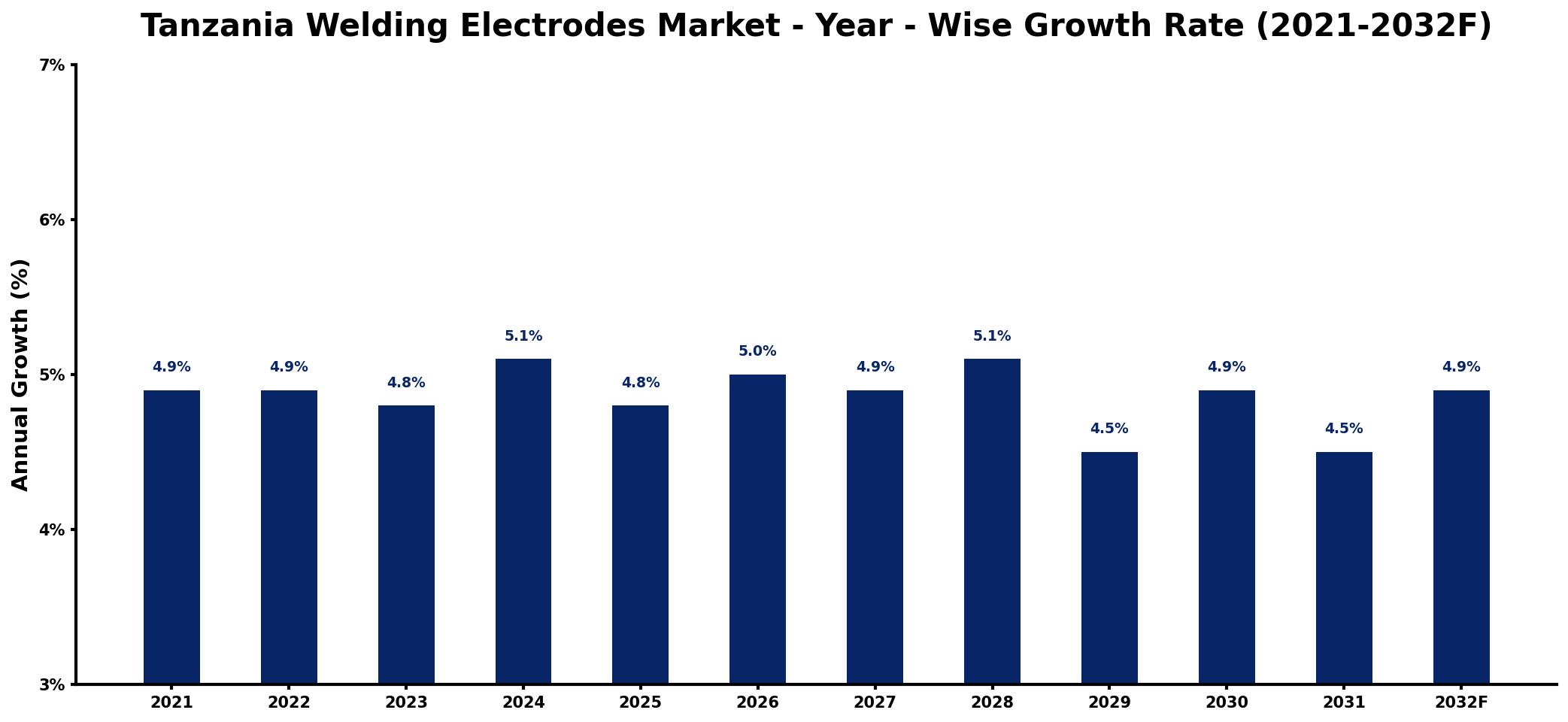
The table below presents the year‑wise growth rates along with the key drivers influencing the market
| Year | Growth Rate | Major Drivers |
| 2021 | 4.9% | Infrastructure projects driving demand |
| 2022 | 4.9% | Manufacturing sector expanding rapidly |
| 2023 | 4.8% | Increased energy sector investments |
| 2024 | 5.1% | Construction industry experiencing growth |
| 2025 | 4.8% | Automotive production scaling up |
| 2026 | 5.0% | Mining operations requiring support |
| 2027 | 4.9% | Technological advancements enhancing capabilities |
| 2028 | 5.1% | Government initiatives promoting development |
| 2029 | 4.5% | Export opportunities in regional markets |
| 2030 | 4.9% | Rising urbanization influencing needs |
| 2031 | 4.5% | Sustainability practices gaining traction |
| 2032 | 4.9% | Skilled workforce attracting investments |
Note: Market size estimations and growth projections presented in this report are based on 6Wresearch's proprietary forecasting methodology, utilizing the latest available industry data, government publications, and primary research inputs.
Tanzania Welding Electrodes Market Synopsis
A significant force currently shaping the Tanzania Welding Electrodes Market is the government's aggressive investment in infrastructure. This emphasis not only addresses immediate construction needs but also fuels the demand for high-quality welding electrodes, critical for ensuring structural integrity and durability.
In tandem with this investment, local manufacturers are expanding their offerings, aiming to meet the varied requirements of their customers. International players are also increasingly recognizing the potential of this market, thereby enhancing competition and driving innovation in product development.
Tanzania Welding Electrodes Market Key Takeaways
- Steady growth in the market driven by industrialization and infrastructure investments.
- Emerging demand for advanced, eco-friendly welding solutions among various sectors.
- Local and international players are diversifying products to capture a larger market share.
- Technological advancements and skill development initiatives are enhancing competitiveness.
- Government policies aimed at ensuring quality and safety are shaping market dynamics.
Evaluation of Restraints in Tanzania Welding Electrodes Market
Despite the optimistic outlook, the Tanzania Welding Electrodes Market faces several constraints that hinder growth. A notable issue is the lack of awareness and technical skills among potential users, which impedes the effective adoption and usage of modern welding solutions. Additionally, the market remains highly fragmented, with numerous small manufacturers struggling to maintain quality and compete on price, creating a challenging environment for both producers and consumers.
Moreover, the limited access to modern machinery and technology further complicates the landscape for local producers. Infrastructure challenges, such as unreliable power supply and inadequate transportation networks, pose logistical difficulties in efficiently distributing products across the nation, thereby restraining market potential.
Tanzania Welding Electrodes Market Trends
The market is currently witnessing a pivotal shift towards innovative and sustainable welding solutions. There is a notable increase in demand for high-performance electrodes that not only enhance welding quality but also prioritize efficiency and environmental impact. Manufacturers are now focusing on producing electrodes characterized by low hydrogen content and superior mechanical properties, catering to the evolving needs of industries.
Additionally, the adoption of automation and digital technologies within the welding processes is becoming increasingly prevalent. These technological advancements are aimed at improving productivity, enhancing precision, and ultimately meeting the higher expectations of customers in various sectors.
Tanzania Welding Electrodes Market Opportunities
Investment opportunities abound in the Tanzania Welding Electrodes Market, fueled by significant infrastructure projects and industrial growth. The construction sector's expansion, alongside a burgeoning oil and gas industry, creates a compelling demand for high-quality welding electrodes. Investors are encouraged to align with the governments focus on local manufacturing and reduce import dependency, which presents a unique window for establishing partnerships with local entities and supplying innovative products tailored to market needs.
Government Initiatives in the Tanzania Welding Electrodes Market
The Tanzanian government has enacted various policies to enhance the welding electrodes market, ensuring adherence to safety standards and quality control. The Tanzania Bureau of Standards (TBS) plays a crucial role in regulating welding electrode standards to protect consumers. Furthermore, initiatives aimed at developing skills among local welders are being promoted, enhancing their capabilities and encouraging the use of high-quality welding electrodes.
Future Insights of the Tanzania Welding Electrodes Market
Looking ahead to the years 2026-2032, the Tanzania Welding Electrodes Market is set for continuous growth driven by ongoing industrialization and infrastructure development. The escalating need for high-quality welding solutions across key sectors like automotive and oil & gas will propel market dynamics forward. Additionally, the government's commitment to promoting local manufacturing and investment is likely to enhance market competitiveness. As technology and skill development efforts advance, the market will likely see a greater focus on innovation, ensuring it remains responsive to the evolving demands of various industries.
Tanzania Welding Electrodes Market Latest Developments (2025 - 2026)
Recent developments in the Tanzania Welding Electrodes Market indicate a notable shift towards the integration of advanced technologies in welding processes. Companies are increasingly investing in research and development to create eco-friendly products that align with global sustainability trends. Additionally, there has been a marked emphasis on training programs aimed at enhancing the skill sets of local welders, thereby facilitating the adoption of new welding technologies.
Tanzania Welding Electrodes Market - Key Attractiveness of the Report
- 10 Years of Market Numbers
- Historical Data Starting from 2022 to 2025
- Base Year: 2025
- Forecast Data until 2032
- Key Performance Indicators Impacting the Market
- Major Upcoming Developments and Projects
Key Highlights of the Report:
- Tanzania Welding Electrodes Market Outlook
- Market Size of Tanzania Welding Electrodes Market, 2025
- Forecast of Tanzania Welding Electrodes Market, 2032
- Historical Data and Forecast of Tanzania Welding Electrodes Revenues & Volume for the Period 2022-2032F
- Tanzania Welding Electrodes Market Trend Evolution
- Tanzania Welding Electrodes Market Drivers and Challenges
- Tanzania Welding Electrodes Price Trends
- Tanzania Welding Electrodes Porter's Five Forces
- Tanzania Welding Electrodes Industry Life Cycle
- Historical Data and Forecast of Tanzania Welding Electrodes Market Revenues & Volume By Type for the Period 2022-2032F
- Historical Data and Forecast of Tanzania Welding Electrodes Market Revenues & Volume By Stick Electrodes for the Period 2022-2032F
- Historical Data and Forecast of Tanzania Welding Electrodes Market Revenues & Volume By Coiled Wires for the Period 2022-2032F
- Historical Data and Forecast of Tanzania Welding Electrodes Market Revenues & Volume By Industry for the Period 2022-2032F
- Historical Data and Forecast of Tanzania Welding Electrodes Market Revenues & Volume By Automotive for the Period 2022-2032F
- Historical Data and Forecast of Tanzania Welding Electrodes Market Revenues & Volume By Building & Construction for the Period 2022-2032F
- Historical Data and Forecast of Tanzania Welding Electrodes Market Revenues & Volume By Oil & Gas for the Period 2022-2032F
- Historical Data and Forecast of Tanzania Welding Electrodes Market Revenues & Volume By Others for the Period 2022-2032F
- Tanzania Welding Electrodes Import Export Trade Statistics
- Market Opportunity Assessment By Type
- Market Opportunity Assessment By Industry
- Tanzania Welding Electrodes Top Companies Market Share
- Tanzania Welding Electrodes Competitive Benchmarking By Technical and Operational Parameters
- Tanzania Welding Electrodes Company Profiles
- Tanzania Welding Electrodes Key Strategic Recommendations






































