Tanzania Whipping Cream Market Size, Share & Growth Rate
The Tanzania Whipping Cream Market was estimated at USD 249 Million in 2025 and is projected to reach USD 335 Million by 2032, growing at a CAGR of 4.3% from 2026 to 2032. This growth trajectory is fueled by an increasing consumer appetite for premium dairy products, particularly within the bustling hospitality sector comprising hotels, restaurants, and cafés. Additionally, the rising trend of home baking among urban dwellers is further propelling retail sales, positioning the market for significant expansion in the coming years.
Tanzania Whipping Cream Market Growth Rate Analysis (2021-2032)
The Tanzania Whipping Cream Market is poised for stable growth, reflecting a compound annual increase of around 5% through the coming years. Notably, growth rates peaked at 5.2% in 2021 and are projected to remain strong, fluctuating between 4.8% and 5.3% up to 2032. Contributing factors include expanding consumer demand due to rising disposable incomes and a growing café culture, alongside increased investments in dairy processing technologies. Moreover, policy support for local dairy farmers is enhancing supply chain stability. Although there are slight declines, such as 4.8% in both 2028 and 2029, these are expected to be temporary, as the market adjusts to evolving consumption trends and infrastructure developments.
Tanzania Whipping Cream Market Year-wise Growth Rate and Key Drivers
This graph highlights how the Tanzania Whipping Cream Market has steadily grown over the past five years, supported by major growth factors.
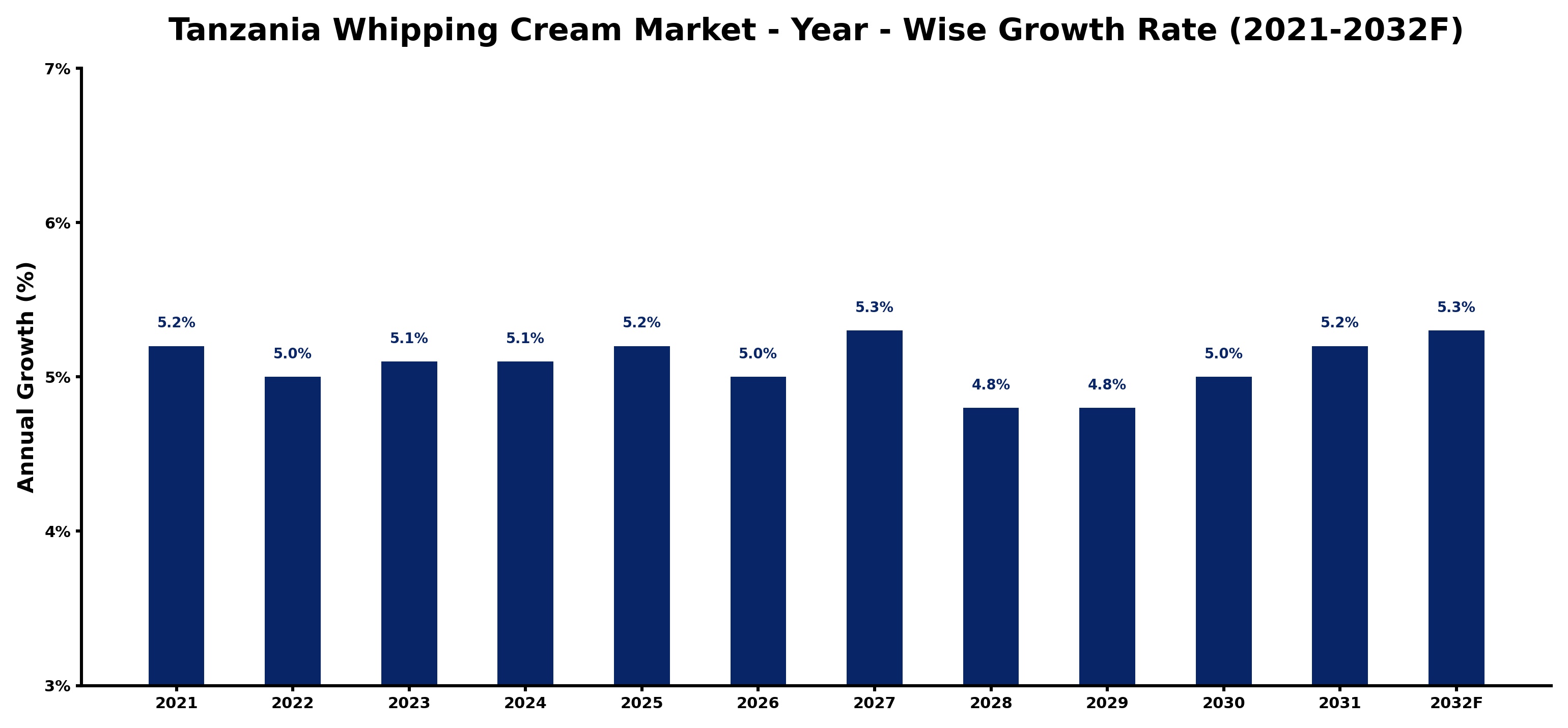
The table below presents the year‑wise growth rates along with the key drivers influencing the market
| Year | Growth Rate | Major Drivers |
| 2021 | 5.2% | Increased dairy consumption trends |
| 2022 | 5.0% | Growing demand for desserts |
| 2023 | 5.1% | Rise in baking popularity |
| 2024 | 5.1% | Expansion of coffee culture |
| 2025 | 5.2% | Increased interest in gourmet foods |
| 2026 | 5.0% | Health-conscious consumer choices rise |
| 2027 | 5.3% | Culinary tourism boosts demand |
| 2028 | 4.8% | Innovative product offerings attract buyers |
| 2029 | 4.8% | Sustainable sourcing practices gain traction |
| 2030 | 5.0% | Emerging food trends influence market |
| 2031 | 5.2% | Home baking resurgence continues growth |
| 2032 | 5.3% | Collaborations with local chefs increase |
Note - Market size estimations and growth projections presented in this report are based on 6Wresearch's advanced forecasting approach, validated with industry datasets as of June 2026.
Tanzania Whipping Cream Market Synopsis
The Tanzania Whipping Cream Market is at a pivotal moment, characterized by a growing interest in high-quality dairy products. Urban consumers are increasingly exploring diverse culinary options, leading to a heightened demand for whipping cream in both professional kitchens and home environments.
As the market evolves, local producers are responding by diversifying their product lines, while imported brands maintain a strong presence. The dual dynamics of local and foreign competition are shaping a vibrant marketplace that is rich with opportunities.
Tanzania Whipping Cream Market Key Takeaways
- The market is poised for steady growth, primarily driven by the hospitality sector and home cooking trends.
- Consumers are gravitating towards premium and organic options, reflecting a broader shift towards quality and sustainability.
- Infrastructure challenges remain a significant hurdle, limiting product availability in some regions.
- Investment opportunities abound for local and international players in production, distribution, and marketing strategies.
- Government regulations play a crucial role in ensuring product safety and supporting local dairy production.
Evaluation of Restraints in Tanzania Whipping Cream Market
Despite the promising growth trajectory, the Tanzania Whipping Cream Market faces several constraints. One of the most pressing issues is the limited consumer awareness about whipping cream, particularly in rural regions where traditional dairy products dominate. This lack of understanding often translates into lower demand, impacting overall market growth. Additionally, infrastructure limitations can hinder efficient distribution, making it challenging for retailers to stock products consistently across various locations. Fluctuating raw material prices further complicate the landscape, as manufacturers grapple with production costs while aiming to maintain competitive pricing.
Tanzania Whipping Cream Market Trends
Current trends in the Tanzania Whipping Cream Market underscore a significant shift towards premiumization. Consumers are not only willing to spend more on high-quality whipping cream but are also expressing interest in organic and locally sourced options. This transition aligns with a global emphasis on health and sustainability. Additionally, innovative packaging and convenient product formats are becoming increasingly popular, catering to the fast-paced lifestyles of urban residents.
Tanzania Whipping Cream Market Opportunities
The Tanzania Whipping Cream Market presents numerous avenues for growth and investment. With the expanding hospitality sector and rising home baking culture, there is an evident appetite for high-quality whipping cream. Investors can explore opportunities in production enhancements, supply chain partnerships with local farmers, and the development of targeted marketing strategies to cater to diverse consumer segments. Furthermore, tapping into the demand for sustainable practices can differentiate brands in an increasingly crowded market.
Government Initiatives in the Tanzania Whipping Cream Market
Government initiatives in the Tanzania Whipping Cream Market focus on maintaining food safety and promoting domestic production. The Tanzania Food and Drugs Authority (TFDA) enforces regulations that ensure the quality and safety of dairy products, including specific labeling requirements and hygiene standards. Additionally, policies may support local manufacturers through import tariffs or other incentives aimed at bolstering the domestic dairy industry, creating a conducive environment for growth.
Future Insights of the Tanzania Whipping Cream Market
Looking ahead to 2026-2032, the Tanzania Whipping Cream Market is expected to experience substantial development fueled by rising disposable incomes and a shift in consumer preferences towards premium food products. The influence of global culinary trends, coupled with urbanization and the expansion of retail channels, will play a pivotal role in expanding the market's reach. As consumers become increasingly discerning, the focus on product innovation and local flavors will be critical for brands aiming to capture a larger share of this burgeoning market.
Tanzania Whipping Cream Market Latest Developments (May 2025 - June 2026)
Recent developments in the Tanzania Whipping Cream Market indicate a growing emphasis on product diversification and innovation. Companies are exploring new formulations and unique flavor profiles to appeal to a broader audience. Meanwhile, the launch of targeted marketing campaigns aims to enhance consumer awareness and education regarding the benefits and uses of whipping cream. Furthermore, strategic partnerships within the supply chain are becoming more prevalent as companies seek to improve distribution and product availability across various regions.
Tanzania Whipping Cream Market - Key Attractiveness of the Report
- 10 Years of Market Numbers
- Historical Data Starting from 2022 to 2025
- Base Year: 2025
- Forecast Data until 2032
- Key Performance Indicators Impacting the Market
- Major Upcoming Developments and Projects
Key Highlights of the Report:
- Tanzania Whipping Cream Market Outlook
- Market Size of Tanzania Whipping Cream Market, 2025
- Forecast of Tanzania Whipping Cream Market, 2032
- Historical Data and Forecast of Tanzania Whipping Cream Revenues & Volume for the Period 2022-2032F
- Tanzania Whipping Cream Market Trend Evolution
- Tanzania Whipping Cream Market Drivers and Challenges
- Tanzania Whipping Cream Price Trends
- Tanzania Whipping Cream Porter's Five Forces
- Tanzania Whipping Cream Industry Life Cycle
- Historical Data and Forecast of Tanzania Whipping Cream Market Revenues & Volume By Product for the Period 2022-2032F
- Historical Data and Forecast of Tanzania Whipping Cream Market Revenues & Volume By Dairy for the Period 2022-2032F
- Historical Data and Forecast of Tanzania Whipping Cream Market Revenues & Volume By Non-Dairy for the Period 2022-2032F
- Historical Data and Forecast of Tanzania Whipping Cream Market Revenues & Volume By Application for the Period 2022-2032F
- Historical Data and Forecast of Tanzania Whipping Cream Market Revenues & Volume By B2B for the Period 2022-2032F
- Historical Data and Forecast of Tanzania Whipping Cream Market Revenues & Volume By B2C for the Period 2022-2032F
- Historical Data and Forecast of Tanzania Whipping Cream Market Revenues & Volume By Distribution Channel for the Period 2022-2032F
- Historical Data and Forecast of Tanzania Whipping Cream Market Revenues & Volume By Warehouse Clubs for the Period 2022-2032F
- Historical Data and Forecast of Tanzania Whipping Cream Market Revenues & Volume By Variety Stores for the Period 2022-2032F
- Historical Data and Forecast of Tanzania Whipping Cream Market Revenues & Volume By Department Stores for the Period 2022-2032F
- Historical Data and Forecast of Tanzania Whipping Cream Market Revenues & Volume By Online Retail for the Period 2022-2032F
- Historical Data and Forecast of Tanzania Whipping Cream Market Revenues & Volume By Convenience Stores for the Period 2022-2032F
- Historical Data and Forecast of Tanzania Whipping Cream Market Revenues & Volume By Supermarkets and Hypermarket for the Period 2022-2032F
- Historical Data and Forecast of Tanzania Whipping Cream Market Revenues & Volume By Specialist Retailers for the Period 2022-2032F
- Historical Data and Forecast of Tanzania Whipping Cream Market Revenues & Volume By Others for the Period 2022-2032F
- Tanzania Whipping Cream Import Export Trade Statistics
- Market Opportunity Assessment By Product
- Market Opportunity Assessment By Application
- Market Opportunity Assessment By Distribution Channel
- Tanzania Whipping Cream Top Companies Market Share
- Tanzania Whipping Cream Competitive Benchmarking By Technical and Operational Parameters
- Tanzania Whipping Cream Company Profiles
- Tanzania Whipping Cream Key Strategic Recommendations






































