Tanzania Wood Pellets Market Summary
The tanzania wood pellets market was estimated at USD 440 Million in 2025 and is projected to reach USD 594 Million by 2032, growing at a CAGR of 5.5% from 2026 to 2032.
Tanzania Wood Pellets Market Year-wise Growth Rate and Key Drivers
This graph highlights how the Tanzania Wood Pellets Market has steadily grown over the past five years, supported by major growth factors.
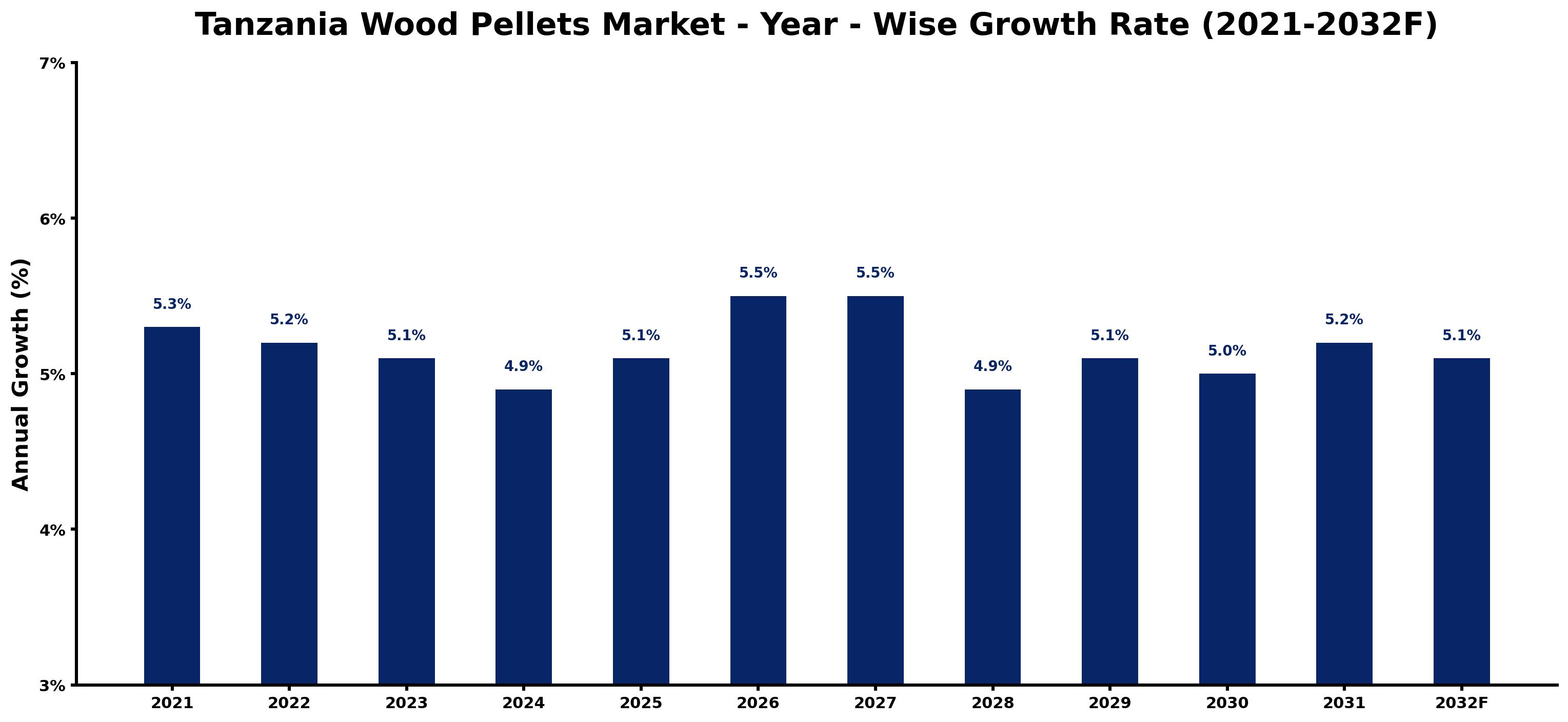
The table below presents the year wise growth rates along with the key drivers influencing the market
| Year | Growth Rate | Major Drivers |
| 2021 | 5.3% | Household energy needs prompted exploration of sustainable wood pellet options. |
| 2022 | 5.2% | Investments in renewable energy infrastructure supported wood pellet production growth. |
| 2023 | 5.1% | Local manufacturing initiatives improved supply chain efficiency for wood pellets. |
| 2024 | 4.9% | Collaboration with NGOs raised awareness about sustainable energy alternatives. |
| 2025 | 5.1% | Emergence of eco-friendly building codes increased demand for biomass energy. |
| 2026 | 5.5% | Technological enhancements in pellet production lowered manufacturing costs significantly. |
| 2027 | 5.5% | Urbanization trends shifted energy consumption patterns towards more reliable sources. |
| 2028 | 4.9% | Partnerships with international firms expanded market access for Tanzanian wood pellets. |
| 2029 | 5.1% | Educational programs highlighted wood pellets' benefits compared to traditional fuels. |
| 2030 | 5.0% | Climate change impacts prompted shifts towards cleaner, renewable energy sources. |
| 2031 | 5.2% | Consumer preferences increasingly favored sustainable products, including wood pellets. |
| 2032 | 5.1% | Electricity outages propelled the search for alternative energy solutions among households. |
Note - Market size estimations and growth projections presented in this report are based on 6Wresearch's advanced forecasting approach, validated with industry datasets as of June 2026.
Tanzania Wood Pellets Market Synopsis
The Tanzania Wood Pellets Market is projected to reach 5.5% and witness significant growth during the forecast period (2026-2032). This growth trajectory is primarily driven by increasing energy demands and the rising need for sustainable energy sources amidst climate change concerns. The transition towards renewable energy is further fueled by governmental initiatives aimed at modernizing power infrastructure, improving utilization ratios, and enhancing dependence on eco-friendly resources. Notably, the residential sector's rising demand for heating applications is also expected to substantially contribute to the market's revenue over the forecast period.
Tanzania Wood Pellets Market Growth Drivers
Several key factors are shaping the Tanzania Wood Pellets Market. The following elements are anticipated to drive the market's expansion:
- Increasing energy consumption in Tanzania is prompting a shift towards renewable sources, with wood pellets being a sustainable alternative to fossil fuels.
- Government initiatives to promote renewable energy adoption are encouraging investments in wood pellet production facilities, which are likely to increase market supply.
- The growing need for heating solutions in residential areas is generating demand for wood pellets, particularly in colder regions.
- Awareness of climate change and environmental degradation is leading consumers and businesses alike to seek sustainable energy options, further boosting wood pellet demand.
- Technological advancements in pellet production and processing are improving efficiency and reducing costs, making wood pellets a more attractive option in the energy market.
Tanzania Wood Pellets Market Challenges and Restraints
Despite the promising growth opportunities in the Tanzania Wood Pellets Market, certain challenges may hinder its progress. These include:
- Competition from other renewable energy sources may limit the growth of the wood pellets market if alternative solutions gain preference among consumers.
- Supply chain challenges, including raw material availability and transportation logistics, can affect production capacity and market stability.
- Regulatory hurdles or lack of governmental support in specific regions may create uncertainty for investors and producers in the wood pellets sector.
- Public perception regarding the environmental impact of wood pellet production could lead to resistance from environmental groups and communities.
- Initial capital expenditure for establishing pellet production facilities can be high, which may deter new players from entering the market.
Tanzania Wood Pellets Market Government Investment and Initiatives
The Tanzanian government is playing a pivotal role in shaping the future of the wood pellets market through various investments and initiatives. Key government strategies include:
- Implementation of the Renewable Energy Feed-in Tariff Program, which incentivizes private investments in renewable energy projects, including wood pellets.
- Increased public spending on infrastructure aimed at enhancing the overall energy production capacity, including advancements in renewable sectors.
- Support for research and development in biomass energy technologies, which promotes innovation and efficiency in wood pellet production.
- Collaboration with international organizations to secure funding and expertise for renewable energy projects, expanding the market's potential.
- Establishment of training programs for local communities to promote sustainable practices and develop a skilled workforce in the renewable energy sector.
Tanzania Wood Pellets Market Latest Developments (May 2025 - June 2026)
Recent developments in the Tanzania Wood Pellets Market indicate a significant shift towards renewable energy adoption. During the period from May 2025 to June 2026, there has been a notable increase in private sector investment aimed at expanding the production capacities of wood pellets. This uptick aligns with the government's ongoing efforts to modernize energy infrastructure and embrace sustainable energy solutions. Furthermore, public awareness regarding climate change and the benefits of using renewable resources is enhancing consumer interest in wood pellets, leading to robust market growth during this timeframe.
Tanzania Wood Pellets Market - Key Attractiveness of the Report
- 10 Years of Market Numbers
- Historical Data Starting from 2022 to 2025
- Base Year: 2025
- Forecast Data until 2032
- Key Performance Indicators Impacting the Market
- Major Upcoming Developments and Projects
Key Highlights of the Report:
- Tanzania Wood Pellets Market Outlook
- Market Size of Tanzania Wood Pellets Market, 2025
- Forecast of Tanzania Wood Pellets Market, 2032F
- Historical Data and Forecast of Tanzania Wood Pellets Revenues & Volume for the Period 2022-2032F
- Tanzania Wood Pellets Market Trend Evolution
- Tanzania Wood Pellets Market Drivers and Challenges
- Tanzania Wood Pellets Price Trends
- Tanzania Wood Pellets Porter's Five Forces
- Tanzania Wood Pellets Industry Life Cycle
- Historical Data and Forecast of Tanzania Wood Pellets Market Revenues & Volume By Types for the Period 2022-2032F
- Historical Data and Forecast of Tanzania Wood Pellets Market Revenues & Volume By Hardwood for the Period 2022-2032F
- Historical Data and Forecast of Tanzania Wood Pellets Market Revenues & Volume By Softwood for the Period 2022-2032F
- Historical Data and Forecast of Tanzania Wood Pellets Market Revenues & Volume By Applications for the Period 2022-2032F
- Historical Data and Forecast of Tanzania Wood Pellets Market Revenues & Volume By Power Plants for the Period 2022-2032F
- Historical Data and Forecast of Tanzania Wood Pellets Market Revenues & Volume By Residential Heating for the Period 2022-2032F
- Historical Data and Forecast of Tanzania Wood Pellets Market Revenues & Volume By Commercial Heating for the Period 2022-2032F
- Historical Data and Forecast of Tanzania Wood Pellets Market Revenues & Volume By Combined Heat and Power (CHP) for the Period 2022-2032F
- Tanzania Wood Pellets Import Export Trade Statistics
- Market Opportunity Assessment By Types
- Market Opportunity Assessment By Applications
- Tanzania Wood Pellets Top Companies Market Share
- Tanzania Wood Pellets Competitive Benchmarking By Technical and Operational Parameters
- Tanzania Wood Pellets Company Profiles
- Tanzania Wood Pellets Key Strategic Recommendations






































