Thailand Abrasives Market Growth Rate
According to 6Wresearch internal database and industry insights, the Thailand Abrasives Market is projected to grow at a compound annual growth rate (CAGR) of around 7.3% during the forecast period of 2026–2032.
Thailand Abrasives Market Year-wise Growth Rate and Key Drivers (2022-2032)
This graph illustrates the annual growth rates of the Thailand Abrasives Market from 2022 to 2032, highlighting a steady upward trajectory and projected market expansion over the forecast period.
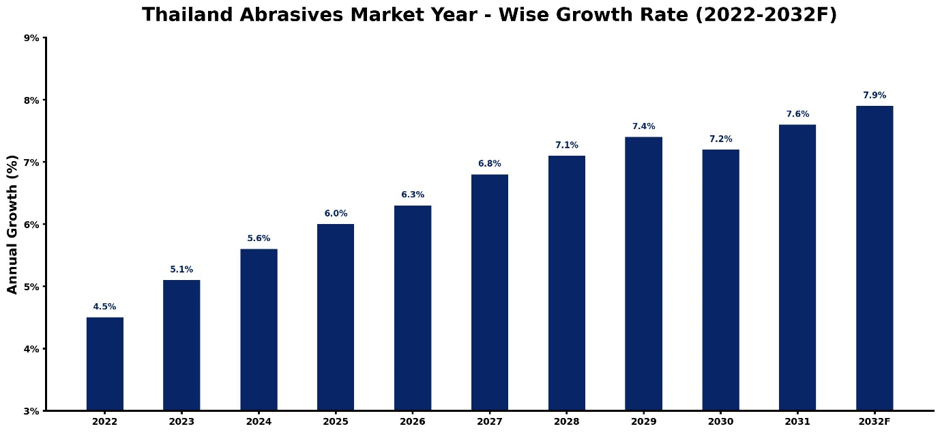
The following table summarizes the historical and forecasted growth rates of the Thailand Abrasives Market, along with the rationale behind each year’s performance.
| Year | Estimated Growth (%) | Market Rationale |
| 2022 | 4.5% | Post-pandemic recovery in manufacturing and construction activities supports baseline demand for abrasives. |
| 2023 | 5.1% | Rising automotive production and metal fabrication activities increase abrasives usage. |
| 2024 | 5.6% | Growth in construction projects and industrial machinery maintenance boosts demand. |
| 2025 | 6% | Expansion of manufacturing exports and infrastructure development strengthens market growth. |
| 2026 | 6.3% | Increased adoption of precision machining and industrial automation supports abrasives demand. |
| 2027 | 6.8% | Strong growth in automotive component manufacturing and metal finishing applications. |
| 2028 | 7.1% | Rising demand from shipbuilding, aerospace components, and heavy engineering sectors. |
| 2029 | 7.4% | Growth in high-performance abrasives for precision engineering and advanced manufacturing. |
| 2030 | 7.2% | Slight moderation due to raw material cost fluctuations and global economic slowdown impact. |
| 2031 | 7.6% | Recovery driven by export growth and industrial modernization initiatives. |
| 2032 | 7.9% | Mature expansion phase with strong adoption in advanced manufacturing and precision industries. |
Topics Covered in the Thailand Abrasives Market Report
The Thailand Abrasives Market report covers the market by Raw Material, Type, Product, Form, Application, and End-Use. The report provides a detailed analysis of ongoing market trends, opportunities/high-growth areas, and key market drivers that will help stakeholders align strategies with current and future market dynamics.
Thailand Abrasives Market Highlights
| Report Name | Thailand Abrasives Market |
| Forecast period | 2026–2032 |
| CAGR | 7.3% |
| Growing Sector | Manufacturing |
Thailand Abrasives Market Synopsis
The Thailand Abrasives Market is experiencing a massive growth due to growing construction works, automobile production, and growing demand for precision engineering and surface finishing. Abrasives refer to industrial materials that are used for purposes such as grinding, cutting, polishing, drilling and surface finishing in the construction, automotive and manufacturing industries. The growth of industrial sector, developments in infrastructure and increase in the adoption of advanced manufacturing technologies also contribute to the growth of this market.
Evaluation of Growth Drivers in Thailand Abrasives Market (2026–2032)
Below are some major drivers and their influence on the market dynamics:
| Drivers | Primary Segment | What This Means |
| Growth in construction and infrastructure projects | New Civil Engineering | Increases demand for grinding, cutting, and finishing materials in large-scale projects |
| Expansion of automotive manufacturing sector | Grinding | Drives demand for precision surface finishing and metal polishing applications |
| Rising industrial manufacturing activities | Bonded Abrasive | Supports higher usage in fabrication, machining, and production processes |
| Increasing renovation and remodeling activities | Residential Renovation | Boosts demand for coated abrasives used in polishing and surface preparation |
| Adoption of advanced manufacturing technologies | Super Abrasive | Enhances usage of high-performance abrasives for precision engineering applications |
The Thailand Abrasives Market growth is expected to surge at a CAGR of around 7.3% during 2026–2032. This growth is boosting due to strong growth in construction, automotive, and industrial manufacturing operations. The growth in infrastructure development and renovation projects further maintain the demand for grinding, cutting, and polishing materials. Moreover, growing trends of adopting new manufacturing technologies and precision engineering techniques in Thailand are contributing positively to the adoption of high-quality abrasives in various end-user industries.
Evaluation of Restraints in Thailand Abrasives Market
Below are some major restraints and their influence on the market dynamics:
| Restraints | Primary Segment | What This Means |
| Raw Material Price Volatility | Manufacturing & Production | Fluctuating costs for inputs like aluminum oxide and silicon carbide squeeze profit margins and disrupt supply chain planning. |
| Stringent Environmental Compliance | Regulatory & Operations | Increasing regulations regarding waste disposal raise demand expensive compliance investments. |
| Market Fragmentation | Competitive Landscape | A highly fragmented market with numerous global and local players increases price competition, which makes it difficult to maintain brand loyalty. |
| Substitution Risks | Technology & Tools | Increasing adoption of non-abrasive technologies such as laser cutting and waterjet machining in high-precision industries affected the demand for traditional abrasives. |
| Import & Tariff Barriers | Logistics & Supply Chain | Complex customs procedures, import licensing requirements, and tariff structures can increase the cost and lead time for high-quality imported abrasive materials. |
Thailand Abrasives Market Challenges
The Thailand abrasives market has a number of challenges, which include heavy reliance on imported raw materials such as alumina, silicon carbide, and industrial diamonds, which exposes manufacturers to global price volatility and supply chain disruptions. Domestic production capacity for high-quality abrasive materials remains limited, making it difficult to achieve cost competitiveness against established international suppliers. The market also struggles with inconsistent availability of skilled labor for precision manufacturing and advanced finishing applications, which affects productivity and quality standards.
Trends in the Thailand Abrasives Market
Some of the key trends shaping the Thailand Abrasives Market are:
- Focus on high-performance super abrasives: The growing trend in industries like automotive and precision engineering is of using diamond and CBN-based abrasives for cutting and finishing applications.
- Demand from construction and infrastructure works: There is a continuous consumption of abrasives with increasing large-scale civil engineering and urban development projects. Where they are used for grinding and cutting applications related to concrete, steel, and stone.
- Demand from automotive manufacturing and EVs: The increasing automotive manufacturing industry in Thailand, including the manufacturing of electric vehicles, is creating a demand for surface finishing and metal polishing abrasives.
Investment Opportunities in Thailand Abrasives Market
The following are some of the major investment opportunities in the Thailand Abrasives Market:
- Establishment of super abrasives manufacturing units: There is an opportunity to invest in the production of diamond and CBN based abrasives due to their rising demand in the precision industries.
- Supply of abrasives to automotive OEM and EVs: The strong automotive manufacturing base in Thailand provides scope for establishing abrasive supply chains.
- Civil engineering and construction material supply chains: The investment in the distribution network of abrasives used in civil engineering and urban construction projects is very promising.
Top Leading Players in Thailand Abrasives Market
Stated below are some of the leading companies contributing significantly to the Thailand Abrasives Market:
1. Saint-Gobain Abrasives (Thailand) Ltd.
| Company Name | Saint-Gobain Abrasives (Thailand) Ltd. |
|---|---|
| Established Year | 1997 |
| Headquarters | Bangkok, Thailand |
| Official Website | Click Here |
A leader in the Thai abrasives industry, the company provides a complete portfolio of high-performance abrasive products.
2. Dia Resibon (Thailand) Co., Ltd.
| Company Name | Dia Resibon (Thailand) Co., Ltd. |
|---|---|
| Established Year | 1987 |
| Headquarters | Samut Prakan, Thailand |
| Official Website | Click Here |
A prominent manufacturer specializing in high-quality grinding wheels and cutting discs. As an oSa-certified member, they are recognized for adhering to strict international safety and quality standards, serving industrial markets across Thailand.
3. Bosun Tools (Thailand) Co., Ltd.
| Company Name | Bosun Tools (Thailand) Co., Ltd. |
|---|---|
| Established Year | 2011 |
| Headquarters | Thailand (Global operations via Bosun Tools) |
| Official Website | Click Here |
A key player in the diamond tool and abrasive segment, focusing on high-efficiency cutting and grinding products.
4. KingsBrite Co., Ltd.
| Company Name | KingsBrite Co., Ltd. |
|---|---|
| Established Year | 1989 |
| Headquarters | Ayutthaya, Thailand |
| Official Website | Click Here |
A specialist manufacturer of coated abrasives, including abrasive rolls, flap discs, and custom surface treatment solutions.
5. Yasun Abrasives Co., Ltd.
| Company Name | Yasun Abrasives Co., Ltd. |
|---|---|
| Established Year | 1977 |
| Headquarters | Zhejiang Province, China |
| Official Website | Click Here |
An established exporter and manufacturer of abrasive products, including cutting discs for industrial use.
Government Initiatives in the Thailand Abrasives Market
According to Thailand government data, there is an increasing trend in indirect support to the abrasives market through infrastructure development projects like Thailand 4.0, the Eastern Economic Corridor (EEC) project, and construction of highway and railway networks, smart cities. These initiatives boost demand for abrasives in construction and manufacturing. Expansion of EEC industry will promote production in automobile and electronic sectors, resulting in increased application of grinding and polishing abrasives. Besides, incentives for industrial modernization and foreign investment in manufacturing further encourage adoption of advanced machining and finishing technologies.
Future Insights of the Thailand Abrasives Market
The Thailand Abrasives Market is expected to grow steadily owing to some major factors, such as increasing construction activities, expanding automotive and manufacturing sectors, and rising infrastructure investments. Future demand will be driven by adoption of high-performance super abrasives and automation in industrial processes. Growth in renovation activities and precision engineering will further support market expansion. Along with this, technological advancements and increasing focus on efficiency and surface quality will boost the use of abrasives in various end-use industries, which makes sure sustained long-term growth in Thailand.
Market Segmentation Analysis
The report offers a comprehensive study of the following market segments and their leading categories in the Thailand Abrasives Market:
By Raw Material – Market Dominated by Synthetic Abrasives, Natural Abrasives Set for Steady Usage
According to Aditya Singh, Senior Research Analyst, 6Wresearch, till 2025, Synthetic abrasives dominated the Thailand Abrasives Market with an estimated 70% share, which was driven by superior performance, durability, and widespread use in automotive and industrial applications. From 2026–2032, Synthetic abrasives are also expected to remain dominant, growing steadily at a CAGR of around 5.8%, supported by increasing demand for high-precision machining.
By Application – Market Dominated by Grinding, Polishing Set for Rapid Expansion
Till 2025, Grinding applications dominated the market with an estimated 30.3% share, which was backed by a heavy usage in metal processing, construction, and manufacturing industries. From 2026–2032, Polishing applications are expected to grow fastest at a CAGR of around 6.7% on account of rising demand for high-quality surface finishing in automotive, electronics, and precision engineering sectors.
By End-Use – Market Dominated by New Civil Engineering, Automotive & Manufacturing Set for Rapid Expansion
Till 2025, New Civil Engineering dominated the Thailand Abrasives Market with an estimated 30.5% share, driven by large-scale infrastructure development and construction projects. From 2026–2032, Automotive and manufacturing-linked applications (New Non-Residential Construction segment influence) are expected to grow fastest at a CAGR of around 6.7%, supported by Thailand’s strong automotive base, EV expansion, and industrial modernization under Thailand 4.0 initiatives.
Note: Market size estimations and growth projections presented in this report are based on 6Wresearch's proprietary forecasting methodology, utilizing the latest available industry data, government publications, and primary research inputs.
Key Attractiveness of the Report:
- 10 Years of Market Numbers
- Historical Data Starting from 2022 to 2025
- Base Year: 2025
- Forecast Data until 2032
- Key Performance Indicators Impacting the Market
- Major Upcoming Developments and Projects
Key Highlights of the Report:
- Thailand Abrasives Market Outlook
- Market Size of Thailand Abrasives Market, 2025
- Forecast of Thailand Abrasives Market, 2032
- Historical Data and Forecast of Thailand Abrasives Revenues & Volume for the Period 2022- 2032
- Thailand Abrasives Market Trend Evolution
- Thailand Abrasives Market Drivers and Challenges
- Thailand Abrasives Price Trends
- Thailand Abrasives Porter's Five Forces
- Thailand Abrasives Industry Life Cycle
- Historical Data and Forecast of Thailand Abrasives Market Revenues & Volume By Raw Material for the Period 2022- 2032
- Historical Data and Forecast of Thailand Abrasives Market Revenues & Volume By Natural for the Period 2022- 2032
- Historical Data and Forecast of Thailand Abrasives Market Revenues & Volume By Synthetic for the Period 2022- 2032
- Historical Data and Forecast of Thailand Abrasives Market Revenues & Volume By Type for the Period 2022- 2032
- Historical Data and Forecast of Thailand Abrasives Market Revenues & Volume By Coated Abrasive for the Period 2022- 2032
- Historical Data and Forecast of Thailand Abrasives Market Revenues & Volume By Bonded Abrasive for the Period 2022- 2032
- Historical Data and Forecast of Thailand Abrasives Market Revenues & Volume By Super Abrasive for the Period 2022- 2032
- Historical Data and Forecast of Thailand Abrasives Market Revenues & Volume By Others for the Period 2022- 2032
- Historical Data and Forecast of Thailand Abrasives Market Revenues & Volume By Product for the Period 2022- 2032
- Historical Data and Forecast of Thailand Abrasives Market Revenues & Volume By Disc for the Period 2022- 2032
- Historical Data and Forecast of Thailand Abrasives Market Revenues & Volume By Cups for the Period 2022- 2032
- Historical Data and Forecast of Thailand Abrasives Market Revenues & Volume By Cylinder for the Period 2022- 2032
- Historical Data and Forecast of Thailand Abrasives Market Revenues & Volume By Sheet & Non- Woven Fabric for the Period 2022- 2032
- Historical Data and Forecast of Thailand Abrasives Market Revenues & Volume By Others for the Period 2022- 2032
- Historical Data and Forecast of Thailand Abrasives Market Revenues & Volume By Form for the Period 2022- 2032
- Historical Data and Forecast of Thailand Abrasives Market Revenues & Volume By Block for the Period 2022- 2032
- Historical Data and Forecast of Thailand Abrasives Market Revenues & Volume By Powdered for the Period 2022- 2032
- Historical Data and Forecast of Thailand Abrasives Market Revenues & Volume By Application for the Period 2022- 2032
- Historical Data and Forecast of Thailand Abrasives Market Revenues & Volume By Grinding for the Period 2022- 2032
- Historical Data and Forecast of Thailand Abrasives Market Revenues & Volume By Cutting for the Period 2022- 2032
- Historical Data and Forecast of Thailand Abrasives Market Revenues & Volume By Polishing for the Period 2022- 2032
- Historical Data and Forecast of Thailand Abrasives Market Revenues & Volume By Drilling for the Period 2022- 2032
- Historical Data and Forecast of Thailand Abrasives Market Revenues & Volume By Finishing for the Period 2022- 2032
- Historical Data and Forecast of Thailand Abrasives Market Revenues & Volume By Others for the Period 2022- 2032
- Historical Data and Forecast of Thailand Abrasives Market Revenues & Volume By End-Use for the Period 2022- 2032
- Historical Data and Forecast of Thailand Abrasives Market Revenues & Volume By New Residential Construction for the Period 2022- 2032
- Historical Data and Forecast of Thailand Abrasives Market Revenues & Volume By Residential Renovation for the Period 2022- 2032
- Historical Data and Forecast of Thailand Abrasives Market Revenues & Volume By New Non-Residential Construction for the Period 2022- 2032
- Historical Data and Forecast of Thailand Abrasives Market Revenues & Volume By Non-Residential Renovation for the Period 2022- 2032
- Historical Data and Forecast of Thailand Abrasives Market Revenues & Volume By New Civil Engineering for the Period 2022- 2032
- Historical Data and Forecast of Thailand Abrasives Market Revenues & Volume By Civil Engineering Renovation for the Period 2022- 2032
- Thailand Abrasives Import Export Trade Statistics
- Market Opportunity Assessment By Raw Material
- Market Opportunity Assessment By Type
- Market Opportunity Assessment By Product
- Market Opportunity Assessment By Form
- Market Opportunity Assessment By Application
- Market Opportunity Assessment By End-Use
- Thailand Abrasives Top Companies Market Share
- Thailand Abrasives Competitive Benchmarking By Technical and Operational Parameters
- Thailand Abrasives Company Profiles
- Thailand Abrasives Key Strategic Recommendations
Market Covered
The report offers an extensive study of the following market segments:
By Raw Material
- Natural
- Synthetic
By Type
- Coated Abrasive
- Bonded Abrasive
- Super Abrasive
- Others
By Product
- Disc
- Cups
- Cylinder
- Sheet & Non-Woven Fabric
- Others
By Form
- Block
- Powdered
By Application
- Grinding
- Cutting
- Polishing
- Drilling
- Finishing
- Others
By End-Use
- New Residential Construction
- Residential Renovation
- New Non-Residential Construction
- Non-Residential Renovation
- New Civil Engineering
- Civil Engineering Renovation






































