Thailand Accelerometer Market Growth Rate
According to 6Wresearch internal database and industry insights, the Thailand Accelerometer Market is expected to grow at an approximate compound annual growth rate (CAGR) of around 10.5% during the forecast period (2026–2032).
Thailand Accelerometer Market Year-wise Growth Rate and Key Drivers (2022–2032)
This graph illustrates the annual growth rates of the Thailand Accelerometer Market from 2022 to 2032, highlighting a steady upward trajectory and projected market expansion over the forecast period.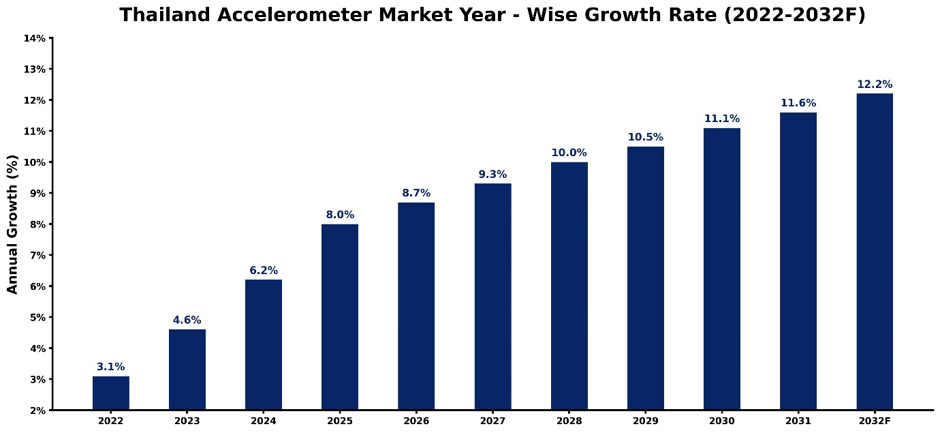 The following table summarizes the historical and forecasted growth rates of the Thailand Accelerometer Market, along with the rationale behind each year’s performance.
| Year | Estimated Growth (%) | Market Rationale |
| 2022 | 3.1% | Market recovery supported by improving electronics supply chains and automotive production revival. |
| 2023 | 4.6% | Growth driven by increasing adoption of smartphones, wearables, and industrial monitoring systems. |
| 2024 | 6.2% | Rising EV production and demand for automotive safety sensors supported market expansion. |
| 2025 | 8% | Increased deployment of accelerometers in smart manufacturing and connected devices boosted demand. |
| 2026 | 8.7% | Growth supported by EV ecosystem development, automation investments, and advanced sensing requirements. |
| 2027 | 9.3% | Expansion of Industry 4.0 initiatives and predictive maintenance applications increased adoption. |
| 2028 | 10% | Rising demand for 3-axis sensors in consumer electronics and automotive applications supported growth. |
| 2029 | 10.5% | Increased integration of sensors in IoT devices and intelligent vehicle systems accelerated adoption. |
| 2030 | 11.1% | Smart factory expansion and healthcare monitoring solutions strengthened accelerometer demand. |
| 2031 | 11.6% | Higher adoption of autonomous technologies and precision sensing applications drove growth. |
| 2032 | 12.2 % | Long-term growth supported by advanced automotive systems, industrial digitization, and sensor innovation. |
Topics Covered in the Thailand Accelerometer Market Report
The Thailand Accelerometer Market report covers the market by type, axis, and end-use industry. The report provides an in-depth analysis of ongoing market trends, opportunities, and growth drivers, enabling stakeholders to align strategies with current and future market dynamics.
Thailand Accelerometer Market Highlights
| Report Name | Thailand Accelerometer Market |
| Forecast period | 2026-2032 |
| CAGR | 10.5% |
| Growing Sector | Automotive |
Thailand Accelerometer Market Synopsis
The growth in the Thailand Accelerometer Market can be attributed to the increasing usage of motion detection technologies in applications from automotive, consumer electronics, healthcare to industrial uses. An accelerometer is a motion sensor that helps detect linear acceleration, vibration and changes in tilt to track movements accurately. Some of the driving factors behind this market include growing demand for smartphones, automobile security systems, monitoring devices and wearable technologies in the healthcare sector.
Evaluation of Growth Drivers in Thailand Accelerometer Market (2026–2032)
Below are some major drivers and their influence on the market dynamics:
| Drivers | Primary Segment Affected | Why It Matters (Evidence) |
| Increasing Adoption of Wearable Devices | Consumer Electronics, 3-Axis | Growing demand for fitness trackers and smart devices is increasing the need for compact motion sensors. |
| Expansion of Smart Manufacturing | Industrial, AC Response | Automation and predictive maintenance systems are driving demand for vibration monitoring accelerometers. |
| Growth of Vehicle Safety Technologies | Automotive, 3-Axis | Advanced safety features such as electronic stability control require accurate motion sensing solutions. |
| Rising Healthcare Monitoring Applications | Healthcare, DC Response | Remote patient monitoring and medical devices are increasing adoption of precision accelerometers. |
| Development of Aerospace and Defense Systems | Aerospace & Defense, High Accuracy Sensors | Navigation, stabilization, and unmanned systems require reliable acceleration measurement technologies. |
The Thailand Accelerometer Market is projected to grow at a CAGR of 10.5% during 2026–2032, driven by rising automation and adoption of technology in automobiles, as well as increasing number of connected devices. In addition, the manufacturing industry accounts for about 25% to 30% of Thailand’s GDP, generating demand for industrial sensors that are used in automation processes. Consumer electronics are increasingly becoming popular with over 90% of the population owning smartphones, leading to high demand for miniature motion sensors.
Evaluation of Restraints in Thailand Accelerometer Market
Below are some major restraints and their influence on the market dynamics:
| Restraints | Primary Segment Affected | What This Means (Evidence) |
| High Sensor Calibration Requirements | Aerospace & Defense, Industrial | Precision applications require frequent calibration, increasing operational costs. |
| Dependence on Imported Components | AC Response, DC Response | Reliance on global semiconductor supply chains increases procurement risks. |
| Limited Domestic Sensor Manufacturing | Advanced Accelerometers | Thailand has limited local production of high-end sensor components. |
| Price Competition Among Suppliers | Consumer Electronics, Automotive | Competitive pricing pressures affect supplier margins and innovation investment. |
| Technical Integration Complexity | Automotive, Industrial | Integration with software platforms and control systems requires specialized expertise. |
Thailand Accelerometer Market Challenges
Some of the issues faced by the Thailand Accelerometer Market include technology dependence, component sourcing limitations and growing demand for high accuracy sensors. Dependence on imported semiconductor materials may create supply fluctuations, while competition among global sensor providers increases pricing pressure. Along with this, developing skilled expertise in sensor technologies and embedded systems remains essential for supporting local innovation and long-term Thailand Accelerometer Market growth.
Thailand Accelerometer Market Trends
Principal trends driving the Thailand Accelerometer Market Growth are outlined below:
- Faster Growth of Wearable and Intelligent Consumer Electronics: Accelerometers are becoming key component in smart watches, fitness trackers, mobile phones, and gaming gadgets due to increasing demand for connected consumer electronics.
- Burgeoning Technology of Health Care Monitoring Devices: Increasing use of connected health care devices is resulting in growing demand for accelerometers for various applications in medical wearable devices and patient activity tracking.
- Technological Advancements in Aerospace and Navigation Applications: High precision accelerometers are required in unmanned systems and stabilization platforms, where advanced accelerometers provide improved accuracy.
Investment Opportunities in the Thailand Accelerometer Market
Major investment opportunities in the Thailand Accelerometer Market are presented below:
- Local Manufacturing of MEMS-Based Accelerometers: In terms of reducing imports and promoting local manufacturing, setting up the facilities for manufacturing MEMS accelerometers would be advantageous to Thailand, particularly due to its increasing automotive.
- IIoT and Smart Factory Solutions: Firms involved in manufacturing accelerometer-based predictive maintenance solutions and automation systems is a significant opportunity to take advantage of Industry 4.0 in Thailand.
- Applications of Health Wearable Sensor: Opportunities may emerge for the development of low-power accelerometer solutions for health monitoring devices and fitness technologies.
Top Players in Thailand Accelerometer Market
A comprehensive list of major companies participating in the Thailand Accelerometer Market is provided below:
1. Bosch Sensortec
| Company Name | Bosch Sensortec |
|---|---|
| Established Year | 2005 |
| Headquarters | Reutlingen, Germany |
| Official Website | Click Here |
Bosch Sensortec develops MEMS-based accelerometers used in automotive, consumer electronics, industrial, and wearable applications.
2. STMicroelectronics
| Company Name | STMicroelectronics |
|---|---|
| Established Year | 1987 |
| Headquarters | Geneva, Switzerland |
| Official Website | Click Here |
STMicroelectronics offers a broad portfolio of MEMS accelerometers supporting automotive, industrial automation, healthcare devices, and consumer electronics applications.
3. Analog Devices Inc.
| Company Name | Analog Devices Inc. |
|---|---|
| Established Year | 1965 |
| Headquarters | Wilmington, Massachusetts, USA |
| Official Website | Click Here |
Analog Devices provides precision accelerometer solutions for industrial, automotive, aerospace, and measurement applications requiring high reliability and accuracy.
4. Honeywell International Inc.
| Company Name | Honeywell International Inc. |
|---|---|
| Established Year | 1906 |
| Headquarters | Charlotte, North Carolina, USA |
| Official Website | Click Here |
Honeywell develops advanced inertial sensing technologies, including high-performance accelerometers used in aerospace, defense, and industrial applications.
5. TDK Corporation
| Company Name | TDK Corporation |
|---|---|
| Established Year | 1935 |
| Headquarters | Tokyo, Japan |
| Official Website | Click Here |
TDK provides MEMS-based motion sensors and accelerometer solutions used in automotive electronics, industrial systems, and consumer devices.
Government Initiatives being implemented in the Thailand Accelerometer Market
According to Thai government data, the country is strengthening its advanced electronics and smart manufacturing ecosystem through programs such as Thailand 4.0, the Eastern Economic Corridor (EEC) development plan, and electric vehicle promotion policies. These initiatives encourage investments in automation, semiconductor technologies, and intelligent manufacturing solutions. For instance, the Thailand Board of Investments (BOI) offers incentives for high-tech industries, which helps in developing electronic components, sensors, and automotive solutions resulting in faster growth of accelerometers.
Future Insights of the Thailand Accelerometer Market
The Thailand Accelerometer Market is expected to witness steady expansion, driven by digitalization, automotive innovations, and industrialization in the country. Thailand's electronics sector contributes around 15% of the export of manufactured products in the country, and thus, offers opportunities for sensor integration across multiple sectors. Moreover, EV sector in the country is estimated to grow rapidly, and EVs are estimated to account for more than 20% of the total sales of vehicles. Moreover, the country's high investment in industrial automation and smart factories results in improvement in efficiency by about 10-20%.
Market Segmentation Analysis
This report presents a detailed analysis of the Thailand Accelerometer Market segments along with their leading categories.
By Type – DC Response Segment Dominated the Market, AC Response to Witness Growth in Industrial Applications
According to Sachin, Senior Research Analyst, 6Wresearch, the DC Response segment dominated the Thailand Accelerometer Market till 2025, accounting for an estimated 68% market share, driven by widespread adoption in automotive systems, consumer electronics, and healthcare devices. However, during 2026–2032, the AC Response segment is expected to witness faster growth, expanding at a CAGR of 10.4%, supported by increasing demand for vibration analysis.
By End-use Industry – Automotive Led the Market, Industrial to Show Rapid Expansion
The Automotive segment dominated the Thailand Accelerometer Market till 2025 with an estimated 30% market share, driven by increasing integration of accelerometers in vehicle safety systems. During 2026–2032, the Industrial segment is expected to show significant growth, expanding at a CAGR of 11.2% on account of smart manufacturing, robotics adoption, and predictive maintenance requirements.
By End-use Industry – Consumer Electronics Led the Market, Aerospace & Defense Drives High-Precision Adoption
The Consumer Electronics segment held a significant Thailand Accelerometer Market share till 2025 with an estimated 30% market share, which was driven by high penetration of smartphones and gaming devices requiring compact motion sensors. However, during 2026–2032, Aerospace & Defense applications are expected to register strong growth with a CAGR of 9.8% on account of increasing demand for navigation systems and precision measurement technologies.
Note: Market size estimations and growth projections presented in this report are based on 6Wresearch's proprietary forecasting methodology, utilizing the latest available industry data, government publications, and primary research inputs.
Key Attractiveness of the Report:
- 10 Years of Market Numbers
- Historical Data Starting from 2022 to 2025
- Base Year: 2025
- Forecast Data until 2032
- Key Performance Indicators Impacting the Market
- Major Upcoming Developments and Projects
Key Highlights of the Report:
- Thailand Accelerometer Market Outlook
- Market Size of Thailand Accelerometer Market, 2025
- Forecast of Thailand Accelerometer Market, 2032
- Historical Data and Forecast of Thailand Accelerometer Revenues & Volume for the Period 2022-2032
- Thailand Accelerometer Market Trend Evolution
- Thailand Accelerometer Market Drivers and Challenges
- Thailand Accelerometer Price Trends
- Thailand Accelerometer Porter's Five Forces
- Thailand Accelerometer Industry Life Cycle
- Historical Data and Forecast of Thailand Accelerometer Market Revenues & Volume By Type for the Period 2022-2032
- Historical Data and Forecast of Thailand Accelerometer Market Revenues & Volume By AC Response for the Period 2022-2032
- Historical Data and Forecast of Thailand Accelerometer Market Revenues & Volume By DC Response for the Period 2022-2032
- Historical Data and Forecast of Thailand Accelerometer Market Revenues & Volume By Axis for the Period 2022-2032
- Historical Data and Forecast of Thailand Accelerometer Market Revenues & Volume By 1-Axis for the Period 2022-2032
- Historical Data and Forecast of Thailand Accelerometer Market Revenues & Volume By 2-Axis for the Period 2022-2032
- Historical Data and Forecast of Thailand Accelerometer Market Revenues & Volume By 3-Axis for the Period 2022-2032
- Historical Data and Forecast of Thailand Accelerometer Market Revenues & Volume By End-use Industry for the Period 2022-2032
- Historical Data and Forecast of Thailand Accelerometer Market Revenues & Volume By Consumer Electronics for the Period 2022-2032
- Historical Data and Forecast of Thailand Accelerometer Market Revenues & Volume By Automotive for the Period 2022-2032
- Historical Data and Forecast of Thailand Accelerometer Market Revenues & Volume By Healthcare for the Period 2022-2032
- Historical Data and Forecast of Thailand Accelerometer Market Revenues & Volume By Aerospace & Defense for the Period 2022-2032
- Historical Data and Forecast of Thailand Accelerometer Market Revenues & Volume By Industrial for the Period 2022-2032
- Historical Data and Forecast of Thailand Accelerometer Market Revenues & Volume By Others for the Period 2022-2032
- Thailand Accelerometer Import Export Trade Statistics
- Market Opportunity Assessment By Type
- Market Opportunity Assessment By Axis
- Market Opportunity Assessment By End-use Industry
- Thailand Accelerometer Top Companies Market Share
- Thailand Accelerometer Competitive Benchmarking By Technical and Operational Parameters
- Thailand Accelerometer Company Profiles
- Thailand Accelerometer Key Strategic Recommendations
Market Covered
The report offers an extensive study of the following market segments:
By Type
- AC Response
- DC Response
By Axis
- 1-Axis
- 2-Axis
- 3-Axis
By End-use Industry
- Consumer Electronics
- Automotive
- Healthcare
- Aerospace & Defense
- Industrial
- Others






































