Thailand Acephate Market Growth Rate
According to 6Wresearch internal database and industry insights, the Thailand Acephate Market is projected to grow at a compound annual growth rate (CAGR) of around 4.6% during the forecast period of 2026–2032.
Thailand Acephate Market Year-wise Growth Rate and Key Drivers (2022-2032)
This graph illustrates the annual growth rates of the Thailand Acephate Market from 2022 to 2032, highlighting a steady upward trajectory and projected market expansion over the forecast period.
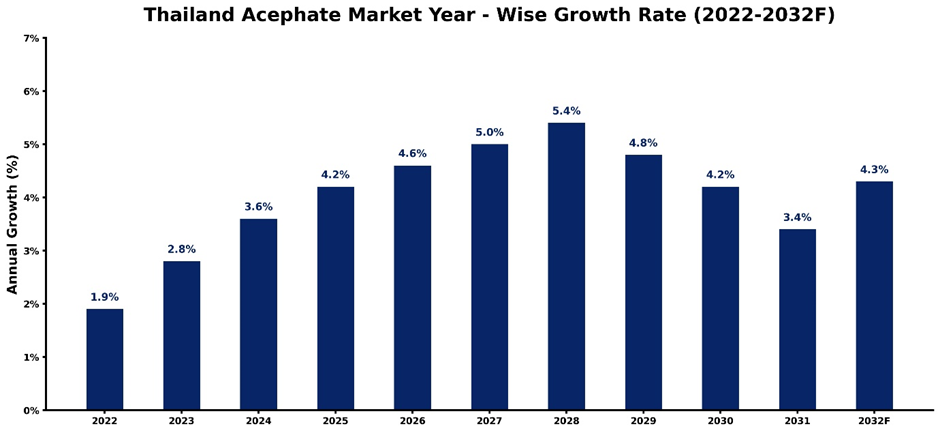
The following table summarizes the historical and forecasted growth rates of the Thailand Acephate Market, along with the rationale behind each year’s performance.
| Year | Estimated Growth (%) | Market Rationale |
| 2022 | 1.9% | Market recovery supported by improved agricultural activities and gradual restoration of crop protection demand after pandemic disruptions. |
| 2023 | 2.8% | Growth driven by increasing pest management requirements and rising demand for insecticides in crop cultivation. |
| 2024 | 3.6% | Expansion supported by higher crop production activities and increased adoption of chemical pest control solutions. |
| 2025 | 4.2% | Demand increased due to commercial farming expansion and growing need to reduce crop losses from insect infestations. |
| 2026 | 4.6% | Market growth supported by rising agricultural productivity initiatives, improved pesticide distribution, and crop protection awareness. |
| 2027 | 5% | Growth driven by adoption of efficient spray applications and increasing demand from large-scale farming operations. |
| 2028 | 5.4% | Expansion supported by precision agriculture adoption, improved pest monitoring, and increasing commercial crop cultivation. |
| 2029 | 4.8% | Growth remains positive, although regulatory focus on pesticide usage and sustainable farming practices slightly limits expansion. |
| 2030 | 4.2% | Market continues growing due to replacement demand and continued use of insecticides in major agricultural applications. |
| 2031 | 3.4% | Growth moderates as alternative pest control solutions gain adoption and pesticide regulations become stricter. |
| 2032 | 4.3% | Stable growth supported by ongoing agricultural demand, improved formulations, and balanced chemical pest management practices. |
Topics Covered in the Thailand Acephate Market Report
The Thailand Acephate Market report covers the market by Type, Application, and End User. The report provides a detailed analysis of ongoing market trends, growth opportunities/high-growth areas, and key market drivers that will help stakeholders align strategies with current and future market dynamics.
Thailand Acephate Market Highlights
| Report Name | Thailand Acephate Market |
| Forecast period | 2026-2032 |
| CAGR | 4.6% |
| Growing Sector | Agriculture & Agrochemicals |
Thailand Acephate Market Synopsis
There is a consistent demand in the Thailand Acephate Market as a result of increased agricultural activities, rising crop protection requirements, and pest management needs. Acephate is an organophosphate insecticide which is commonly used for controlling sucking and chewing pests among vegetables, fruits, and field crops. The main factors that contribute to the growth of the market include increasing agricultural output, pest infestation concerns, and use of crop protection chemicals by farmers.
Evaluation of Growth Drivers in Thailand Acephate Market (2026–2032)
Below are some major drivers and their influence on the market dynamics:
| Drivers | Primary Segment | What This Means |
| Pest Control Demand | Agriculture | High necessity to protect staple crops from recurring tropical insect outbreaks. |
| Yield Optimization | Commercial Farming | Increased application to meet rising food demand and maximize output per hectare. |
| Residual Efficacy | Crop Protection | Preference for insecticides that provide long-lasting defense against infestations. |
| Agricultural Modernization | Technology | Adoption of precision spraying tools leads to more efficient product delivery. |
| Export Competitiveness | Horticulture | Disciplined use of inputs to maintain quality standards for international trade. |
The Thailand Acephate Market is projected to grow at a CAGR of approximately 4.6% during 2026–2032. Some of the major factors that are contributing to market growth include increased agricultural output, rising pest infestation concerns, and growing demand for effective crop protection. Agriculture contributes approximately 8% of GDP in Thailand, where there is increased cultivation of rice, fruits, vegetables, and commercial crops, which is driving insecticides demand. Moreover, increased demand for high yield crops, export quality produce, and horticulture are expected to drive market growth at a rate of 4%-6% per year during the forecast period.
Evaluation of Restraints in Thailand Acephate Market
Below mentioned are some major restraints and their influence on the market dynamics:
| Restraints | Primary Segment | What This Means |
| Environmental Regulations | Public Policy | Tightening controls on chemical runoff and water source contamination. |
| Sustainable Farming Shift | Organic Sector | Growing consumer and policy pressure toward organic and biological alternatives. |
| Health & Safety Concerns | Occupational Health | Increased monitoring of farmer exposure to organophosphates during application. |
| Food Residue Standards | Export Markets | Stringent Maximum Residue Limits (MRLs) required for international trade access. |
| Resistance Management | Pest Control | Potential for declining efficacy necessitating shifts toward complex rotation cycles. |
Thailand Acephate Market Challenges
The market faces structural shifts as the agricultural sector pivots toward sustainability, with government and consumer groups pushing for alternatives to traditional synthetic pesticides. The process of regulatory oversight becomes more stringent with the advent of monitoring processes that concentrate on the environmental implications of organophosphate contamination and occupational health risks for farmers. Moreover, in order to access the export markets, the producers need to comply with increasingly strict safety guidelines. The market therefore requires an effective transition towards highly targeted application methods, balanced with ongoing education regarding safe handling to ensure long-term viability.
Trends in the Thailand Acephate Market
Below are some of the major trends shaping the industry growth, including:
- Preference for effective methods of application: Farmers are gradually moving towards spray-based methods of applying pesticides owing to their effectiveness in covering large cultivation areas and improving pest control efficiency.
- Increased emphasis on integrated pest management techniques: Use of integrated pest management is influencing pesticide usage patterns, encouraging optimized and targeted application of insecticides.
- Agricultural mechanization: Increase in the level of mechanization of agriculture is encouraging the implementation of advanced crop protection techniques, which includes improvement in the use of insecticides.
Investment Opportunities in the Thailand Acephate Market
Some of the areas in which investments will be profitable include:
- Strengthening agricultural chemical distribution channels: Improvement of distribution channel in rural farming areas may help increase accessibility of the product.
- Implementation of precision agriculture: Integration of pesticide application with digital farming technologies can help increase efficiency of chemicals and reduce their wastage.
- Increasing emphasis on commercial farming: Increase in investment in commercial farming and plantations provides opportunities for the suppliers of Acephate catering to commercial consumers.
Top Leading Players in Thailand Acephate Market
Stated below are some of the leading companies contributing significantly to the growth of the Thailand Acephate Market share:
Government Initiatives in the Thailand Acephate Market
According to Thai government data, agricultural modernization programs under the Thailand 4.0 strategy, support from the Ministry of Agriculture and Cooperatives, and initiatives promoting smart farming have encouraged efficient crop protection measures. Projects like the Smart Farmer project and digital agriculture development projects are there to increase farm productivity through the adoption of technology and better management of resources. Moreover, measures related to GAP certification and sustainable use of pesticides are also shaping the implementation of efficient crop protection solutions like insecticides such as Acephate.
Future Insights of the Thailand Acephate Market
The Thailand Acephate Market will see growth in the coming years due to increased demand for crop protection chemicals, growing need for agricultural productivity, and increasing commercial farming activities. With the agriculture sector providing about 8% of Thailand's GDP, demand for insecticides will be supported by this industry as far as cultivation of crops like rice, fruits, and vegetables is concerned. Spray applications will be dominant in the coming years accounting for more than 50% of the total application by 2032.
Market Segmentation Analysis
The report offers a comprehensive study of the following market segments and their leading categories in the Thailand Acephate Market:
By Type – Organo Phosphorus Dominated the Market, Natural Sources Segment Expected to Gain Momentum
According to Sumit Sagar, Senior Research Analyst, 6Wresearch, the Organo Phosphorus segment dominated the Thailand Acephate Market with an estimated 60% share in 2025, driven by its widespread application in agricultural pest control. From 2026–2032, the Natural Sources segment is expected to witness increasing adoption with a CAGR of around 4.2%, supported by growing demand for environmentally sustainable pest management solutions.
By End User – Agriculture Dominated the Market, Commercial Segment Expected to Grow Significantly
The Agriculture segment dominated the Thailand Acephate Market with an estimated 75% share in 2025, driven by increasing insecticide demand across rice farming, horticulture, and commercial crop production. From 2026–2032, The Commercial segment is expected to witness the highest growth with a CAGR of around 5.2%, supported by expansion of large-scale farming operations, plantation activities, and professional pest management services requiring effective insect control solutions.
Note: Market size estimations and growth projections presented in this report are based on 6Wresearch's proprietary forecasting methodology, utilizing the latest available industry data, government publications, and primary research inputs.
Key Attractiveness of the Report:
- 10 Years of Market Numbers
- Historical Data Starting from 2022 to 2025
- Base Year: 2025
- Forecast Data until 2032
- Key Performance Indicators Impacting the Market
- Major Upcoming Developments and Projects
Key Highlights of the Report:
- Thailand Acephate Market Outlook
- Market Size of Thailand Acephate Market, 2025
- Forecast of Thailand Acephate Market, 2032
- Historical Data and Forecast of Thailand Acephate Revenues & Volume for the Period 2022-2032
- Thailand Acephate Market Trend Evolution
- Thailand Acephate Market Drivers and Challenges
- Thailand Acephate Price Trends
- Thailand Acephate Porter's Five Forces
- Thailand Acephate Industry Life Cycle
- Historical Data and Forecast of Thailand Acephate Market Revenues & Volume By Type for the Period 2022-2032
- Historical Data and Forecast of Thailand Acephate Market Revenues & Volume By Organo Chlorine for the Period 2022-2032
- Historical Data and Forecast of Thailand Acephate Market Revenues & Volume By Organo Phosphorus for the Period 2022-2032
- Historical Data and Forecast of Thailand Acephate Market Revenues & Volume By Carbamate for the Period 2022-2032
- Historical Data and Forecast of Thailand Acephate Market Revenues & Volume By Arsenicals for the Period 2022-2032
- Historical Data and Forecast of Thailand Acephate Market Revenues & Volume By Natural Sources for the Period 2022-2032
- Historical Data and Forecast of Thailand Acephate Market Revenues & Volume By Others for the Period 2022-2032
- Historical Data and Forecast of Thailand Acephate Market Revenues & Volume By Application for the Period 2022-2032
- Historical Data and Forecast of Thailand Acephate Market Revenues & Volume By Spray for the Period 2022-2032
- Historical Data and Forecast of Thailand Acephate Market Revenues & Volume By Dipping Vat for the Period 2022-2032
- Historical Data and Forecast of Thailand Acephate Market Revenues & Volume By Hand Dressing for the Period 2022-2032
- Historical Data and Forecast of Thailand Acephate Market Revenues & Volume By Others for the Period 2022-2032
- Historical Data and Forecast of Thailand Acephate Market Revenues & Volume By End-User for the Period 2022-2032
- Historical Data and Forecast of Thailand Acephate Market Revenues & Volume By Agriculture for the Period 2022-2032
- Historical Data and Forecast of Thailand Acephate Market Revenues & Volume By Animal Husbandry for the Period 2022-2032
- Historical Data and Forecast of Thailand Acephate Market Revenues & Volume By Commercial for the Period 2022-2032
- Historical Data and Forecast of Thailand Acephate Market Revenues & Volume By Others for the Period 2022-2032
- Thailand Acephate Import Export Trade Statistics
- Market Opportunity Assessment By Type
- Market Opportunity Assessment By Application
- Market Opportunity Assessment By End-User
- Thailand Acephate Top Companies Market Share
- Thailand Acephate Competitive Benchmarking By Technical and Operational Parameters
- Thailand Acephate Company Profiles
- Thailand Acephate Key Strategic Recommendations
Market Covered
The report offers an extensive study of the following market segments:
By Type
- Organo Chlorine
- Organo Phosphorus
- Carbamate
- Arsenicals
- Natural Sources
- Others
By Application
- Spray
- Dipping Vat
- Hand Dressing
- Others
By End User
- Agriculture
- Animal Husbandry
- Commercial
- Others






































