Thailand Acetone Market Growth Rate
According to 6Wresearch internal database and industry insights, the Thailand Acetone Market is projected to grow at a compound annual growth rate (CAGR) of around 5.9% during the forecast period of 2026–2032.
Thailand Acetone Market Year-wise Growth Rate and Key Drivers (2022-2032)
This graph illustrates the annual growth rates of the Thailand Acetone Market from 2022 to 2032, highlighting a steady upward trajectory and projected market expansion over the forecast period.
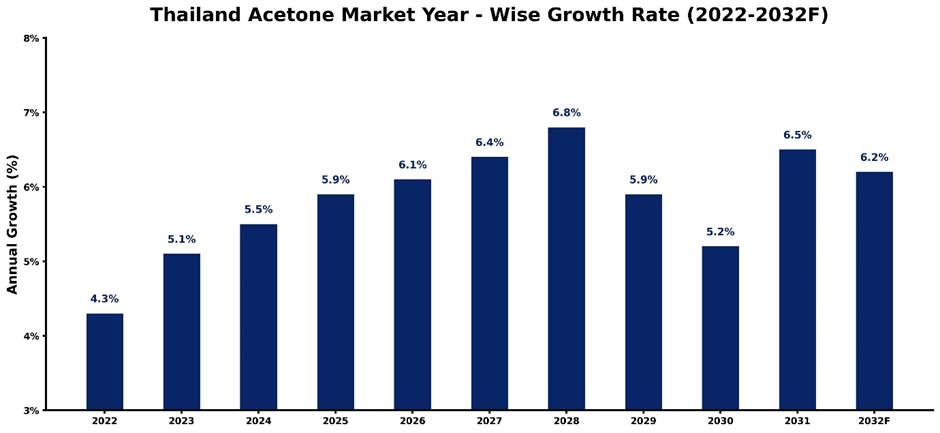 The following table summarizes the historical and forecasted growth rates of the Thailand Acetone Market, along with the rationale behind each year’s performance.
| Year | Estimated Growth (%) | Market Rationale |
| 2022 | 4.3% | Market recovery after pandemic-related slowdown increased demand from paints, coatings, and chemical processing industries. |
| 2023 | 5.1% | Rising industrial production and improving demand for solvents and plastic manufacturing supported market growth. |
| 2024 | 5.5% | Expansion of automotive, construction, and polymer industries increased acetone consumption. |
| 2025 | 5.9% | Higher demand from paints & coatings, adhesives, and pharmaceutical applications supported steady growth. |
| 2026 | 6.1% | Increasing BPA and MMA production, along with growth in chemical processing industries, is expected to strengthen demand. |
| 2027 | 6.4% | Rising plastic manufacturing and increasing adoption of acetone-based solvents in industrial applications are projected to drive growth. |
| 2028 | 6.8% | Expansion of electronics manufacturing and growing demand for high-purity acetone applications are expected to support market growth. |
| 2029 | 5.9% | Growth continues with stable industrial demand, while raw material price fluctuations may slightly moderate expansion. |
| 2030 | 5.2% | Increasing automotive production and polymer consumption are expected to create higher acetone demand. |
| 2031 | 6.5% | Growth in pharmaceutical, cosmetics, and specialty chemical applications is projected to enhance market expansion. |
| 2032 | 6.2% | Mature industrial demand and continued usage across solvents, plastics, and coatings will maintain steady market growth. |
Topics Covered in the Thailand Acetone Market Report
The Thailand Acetone Market report covers the market by Application and End-Use. The report provides a detailed analysis of market developments, demand patterns, emerging opportunities, and high-growth segments that enable stakeholders to understand present and future industry dynamics.
Thailand Acetone Market Highlights
| Report Name | Thailand Acetone Market |
| Forecast period | 2026-2032 |
| CAGR | 5.9% |
| Growing Sector | Paints, Coatings & Chemical Processing |
Thailand Acetone Market Synopsis
The Thailand Acetone Market is witnessing constant growth owing to increasing usage in the chemicals, automotive, construction, and consumer goods industries. Acetone is an extremely versatile organic solvent that are widely used for cleaning, thinning, and chemical synthesis applications. This organic compound is a basic raw material for the manufacturing of Bisphenol A (BPA) and Methyl Methacrylate (MMA). The rising industrial production, growing electronics manufacturing sector, and increasing usage of coatings and adhesives are projected to drive the market growth in the coming years.
Evaluation of Growth Drivers in Thailand Acetone Market (2026–2032)
Below mentioned are some major drivers and their influence on the market dynamics:
| Drivers | Primary Segment | What This Means |
| Expansion of Plastic and Polymer Manufacturing | BPA & MMA Production | Increasing production of polycarbonate plastics and acrylic materials is boosting acetone consumption. |
| Rising Demand for Industrial Solvents | Solvent Application | Growing usage in paints, coatings, adhesives, and cleaning formulations is supporting market growth. |
| Growth of Automotive Manufacturing | Automotive Industry | Increasing vehicle production is driving demand for coatings, plastics, and adhesive applications. |
| Increasing Pharmaceutical Production | Pharmaceutical Industry | Acetone usage in drug formulation, extraction, and processing is creating additional demand. |
| Expansion of Electronics Manufacturing | Electrical & Electronics | Rising demand for electronic components is increasing usage of acetone for cleaning and processing applications. |
The Thailand Acetone Market growth is projected to surge at a CAGR of approximately 5.9% during 2026–2032, which is supported by increasing demand from solvent, polymer, automotive, and electronics applications. Along with that, the Plastic industry contributed approximately 25% market share in 2025, while increasing electronics manufacturing and pharmaceutical production are expected to further accelerate acetone consumption during the forecast period. Additionally, the use of acetone in the production of downstream chemicals such as Bisphenol A (BPA) and Methyl Methacrylate (MMA) further supports market growth.
Evaluation of Restraints in Thailand Acetone Market
Below mentioned are some major restraints and their influence on the market dynamics:
| Restraints | Primary Segment | What This Means |
| Fluctuating Raw Material Prices | Chemical Manufacturing | Variations in propylene and benzene prices affect acetone production costs. |
| Environmental Regulations | Solvent Applications | Increasing restrictions on volatile organic compounds may impact solvent usage. |
| Import Dependency | Supply Chain | The dependence on international suppliers can cause problems with prices and availability. |
| Health and Safety Concerns | Industrial Users | Exposure risks require strict handling and storage measures. |
| Competition from Alternative Solvents | Solvent Segment | Adoption of eco-friendly alternatives may limit acetone demand in certain applications. |
Thailand Acetone Market Challenges
Some of the key issues faced by the Thailand Acetone Market are related to volatile raw material costs, stringent environment-related laws, and uncertainties in the supply chain. Around 40% of the fluctuation in production cost are influenced in feedstock availability and energy prices. The rising environmental legislation on volatile organic compounds (VOCs) may lead to the adoption of alternate solvents by various industries. Also, import dependency for acetone is likely to lead to increased pressure on pricing during supply chain disruption in the international market.
Trends in the Thailand Acetone Market
Below are some of the major trends shaping the industry growth, including:
- Growing Demand for Environmentally Friendly Acetone Products: The adoption of solvent technologies that have low emissions and are environmentally friendly to cater to regulatory needs, encouraging companies to produce sustainable acetone products.
- Increased Production of Polymers and Plastics: The increased requirement for plastics such as polycarbonates and acrylic materials is increasing acetone consumption for BPA and MMA manufacturing due to expanding applications in automotive components.
- Increased Production of Electronics: The increasing production of electronics in Thailand is supporting acetone use for cleaning purpose owing to the growing investments in semiconductors manufacturing and advanced manufacturing industries.
Investment Opportunities in Thailand Acetone Market
Some of the lucrative investment possibilities in Thailand acetone market include:
- Production of Domestic Acetone Products: Investment in domestic manufacturing plants can help cut down import dependency and support increasing demands from various industries through higher supply.
- Specialized Acetone Products: Manufacturers can consider the production of high-purity acetone products to meet the demands from specialized sectors such as pharmaceuticals.
- Environmentally Sustainable Chemical Products: Adoption of energy-efficient can enhance operational efficiencies and help companies align with future sustainability regulations in the chemical industry.
Top Leading Players in Thailand Acetone Market
Stated below are some of the leading companies contributing significantly to increase the Thailand Acetone Market share:
1. INEOS
| Company Name | INEOS |
|---|---|
| Established Year | 1998 |
| Headquarters | London, United Kingdom |
| Official Website | Click Here |
INEOS manufactures a wide range of petrochemicals and specialty chemicals, including acetone and related chemical intermediates used in industrial applications.
2. Mitsui Chemicals
| Company Name | Mitsui Chemicals |
|---|---|
| Established Year | 1997 |
| Headquarters | Tokyo, Japan |
| Official Website | Click Here |
Mitsui Chemicals produces performance chemicals and industrial materials, supplying acetone-related products for plastics, coatings, and chemical processing industries.
3. Shell
| Company Name | Shell |
|---|---|
| Established Year | 1907 |
| Headquarters | London, United Kingdom |
| Official Website | Click Here |
Shell provides chemical solutions and petrochemical products supporting industrial manufacturing and specialty chemical applications.
4. LyondellBasell Industries
| Company Name | LyondellBasell Industries |
|---|---|
| Established Year | 2007 |
| Headquarters | Houston, USA |
| Official Website | Click Here |
LyondellBasell produces chemicals and polymers used in plastics, automotive, packaging, and industrial applications.
5. LG Chem
| Company Name | LG Chem |
|---|---|
| Established Year | 1947 |
| Headquarters | Seoul, South Korea |
| Official Website | Click Here |
LG Chem develops petrochemical and advanced material solutions used across electronics, automotive, and industrial sectors.
Government Initiatives in the Thailand Acetone Market
Based on the data from the Thai government, Thailand’s chemical and petrochemical industry is being bolstered by industrial development programs, investment incentives, and infrastructure development. The Eastern Economic Corridor (EEC) project supports the development of advanced chemical manufacturing as well as downstream activities by investing in petrochemical and specialty chemical production. Furthermore, the government policy that is aimed at boosting electronics, automobile, and manufacturing industries indirectly boosts the use of acetone due to increased demand for plastics, paints, adhesive, and solvents.
Future Insights of the Thailand Acetone Market
The Thailand Acetone Market is predicted to grow positively owing to the growing demand for acetone from plastic manufacturing, automobile production, electronics assembly, and industrial paints. Increasing production of BPA and MMA, rise in pharmaceutical manufacturing, and growing use of acetone in high purity application are expected to open up new avenues in the market. Increasing investments in Thailand’s chemical and industrial infrastructure, along with rising focus on specialty solvent production, are further expected to support market growth over the forecast period.
Market Segmentation Analysis
The report offers a comprehensive study of the following market segments and their leading categories in the Thailand Acetone Market:
By Application – Solvent Segment Dominated the Market, Methyl Methacrylate (MMA) Expected to Witness Strong Growth
According to Sachin Kumar Rai, Senior Research Analyst, 6Wresearch, the Solvent segment dominated the Thailand Acetone Market with an estimated 40% share in 2025, owing to widespread utilization of acetone as a fast-evaporating solvent in paints & coatings. However, during 2026–2032, the Methyl Methacrylate (MMA) segment is expected to experience strong growth with a CAGR of around 6.6%, supported by increasing demand for acrylic plastics, polymer materials, automotive components, and transparent specialty products.
By End-Use – Paints & Coatings Segment Led the Market, Electrical & Electronics Sector Set for Higher Growth
In 2025, the Paints & Coatings segment accounted for an estimated 31% share of the Thailand Acetone Market, driven by rising construction activities. However, during 2026–2032, the Electrical & Electronics segment is expected to have significant growth with a CAGR of around 6.7%, which is supported by Thailand’s expanding electronics manufacturing industry.
Note: Market size estimations and growth projections presented in this report are based on 6Wresearch's proprietary forecasting methodology, utilizing the latest available industry data, government publications, and primary research inputs.
Key Attractiveness of the Report:
- 10 Years of Market Numbers
- Historical Data Starting from 2022 to 2025
- Base Year: 2025
- Forecast Data until 2032
- Key Performance Indicators Impacting the Market
- Major Upcoming Developments and Projects
Key Highlights of the Report:
- Thailand Acetone Market Outlook
- Market Size of Thailand Acetone Market, 2025
- Forecast of Thailand Acetone Market, 2032
- Historical Data and Forecast of Thailand Acetone Revenues & Volume for the Period 2022-2032F
- Thailand Acetone Market Trend Evolution
- Thailand Acetone Market Drivers and Challenges
- Thailand Acetone Price Trends
- Thailand Acetone Porter's Five Forces
- Thailand Acetone Industry Life Cycle
- Historical Data and Forecast of Thailand Acetone Market Revenues & Volume By Application for the Period 2022-2032F
- Historical Data and Forecast of Thailand Acetone Market Revenues & Volume By Solvent for the Period 2022-2032F
- Historical Data and Forecast of Thailand Acetone Market Revenues & Volume By Bisphenol A (BPA) for the Period 2022-2032F
- Historical Data and Forecast of Thailand Acetone Market Revenues & Volume By Methyl Methacrylate (MMA) for the Period 2022-2032F
- Historical Data and Forecast of Thailand Acetone Market Revenues & Volume By Others for the Period 2022-2032F
- Historical Data and Forecast of Thailand Acetone Market Revenues & Volume By End-Use for the Period 2022-2032F
- Historical Data and Forecast of Thailand Acetone Market Revenues & Volume By Paints & Coatings for the Period 2022-2032F
- Historical Data and Forecast of Thailand Acetone Market Revenues & Volume By Plastic for the Period 2022-2032F
- Historical Data and Forecast of Thailand Acetone Market Revenues & Volume By Automotive for the Period 2022-2032F
- Historical Data and Forecast of Thailand Acetone Market Revenues & Volume By Adhesives for the Period 2022-2032F
- Historical Data and Forecast of Thailand Acetone Market Revenues & Volume By Pharmaceuticals for the Period 2022-2032F
- Historical Data and Forecast of Thailand Acetone Market Revenues & Volume By Cosmetics for the Period 2022-2032F
- Historical Data and Forecast of Thailand Acetone Market Revenues & Volume By Electrical & Electronics for the Period 2022-2032F
- Historical Data and Forecast of Thailand Acetone Market Revenues & Volume By Others for the Period 2022-2032F
- Thailand Acetone Import Export Trade Statistics
- Market Opportunity Assessment By Application
- Market Opportunity Assessment By End-Use
- Thailand Acetone Top Companies Market Share
- Thailand Acetone Competitive Benchmarking By Technical and Operational Parameters
- Thailand Acetone Company Profiles
- Thailand Acetone Key Strategic Recommendations
Market Covered
The report offers an extensive study of the following market segments:
By Application
- Solvent
- Bisphenol A (BPA)
- Methyl Methacrylate (MMA)
- Others
By End-Use
- Paints & Coatings
- Plastic
- Automotive
- Adhesives
- Pharmaceuticals
- Cosmetics
- Electrical & Electronics
- Others






































