Thailand Acrylate Monomers Market Growth Rate
According to 6Wresearch internal database and industry insights, the Thailand Acrylate Monomers Market is expected to grow at a steady CAGR of approximately 6.4% during the forecast period of 2026–2032.
Thailand Acrylate Monomers Market Year-wise Growth Rate and Key Drivers (2022-2032)
This graph illustrates the annual growth rates of the Thailand Acrylate Monomers Market from 2022 to 2032, highlighting a steady upward trajectory and projected market expansion over the forecast period.
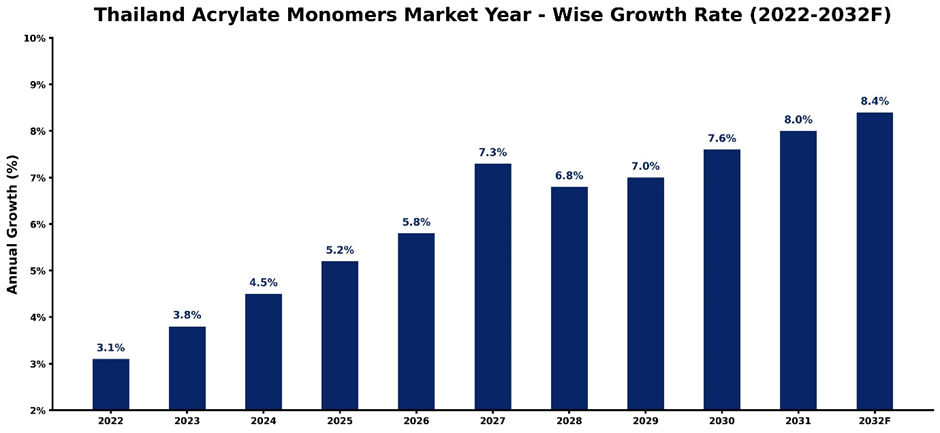
The following table summarizes the historical and forecasted growth rates of Thailand Acrylate Monomers Market, along with the rationale behind each year’s performance.
| Year | Estimated Annual Growth (%) | Market Rationale |
| 2022 | 3.1% | Recovery in construction, automotive, and coatings industries supported demand for acrylate monomers. |
| 2023 | 3.8% | Increasing consumption in adhesives, paints, and polymer production supported market expansion. |
| 2024 | 4.5% | Growth in industrial manufacturing and rising demand for specialty chemical materials improved market performance. |
| 2025 | 5.2% | Expansion of coatings, sealants, and adhesive applications increased acrylate monomer demand. |
| 2026 | 5.8% | Infrastructure development and growing manufacturing activities are expected to support market growth. |
| 2027 | 7.3% | Increasing adoption of water-based coatings and advanced polymer solutions is projected to drive demand. |
| 2028 | 6.8% | Growth in automotive production and construction activities is expected to increase consumption. |
| 2029 | 7% | Rising demand for high-performance adhesives and coatings will create additional market opportunities. |
| 2030 | 7.6% | Expansion of industrial applications and specialty chemical production is expected to strengthen market growth. |
| 2031 | 8% | Continued investments in manufacturing and infrastructure are projected to sustain demand. |
| 2032 | 8.4% | Long-term growth from coatings, adhesives, plastics, and polymer industries is expected to support market expansion. |
Topics Covered in the Thailand Acrylate Monomers Market Report
The Thailand Acrylate Monomers Market report provides comprehensive coverage of the industry based on Type and Application. The report provides a detailed analysis of ongoing market trends, growth opportunities/high-growth areas, competitive landscape, and market dynamics that will help stakeholders align their strategies with current and future specialty chemical industry developments.
Thailand Acrylate Monomers Market Highlights
| Report Name | Thailand Acrylate Monomers Market |
| Forecast period | 2026-2032 |
| CAGR | 6.4% |
| Growing Sector | Specialty Chemicals |
Thailand Acrylate Monomers Market Overview
The Thailand Acrylate Monomers Market is witnessing steady growth owing to rising demand for durable coatings, flexible plastics, industrial adhesives, and printing ink solutions. Acrylate monomers are reactive chemical intermediates primarily used in the production of acrylic polymers, resins, coatings, adhesives, and plastics. Increasing infrastructure development and manufacturing expansion are increasing the consumption of acrylate-based materials. Thailand’s growing chemical and petrochemical ecosystem, along with rising adoption of advanced polymer technologies, is expected to create favorable growth opportunities for acrylate monomer suppliers.
Key Growth Drivers Influencing Thailand Acrylate Monomers Market (2026–2032)
Below mentioned are some major drivers and their influence on the market dynamics:
| Growth Driver | Major Impacted Segment | Why It Matters |
| Rising Architectural & Infrastructure Projects | Paints and Coatings | Boosts domestic requirements for durable exterior emulsions and protective architectural layers. |
| Expansion of Automotive Assembly Facilities | Plastics, Adhesives | Elevates the consumption of structural bonding components and high-grade vehicle finish resins. |
| Surge in Flexible Packaging Sectors | Adhesives, Printing Inks | Increases demand for pressure-sensitive adhesives and high-clarity packaging coatings. |
| Shift Toward Low-VOC Green Formulations | Paints and Coatings | Encourages local producers to adopt eco-friendly, water-borne synthesis technologies. |
| Rise in Consumer Electronics Manufacturing | Plastics | Increases utility for specialized protective plastic casings and high-transparency optical displays. |
The Thailand Acrylate Monomers Market growth is projected to reach at a CAGR of approximately 6.4% during 2026–2032, on account of rapid industrialization and increasing domestic consumption in key end-use domains, with the paints, coatings, and plastics sectors collectively driving over 50% of aggregate chemical demand. Furthermore, active manufacturing upgrades and steady foreign investments directed toward regional industrial zones continue to lift market revenues past traditional baseline estimates. Expansion of industrial manufacturing, rising infrastructure investments, and growing preference for durable and flexible polymer solutions are further strengthening the adoption of acrylate monomers across various end-use industries.
Evaluation of Restraints in Thailand Acrylate Monomers Market
Below mentioned are some major restraints and their influence on the market dynamics:
| Restraint | Major Impacted Segment | What This Means |
| Crude Oil Price Instability | Butyl Acrylate, Methyl Acrylate | Induces sudden operating budget shifts due to volatile propylene feedstock costs. |
| Stringent Environmental Compliance Laws | Paints and Coatings, Printing Inks | Forces chemical synthesis plants to allocate high capital for emissions control. |
| Supply Chain Vulnerabilities | Ethylhexyl Acrylate, Ethyl Acrylate | Creates intermittent regional shipment delays and temporary inventory shortages. |
| Competition from Bio-Based Substitutes | Adhesives, Plastics | Captures environment-friendly consumers into alternate bio-based polymers. |
| High Equipment Maintenance Expenses | Plastics, Others | Constrains smaller compounders of chemicals from improving their old reaction vessels. |
Thailand Acrylate Monomers Market Challenges
The Thailand Acrylate Monomers Market is constantly challenged with price fluctuations in raw materials, with unpredictable fluctuations in crude oil benchmarks leading to an increase in manufacturing costs in the range of 12% to 18%. Manufacturers have to face stringent environmental laws concerning emissions, forcing them to spend heavily on plant overhauls. Furthermore, the high dependence on imported petrochemicals makes the local supply chain vulnerable to global shipping blockages as well as foreign currency exchange fluctuations. Moreover, a lack of technical expertise to manage the advanced reactor system hampers the ability of local firms to increase production capacities.
Trends in Thailand Acrylate Monomers Market
Below are some of the major trends shaping the industry growth, including:
- Transition to Bio-Based Feedstocks: Manufacturers are gradually looking into renewable feedstock acrylic precursors to meet the stringent requirements of corporate sustainability programs.
- Usage of UV Curable Formulations: The use of ultraviolet curable printing ink and coatings formulation is becoming popular to reduce the curing time and energy overheads.
- Digitization of Chemical Plants: Automated process control and monitoring using artificial intelligence technologies are helping optimize reaction yields and curb material waste.
Investment Opportunities in Thailand Acrylate Monomers Market
Some of the profitable investment opportunities are:
- Special Economic Zone Tax Incentives: Setting up manufacturing footprints within designated industrial corridors allows investors to benefit from multi-year corporate tax holidays.
- Manufacture of Specialty High Purity Monomers: Entering the lucrative specialty markets such as ethylhexyl acrylate for high value applications in adhesive market ensures lucrative export potential in ASEAN region.
- Green Chemistry Joint Ventures: Collaboration with global companies on low-VOC water borne emulsion chemistry can provide lucrative long-term supply contracts.
Leading Players in Thailand Acrylate Monomers Market
Stated below are some of the leading companies contributing significantly to increasing Thailand Acrylate Monomers Market share:
1. BASF SE
| Company Name | BASF SE |
|---|---|
| Established Year | 1865 |
| Headquarters | Ludwigshafen, Germany |
| Official Website | Click Here |
BASF SE operates a massive global chemical portfolio, supplying high-grade industrial monomers, dispersions, and reactive chemical intermediates.
2. Arkema S.A.
| Company Name | Arkema S.A. |
|---|---|
| Established Year | 2004 |
| Headquarters | Colombes, France |
| Official Website | Click Here |
Arkema specializes in specialty materials and polymer chemistry, offering advanced acrylate solutions tailored for coatings and adhesives.
3. Dow Chemical Company
| Company Name | Dow Chemical Company |
|---|---|
| Established Year | 1897 |
| Headquarters | Midland, Michigan, United States |
| Official Website | Click Here |
Dow delivers a broad spectrum of science-based material solutions, including high-performance acrylic monomers for diverse industrial applications.
4. LG Chem Ltd.
| Company Name | LG Chem Ltd. |
|---|---|
| Established Year | 1947 |
| Headquarters | Seoul, South Korea |
| Official Website | Click Here |
LG Chem manufactures a diverse lineup of petrochemicals, basic materials, and specialized acrylate derivatives supporting industrial growth across Asia.
Thailand Acrylate Monomers Market: Government Initiatives
According to Thai Government data, the country is focusing on strengthening industrial development, chemical manufacturing, and sustainable production through several initiatives, which promote downstream industries. With regard to downstream industry promotion, there is the initiative known as the Eastern Economic Corridor that was started in 2017, which has encouraged investments in advanced manufacturing and specialty chemicals, leading to higher demand for acrylate monomers which are used in coatings and adhesives. Furthermore, there is the Bio-Circular-Green Economy model introduced in 2021 promotes sustainable material development and environmentally responsible chemical production.
Future Outlook of Thailand Acrylate Monomers Market
The Thailand Acrylate Monomers Market is expected to witness steady expansion, supported by increasing industrial production and rising demand for acrylic-based materials across coatings, adhesives, plastics, and printing applications. Thailand’s construction industry, which contributes around 8% of national GDP, is expected to remain a major demand contributor due to increasing usage of acrylic coatings and polymer-based construction materials. Growing investments in chemical manufacturing and increasing demand for high-performance materials are expected to create new growth opportunities for acrylate monomer manufacturers and suppliers during the forecast period.
Market Segmentation Analysis
The report offers a comprehensive study of the following market segments and their leading categories in the Market:
By Type – Butyl Acrylate Dominated the Market, Ethylhexyl Acrylate Segment Expected to Witness Growth
According to Sumit Sagar, Senior Research Analyst, 6Wresearch, Butyl Acrylate dominated the Thailand Acrylate Monomers Market with an estimated 42% market share in 2025, driven by its widespread utility in high-performance paints and architectural coatings. However, during 2026–2032, the Ethylhexyl Acrylate segment is expected to grow at a robust CAGR of around 8.8%, supported by rising adoption in specialized industrial sealants and pressure-sensitive adhesives.
By Application – Paints and Coatings Led the Market, Adhesives Expected to Experience Growth
In 2025, Paints and Coatings accounted for approximately 48% share of the Thailand Acrylate Monomers Market, supported by heavy building and infrastructure maintenance demands. However, during 2026–2032, Adhesives are projected to register a leading CAGR of around 8.6%, as it is driven by rapid advancements in flexible packaging and e-commerce logistics operations.
Note: Market size estimations and growth projections presented in this report are based on 6Wresearch's proprietary forecasting methodology, utilizing the latest available industry data, government publications, and primary research inputs.
Key Attractiveness of the Report:
- 10 Years of Market Numbers
- Historical Data Starting from 2022 to 2025
- Base Year: 2025
- Forecast Data until 2032
- Key Performance Indicators Impacting the Market
- Major Upcoming Developments and Projects
Key Highlights of the Report:
- Thailand Acrylate Monomers Market Outlook
- Market Size of Thailand Acrylate Monomers Market, 2025
- Forecast of Thailand Acrylate Monomers Market, 2032
- Historical Data and Forecast of Thailand Acrylate Monomers Revenues & Volume for the Period 2022-2032F
- Thailand Acrylate Monomers Market Trend Evolution
- Thailand Acrylate Monomers Market Drivers and Challenges
- Thailand Acrylate Monomers Price Trends
- Thailand Acrylate Monomers Porter's Five Forces
- Thailand Acrylate Monomers Industry Life Cycle
- Historical Data and Forecast of Thailand Acrylate Monomers Market Revenues & Volume By Type for the Period 2022-2032F
- Historical Data and Forecast of Thailand Acrylate Monomers Market Revenues & Volume By Butyl Acrylate for the Period 2022-2032F
- Historical Data and Forecast of Thailand Acrylate Monomers Market Revenues & Volume By Ethyl Acrylate for the Period 2022-2032F
- Historical Data and Forecast of Thailand Acrylate Monomers Market Revenues & Volume By Ethylhexyl Acrylate for the Period 2022-2032F
- Historical Data and Forecast of Thailand Acrylate Monomers Market Revenues & Volume By Methyl Acrylate for the Period 2022-2032F
- Historical Data and Forecast of Thailand Acrylate Monomers Market Revenues & Volume By Application for the Period 2022-2032F
- Historical Data and Forecast of Thailand Acrylate Monomers Market Revenues & Volume By Paints and Coatings for the Period 2022-2032F
- Historical Data and Forecast of Thailand Acrylate Monomers Market Revenues & Volume By Plastics for the Period 2022-2032F
- Historical Data and Forecast of Thailand Acrylate Monomers Market Revenues & Volume By Adhesives for the Period 2022-2032F
- Historical Data and Forecast of Thailand Acrylate Monomers Market Revenues & Volume By Printing Inks for the Period 2022-2032F
- Thailand Acrylate Monomers Import Export Trade Statistics
- Market Opportunity Assessment By Type
- Market Opportunity Assessment By Application
- Thailand Acrylate Monomers Top Companies Market Share
- Thailand Acrylate Monomers Competitive Benchmarking By Technical and Operational Parameters
- Thailand Acrylate Monomers Company Profiles
- Thailand Acrylate Monomers Key Strategic Recommendations
Market Covered
The report offers an extensive study of the following market segments:
By Type
- Butyl Acrylate
- Ethyl Acrylate
- Ethylhexyl Acrylate
- Methyl Acrylate
By Application
- Paints and Coatings
- Plastics
- Adhesives
- Printing Inks






































