Thailand Acrylic Acid Market: Import Trend Analysis
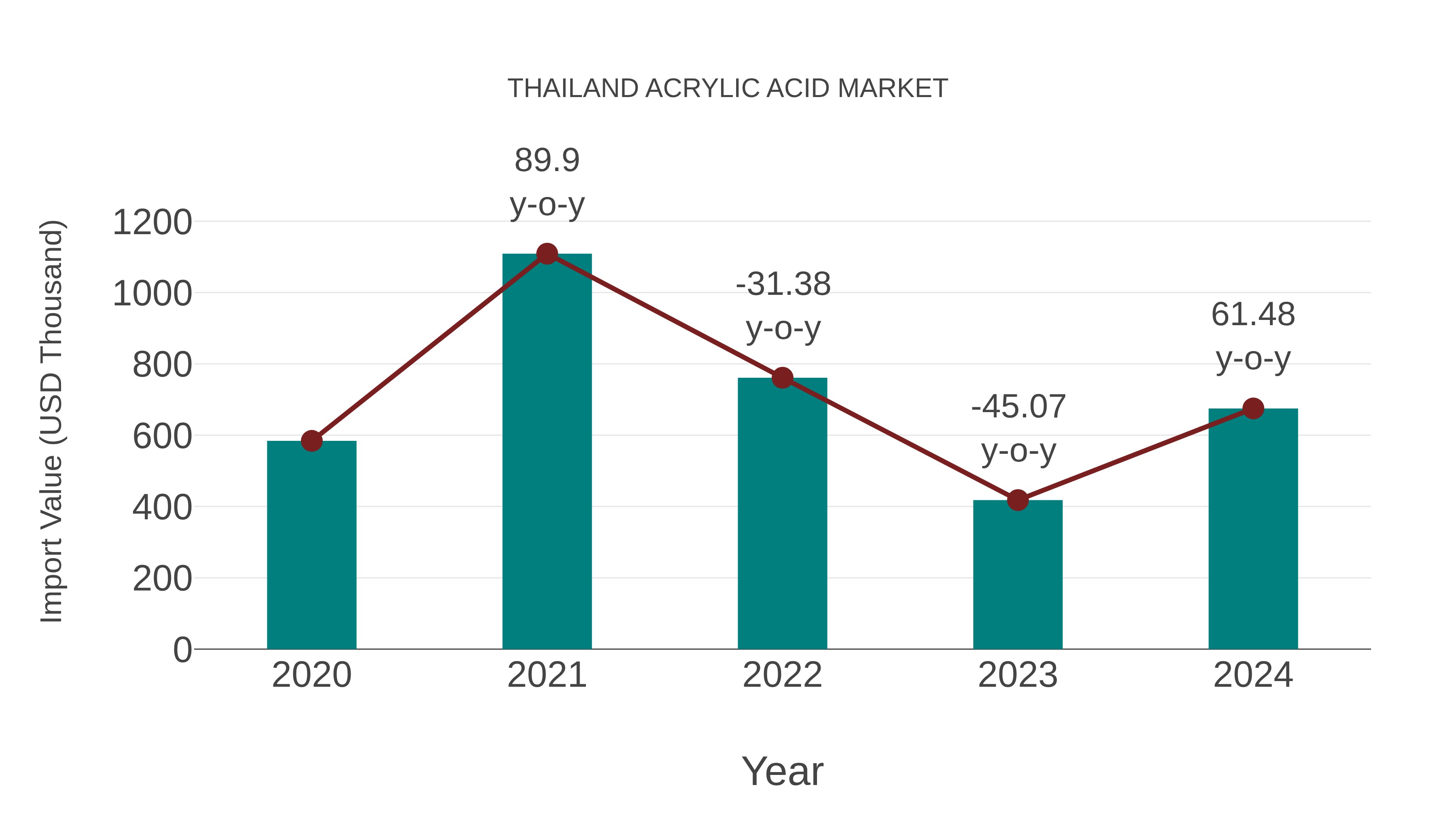
Thailand import trend for acrylic acid in 2024 exhibited a notable growth rate of 61.48% compared to 2023, with a compound annual growth rate (CAGR) of 3.69% for the period 2020-2024. This surge in imports can be attributed to a significant shift in demand dynamics within the market, potentially influenced by evolving trade policies or market recovery efforts.
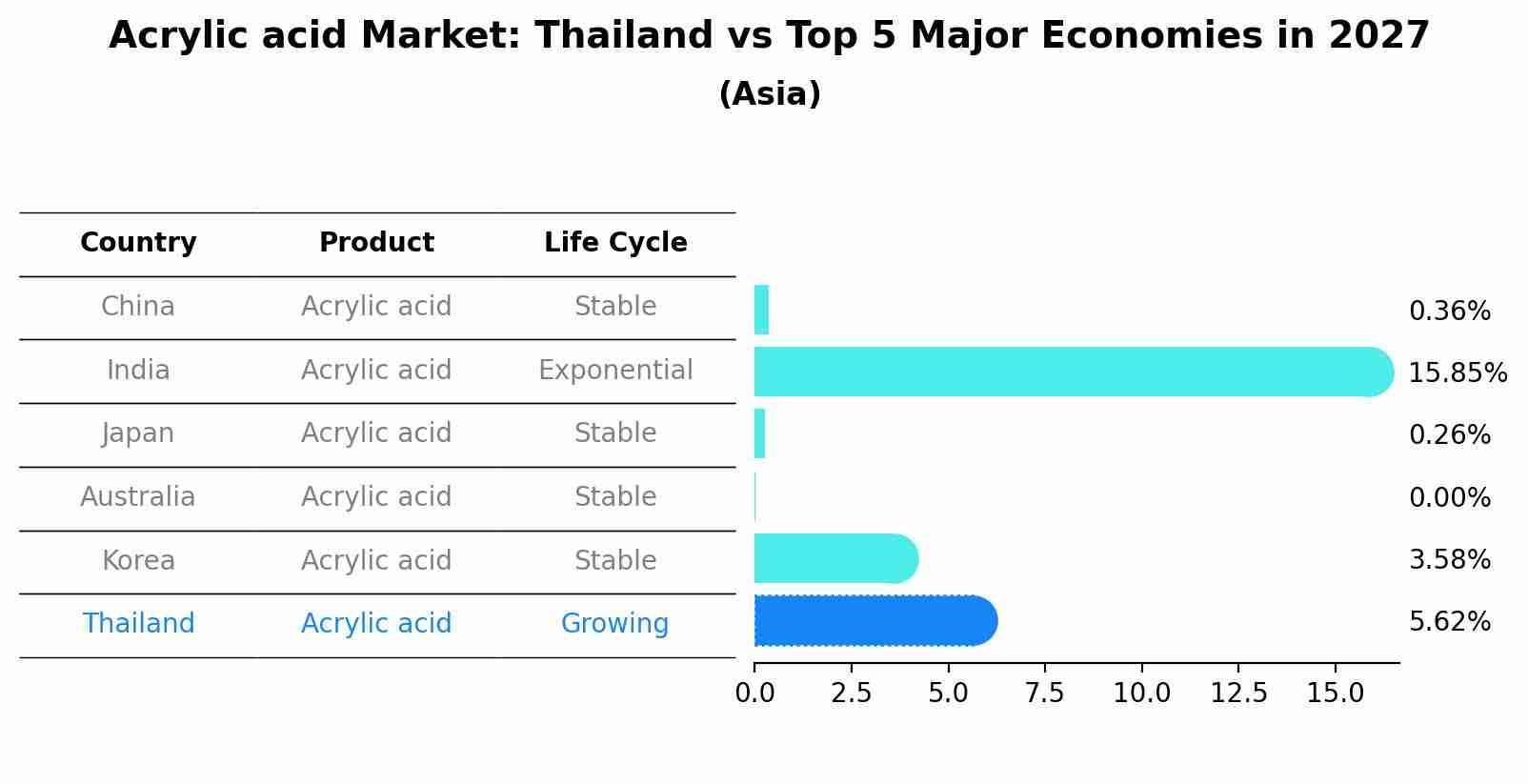
Acrylic acid Market: Thailand vs Top 5 Major Economies in 2027 (Asia)
By 2027, the Acrylic acid market in Thailand is anticipated to reach a growth rate of 5.62%, as part of an increasingly competitive Asia region, where China remains at the forefront, supported by India, Japan, Australia and South Korea, driving innovations and market adoption across sectors.
Thailand Acrylic Acid Market Synopsis
The Thailand acrylic acid market size is estimated to be USD 4.07 billion in 2025 and is projected to reach USD 5.55, growing at a CAGR of 6.7%. The major factor driving the growth of the market is increasing construction activities due to rapid urbanization in developing countries such as China and India. Additionally, rising demand for automotive paints & coatings in Asia-Pacific region are anticipated to further drive the growth of the global acrylic acid market during this period.
Drivers of the Market
The acrylic acid market in Thailand is influenced by its wide range of applications in industries like adhesives, textiles, paints, and coatings. As industrial production and construction activities continue to grow, the demand for acrylic acid-based products increases. Additionally, the shift towards eco-friendly and sustainable products is driving the adoption of bio-based acrylic acids.
Challenges of the Market
The Thailand acrylic acid market faces challenges related to feedstock availability and environmental impact. Acrylic acid is a key chemical used in the production of various polymers. Challenges include sourcing sufficient raw materials and minimizing the carbon footprint associated with acrylic acid production processes.
COVID-19 Impact on the Market
The acrylic acid market witnessed mixed effects. While the initial disruption hampered production, the market later recovered due to the increased demand for hygiene products like sanitizers and disinfectants.
Key Players in the Market
Acrylic acid finds use in various products, including adhesives and coatings. Key players could be BASF, Dow Chemical Company, and Nippon Shokubai.
Key Highlights of the Report:
- Thailand Acrylic acid Market Outlook
- Market Size of Thailand Acrylic acid Market, 2025
- Forecast of Thailand Acrylic acid Market, 2032
- Historical Data and Forecast of Thailand Acrylic acid Revenues & Volume for the Period 2022-2032F
- Thailand Acrylic acid Market Trend Evolution
- Thailand Acrylic acid Market Drivers and Challenges
- Thailand Acrylic acid Price Trends
- Thailand Acrylic acid Porter's Five Forces
- Thailand Acrylic acid Industry Life Cycle
- Historical Data and Forecast of Thailand Acrylic acid Market Revenues & Volume By Product for the Period 2022-2032F
- Historical Data and Forecast of Thailand Acrylic acid Market Revenues & Volume By Acrylate Esters for the Period 2022-2032F
- Historical Data and Forecast of Thailand Acrylic acid Market Revenues & Volume By Glacial Acrylic Acid for the Period 2022-2032F
- Historical Data and Forecast of Thailand Acrylic acid Market Revenues & Volume By Others for the Period 2022-2032F
- Historical Data and Forecast of Thailand Acrylic acid Market Revenues & Volume By End-users for the Period 2022-2032F
- Historical Data and Forecast of Thailand Acrylic acid Market Revenues & Volume By Surfactants and Surface Coatings for the Period 2022-2032F
- Historical Data and Forecast of Thailand Acrylic acid Market Revenues & Volume By Organic Chemicals for the Period 2022-2032F
- Historical Data and Forecast of Thailand Acrylic acid Market Revenues & Volume By Water Filtration for the Period 2022-2032F
- Historical Data and Forecast of Thailand Acrylic acid Market Revenues & Volume By Adhesives and Sealants for the Period 2022-2032F
- Historical Data and Forecast of Thailand Acrylic acid Market Revenues & Volume By Textiles for the Period 2022-2032F
- Historical Data and Forecast of Thailand Acrylic acid Market Revenues & Volume By Water Treatment for the Period 2022-2032F
- Historical Data and Forecast of Thailand Acrylic acid Market Revenues & Volume By Personal Care Products for the Period 2022-2032F
- Historical Data and Forecast of Thailand Acrylic acid Market Revenues & Volume By Others for the Period 2022-2032F
- Thailand Acrylic acid Import Export Trade Statistics
- Market Opportunity Assessment By Product
- Market Opportunity Assessment By End-users
- Thailand Acrylic acid Top Companies Market Share
- Thailand Acrylic acid Competitive Benchmarking By Technical and Operational Parameters
- Thailand Acrylic acid Company Profiles
- Thailand Acrylic acid Key Strategic Recommendations






































