hailand Acrylic Elastomers Market Growth Rate
According to 6Wresearch internal database and industry analysis, the Thailand Acrylic Elastomers Market is expected to grow at a steady CAGR of approximately 5.4% during the forecast period of 2026–2032.
Thailand Acrylic Elastomers Market Year-wise Growth Rate and Key Drivers (2022-2032)
This graph illustrates the annual growth rates of the Thailand Acrylic Elastomers Market from 2022 to 2032, highlighting a steady upward trajectory and projected market expansion over the forecast period.
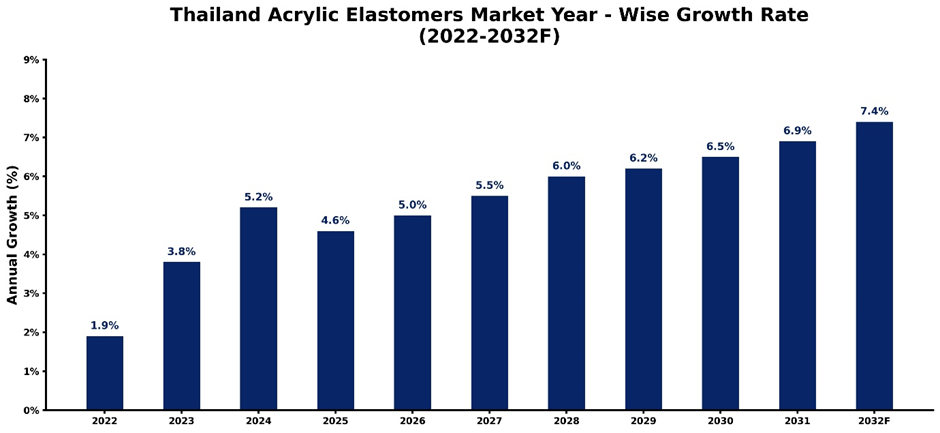 The following table summarizes the historical and forecasted growth rates of Thailand Acrylic Elastomers Market, along with the rationale behind each year’s performance.
| Year | Estimated Annual Growth (%) | Market Rationale |
| 2022 | 1.9% | Market declined due to COVID-19 impact, supply chain issues, and weak automotive demand. |
| 2023 | 3.8% | Recovery in automotive production and industrial activity improved elastomer demand. |
| 2024 | 5.2% | Growth supported by vehicle manufacturing, industrial applications, and specialty rubber demand. |
| 2025 | 4.6% | Stable automotive sector and increasing demand for high-performance sealing materials. |
| 2026 | 5% | Growth driven by EV expansion, automotive components, and industrial applications. |
| 2027 | 5.5% | Increasing EV production and localization of automotive supply chains boost consumption. |
| 2028 | 6% | Higher demand from construction, machinery, and advanced polymer applications. |
| 2029 | 6.2% | Replacement of conventional rubber with heat- and oil-resistant acrylic elastomers supports growth. |
| 2030 | 6.5% | EV ecosystem growth and industrial modernization increase market penetration. |
| 2031 | 6.9% | Rising use in electronics, transportation, and specialized industrial components. |
| 2032 | 7.4% | Long-term demand growth from advanced materials and sustainable polymer applications. |
Topics Covered in the Thailand Acrylic Elastomers Market Report
The Thailand Acrylic Elastomers Market report provides comprehensive coverage of the industry based on Type and Application. The report provides a detailed analysis of ongoing market trends, growth opportunities/high-growth areas, competitive landscape, and market dynamics that will help stakeholders align their strategies with current and future industrial material developments.
Thailand Acrylic Elastomers Market Highlights
| Report Name | Thailand Acrylic Elastomers Market |
| Forecast period | 2026-2032 |
| CAGR | 5.4% |
| Growing Sector | Automotive |
Thailand Acrylic Elastomers Market Overview
In Thailand, the acrylic elastomers market has been experiencing a steady expansion on account of increasing utilization in automotive components such as seals, gaskets, and hoses, along with rising applications in construction and industrial machinery. Acrylic elastomers are synthetic rubber materials known for their excellent resistance to heat, oxidation, weathering, and petroleum-based oils which make them suitable for demanding industrial applications. Growing manufacturing activities, export-oriented automotive production, and demand for durable polymer solutions are expected to drive market growth.
Key Growth Drivers Influencing Thailand Acrylic Elastomers Market (2026–2032)
Below mentioned are some major drivers and their influence on the market dynamics:
| Growth Driver | Major Impacted Segment | Market Impact |
| Rising Automotive Manufacturing Activities | Automotive Application | Increasing vehicle production in Thailand is boosting demand for heat-resistant elastomer components used in engines, transmission systems, and sealing applications. |
| Surge of Industrial Manufacturing Sector | Industrial Application | There is a growing machinery and manufacturing activities, which are increasing the adoption of durable elastomer materials. |
| Infrastructure Development and Construction Growth | Construction Application | Increasing infrastructure projects are creating demand for weather-resistant and long-lasting elastomer-based materials. |
| Rising Shift Towards High-Performance Polymer Materials | Acrylic Co-Monomer Elastomer | Industries are replacing conventional rubber materials with advanced acrylic elastomers offering improved durability. |
| Increasing Export-Oriented Automotive Production | Ethylene Acrylic Elastomers | Thailand’s position as an automotive manufacturing hub is supporting demand for specialty elastomers used in exported vehicles. |
The Thailand Acrylic Elastomers Market growth is projected to reach a CAGR of approximately 5.4% during 2026–2032 on account of Thailand’s expanding automotive manufacturing base, which contributes over 1.8 million vehicle production capacity annually, along with increasing investments in industrial automation and infrastructure development. Rising demand for high-temperature resistant materials, growing replacement of conventional rubber products, and increasing adoption of advanced elastomers in automotive sealing applications are expected to accelerate market expansion. Additionally, Thailand’s strong manufacturing ecosystem and government support for industrial development are expected to create favorable growth opportunities.
Evaluation of Restraints in Thailand Acrylic Elastomers Market
Below mentioned are some major restraints and their influence on the market dynamics:
| Restraint | Major Impacted Segment | Market Impact |
| High Production Cost Compared to Conventional Rubber | Acrylic Co-Monomer Elastomer | Higher manufacturing costs may limit adoption among price-sensitive industries. |
| Dependence on Imported Raw Materials | All Segments | Changes in raw material prices and supply chain disruptions may impact production costs. |
| Limited Domestic Manufacturing Capability | Ethylene Acrylic Elastomers | Due to a high dependence on international suppliers, there may be some restrictions in market competitiveness. |
| Availability of Alternative Elastomer Materials | Automotive & Industrial Applications | Acrylic elastomers are subject to competition from silicone rubber and other synthetic elastomers. |
| Technical Processing Requirements | Industrial Application | Specialized processing equipment and expertise may increase operational challenges. |
Thailand Acrylic Elastomers Market Challenges
The Thailand Acrylic Elastomers Market is challenged by issues related to material sourcing, cost considerations, and competition from alternative elastomer solutions. Thailand imports a considerable number of polymer materials that leave the producers vulnerable to changes in global supply chains and currency changes. Along with this, conventional elastomers continue to dominate several price-sensitive applications due to their lower costs. Although Thailand produces over 1.8 million vehicles annually, increasing competition among material suppliers and the requirement for advanced processing technologies remain key challenges affecting broader acrylic elastomer adoption across industries.
Trends in Thailand Acrylic Elastomers Market
Below are some of the major trends shaping the industry growth, including:
- Increased Adoption in Electric Vehicle Components: The adoption of electric vehicles (EVs) in Thailand is generating a demand for sealing materials that will withstand variations in temperatures and chemicals.
- Growing Demand for Light Weight Automotive Materials: There is an increasing adoption of elastomers by automobile manufacturers to make their products lighter without compromising on performance and durability.
- Increasing Applications in Industrial Machinery: Acrylic elastomers are being used in the manufacturing of machinery parts due to their resistance to heat, oil, and harsh operating conditions.
Investment Opportunities in Thailand Acrylic Elastomers Market
Some of the lucrative investment opportunities are:
- Manufacture of Automotive Components: Increased production of automobiles and EVs offers opportunities for companies involved in the manufacture of elastomer seals, hoses, and vibration control components.
- Recyclable Elastomers Solutions: Companies involved in the production of sustainable solutions in terms of recyclable elastomers will have opportunities due to growing demand from automobile manufacturers across the globe.
- Industrial Machinery Applications: Increasing automation and machinery investments create opportunities for acrylic elastomer suppliers targeting industrial applications.
Leading Players in Thailand Acrylic Elastomers Market
Stated below are some of the leading companies contributing significantly to increasing Thailand Acrylic Elastomers Market share:
1. Zeon Corporation
| Company Name | Zeon Corporation |
|---|---|
| Established Year | 1950 |
| Headquarters | Tokyo, Japan |
| Official Website | Click Here |
Zeon Corporation is a leading specialty chemical company involved in the production of synthetic rubber and advanced elastomer materials.
2. NOK Corporation
| Company Name | NOK Corporation |
|---|---|
| Established Year | 1939 |
| Headquarters | Tokyo, Japan |
| Official Website | Click Here |
NOK Corporation specializes in sealing technologies, including oil seals, gaskets, and rubber-based components. The company supplies advanced elastomer solutions for automotive and industrial applications.
3. Dow Inc.
| Company Name | Dow Inc. |
|---|---|
| Established Year | 1897 |
| Headquarters | Midland, Michigan, USA |
| Official Website | Click Here |
Dow Inc. develops advanced polymer and elastomer materials serving automotive, construction, and industrial sectors. The company provides specialty material solutions designed for improved performance and chemical resistance.
4. DuPont
| Company Name | DuPont |
|---|---|
| Established Year | 2017 |
| Headquarters | Wilmington, Delaware, USA |
| Official Website | Click Here |
DuPont manufactures specialty materials and engineered polymer solutions used across automotive, industrial, and construction applications.
Thailand Acrylic Elastomers Market: Government Initiatives
According to Thai Government data, Thailand has implemented initiatives supporting advanced manufacturing and specialty material industries, indirectly benefiting the acrylic elastomers market. The Eastern Economic Corridor (EEC) initiative launched in 2017, which has led to the increased investment in automotive, petrochemical, and advanced manufacturing industry, increasing the demand for high performance elastomers. Moreover, EV 3.0 incentive package rolled out in 2022 has helped boost the production of electric vehicles and its supply chain, which in turn presents growth opportunities for acrylic elastomers used in automobiles.
Future Outlook of Thailand Acrylic Elastomers Market
The Thailand Acrylic Elastomers Market is expected to witness steady growth, supported by some important factors, such as the rising demand from the automotive, construction, and industrial segments. Rising preference for high performance elastomers due to superior heat resistance and durability is expected to support the growth of the market. Moreover, technological innovations in manufacturing processes, rising investment in industrial growth, and emphasis on lightweight and durable materials are likely to provide new avenues for acrylic elastomer providers in Thailand.
Market Segmentation Analysis
The report offers a comprehensive study of the following market segments and their leading categories in the Market:
By Type – Acrylic Co-Monomer Elastomers Dominated the Market, Ethylene Acrylic Elastomers Segment Expected to Witness Growth
According to Sumit Sagar, Senior Research Analyst, 6Wresearch, Acrylic Co-Monomer Elastomers dominated the Thailand Acrylic Elastomers Market with an estimated 62% market share in 2025, driven by their widespread adoption in automotive sealing systems. However, during 2026–2032, the Ethylene Acrylic Elastomers segment is expected to grow at a CAGR of around 9%, supported by increasing demand for advanced elastomer materials with enhanced durability, temperature resistance.
By Application – Automotive Led the Market, Industrial Segment Expected to Experience Growth
In 2025, Automotive applications accounted for approximately 58% share of the Thailand Acrylic Elastomers Market, supported by Thailand’s strong automotive manufacturing base. However, during 2026–2032, the Industrial segment is projected to register a CAGR of around 8.5%, driven by rising industrial automation.
Note: Market size estimations and growth projections presented in this report are based on 6Wresearch's proprietary forecasting methodology, utilizing the latest available industry data, government publications, and primary research inputs.
Key Attractiveness of the Report:
- 10 Years of Market Numbers
- Historical Data Starting from 2022 to 2025
- Base Year: 2025
- Forecast Data until 2032
- Key Performance Indicators Impacting the Market
- Major Upcoming Developments and Projects
Key Highlights of the Report:
- Thailand Acrylic Elastomers Market Outlook
- Market Size of Thailand Acrylic Elastomers Market, 2025
- Forecast of Thailand Acrylic Elastomers Market, 2032
- Historical Data and Forecast of Thailand Acrylic Elastomers Revenues & Volume for the Period 2022-2032
- Thailand Acrylic Elastomers Market Trend Evolution
- Thailand Acrylic Elastomers Market Drivers and Challenges
- Thailand Acrylic Elastomers Price Trends
- Thailand Acrylic Elastomers Porter's Five Forces
- Thailand Acrylic Elastomers Industry Life Cycle
- Historical Data and Forecast of Thailand Acrylic Elastomers Market Revenues & Volume By Type for the Period 2022-2032
- Historical Data and Forecast of Thailand Acrylic Elastomers Market Revenues & Volume By Acrylic Co-Monomer Elastomer for the Period 2022-2032
- Historical Data and Forecast of Thailand Acrylic Elastomers Market Revenues & Volume By Ethylene Acrylic Elastomers for the Period 2022-2032
- Historical Data and Forecast of Thailand Acrylic Elastomers Market Revenues & Volume By Application for the Period 2022-2032
- Historical Data and Forecast of Thailand Acrylic Elastomers Market Revenues & Volume By Automotive for the Period 2022-2032
- Historical Data and Forecast of Thailand Acrylic Elastomers Market Revenues & Volume By Construction for the Period 2022-2032
- Historical Data and Forecast of Thailand Acrylic Elastomers Market Revenues & Volume By Industrial for the Period 2022-2032
- Thailand Acrylic Elastomers Import Export Trade Statistics
- Market Opportunity Assessment By Type
- Market Opportunity Assessment By Application
- Thailand Acrylic Elastomers Top Companies Market Share
- Thailand Acrylic Elastomers Competitive Benchmarking By Technical and Operational Parameters
- Thailand Acrylic Elastomers Company Profiles
- Thailand Acrylic Elastomers Key Strategic Recommendations
Market Covered
The report offers an extensive study of the following market segments:
By Type:
- Acrylic Co-Monomer Elastomer
- Ethylene Acrylic Elastomers
By Application:
- Automotive
- Construction
- Industrial






































