Thailand Activated Carbon Market: Import Trend Analysis
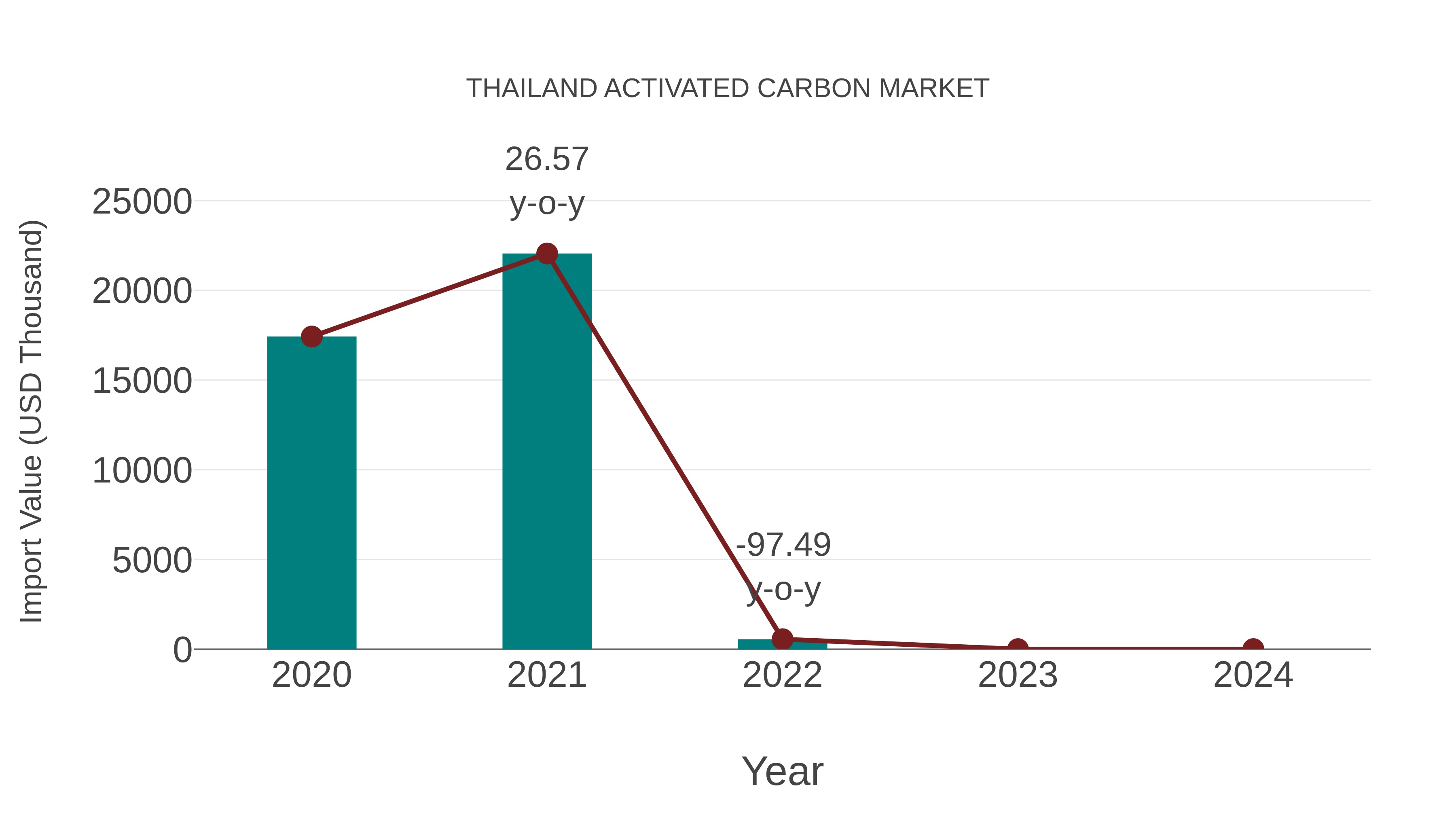
Thailand import trend for the activated carbon market experienced a significant decline with a Compound Annual Growth Rate (CAGR) of -82.17% from 2020 to 2024. This sharp decrease indicates a notable shift in demand dynamics or possible market stability challenges impacting trade performance during this period.
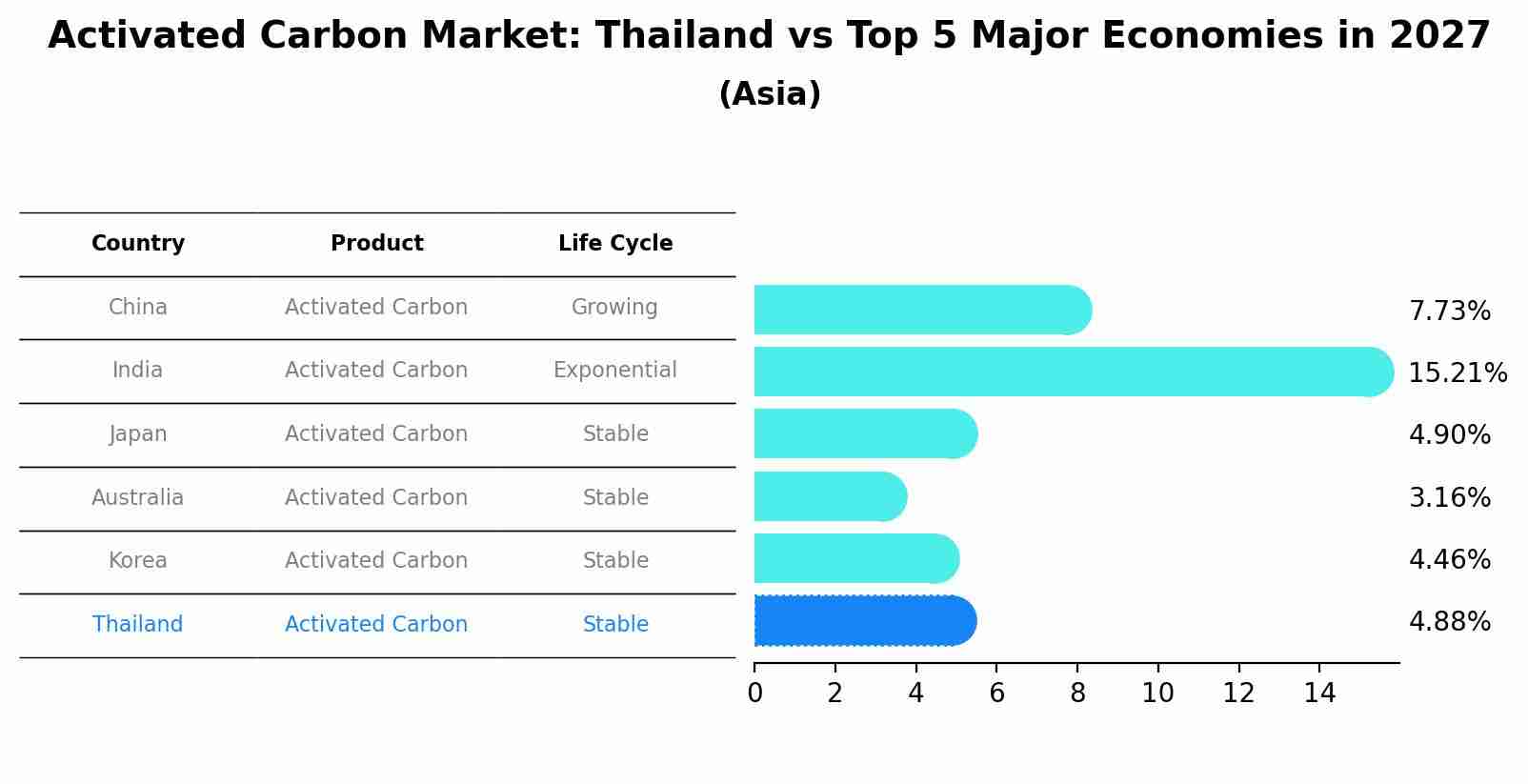
Activated Carbon Market: Thailand vs Top 5 Major Economies in 2027 (Asia)
Thailand's Activated Carbon market is anticipated to experience a stable growth rate of 4.88% by 2027, reflecting trends observed in the largest economy China, followed by India, Japan, Australia and South Korea.
Thailand Activated Carbon Market Synopsis
The activated carbon market in Thailand has witnessed significant growth, driven by the country`s expanding water treatment, air purification, and industrial sectors. Activated carbon is a highly porous form of carbon that exhibits strong adsorption properties, making it an effective material for removing impurities and pollutants from air and water. In Thailand, the demand for activated carbon has been influenced by the increasing focus on environmental protection and sustainable practices. The market offers a wide range of activated carbon products, catering to diverse industrial applications, such as wastewater treatment, gas purification, and the removal of volatile organic compounds (VOCs) from air.
Market Drivers
Several factors have driven the growth of the activated carbon market in Thailand. Firstly, the country`s growing population and rapid industrialization have led to increased water and air pollution, necessitating effective solutions for environmental remediation. Activated carbon, with its high surface area and adsorption capabilities, has emerged as a preferred choice for water and air purification. Secondly, the implementation of stricter environmental regulations and the emphasis on sustainable practices have driven the adoption of activated carbon in various industries to meet compliance standards and ensure responsible waste management.
Challenges of the Market
While the activated carbon market in Thailand shows significant growth, it also faces certain challenges. One of the primary hurdles is the competition from alternative purification technologies and materials. Some industries may explore other adsorbents or treatment methods that offer similar benefits. To maintain market share, activated carbon manufacturers need to showcase its unique properties and cost-effectiveness in specific environmental applications. Additionally, fluctuations in raw material prices and the availability of coconut shell, wood, or coal, which are commonly used as feedstock for activated carbon production, can impact production costs and supply in the market.
Covid-19 Impact on the Market
The Covid-19 pandemic had mixed impacts on the activated carbon market in Thailand. During the initial stages of the pandemic, disruptions in supply chains and reduced industrial activities affected the demand for activated carbon from various sectors. The economic uncertainties also led to cautious spending on environmental solutions. However, as the situation improved and industries resumed operations, the demand for activated carbon recovered. Moreover, the emphasis on maintaining air quality and water sanitation during the pandemic further supported the adoption of activated carbon in relevant applications.
Key Highlights of the Report:
- Thailand Activated Carbon Market Outlook
- Market Size of Thailand Activated Carbon Market, 2025
- Forecast of Thailand Activated Carbon Market, 2032
- Historical Data and Forecast of Thailand Activated Carbon Revenues & Volume for the Period 2022-2032F
- Thailand Activated Carbon Market Trend Evolution
- Thailand Activated Carbon Market Drivers and Challenges
- Thailand Activated Carbon Price Trends
- Thailand Activated Carbon Porter's Five Forces
- Thailand Activated Carbon Industry Life Cycle
- Historical Data and Forecast of Thailand Activated Carbon Market Revenues & Volume By Product for the Period 2022-2032F
- Historical Data and Forecast of Thailand Activated Carbon Market Revenues & Volume By Powdered for the Period 2022-2032F
- Historical Data and Forecast of Thailand Activated Carbon Market Revenues & Volume By Granular for the Period 2022-2032F
- Historical Data and Forecast of Thailand Activated Carbon Market Revenues & Volume By Others for the Period 2022-2032F
- Historical Data and Forecast of Thailand Activated Carbon Market Revenues & Volume By Application for the Period 2022-2032F
- Historical Data and Forecast of Thailand Activated Carbon Market Revenues & Volume By Liquid Phase for the Period 2022-2032F
- Historical Data and Forecast of Thailand Activated Carbon Market Revenues & Volume By Gas Phase for the Period 2022-2032F
- Historical Data and Forecast of Thailand Activated Carbon Market Revenues & Volume By End-use for the Period 2022-2032F
- Historical Data and Forecast of Thailand Activated Carbon Market Revenues & Volume By Water Treatment for the Period 2022-2032F
- Historical Data and Forecast of Thailand Activated Carbon Market Revenues & Volume By Food & Beverage Processing for the Period 2022-2032F
- Historical Data and Forecast of Thailand Activated Carbon Market Revenues & Volume By Pharmaceutical & Medical for the Period 2022-2032F
- Historical Data and Forecast of Thailand Activated Carbon Market Revenues & Volume By Automotive for the Period 2022-2032F
- Historical Data and Forecast of Thailand Activated Carbon Market Revenues & Volume By Air Purification for the Period 2022-2032F
- Historical Data and Forecast of Thailand Activated Carbon Market Revenues & Volume By Others for the Period 2022-2032F
- Thailand Activated Carbon Import Export Trade Statistics
- Market Opportunity Assessment By Product
- Market Opportunity Assessment By Application
- Market Opportunity Assessment By End-use
- Thailand Activated Carbon Top Companies Market Share
- Thailand Activated Carbon Competitive Benchmarking By Technical and Operational Parameters
- Thailand Activated Carbon Company Profiles
- Thailand Activated Carbon Key Strategic Recommendations






































