Thailand Active Space Debris Removal Market Size, Share & Growth Rate
The Thailand Active Space Debris Removal Market was estimated at USD 159 Million in 2025 and is projected to reach USD 181 Million by 2032, growing at a CAGR of 1.9% from 2026 to 2032. This anticipated growth is largely influenced by escalating concerns surrounding the threats posed by space debris to operational satellites and the burgeoning number of space missions launched by both public and private entities. The integration of cutting-edge technologies, such as advanced robotics and artificial intelligence, is also expected to enhance the efficiency and effectiveness of debris removal initiatives.
Thailand Active Space Debris Removal Market Year-wise Growth Rate and Key Drivers
This graph highlights how the Thailand Active Space Debris Removal Market has steadily grown over the years, supported by major growth factors.
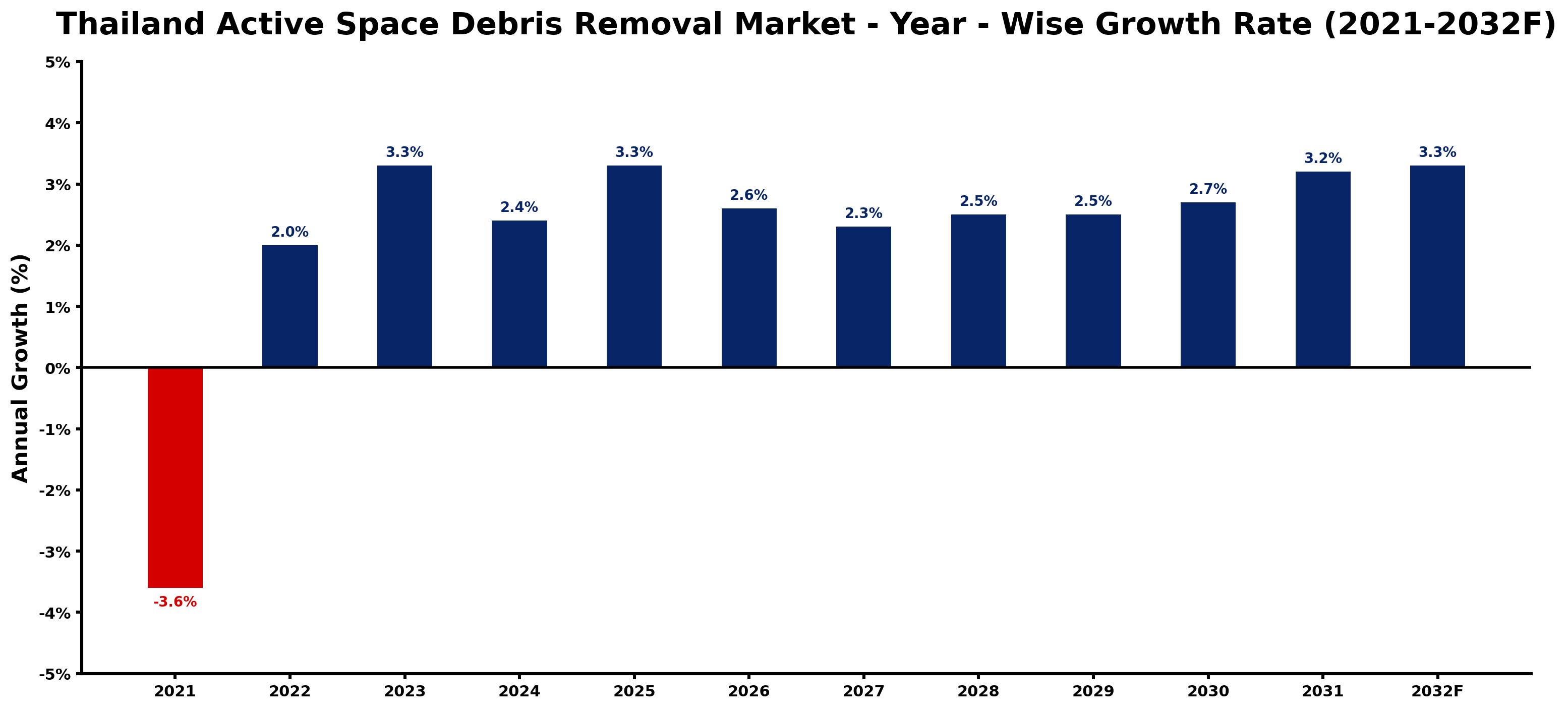
The table below presents the year‑wise growth rates along with the key drivers influencing the market
| Year | Growth Rate | Major Drivers |
| 2021 | -3.6% | Growing renewable energy integration projects |
| 2022 | 2.0% | Increasing industrial automation investments |
| 2023 | 3.3% | Increasing industrial infrastructure investments |
| 2024 | 2.4% | Rapid growth in telecom and data center sectors |
| 2025 | 3.3% | Government infrastructure modernization initiatives |
| 2026 | 2.6% | Increasing industrial infrastructure investments |
| 2027 | 2.3% | Rapid growth in telecom and data center sectors |
| 2028 | 2.5% | Increasing smart city development projects |
| 2029 | 2.5% | Rising electricity demand across industries |
| 2030 | 2.7% | Rising electricity demand across industries |
| 2031 | 3.2% | Rapid growth in telecom and data center sectors |
| 2032 | 3.3% | Government infrastructure modernization initiatives |
Note - Market size estimations and growth projections presented in this report are based on 6Wresearch's advanced forecasting approach, validated with industry datasets as of June 2026.
Thailand Active Space Debris Removal Market Synopsis
Currently, the most significant force shaping the Thailand Active Space Debris Removal Market is the increasing recognition of the dangers posed by orbital debris. With the global satellite count on the rise, the imperative for effective debris removal solutions has never been clearer, as nations understand that the future of their space operations depends on maintaining a safer orbital environment.
In addition, collaborative efforts from international organizations, particularly those set forth by the United Nations Office for Outer Space Affairs (UNOOSA), emphasize the urgency of addressing this issue. As countries like Thailand engage in global dialogues and share technological advances, the local market for active debris removal is set to evolve rapidly, reinforcing its importance in global space sustainability efforts.
Thailand Active Space Debris Removal Market Key Takeaways
- Rising awareness of space debris impacts is driving demand for debris removal technologies in Thailand.
- Advanced robotics and space technologies are crucial for effective debris removal operations.
- International collaborations, including UNOOSA guidelines, are fostering growth in the local market.
- The market is recovering from pandemic-induced setbacks and is positioned for renewed momentum.
- Key players are innovating to provide effective solutions to meet the diverse needs of the market.
Evaluation of Restraints in Thailand Active Space Debris Removal Market
Despite the positive outlook, several restraints continue to hinder the Thailand Active Space Debris Removal Market's growth trajectory. Budget constraints often limit investment in space initiatives, impacting the pace of technology deployment and operational readiness. Furthermore, the complexity and high costs associated with developing and deploying effective debris removal technologies can deter both public and private sector engagement. Lastly, regulatory uncertainties and a lack of comprehensive frameworks for debris mitigation can stifle innovation, making it challenging for stakeholders to commit resources to these vital missions.
Thailand Active Space Debris Removal Market Trends
Current trends shaping the Thailand Active Space Debris Removal Market include a shift toward public-private partnerships to share risks and resources. Additionally, the integration of artificial intelligence and machine learning is being embraced to enhance the precision and efficiency of debris tracking and removal operations. The push for sustainable space practices is influencing companies to develop technologies that align with global best practices in space debris mitigation, fostering an environment ripe for innovation.
Thailand Active Space Debris Removal Market Opportunities
There are significant growth and investment opportunities within the Thailand Active Space Debris Removal Market. The demand for innovative debris removal technologies presents a unique avenue for startups and established players to collaborate on research and development. Furthermore, as international pressure mounts to address the growing space debris crisis, funding from governmental and non-governmental organizations is expected to increase, providing a supportive backdrop for new ventures and initiatives in the sector.
Government Initiatives in the Thailand Active Space Debris Removal Market
The Thai government has recognized the importance of addressing space debris through various initiatives and policy frameworks. Public spending on space exploration and technology has increased, with a focus on sustainable practices to protect national space assets. International collaborations and participation in global forums highlight Thailand's commitment to engaging in effective space debris mitigation strategies. These efforts are aligned with broader governmental goals of enhancing national security and promoting technological advancement in the aerospace sector.
Future Insights of the Thailand Active Space Debris Removal Market
Looking ahead to 2026-2032, the Thailand Active Space Debris Removal Market is poised for significant transformation. With increasing satellite launches and a growing body of international regulations, there will be a heightened need for debris removal technologies. As companies refine their strategies and invest in more sophisticated methods for debris capture and disposal, we can expect to see a marked improvement in operational safety for space missions. The emphasis on sustainability and space governance will drive innovation and investment, solidifying Thailand's position as an emerging player in the global space landscape.
Thailand Active Space Debris Removal Market Latest Developments (May 2025 - June 2026)
Recent developments in the Thailand Active Space Debris Removal Market indicate an uptick in collaborative research efforts among universities, government agencies, and industry players aimed at developing novel debris removal technologies. Pilot programs are being launched to test advanced robotic systems, while strategic partnerships are forming with international bodies to share knowledge and best practices. These movements are reflective of a burgeoning focus on creating a comprehensive strategy for addressing the growing challenges posed by space debris.
Thailand Active Space Debris Removal Market - Key Attractiveness of the Report
- 10 Years of Market Numbers
- Historical Data Starting from 2022 to 2025
- Base Year: 2025
- Forecast Data until 2032
- Key Performance Indicators Impacting the Market
- Major Upcoming Developments and Projects
Key Highlights of the Report:
- Thailand Active Space Debris Removal Market Outlook
- Market Size of Thailand Active Space Debris Removal Market, 2025
- Forecast of Thailand Active Space Debris Removal Market, 2032
- Historical Data and Forecast of Thailand Active Space Debris Removal Revenues & Volume for the Period 2022-2032F
- Thailand Active Space Debris Removal Market Trend Evolution
- Thailand Active Space Debris Removal Market Drivers and Challenges
- Thailand Active Space Debris Removal Price Trends
- Thailand Active Space Debris Removal Porter's Five Forces
- Thailand Active Space Debris Removal Industry Life Cycle
- Historical Data and Forecast of Thailand Active Space Debris Removal Market Revenues & Volume By Debris Size for the Period 2022-2032F
- Historical Data and Forecast of Thailand Active Space Debris Removal Market Revenues & Volume By Between 1 mm and 1 cm for the Period 2022-2032F
- Historical Data and Forecast of Thailand Active Space Debris Removal Market Revenues & Volume By Between 1 cm to 10 cm for the Period 2022-2032F
- Historical Data and Forecast of Thailand Active Space Debris Removal Market Revenues & Volume By More than 10 cm for the Period 2022-2032F
- Historical Data and Forecast of Thailand Active Space Debris Removal Market Revenues & Volume By End-users for the Period 2022-2032F
- Historical Data and Forecast of Thailand Active Space Debris Removal Market Revenues & Volume By Commercial for the Period 2022-2032F
- Historical Data and Forecast of Thailand Active Space Debris Removal Market Revenues & Volume By Defense for the Period 2022-2032F
- Thailand Active Space Debris Removal Import Export Trade Statistics
- Market Opportunity Assessment By Debris Size
- Market Opportunity Assessment By End-users
- Thailand Active Space Debris Removal Top Companies Market Share
- Thailand Active Space Debris Removal Competitive Benchmarking By Technical and Operational Parameters
- Thailand Active Space Debris Removal Company Profiles
- Thailand Active Space Debris Removal Key Strategic Recommendations






































