Thailand AI in Education Market Size & Growth Rate (2026-2032)
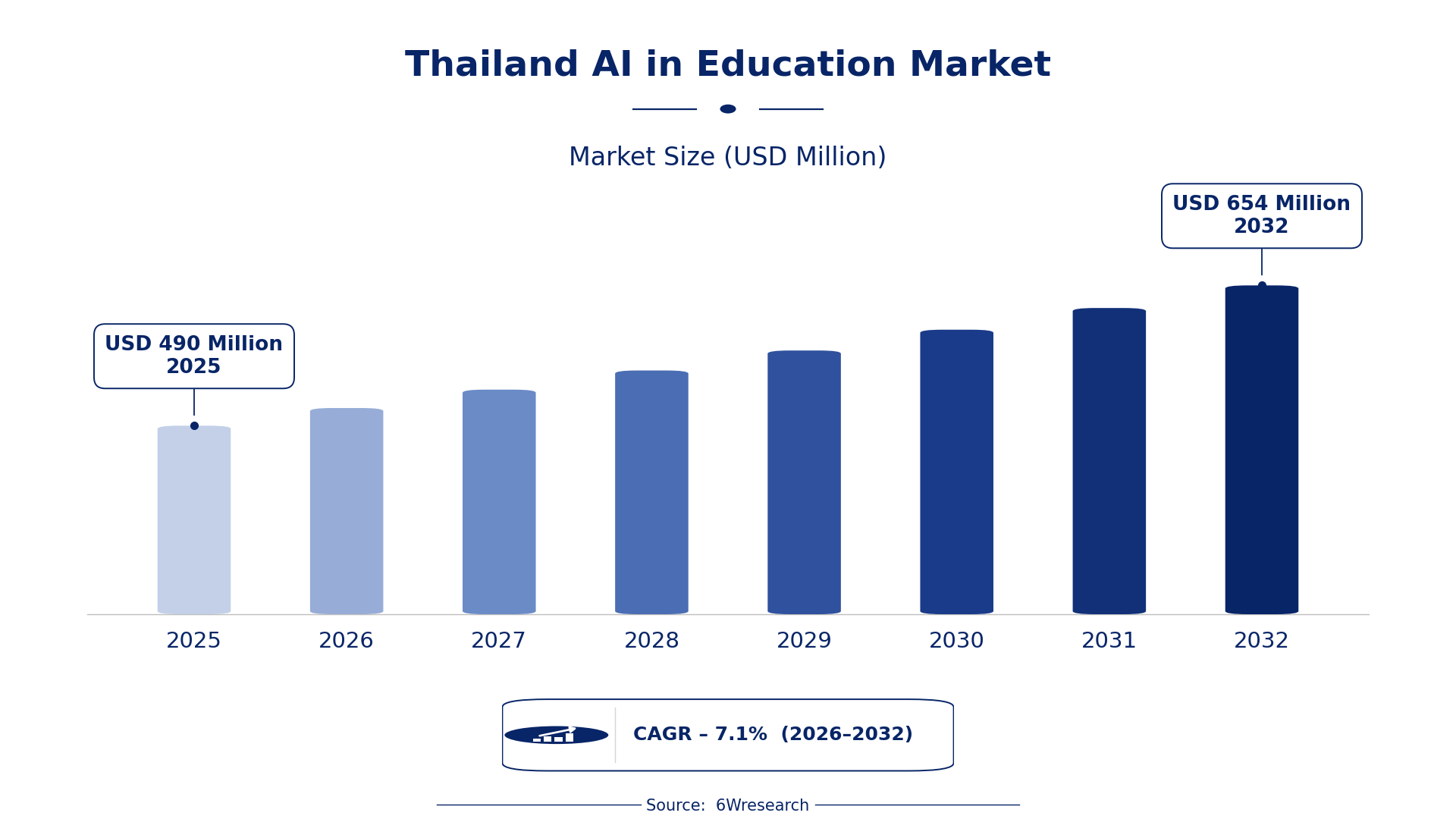
The Thailand AI in Education Market was estimated at USD 490 Million in 2025 and is projected to reach USD 654 Million by 2032, growing at a CAGR of 7.1% from 2026 to 2032.
Thailand AI in Education Market Synopsis
AI in the education sector of Thailand is becoming indispensable as institutions increasingly recognize its potential to enhance learning experiences. The push for personalized education solutions is not just a trend; it’s a necessity as diverse learning needs become more apparent.
With an increasing number of institutions adopting AI-driven tools, the focus is on improving educational outcomes while supporting educators. This integration fosters an environment where students can thrive, adapting to their unique learning styles with the help of intelligent tutoring systems.
Thailand AI in Education Market Year-wise Growth Rate and Key Drivers
This graph illustrates the annual growth rates of the Thailand AI in Education Market from 2021 to 2032, highlighting a steady upward trajectory and projected expansion over the forecast period.
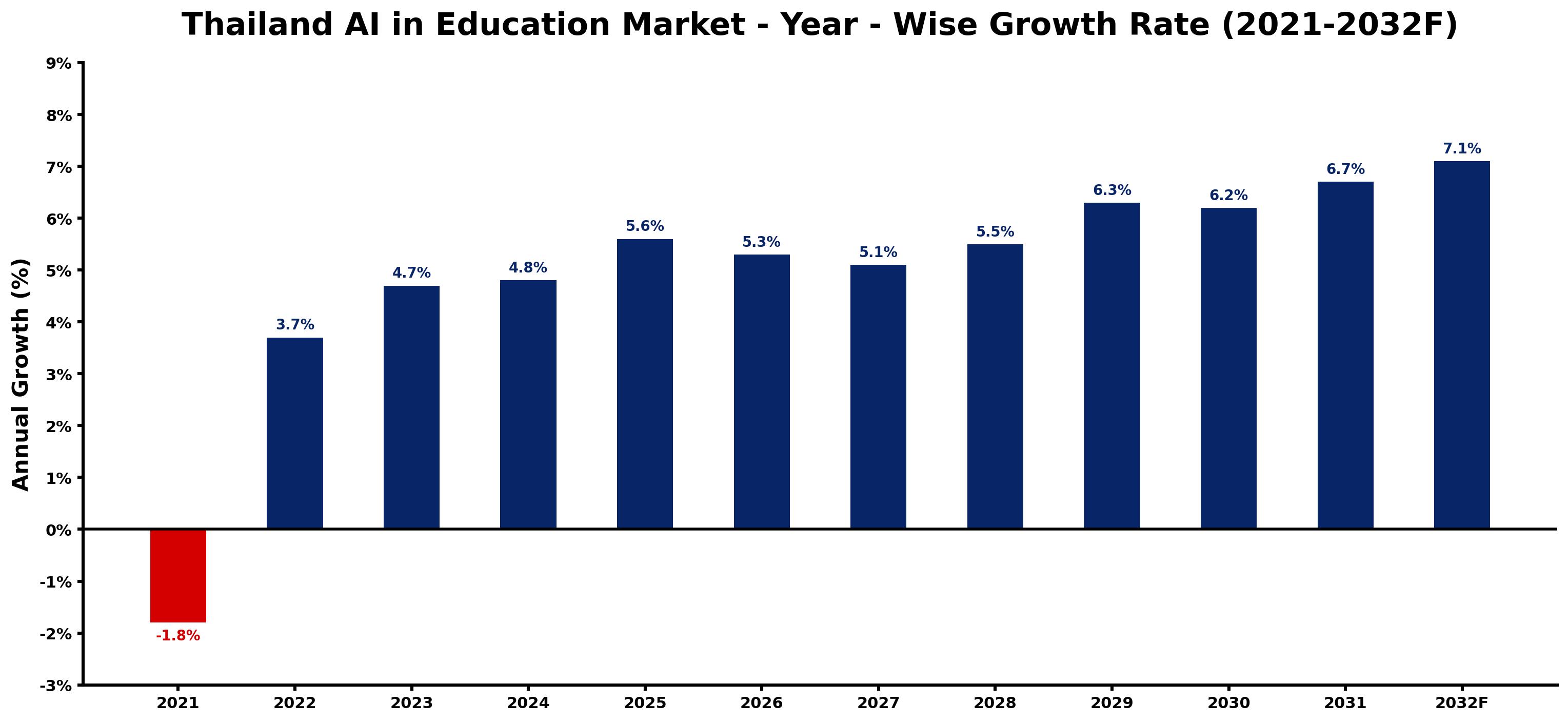
The table below presents the year‑wise growth rates along with the key drivers influencing the market
| Year | Growth Rate | Major Drivers |
| 2021 | -1.8% | Limited internet access in rural education sectors. |
| 2022 | 3.7% | Implementation of Thailand's Education 4.0 framework. |
| 2023 | 4.7% | Government grants for edtech startups and innovations. |
| 2024 | 4.8% | Collaboration with international universities for AI curriculum. |
| 2025 | 5.6% | Rising smartphone penetration among students in Thailand. |
| 2026 | 5.3% | Increased investment in virtual reality educational resources. |
| 2027 | 5.1% | Growing focus on STEM education in schools. |
| 2028 | 5.5% | Partnerships with tech firms for AI training programs. |
| 2029 | 6.3% | Launch of national digital literacy initiatives for youth. |
| 2030 | 6.2% | Support from the Digital Economy Promotion Agency. |
| 2031 | 6.7% | Rise of localized educational AI content and tools. |
| 2032 | 7.1% | Surge in demand for AI-enhanced assessment systems. |
Note: Market size estimations and growth projections presented in this report are based on 6Wresearch's proprietary forecasting methodology, utilizing the latest available industry data, government publications, and primary research inputs.
Thailand AI in Education Market Key Takeaways
Below are some of the specific key takeaways from the market, including:
- The demand for personalized learning solutions is driving innovation in AI educational technologies.
- AI applications are increasingly supporting teachers by automating administrative tasks and enhancing instructional methods.
- The COVID-19 pandemic accelerated the adoption of AI in education, emphasizing the need for adaptable learning solutions.
- Concerns about data privacy and the need for inclusivity present ongoing challenges for market growth.
- Government initiatives are playing a significant role in shaping the regulatory environment for AI in education.
Evaluation of Restraints in Thailand AI in Education Market
The integration of AI technologies in Thailand's education system faces several significant restraints. Traditional teaching methods often clash with the innovative approaches required for effective AI implementation. Many educators are hesitant to embrace AI, fearing it may undermine their roles or complicate existing structures. on top of that, the pressing issue of data privacy poses a serious concern, with parents and institutions wary of how student data is collected and utilized. Finally, ensuring that AI-driven education remains inclusive and accessible to all learners remains a considerable hurdle that needs addressing.
Thailand AI in Education Market Trends
Current trends indicate a strong shift towards AI tools that offer adaptive learning paths tailored to individual student needs. There is a notable increase in the development of intelligent tutoring systems that provide real-time feedback, facilitating a more engaging learning environment. Additionally, the incorporation of machine learning algorithms into educational platforms enhances the ability to assess student performance continuously, driving better academic outcomes. Educators are also showing a growing interest in AI for administrative efficiencies, which allows them to focus more on teaching.
Thailand AI in Education Market Opportunities
There are promising opportunities for growth and investment within the Thailand AI in Education Market. The ongoing digital transformation in education indicates a ripe environment for innovative solutions that can cater to diverse learning requirements. Partnerships between educational institutions and tech companies can facilitate the development of customized AI tools. on top of that, as the government continues to support technology integration in education, businesses focusing on AI applications for personalized learning are likely to find fertile ground for expansion.
Government Initiatives in the Thailand AI in Education Market
The Thai government is actively shaping the future of AI in education through a variety of initiatives designed to integrate technology into learning environments. Their focus on enhancing educational quality through technology is reflected in several recent and ongoing programs that aim to modernize the educational framework. As the demand for AI solutions grows, the government is positioning itself to support this evolution with strategic policies.
- A recently launched initiative aimed at upgrading digital infrastructure in schools to facilitate AI integration across the curriculum.
- Current efforts include a training program for educators on effectively using AI tools in the classroom, enhancing their teaching methods.
- A planned national policy expected to roll out in the next few years will focus on data privacy standards in AI educational applications.
- Development of an AI framework for educational institutions that is currently underway, which will provide guidelines for implementation and best practices.
Future Insights of the Thailand AI in Education Market
Looking ahead to 2026-2032, the Thailand AI in Education Market is expected to flourish as technological advancements continue to influence educational practices. The emphasis on personalized learning will drive demand for AI solutions that can cater to varying student needs. As educators become more comfortable with AI, there will be an increase in collaborative efforts between technology providers and schools. This will not only enhance the learning experience but will also position Thailand as a leader in innovative educational strategies in the region.
Thailand AI in Education Market Latest Developments
Recent activity in the Thailand AI in Education Market highlights a strong trend towards embracing innovative educational technologies. Over the past year, various developments have emerged, reflecting the dynamic nature of this sector. As institutions continue to adopt AI solutions, the market is becoming increasingly competitive and collaborative.
- A major technology vendor announced the rollout of an AI-powered learning management system in Q3 2025, which enhances student engagement through personalized content.
- An initiative that began in early 2025 aims to develop a nationwide AI curriculum, fostering digital literacy among students at all educational levels.
- A partnership between several educational institutions and tech firms is currently underway, focusing on creating adaptive learning tools tailored for Thai students.
- A product upgrade for existing AI educational platforms is expected to be completed by mid-2026, enhancing user experience and functionality.
Thailand AI in Education Market - Key Attractiveness of the Report
- 10 Years of Market Numbers
- Historical Data Starting from 2022 to 2025
- Base Year: 2025
- Forecast Data until 2032
- Key Performance Indicators Impacting the Market
- Major Upcoming Developments and Projects
Key Highlights of the Report:
- Thailand AI in Education Market Outlook
- Market Size of Thailand AI in Education Market, 2025
- Forecast of Thailand AI in Education Market, 2032
- Historical Data and Forecast of Thailand AI in Education Revenues & Volume for the Period 2022-2032F
- Thailand AI in Education Market Trend Evolution
- Thailand AI in Education Market Drivers and Challenges
- Thailand AI in Education Price Trends
- Thailand AI in Education Porter's Five Forces
- Thailand AI in Education Industry Life Cycle
- Historical Data and Forecast of Thailand AI in Education Market Revenues & Volume By Technology for the Period 2022-2032F
- Historical Data and Forecast of Thailand AI in Education Market Revenues & Volume By Deep Learning and Machine Learning for the Period 2022-2032F
- Historical Data and Forecast of Thailand AI in Education Market Revenues & Volume By Natural Language Processing (NLP) for the Period 2022-2032F
- Historical Data and Forecast of Thailand AI in Education Market Revenues & Volume By Component for the Period 2022-2032F
- Historical Data and Forecast of Thailand AI in Education Market Revenues & Volume By Solutions for the Period 2022-2032F
- Historical Data and Forecast of Thailand AI in Education Market Revenues & Volume By Services for the Period 2022-2032F
- Historical Data and Forecast of Thailand AI in Education Market Revenues & Volume By Application for the Period 2022-2032F
- Historical Data and Forecast of Thailand AI in Education Market Revenues & Volume By Virtual Facilitators and Learning Environments for the Period 2022-2032F
- Historical Data and Forecast of Thailand AI in Education Market Revenues & Volume By Intelligent Tutoring Systems (ITS) for the Period 2022-2032F
- Historical Data and Forecast of Thailand AI in Education Market Revenues & Volume By Content Delivery Systems for the Period 2022-2032F
- Historical Data and Forecast of Thailand AI in Education Market Revenues & Volume By Fraud and Risk Management for the Period 2022-2032F
- Historical Data and Forecast of Thailand AI in Education Market Revenues & Volume By Student-initiated learning for the Period 2022-2032F
- Historical Data and Forecast of Thailand AI in Education Market Revenues & Volume By Others for the Period 2022-2032F
- Historical Data and Forecast of Thailand AI in Education Market Revenues & Volume By Deployment for the Period 2022-2032F
- Historical Data and Forecast of Thailand AI in Education Market Revenues & Volume By Cloud for the Period 2022-2032F
- Historical Data and Forecast of Thailand AI in Education Market Revenues & Volume By On-premises for the Period 2022-2032F
- Historical Data and Forecast of Thailand AI in Education Market Revenues & Volume By End for the Period 2022-2032F
- Historical Data and Forecast of Thailand AI in Education Market Revenues & Volume By Educational Institutes for the Period 2022-2032F
- Historical Data and Forecast of Thailand AI in Education Market Revenues & Volume By Educational Publishers for the Period 2022-2032F
- Historical Data and Forecast of Thailand AI in Education Market Revenues & Volume By Others for the Period 2022-2032F
- Thailand AI in Education Import Export Trade Statistics
- Market Opportunity Assessment By Technology
- Market Opportunity Assessment By Component
- Market Opportunity Assessment By Application
- Market Opportunity Assessment By Deployment
- Market Opportunity Assessment By End
- Thailand AI in Education Top Companies Market Share
- Thailand AI in Education Competitive Benchmarking By Technical and Operational Parameters
- Thailand AI in Education Company Profiles
- Thailand AI in Education Key Strategic Recommendations






































