Thailand AI in IoT Market Size & Growth Rate (2026-2032)
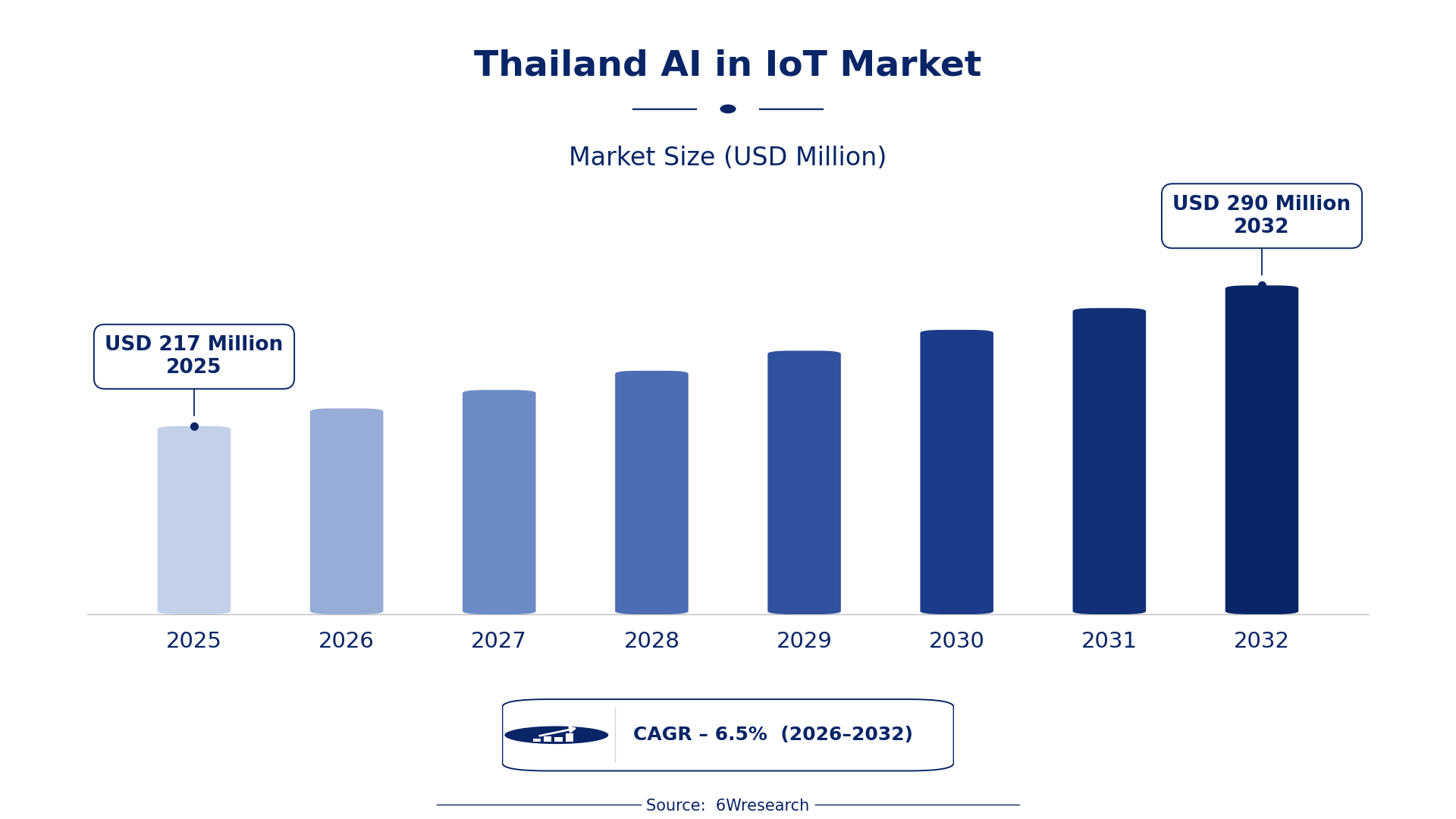
The Thailand AI in IoT Market was estimated at USD 217 Million in 2025 and is projected to reach USD 290 Million by 2032, growing at a CAGR of 6.5% from 2026 to 2032.
Thailand AI in IoT Market Synopsis
The convergence of artificial intelligence and the Internet of Things is reshaping Thailand’s technological and industrial environment. Companies are increasingly incorporating AI capabilities into IoT systems to enhance data processing and operational efficiency, resulting in a more connected and intelligent ecosystem.
As businesses across various sectors recognize the potential benefits, the demand for AI-driven IoT solutions is surging. This trend is accelerating the digital transformation initiatives, making AI in IoT a critical component for achieving smarter, data-driven decision-making.
Thailand AI in IoT Market Year-wise Growth Rate and Key Drivers
This graph illustrates the annual growth rates of the Thailand AI in IoT Market from 2021 to 2032, highlighting a steady upward trajectory and projected expansion over the forecast period.
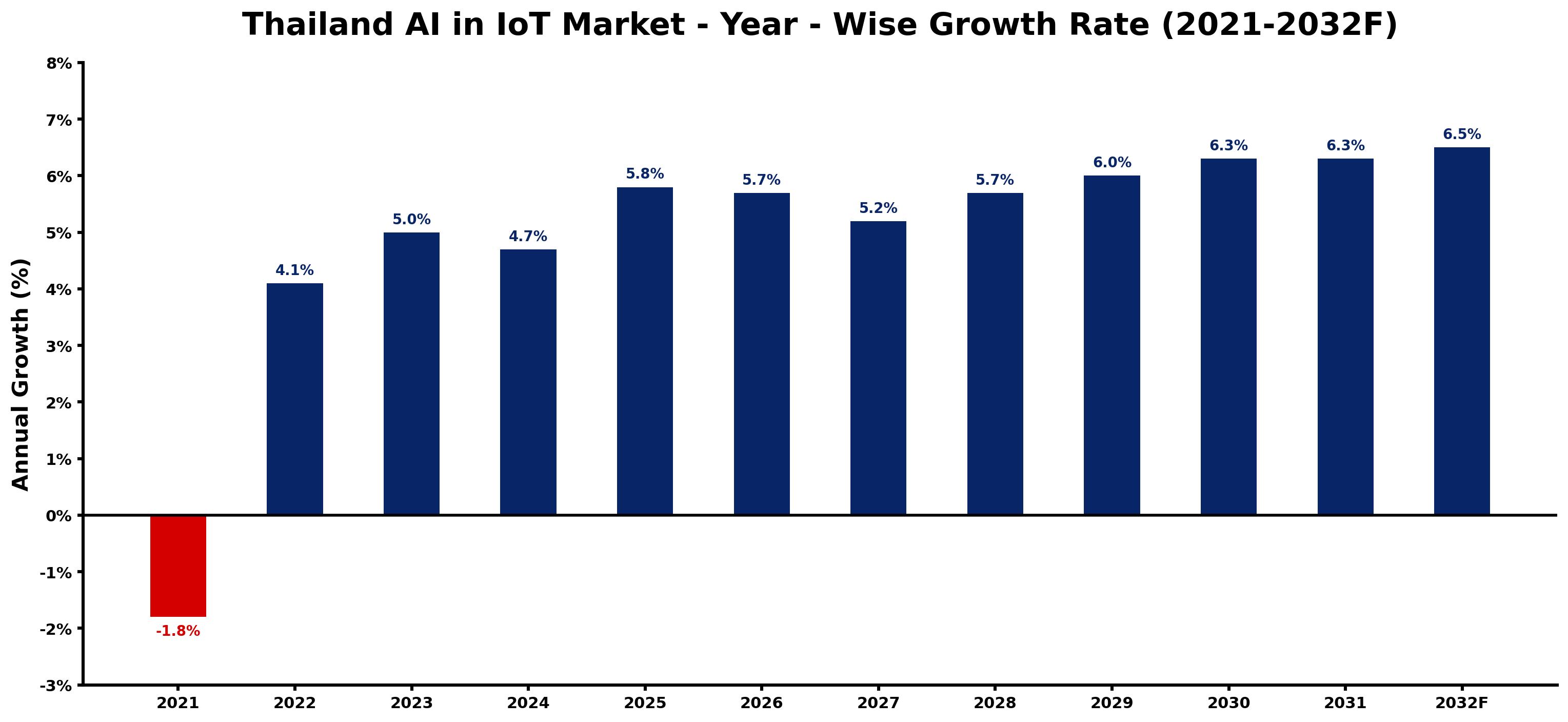
The table below presents the year‑wise growth rates along with the key drivers influencing the market
| Year | Growth Rate | Major Drivers |
| 2021 | -1.8% | Delayed adoption due to lack of government incentives. |
| 2022 | 4.1% | AI adoption driven by Thailand 4.0 policy framework |
| 2023 | 5.0% | Increased investments in smart agriculture technology solutions |
| 2024 | 4.7% | Local startups developing IoT security solutions gain traction |
| 2025 | 5.8% | Government subsidies for smart home technology integration |
| 2026 | 5.7% | Growing industrial automation in manufacturing sectors boosts uptake |
| 2027 | 5.2% | Rise of connected healthcare devices in urban areas |
| 2028 | 5.7% | Tourism sector leveraging IoT for enhanced visitor experiences |
| 2029 | 6.0% | Emergence of AI-driven logistics optimizing supply chain efficiency |
| 2030 | 6.3% | Strong demand for smart energy management systems increasing |
| 2031 | 6.3% | Thai universities promoting IoT and AI tech research collaborations |
| 2032 | 6.5% | Local fintech apps utilizing IoT for secure transactions |
Note: Market size estimations and growth projections presented in this report are based on 6Wresearch's proprietary forecasting methodology, utilizing the latest available industry data, government publications, and primary research inputs.
Thailand AI in IoT Market Key Takeaways
Below are some of the specific key takeaways from the market, including:
- The integration of AI into IoT systems is enhancing data analytics and decision-making processes.
- Businesses are prioritizing predictive maintenance and real-time monitoring capabilities through AI in IoT solutions.
- The market is fueled by the growing adoption of IoT technology across various industries.
- Security concerns regarding IoT devices remain a critical challenge for the market's growth.
- Government initiatives are actively promoting the development of AI in IoT technologies.
Evaluation of Restraints in Thailand AI in IoT Market
Interoperability issues among diverse IoT devices present a significant challenge in the Thailand AI in IoT market. With numerous manufacturers producing varied devices, ensuring consistent communication and integration is essential yet complex. on top of that, security concerns surrounding data privacy and the interconnected nature of IoT systems complicate implementation, necessitating robust security measures to protect sensitive information. These challenges must be addressed for the market to achieve its full potential.
Thailand AI in IoT Market Trends
The demand for AI in IoT is being driven by several key trends. First, the push for automation in industries such as manufacturing and logistics is leading to increased investment in AI-enabled IoT solutions. Additionally, advancements in machine learning and data analytics are making it easier for businesses to extract actionable insights from vast amounts of IoT-generated data. The rise of edge computing is also enabling real-time data processing, further enhancing the appeal of AI in IoT systems.
Thailand AI in IoT Market Opportunities
There is significant potential for growth in areas such as smart cities and industrial automation. Investments in smart infrastructure are creating opportunities for AI in IoT solutions that can optimize energy use and improve resource management. on top of that, the healthcare sector presents a ripe opportunity for AI integration, enabling better patient monitoring and predictive analytics. As organizations continue to seek efficiency and innovation, the AI in IoT market is well-positioned for expansion.
Government Initiatives in the Thailand AI in IoT Market
The Thai government is actively promoting the integration of AI in IoT technologies as part of its broader digital transformation agenda. Public policy is focused on enhancing technological capabilities while addressing regulatory and infrastructure needs. These initiatives are crucial as they lay the groundwork for fostering innovation and attracting investments in this sector.
- A national digital infrastructure upgrade programme launched in early 2023 aims to improve connectivity for IoT devices nationwide.
- Currently underway is a government-led initiative encouraging research and development in AI and IoT applications across various industries.
- A planned public-private partnership expected to enhance smart city projects is set to begin in mid-2024, focusing on transportation and utilities.
- In late 2022, a regulatory framework was introduced to establish standards for IoT device interoperability and security.
Future Insights of the Thailand AI in IoT Market
Looking ahead to 2026-2032, the Thailand AI in IoT market is expected to experience robust growth as businesses increasingly adopt these technologies. The drive for automation and efficiency will continue to be key factors. As companies invest in AI capabilities, the landscape will become more competitive, with a focus on innovative solutions that address specific industry needs. Collaboration between the government and private sector will further support this trajectory, enhancing the market's potential.
Thailand AI in IoT Market Latest Developments
Recent activity in the Thailand AI in IoT market indicates a growing momentum toward advanced technological solutions. Companies are stepping up their efforts to integrate AI with IoT to enhance operational efficiencies and customer experiences. This trend is being reinforced by ongoing public-sector initiatives aimed at fostering innovation.
- A major technology vendor began a rollout of a new AI-powered IoT platform in Q2 2023, targeting manufacturers seeking predictive maintenance solutions.
- A partnership between a leading telecommunications operator and a software company was announced in early 2023 to develop smart city applications using AI in IoT.
- A health-tech startup launched a pilot programme in late 2023 that leverages AI in IoT for remote patient monitoring, improving healthcare delivery.
- Currently ongoing is a joint initiative between universities and industry players to advance research in AI and IoT, which began in early 2023.
Thailand AI in IoT Market - Key Attractiveness of the Report
- 10 Years of Market Numbers
- Historical Data Starting from 2022 to 2025
- Base Year: 2025
- Forecast Data until 2032
- Key Performance Indicators Impacting the Market
- Major Upcoming Developments and Projects
Key Highlights of the Report:
- Thailand AI in IoT Market Outlook
- Market Size of Thailand AI in IoT Market, 2025
- Forecast of Thailand AI in IoT Market, 2032
- Historical Data and Forecast of Thailand AI in IoT Revenues & Volume for the Period 2022-2032F
- Thailand AI in IoT Market Trend Evolution
- Thailand AI in IoT Market Drivers and Challenges
- Thailand AI in IoT Price Trends
- Thailand AI in IoT Porter's Five Forces
- Thailand AI in IoT Industry Life Cycle
- Historical Data and Forecast of Thailand AI in IoT Market Revenues & Volume By Component for the Period 2022-2032F
- Historical Data and Forecast of Thailand AI in IoT Market Revenues & Volume By Platforms for the Period 2022-2032F
- Historical Data and Forecast of Thailand AI in IoT Market Revenues & Volume By Software Solutions for the Period 2022-2032F
- Historical Data and Forecast of Thailand AI in IoT Market Revenues & Volume By Services for the Period 2022-2032F
- Historical Data and Forecast of Thailand AI in IoT Market Revenues & Volume By Vertical for the Period 2022-2032F
- Historical Data and Forecast of Thailand AI in IoT Market Revenues & Volume By Manufacturing for the Period 2022-2032F
- Historical Data and Forecast of Thailand AI in IoT Market Revenues & Volume By Energy and Utilities for the Period 2022-2032F
- Historical Data and Forecast of Thailand AI in IoT Market Revenues & Volume By Transportation and Mobility for the Period 2022-2032F
- Historical Data and Forecast of Thailand AI in IoT Market Revenues & Volume By BFSI for the Period 2022-2032F
- Historical Data and Forecast of Thailand AI in IoT Market Revenues & Volume By Government and Defense for the Period 2022-2032F
- Historical Data and Forecast of Thailand AI in IoT Market Revenues & Volume By Retail for the Period 2022-2032F
- Historical Data and Forecast of Thailand AI in IoT Market Revenues & Volume By Healthcare and Life Sciences for the Period 2022-2032F
- Historical Data and Forecast of Thailand AI in IoT Market Revenues & Volume By Telecom for the Period 2022-2032F
- Historical Data and Forecast of Thailand AI in IoT Market Revenues & Volume By Technology for the Period 2022-2032F
- Historical Data and Forecast of Thailand AI in IoT Market Revenues & Volume By ML and Deep Learning for the Period 2022-2032F
- Historical Data and Forecast of Thailand AI in IoT Market Revenues & Volume By NLP for the Period 2022-2032F
- Thailand AI in IoT Import Export Trade Statistics
- Market Opportunity Assessment By Component
- Market Opportunity Assessment By Vertical
- Market Opportunity Assessment By Technology
- Thailand AI in IoT Top Companies Market Share
- Thailand AI in IoT Competitive Benchmarking By Technical and Operational Parameters
- Thailand AI in IoT Company Profiles
- Thailand AI in IoT Key Strategic Recommendations






































