Thailand AI in Telecommunication Market Size & Growth Rate (2026-2032)
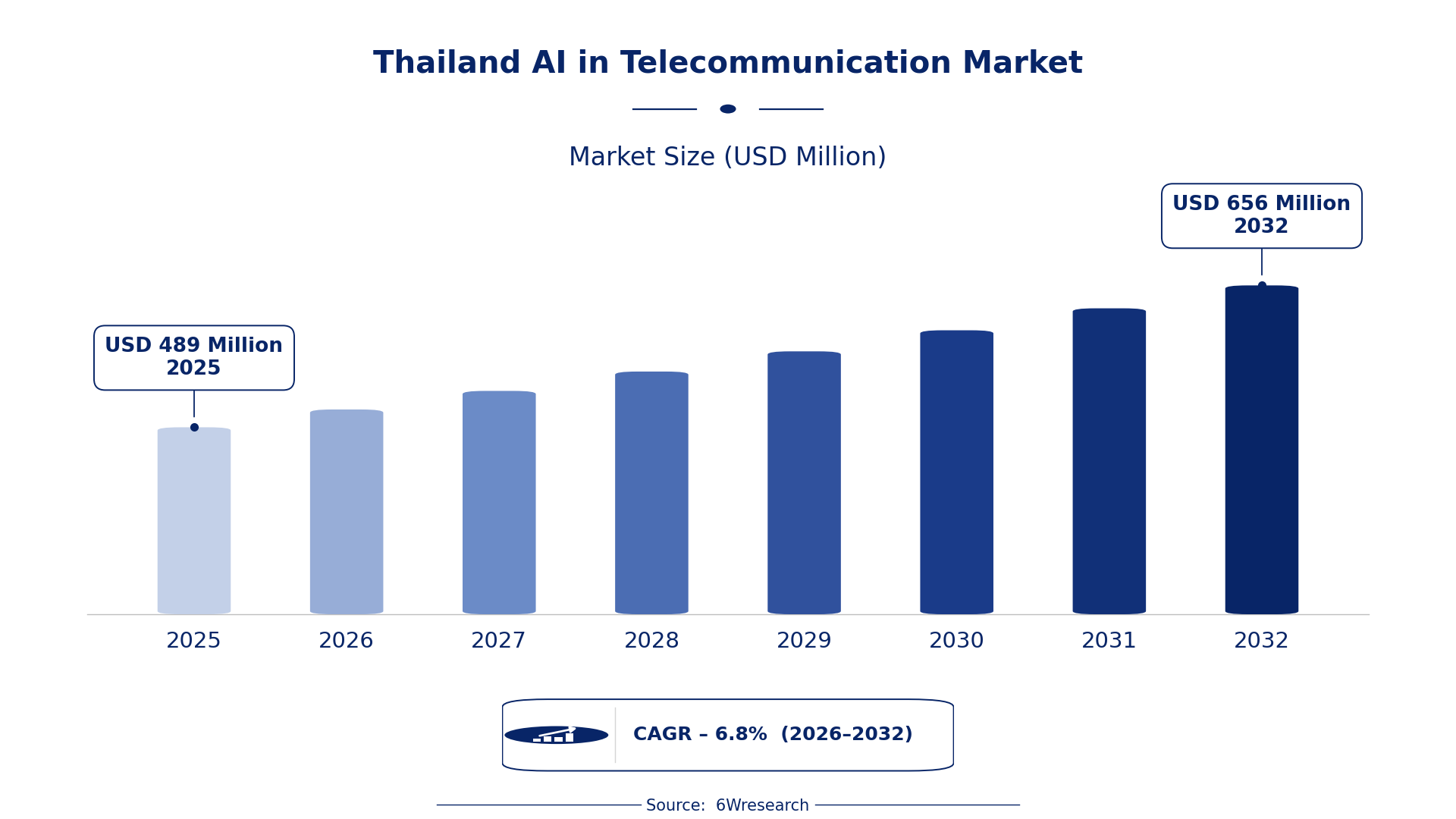
The Thailand AI in Telecommunication Market was estimated at USD 489 Million in 2025 and is projected to reach USD 656 Million by 2032, growing at a CAGR of 6.8% from 2026 to 2032.
Thailand AI in Telecommunication Market Synopsis
The recent surge in AI adoption among telecom operators marks a transformative shift in the Thailand AI in Telecommunication Market. With the need for enhanced customer service and network efficiency becoming critical, operators are increasingly leaning on AI technologies to redefine their operational strategies.
Looking ahead, the integration of AI is set to become more sophisticated, with predictive analytics and customer engagement tools taking center stage. This growth trajectory reflects a broader trend in which telecom services are adapting to more complex consumer demands and expectations.
Thailand AI in Telecommunication Market Year-wise Growth Rate and Key Drivers
This graph illustrates the annual growth rates of the Thailand AI in Telecommunication Market from 2021 to 2032, highlighting a steady upward trajectory and projected expansion over the forecast period.
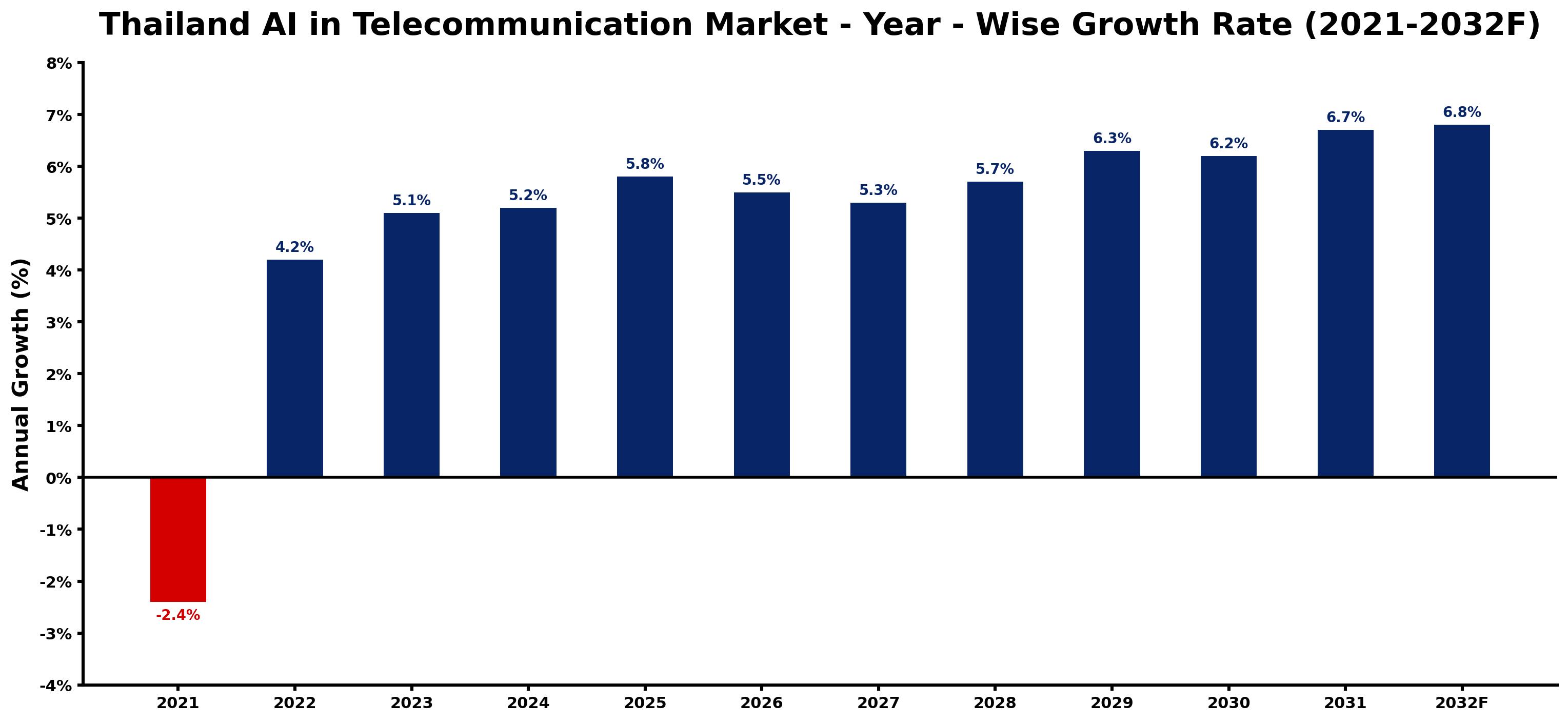
The table below presents the year‑wise growth rates along with the key drivers influencing the market
| Year | Growth Rate | Major Drivers |
| 2021 | -2.4% | Limited 5G rollout by National Broadcasting and Telecommunications Commission |
| 2022 | 4.2% | True 5G network rollout by National Broadcasting and Telecommunications Commission |
| 2023 | 5.1% | Increased government investment in smart city projects |
| 2024 | 5.2% | Growing adoption of AI-driven customer support chatbots |
| 2025 | 5.8% | Launch of Thailand's AI roadmap by government initiatives |
| 2026 | 5.5% | Demand for enhanced fiber-optic broadband services increases |
| 2027 | 5.3% | Telecom companies leveraging machine learning for predictive maintenance |
| 2028 | 5.7% | Rising focus on cybersecurity solutions for telecom networks |
| 2029 | 6.3% | Integration of AI in network optimization by telecom providers |
| 2030 | 6.2% | Emerging partnerships between telcos and AI startups |
| 2031 | 6.7% | Increase in digital payment and fintech services adoption |
| 2032 | 6.8% | Government policies promoting AI literacy among telecom professionals |
Note: Market size estimations and growth projections presented in this report are based on 6Wresearch's proprietary forecasting methodology, utilizing the latest available industry data, government publications, and primary research inputs.
Thailand AI in Telecommunication Market Key Takeaways
Below are some of the specific key takeaways from the market, including:
- AI is transforming customer service through chatbots and virtual assistants, enhancing user interaction.
- Network optimization using AI is enabling telecom companies to predict and address issues proactively.
- The market is driven by rising complexities in telecom networks and the need for operational efficiency.
- COVID-19 accelerated the adoption of AI solutions, emphasizing the importance of reliable connectivity.
- Key players are focused on integrating AI for improved customer experiences and service delivery.
Evaluation of Restraints in Thailand AI in Telecommunication Market
Despite the growth, several constraints hinder the Thailand AI in Telecommunication Market. Integrating AI into existing infrastructure poses a technical challenge, requiring significant investment and expertise. The ethical use of AI also looms large, as telecom operators face scrutiny over data privacy and job displacement concerns. These challenges necessitate a collaborative effort among stakeholders to foster trust and acceptance of AI technologies within the industry.
Thailand AI in Telecommunication Market Trends
Several trends are shaping the Thailand AI in Telecommunication Market. The increasing reliance on AI for predictive maintenance is noteworthy, as telecom companies seek to minimize downtime and enhance service reliability. Additionally, the push for personalized customer experiences has led to the development of advanced analytics tools that tailor services to individual needs. The trend towards automation in customer service functions further reflects a broader move to streamline operations and reduce costs.
Thailand AI in Telecommunication Market Opportunities
The market presents several growth opportunities for stakeholders. Investment in AI-driven analytics tools for data management and customer insights can significantly enhance operational efficiencies. Furthermore, partnerships between telecom operators and technology providers can accelerate innovation and implementation of cutting-edge solutions. Expansion into underserved regions of Thailand using AI to optimize resource allocation will also open new avenues for growth.
Government Initiatives in the Thailand AI in Telecommunication Market
Government policies are crucial in shaping the Thailand AI in Telecommunication Market, emphasizing the need for a supportive regulatory environment. The current focus is on modernizing digital infrastructure while ensuring ethical standards in AI deployment. Public-sector priorities include fostering innovation and addressing potential workforce impacts due to AI technologies.
- A national digital infrastructure upgrade programme launched in early 2025 aims to improve connectivity across rural areas.
- The regulatory body introduced a framework in mid-2025 to promote transparency in AI applications within telecommunications.
- Ongoing initiatives support skill development for workers transitioning to AI-enhanced roles within the industry.
- A planned public-private partnership set to begin in 2026 aims to expand AI integration across all telecom services.
Future Insights of the Thailand AI in Telecommunication Market
From 2026 to 2032, the Thailand AI in Telecommunication Market is expected to evolve significantly. As telecom operators prioritize enhanced customer interactions and operational efficiencies, investments in AI will increase. The focus on network optimization will drive innovation, positioning AI as a cornerstone of future telecom strategies. With growing consumer expectations for service quality and personalized experiences, the role of AI will only become more pivotal in this competitive space.
Thailand AI in Telecommunication Market Latest Developments
Recent industry activity indicates a dynamic shift within the Thailand AI in Telecommunication Market. Operators are rapidly integrating AI solutions to meet rising consumer demands for efficiency and personalized service. The pace of development is encouraging as companies experiment with new AI technologies to enhance their service offerings.
- A major telecom operator announced the deployment of AI-driven network analytics tools in Q1 2025, enabling improved predictive maintenance.
- Currently ongoing, a project aims to implement AI chatbots across customer service channels to enhance response times and satisfaction.
- Plans for a comprehensive AI training program for telecom staff were unveiled in late 2025, aimed at upskilling employees for the new digital landscape.
- An upcoming AI technology rollout is set to begin in mid-2026, targeting smarter resource allocation across urban telecom networks.
Thailand AI in Telecommunication Market - Key Attractiveness of the Report
- 10 Years of Market Numbers
- Historical Data Starting from 2022 to 2025
- Base Year: 2025
- Forecast Data until 2032
- Key Performance Indicators Impacting the Market
- Major Upcoming Developments and Projects
Key Highlights of the Report:
- Thailand AI in Telecommunication Market Outlook
- Market Size of Thailand AI in Telecommunication Market, 2025
- Forecast of Thailand AI in Telecommunication Market, 2032
- Historical Data and Forecast of Thailand AI in Telecommunication Revenues & Volume for the Period 2022-2032F
- Thailand AI in Telecommunication Market Trend Evolution
- Thailand AI in Telecommunication Market Drivers and Challenges
- Thailand AI in Telecommunication Price Trends
- Thailand AI in Telecommunication Porter's Five Forces
- Thailand AI in Telecommunication Industry Life Cycle
- Historical Data and Forecast of Thailand AI in Telecommunication Market Revenues & Volume By Application for the Period 2022-2032F
- Historical Data and Forecast of Thailand AI in Telecommunication Market Revenues & Volume By Customer analytics for the Period 2022-2032F
- Historical Data and Forecast of Thailand AI in Telecommunication Market Revenues & Volume By Network security for the Period 2022-2032F
- Historical Data and Forecast of Thailand AI in Telecommunication Market Revenues & Volume By Network optimization for the Period 2022-2032F
- Historical Data and Forecast of Thailand AI in Telecommunication Market Revenues & Volume By Self-diagnostics for the Period 2022-2032F
- Historical Data and Forecast of Thailand AI in Telecommunication Market Revenues & Volume By Virtual assistance for the Period 2022-2032F
- Historical Data and Forecast of Thailand AI in Telecommunication Market Revenues & Volume By Others (contact center analytics and marketing campaign analytics) for the Period 2022-2032F
- Historical Data and Forecast of Thailand AI in Telecommunication Market Revenues & Volume By Component for the Period 2022-2032F
- Historical Data and Forecast of Thailand AI in Telecommunication Market Revenues & Volume By Solutions for the Period 2022-2032F
- Historical Data and Forecast of Thailand AI in Telecommunication Market Revenues & Volume By Services for the Period 2022-2032F
- Historical Data and Forecast of Thailand AI in Telecommunication Market Revenues & Volume By Deployment Mode for the Period 2022-2032F
- Historical Data and Forecast of Thailand AI in Telecommunication Market Revenues & Volume By Cloud for the Period 2022-2032F
- Historical Data and Forecast of Thailand AI in Telecommunication Market Revenues & Volume By On-premises for the Period 2022-2032F
- Historical Data and Forecast of Thailand AI in Telecommunication Market Revenues & Volume By Technology for the Period 2022-2032F
- Historical Data and Forecast of Thailand AI in Telecommunication Market Revenues & Volume By Machine learning and deep learning for the Period 2022-2032F
- Historical Data and Forecast of Thailand AI in Telecommunication Market Revenues & Volume By Natural Language Processing (NLP) for the Period 2022-2032F
- Thailand AI in Telecommunication Import Export Trade Statistics
- Market Opportunity Assessment By Application
- Market Opportunity Assessment By Component
- Market Opportunity Assessment By Deployment Mode
- Market Opportunity Assessment By Technology
- Thailand AI in Telecommunication Top Companies Market Share
- Thailand AI in Telecommunication Competitive Benchmarking By Technical and Operational Parameters
- Thailand AI in Telecommunication Company Profiles
- Thailand AI in Telecommunication Key Strategic Recommendations






































