Global AI In Telecommunication Market Highlights
| Market Size (2025) | USD 3.7 Billion |
| Forecast Size (2032) | USD 9.2 Billion |
| CAGR | 14.02% |
| Base Year | 2025 |
| Forecast Period | 2026-2032 |
| Largest Region | North America |
| Fastest Growing Region | Asia |
| Largest Segment | Network Security |
| Fastest Growing Segment | Network Optimization |
| Leading Companies | IBM, Nokia, Ericsson, Cisco, Huawei |
Global AI In Telecommunication Market Size & Growth Rate (2026-2032)
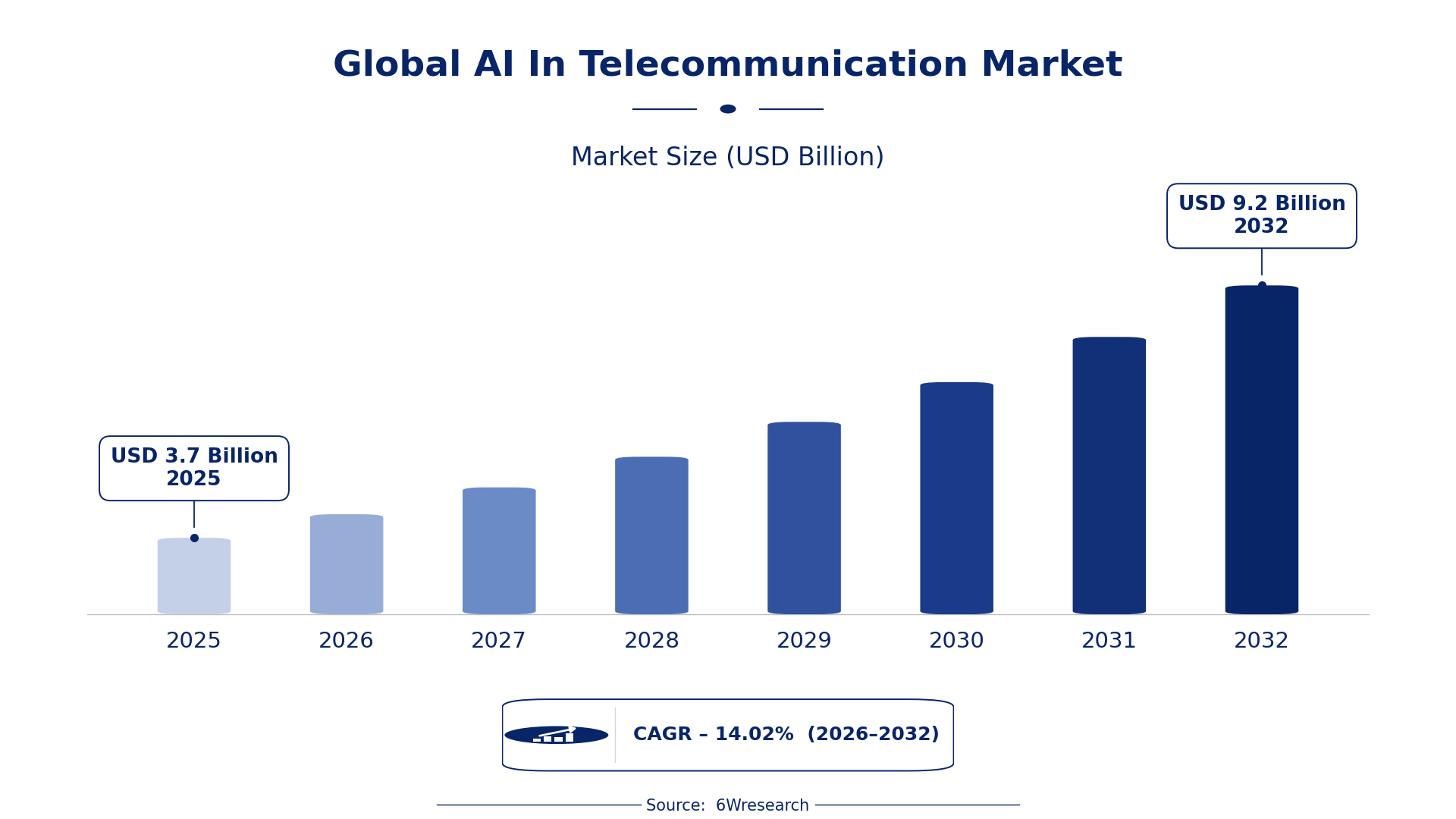
The Global AI In Telecommunication Market was estimated at USD 3.7 Billion in 2025 and is projected to reach USD 9.2 Billion by 2032, growing at a CAGR of 14.02% from 2026 to 2032.
Global AI In Telecommunication Market Synopsis
The transformative potential of artificial intelligence in telecommunications is becoming increasingly evident, particularly in optimizing network operations and enhancing customer engagement. By implementing machine learning algorithms and predictive analytics, telecom firms can streamline their services, leading to improved operational efficiency and cost reduction.
Moreover, with the rise in data traffic precipitated by the proliferation of IoT devices, the demand for AI-driven solutions has intensified. The telecommunications industry is focusing on integrating AI for predictive maintenance and seamless service personalization, thereby revolutionizing customer interactions and overall service delivery.
Global AI In Telecommunication Market Year-wise Growth Rate and Key Drivers
This graph illustrates the annual growth rates of the Global AI In Telecommunication Market from 2022 to 2032, highlighting a steady upward trajectory and projected expansion over the forecast period.
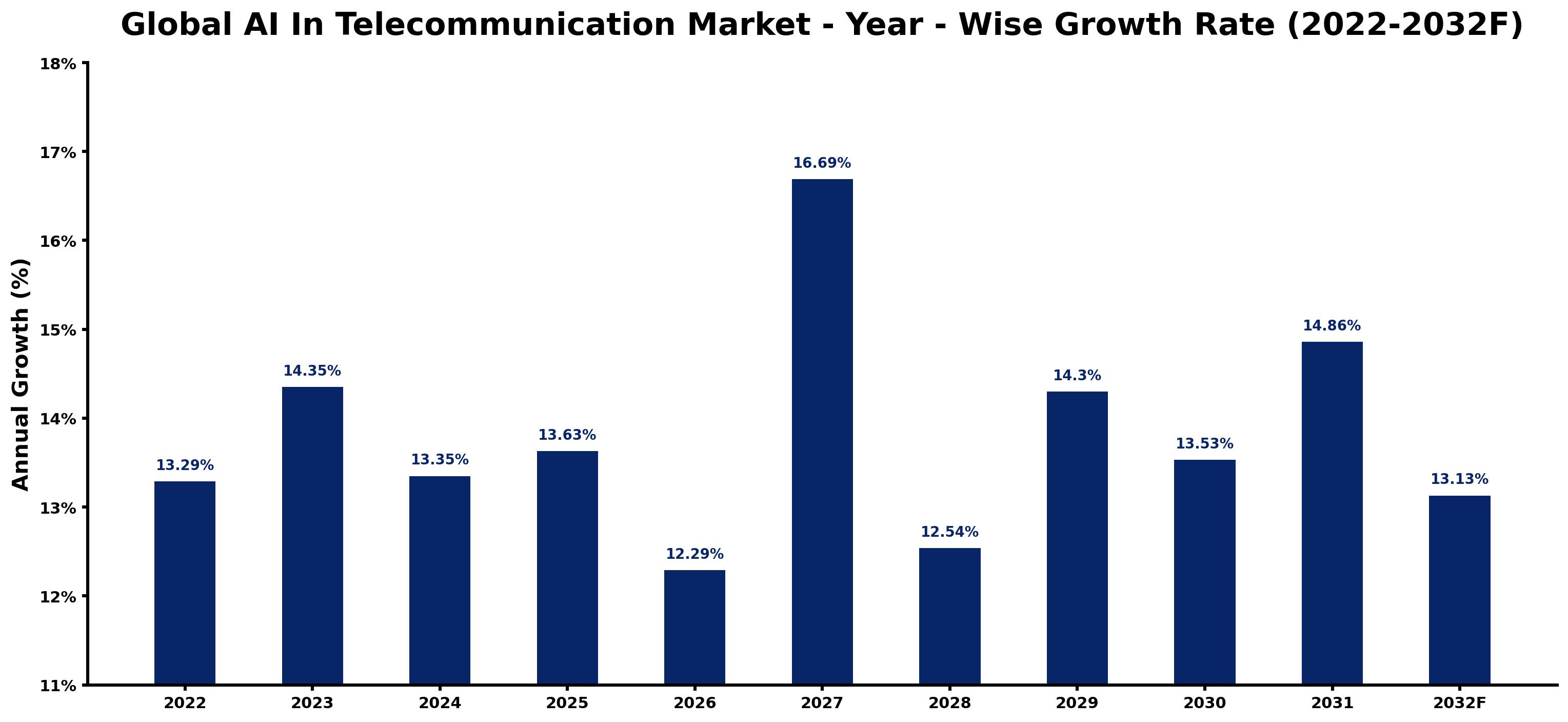
The table below presents the year‑wise growth rates along with the key drivers influencing the market
| Year | Growth Rate (%) | Major Drivers |
| 2022 | 13.29 | As telecom companies invest in training, AI skills are becoming increasingly vital. |
| 2023 | 14.35 | In North America, regulatory changes are enhancing AI opportunities across telecommunications. |
| 2024 | 13.35 | A surge in mergers and acquisitions is driving strategic growth in AI telecommunication solutions. |
| 2025 | 13.63 | A shift toward 5G rollout is expanding the potential of AI in telecommunication networks. |
| 2026 | 12.29 | Telecommunication providers are increasingly expanding service coverage to include remote areas. |
| 2027 | 16.69 | Telecom manufacturers are optimizing supply chains to support AI-driven service enhancements. |
| 2028 | 12.54 | Telecommunication infrastructure providers are adapting to a shifting competitive landscape in AI. |
| 2029 | 14.3 | Increasing investments in fiber-optic networks are enabling enhanced AI telecommunication functionalities. |
| 2030 | 13.53 | A growing request for personalized services is prompting advancements in AI applications. |
| 2031 | 14.86 | AI algorithms in network management are becoming crucial for achieving sustainability goals. |
| 2032 | 13.13 | Smartphone adoption of AI features is changing the dynamics of telecommunication services. |
Note - Market size estimations and growth projections presented in this report are based on 6Wresearch's proprietary research methodology, combining internal industry data, secondary research, and primary validation, updated periodically to reflect current market conditions. As markets evolve rapidly, figures for certain industries may vary slightly and are intended as informed estimates rather than absolute figures. For the most current market sizing, we recommend validating figures with a 6Wresearch analyst.
Global AI In Telecommunication Market Key Takeaways
Below are some of the specific key takeaways from the market, including:
- As of 2025, the network security segment commands approximately 35% of the market share.
- Nokia launched its AI-powered Traffic Management system in 2022, significantly improving network efficiency.
- The network optimization segment is projected to grow at a CAGR of 20.5% from 2026 to 2032, reflecting increasing reliance on AI for operational excellence.
- IBM has committed over USD 1.5 billion in R&D towards AI solutions tailored for the telecommunications sector by 2025.
Evaluation of Restraints in Global AI In Telecommunication Market
One notable restraint in the Global AI In Telecommunication Market is the significant investment required for AI integration, often exceeding USD 10 million for large telecom operators. This high cost can deter investments, particularly for smaller companies lacking sufficient capital. Additionally, regulatory hurdles such as stringent data protection laws complicate the deployment of AI technologies. For example, the implementation of the General Data Protection Regulation (GDPR) in Europe imposes strict requirements on data handling and privacy, thereby increasing compliance costs and limiting AI applications in customer data analytics.
Global AI In Telecommunication Market Trends
Several trends are shaping the Global AI In Telecommunication Market, particularly around automation and enhanced security measures. Firstly, the implementation of machine learning for predictive maintenance is gaining traction; for instance, AT&T has reported a reduction in network downtime by up to 30% using AI insights. Secondly, there's a significant shift toward automated customer service solutions, with companies like Ericsson investing heavily in AI chatbots that handle customer queries effectively, potentially reducing operational expenses by around 25%. These shifts reflect a broader movement toward operational efficiency in the telecom sector, driven by technological advancements in AI.
Global AI In Telecommunication Market Opportunities
The Global AI In Telecommunication Market presents numerous opportunities for revenue growth, particularly in the realm of data analysis and customer interaction. For instance, the advent of AI-driven virtual assistants, expected to generate revenue upwards of USD 500 million by 2028, demonstrates a clear market need for improved customer engagement. Moreover, companies like Vodafone are exploring the development of AI solutions for network optimization, forecasting up to 30% revenue growth by integrating smart analytics into their operations. Furthermore, the deployment of AI applications in 5G networks is anticipated to enhance performance metrics, creating a multi-billion-dollar opportunity in the next few years.
Global AI In Telecommunication Market by Application
As of 2025, the network security segment leads the Global AI In Telecommunication Market with a share of approximately 35%, emphasizing its critical role in protecting the vast data flows inherent in telecommunications. Conversely, the network optimization segment is the fastest-growing, projected to achieve a CAGR of 20.5% from 2026 to 2032. This rapid growth can be attributed to the necessity for efficiency, driven by increasing data demand and operational complexities. Companies are prioritizing AI solutions in network optimization to enhance service reliability and reduce operational costs, setting the stage for dynamic growth in this segment.
Global AI In Telecommunication Market by Region
North America dominates the Global AI In Telecommunication Market, commanding a share of approximately 40% in 2025, driven by advanced technological infrastructure and high investment levels in AI research. Meanwhile, the fastest-growing region is Asia, with a projected CAGR of 18.3% from 2026 to 2032. This growth is bolstered by increased telecom penetration, government initiatives, and an expanding consumer base, positioning Asia as a key player in the adoption of AI technologies within the telecommunications sector.
Government Initiatives in the Global AI In Telecommunication Market
The regulatory environment surrounding the Global AI In Telecommunication Market is evolving to support innovation and safeguard consumer interests. Various governments worldwide are investing in AI initiatives that catalyze market growth and technological advancement, particularly in telecommunications. These initiatives range from funding programs to strategic partnerships aimed at enhancing infrastructure capabilities.
- Federal Communications Commission, National Broadband Plan, 2022 – This initiative enhances broadband access, enabling more efficient AI integration across telecom networks.
- European Commission, Digital Europe Programme, 2021 – A budget of €7.5 billion is allocated to support AI innovations in telecommunications, facilitating infrastructure development.
- Telecommunications Regulatory Authority of India, National Digital Communications Policy, 2018 – This ongoing policy aims to boost AI solutions in telecom, promoting innovation and consumer protection.
- Ministry of Internal Affairs and Communications (Japan), AI for Telecommunication Strategy, Expected Launch 2024 – Aiming to enhance AI-driven network optimization and security, this strategy predicts substantial telecom efficiency improvements.
Future Insights of the Global AI In Telecommunication Market
The Global AI In Telecommunication Market is set to experience transformative changes as operators leverage AI technologies for enhanced service delivery and operational efficiencies. By 2032, the integration of AI in 5G networks is projected to streamline operations and facilitate data handling, significantly improving network performance metrics. Companies like Cisco are actively developing AI solutions that enhance real-time data analysis capabilities, addressing escalating data traffic from emerging technologies and IoT devices, thus reinforcing their market positioning.
Global AI In Telecommunication Market Latest Developments
Recent developments in the Global AI In Telecommunication Market underscore the competitive dynamics and technological advancements spearheading the industry.
- In early 2023, IBM unveiled its AI-driven network management platform, which enables telecom operators to automate routine tasks, reducing operational costs and improving service uptime.
- Ericsson is currently enhancing its AI capabilities by integrating machine learning algorithms into its radio access network solutions, aiming for rollout by late 2024 to optimize network efficiency.
- Nokia is actively working on a new AI-based analytics software designed to predict network traffic patterns, expected to launch in mid-2024, thus assisting telecom providers in resource allocation.
- In September 2023, Huawei launched a comprehensive AI security solution to bolster cybersecurity measures in telecom networks, reflecting a commitment to safeguarding user data.
Global AI In Telecommunication Market Key Players and Industry Positioning
The competitive structure of the Global AI In Telecommunication Market is moderately consolidated, with several key players driving technological advancements and market growth. These companies leverage their unique strengths to capture market share and enhance service offerings.
| Leading Company | Core Strength | Strategic Focus |
|---|---|---|
| IBM | Strong R&D capabilities in AI and cloud computing. | Developing AI solutions for network management and automation. |
| Nokia | Expertise in network infrastructure and optimization tools. | Focusing on AI-powered analytics for enhanced traffic management. |
| Ericsson | Advanced software solutions integrated with AI for mobile networks. | Investing in automation technologies for network optimization. |
| Cisco | Robust cybersecurity tools that incorporate AI elements. | Enhancing security measures through AI for telecom operators. |
| Huawei | Strength in telecommunications equipment and cloud solutions. | Advancing AI applications in security and data analytics. |
As the competitive landscape evolves, these players are likely to intensify their efforts in innovation and differentiation, ensuring they remain at the forefront of the AI telecommunications revolution.
Key Attractiveness of the Report
- 10 Years of Market Numbers
- Historical Data Starting from 2022 to 2025
- Base Year: 2025
- Forecast Data until 2032
- Key Performance Indicators Impacting the Market
- Major Upcoming Developments and Projects
Key Highlights of the Report:
- Global AI In Telecommunication Market Outlook
- Market Size of Global AI In Telecommunication Market, 2025
- Forecast of Global AI In Telecommunication Market, 2032
- Historical Data and Forecast of Global AI In Telecommunication Revenues & Volume for the Period 2022-2032
- Global AI In Telecommunication Market Trend Evolution
- Global AI In Telecommunication Market Drivers and Challenges
- Global AI In Telecommunication Price Trends
- Global AI In Telecommunication Porter's Five Forces
- Global AI In Telecommunication Industry Life Cycle
- Historical Data and Forecast of Global AI In Telecommunication Market Revenues & Volume
- Historical Data and Forecast of Global AI In Telecommunication Market Revenues & Volume By Application for the Period 2022-2032
- Historical Data and Forecast of Global AI In Telecommunication Market Revenues & Volume By Network Security for the Period 2022-2032
- Historical Data and Forecast of Global AI In Telecommunication Market Revenues & Volume By Network Optimization for the Period 2022-2032
- Historical Data and Forecast of Global AI In Telecommunication Market Revenues & Volume By Customer Analytics for the Period 2022-2032
- Historical Data and Forecast of Global AI In Telecommunication Market Revenues & Volume By Virtual AssistanceSelf-Diagnostics for the Period 2022-2032
- Historical Data and Forecast of Global AI In Telecommunication Market Revenues & Volume By Others for the Period 2022-2032
- Historical Data and Forecast of North America AI In Telecommunication Market Revenues & Volume By Application for the Period 2022-2032
- Historical Data and Forecast of North America AI In Telecommunication Market Revenues & Volume By Network Security for the Period 2022-2032
- Historical Data and Forecast of North America AI In Telecommunication Market Revenues & Volume By Network Optimization for the Period 2022-2032
- Historical Data and Forecast of North America AI In Telecommunication Market Revenues & Volume By Customer Analytics for the Period 2022-2032
- Historical Data and Forecast of North America AI In Telecommunication Market Revenues & Volume By Virtual AssistanceSelf-Diagnostics for the Period 2022-2032
- Historical Data and Forecast of North America AI In Telecommunication Market Revenues & Volume By Others for the Period 2022-2032
- Historical Data and Forecast of United States of America AI In Telecommunication Market Revenues & Volume for the Period 2022-2032
- Historical Data and Forecast of Canada AI In Telecommunication Market Revenues & Volume for the Period 2022-2032
- Historical Data and Forecast of Rest of North America AI In Telecommunication Market Revenues & Volume for the Period 2022-2032
- Historical Data and Forecast of Latin America (LATAM) AI In Telecommunication Market Revenues & Volume By Application for the Period 2022-2032
- Historical Data and Forecast of Latin America (LATAM) AI In Telecommunication Market Revenues & Volume By Network Security for the Period 2022-2032
- Historical Data and Forecast of Latin America (LATAM) AI In Telecommunication Market Revenues & Volume By Network Optimization for the Period 2022-2032
- Historical Data and Forecast of Latin America (LATAM) AI In Telecommunication Market Revenues & Volume By Customer Analytics for the Period 2022-2032
- Historical Data and Forecast of Latin America (LATAM) AI In Telecommunication Market Revenues & Volume By Virtual AssistanceSelf-Diagnostics for the Period 2022-2032
- Historical Data and Forecast of Latin America (LATAM) AI In Telecommunication Market Revenues & Volume By Others for the Period 2022-2032
- Historical Data and Forecast of Brazil AI In Telecommunication Market Revenues & Volume for the Period 2022-2032
- Historical Data and Forecast of Mexico AI In Telecommunication Market Revenues & Volume for the Period 2022-2032
- Historical Data and Forecast of Argentina AI In Telecommunication Market Revenues & Volume for the Period 2022-2032
- Historical Data and Forecast of Rest of LATAM AI In Telecommunication Market Revenues & Volume for the Period 2022-2032
- Historical Data and Forecast of Asia AI In Telecommunication Market Revenues & Volume By Application for the Period 2022-2032
- Historical Data and Forecast of Asia AI In Telecommunication Market Revenues & Volume By Network Security for the Period 2022-2032
- Historical Data and Forecast of Asia AI In Telecommunication Market Revenues & Volume By Network Optimization for the Period 2022-2032
- Historical Data and Forecast of Asia AI In Telecommunication Market Revenues & Volume By Customer Analytics for the Period 2022-2032
- Historical Data and Forecast of Asia AI In Telecommunication Market Revenues & Volume By Virtual AssistanceSelf-Diagnostics for the Period 2022-2032
- Historical Data and Forecast of Asia AI In Telecommunication Market Revenues & Volume By Others for the Period 2022-2032
- Historical Data and Forecast of China AI In Telecommunication Market Revenues & Volume for the Period 2022-2032
- Historical Data and Forecast of India AI In Telecommunication Market Revenues & Volume for the Period 2022-2032
- Historical Data and Forecast of Japan AI In Telecommunication Market Revenues & Volume for the Period 2022-2032
- Historical Data and Forecast of Rest of Asia AI In Telecommunication Market Revenues & Volume for the Period 2022-2032
- Historical Data and Forecast of Africa AI In Telecommunication Market Revenues & Volume By Application for the Period 2022-2032
- Historical Data and Forecast of Africa AI In Telecommunication Market Revenues & Volume By Network Security for the Period 2022-2032
- Historical Data and Forecast of Africa AI In Telecommunication Market Revenues & Volume By Network Optimization for the Period 2022-2032
- Historical Data and Forecast of Africa AI In Telecommunication Market Revenues & Volume By Customer Analytics for the Period 2022-2032
- Historical Data and Forecast of Africa AI In Telecommunication Market Revenues & Volume By Virtual AssistanceSelf-Diagnostics for the Period 2022-2032
- Historical Data and Forecast of Africa AI In Telecommunication Market Revenues & Volume By Others for the Period 2022-2032
- Historical Data and Forecast of South Africa AI In Telecommunication Market Revenues & Volume for the Period 2022-2032
- Historical Data and Forecast of Nigeria AI In Telecommunication Market Revenues & Volume for the Period 2022-2032
- Historical Data and Forecast of Egypt AI In Telecommunication Market Revenues & Volume for the Period 2022-2032
- Historical Data and Forecast of Rest of Africa AI In Telecommunication Market Revenues & Volume for the Period 2022-2032
- Historical Data and Forecast of Europe AI In Telecommunication Market Revenues & Volume By Application for the Period 2022-2032
- Historical Data and Forecast of Europe AI In Telecommunication Market Revenues & Volume By Network Security for the Period 2022-2032
- Historical Data and Forecast of Europe AI In Telecommunication Market Revenues & Volume By Network Optimization for the Period 2022-2032
- Historical Data and Forecast of Europe AI In Telecommunication Market Revenues & Volume By Customer Analytics for the Period 2022-2032
- Historical Data and Forecast of Europe AI In Telecommunication Market Revenues & Volume By Virtual AssistanceSelf-Diagnostics for the Period 2022-2032
- Historical Data and Forecast of Europe AI In Telecommunication Market Revenues & Volume By Others for the Period 2022-2032
- Historical Data and Forecast of United Kingdom AI In Telecommunication Market Revenues & Volume for the Period 2022-2032
- Historical Data and Forecast of France AI In Telecommunication Market Revenues & Volume for the Period 2022-2032
- Historical Data and Forecast of Germany AI In Telecommunication Market Revenues & Volume for the Period 2022-2032
- Historical Data and Forecast of Rest of Europe AI In Telecommunication Market Revenues & Volume for the Period 2022-2032
- Historical Data and Forecast of Middle East AI In Telecommunication Market Revenues & Volume By Application for the Period 2022-2032
- Historical Data and Forecast of Middle East AI In Telecommunication Market Revenues & Volume By Network Security for the Period 2022-2032
- Historical Data and Forecast of Middle East AI In Telecommunication Market Revenues & Volume By Network Optimization for the Period 2022-2032
- Historical Data and Forecast of Middle East AI In Telecommunication Market Revenues & Volume By Customer Analytics for the Period 2022-2032
- Historical Data and Forecast of Middle East AI In Telecommunication Market Revenues & Volume By Virtual AssistanceSelf-Diagnostics for the Period 2022-2032
- Historical Data and Forecast of Middle East AI In Telecommunication Market Revenues & Volume By Others for the Period 2022-2032
- Historical Data and Forecast of Saudi Arabia AI In Telecommunication Market Revenues & Volume for the Period 2022-2032
- Historical Data and Forecast of UAE AI In Telecommunication Market Revenues & Volume for the Period 2022-2032
- Historical Data and Forecast of Turkey AI In Telecommunication Market Revenues & Volume for the Period 2022-2032
- Historical Data and Forecast of Rest of Middle East AI In Telecommunication Market Revenues & Volume for the Period 2022-2032
- Global AI In Telecommunication Market - Key Performance Indicators
- Global AI In Telecommunication Market - Import Export Trade Statistics
- Global AI In Telecommunication Market - Opportunity Assessment By Countries
- Global AI In Telecommunication Market - Opportunity Assessment By Application
- 0
- Global AI In Telecommunication Market - Top Companies Market Share
- Global AI In Telecommunication Market - Top Companies Profiles
- Global AI In Telecommunication Market - Comparison of Players in Technical and Operating Parameters
- Global AI In Telecommunication Market - Strategic Recommendations
Markets Covered
The Global AI In Telecommunication Market report provides a detailed analysis of the following market segments:
By Regions and Countries:
- North America
- Europe
- LATAM
- Middle East
- Asia
- Africa
By Application:
- Network Security
- Network Optimization
- Customer Analytics
- Virtual AssistanceSelf-Diagnostics
- Others






































