Poland AI in Telecommunication Market Size & Growth Rate (2026-2032)
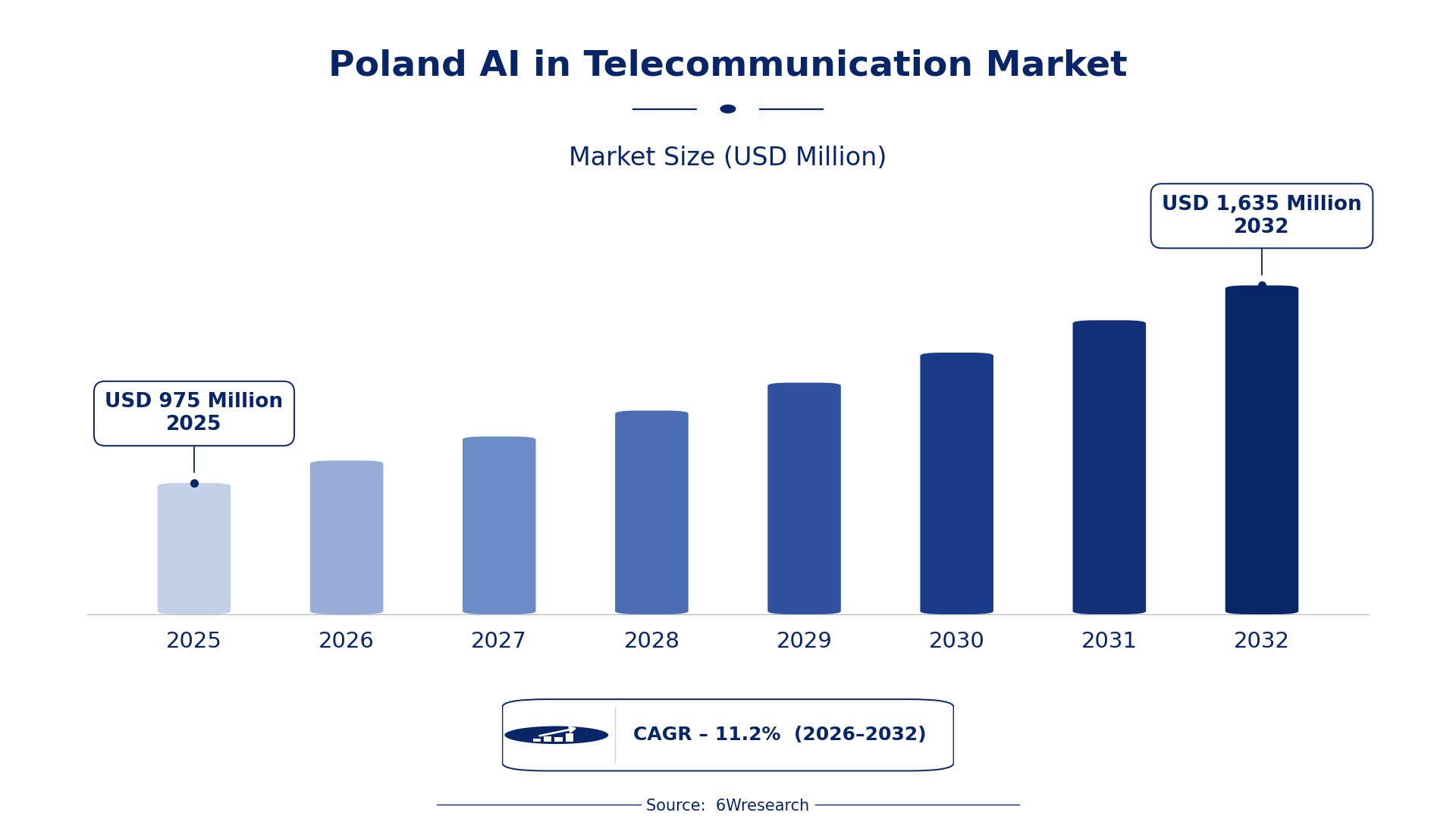
The Poland AI in Telecommunication Market was estimated at USD 975 Million in 2025 and is projected to reach USD 1635 Million by 2032, growing at a CAGR of 11.2% from 2026 to 2032.
Poland AI in Telecommunication Market Synopsis
The AI in Telecommunication market in Poland is witnessing a surge in activity, thanks to telecom companies embracing advanced technologies. This momentum reflects a broader shift in the industry, where AI's capabilities are being harnessed to streamline operations, improve customer experiences, and drive revenue growth.
Looking ahead, the market is on a trajectory of accelerated growth. Emerging technologies such as 5G and IoT are catalyzing this shift, creating fertile ground for innovative AI applications. Companies are not just adapting; they're actively seeking out transformative AI solutions tailored to the unique demands of the telecommunications sector.
Poland AI in Telecommunication Market Year-wise Growth Rate and Key Drivers
This graph illustrates the annual growth rates of the Poland AI in Telecommunication Market from 2021 to 2032, highlighting a steady upward trajectory and projected expansion over the forecast period.
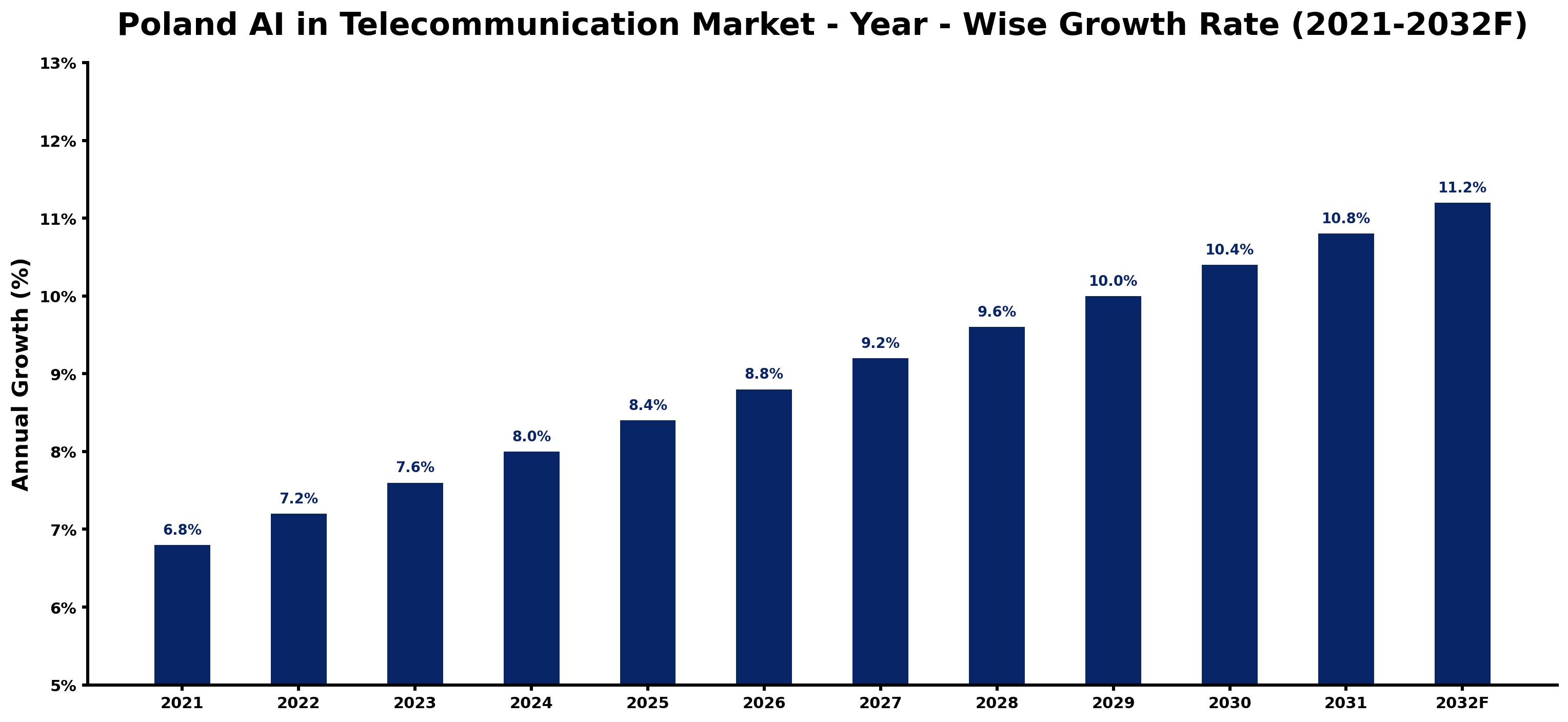
The table below presents the year‑wise growth rates along with the key drivers influencing the market
| Year | Growth Rate | Major Drivers |
| 2021 | 6.8% | 5G deployment by UKE boosting AI applications |
| 2022 | 7.2% | Increased investment from Polish telecom providers in AI |
| 2023 | 7.6% | National AI Strategy supporting tech innovation initiatives |
| 2024 | 8.0% | Growing adoption of IoT driving telecom AI integration |
| 2025 | 8.4% | EU digitalization funds boosting telecommunication AI projects |
| 2026 | 8.8% | Surge in demand for data analytics in telecommunications |
| 2027 | 9.2% | Local startups pioneering AI solutions for telecom operations |
| 2028 | 9.6% | Government incentives for AI adoption in digital services |
| 2029 | 10.0% | Growing consumer preference for AI-driven mobile services |
| 2030 | 10.4% | Partnerships between universities and telecoms for AI research |
| 2031 | 10.8% | Telecom industry adapting to regulations on data privacy |
| 2032 | 11.2% | Increased competition among carriers enhancing AI service offerings |
Note: Market size estimations and growth projections presented in this report are based on 6Wresearch's proprietary forecasting methodology, utilizing the latest available industry data, government publications, and primary research inputs.
Poland AI in Telecommunication Market Key Takeaways
Below are some of the specific key takeaways from the market, including:
- Telecom companies are increasingly deploying AI-driven chatbots and virtual assistants to enhance customer support.
- Predictive analytics is gaining traction for network optimization, leading to more efficient operations.
- Data privacy concerns are shaping regulatory frameworks affecting AI implementations.
- Investments in AI solutions are on the rise, with firms eager to improve customer experiences and operational efficiencies.
- The government's proactive stance on digital transformation is bolstering AI adoption in telecom.
Evaluation of Restraints in Poland AI in Telecommunication Market
Regulatory challenges surrounding data privacy and security remain significant hurdles for the AI in Telecommunication market in Poland. As telecom companies navigate the complexities of implementing AI solutions, they must ensure compliance with stringent data protection regulations. The talent gap in AI skill sets also presents a barrier; finding qualified professionals who can design and execute these technologies is increasingly difficult. Resistance from the workforce concerning job displacement further complicates the transition, as does the need for seamless integration with existing infrastructures. Addressing these limitations will be crucial for companies aiming to maximize the potential of AI within the telecommunications sector.
Poland AI in Telecommunication Market Trends
A noticeable trend in the market is the shift towards AI-driven customer service enhancements. Companies are investing heavily in chatbots that provide round-the-clock assistance, leading to higher customer satisfaction levels. Network performance optimization through AI algorithms is another significant trend, enabling firms to predict maintenance requirements and automate numerous processes. Personalized marketing strategies are on the rise as well, with AI helping companies tailor their campaigns based on user behavior and preferences. This trend reflects a broader move towards data-driven decision-making, enhancing both operational efficiency and customer engagement.
Poland AI in Telecommunication Market Opportunities
The Polish telecommunications landscape presents numerous avenues for growth and investment. The increasing reliance on advanced communication services, paired with the government's digital transformation initiatives, signals a fertile environment for AI innovation. Companies that focus on developing tailored AI solutions designed for specific telecom challenges stand to gain significantly. Additionally, partnerships with local telecom operators and startups can yield mutual benefits and access to new technologies, making the market ripe for entrepreneurial ventures.
Government Initiatives in the Poland AI in Telecommunication Market
The Polish government has made substantial efforts to promote AI integration within the telecommunications sector. With the Ministry of Digital Affairs spearheading initiatives, there's a clear focus on fostering a regulatory framework that supports AI while addressing data privacy and security. The government's stance is pivotal as it shapes the future of AI applications in telecom, emphasizing ethical standards and innovative development.
- A recently completed AI Strategy for Poland outlines specific priorities for the telecommunications sector.
- A current initiative underway involves establishing the National Center for Research and Development (NCBR) to fund AI-focused telecom projects.
- The government is currently revising regulations to bolster transparency in AI applications, especially in customer data handling.
- Planned workshops and training programs aim to address the skill shortages in AI development relevant to telecommunications.
- A future public-private partnership initiative is expected to enhance telecom infrastructure access by 2028.
Future Insights of the Poland AI in Telecommunication Market
As we look toward 2026-2032, the future of the Poland AI in Telecommunication market is bright. Continuous advancements in technology, particularly with the rollout of 5G and IoT, will further catalyze AI adoption across the sector. The integration of AI solutions will not only enhance operational efficiencies but also enable telecom firms to better understand and respond to customer demands. The current investment climate is conducive to innovation, ensuring that as the market evolves, companies that embrace AI strategically will emerge as leaders.
Poland AI in Telecommunication Market Latest Developments
Recent activity in the Poland AI in Telecommunication market has highlighted a dynamic period for companies in the sector. Operators are ramping up efforts to implement AI technologies that facilitate both customer interactions and backend operations, setting the stage for competitive advantages in the market.
- A major telecom operator launched a new AI-based customer service platform in early 2025, streamlining customer inquiries and reducing response times.
- An initiative that began in mid-2025 is focused on enhancing network resilience through AI, enabling predictive maintenance and rapid incident response.
- A technology vendor is currently expanding its AI analytics capabilities for telecom clients, with upgrades scheduled for completion by late 2026.
- A planned rollout of an AI-driven fraud detection system is expected to begin in Q3 2026, aimed at reducing revenue loss from fraudulent activities.
- A partnership between leading telecom firms was established in early 2025 to jointly develop AI solutions for network optimization.
Poland AI in Telecommunication Market - Key Attractiveness of the Report
- 10 Years of Market Numbers
- Historical Data Starting from 2022 to 2025
- Base Year: 2025
- Forecast Data until 2032
- Key Performance Indicators Impacting the Market
- Major Upcoming Developments and Projects
Key Highlights of the Report:
- Poland AI in Telecommunication Market Outlook
- Market Size of Poland AI in Telecommunication Market, 2025
- Forecast of Poland AI in Telecommunication Market, 2032
- Historical Data and Forecast of Poland AI in Telecommunication Revenues & Volume for the Period 2022-2032F
- Poland AI in Telecommunication Market Trend Evolution
- Poland AI in Telecommunication Market Drivers and Challenges
- Poland AI in Telecommunication Price Trends
- Poland AI in Telecommunication Porter's Five Forces
- Poland AI in Telecommunication Industry Life Cycle
- Historical Data and Forecast of Poland AI in Telecommunication Market Revenues & Volume By Application for the Period 2022-2032F
- Historical Data and Forecast of Poland AI in Telecommunication Market Revenues & Volume By Customer analytics for the Period 2022-2032F
- Historical Data and Forecast of Poland AI in Telecommunication Market Revenues & Volume By Network security for the Period 2022-2032F
- Historical Data and Forecast of Poland AI in Telecommunication Market Revenues & Volume By Network optimization for the Period 2022-2032F
- Historical Data and Forecast of Poland AI in Telecommunication Market Revenues & Volume By Self-diagnostics for the Period 2022-2032F
- Historical Data and Forecast of Poland AI in Telecommunication Market Revenues & Volume By Virtual assistance for the Period 2022-2032F
- Historical Data and Forecast of Poland AI in Telecommunication Market Revenues & Volume By Others (contact center analytics and marketing campaign analytics) for the Period 2022-2032F
- Historical Data and Forecast of Poland AI in Telecommunication Market Revenues & Volume By Component for the Period 2022-2032F
- Historical Data and Forecast of Poland AI in Telecommunication Market Revenues & Volume By Solutions for the Period 2022-2032F
- Historical Data and Forecast of Poland AI in Telecommunication Market Revenues & Volume By Services for the Period 2022-2032F
- Historical Data and Forecast of Poland AI in Telecommunication Market Revenues & Volume By Deployment Mode for the Period 2022-2032F
- Historical Data and Forecast of Poland AI in Telecommunication Market Revenues & Volume By Cloud for the Period 2022-2032F
- Historical Data and Forecast of Poland AI in Telecommunication Market Revenues & Volume By On-premises for the Period 2022-2032F
- Historical Data and Forecast of Poland AI in Telecommunication Market Revenues & Volume By Technology for the Period 2022-2032F
- Historical Data and Forecast of Poland AI in Telecommunication Market Revenues & Volume By Machine learning and deep learning for the Period 2022-2032F
- Historical Data and Forecast of Poland AI in Telecommunication Market Revenues & Volume By Natural Language Processing (NLP) for the Period 2022-2032F
- Poland AI in Telecommunication Import Export Trade Statistics
- Market Opportunity Assessment By Application
- Market Opportunity Assessment By Component
- Market Opportunity Assessment By Deployment Mode
- Market Opportunity Assessment By Technology
- Poland AI in Telecommunication Top Companies Market Share
- Poland AI in Telecommunication Competitive Benchmarking By Technical and Operational Parameters
- Poland AI in Telecommunication Company Profiles
- Poland AI in Telecommunication Key Strategic Recommendations






































