Argentina AI in Telecommunication Market Size & Growth Rate (2026-2032)
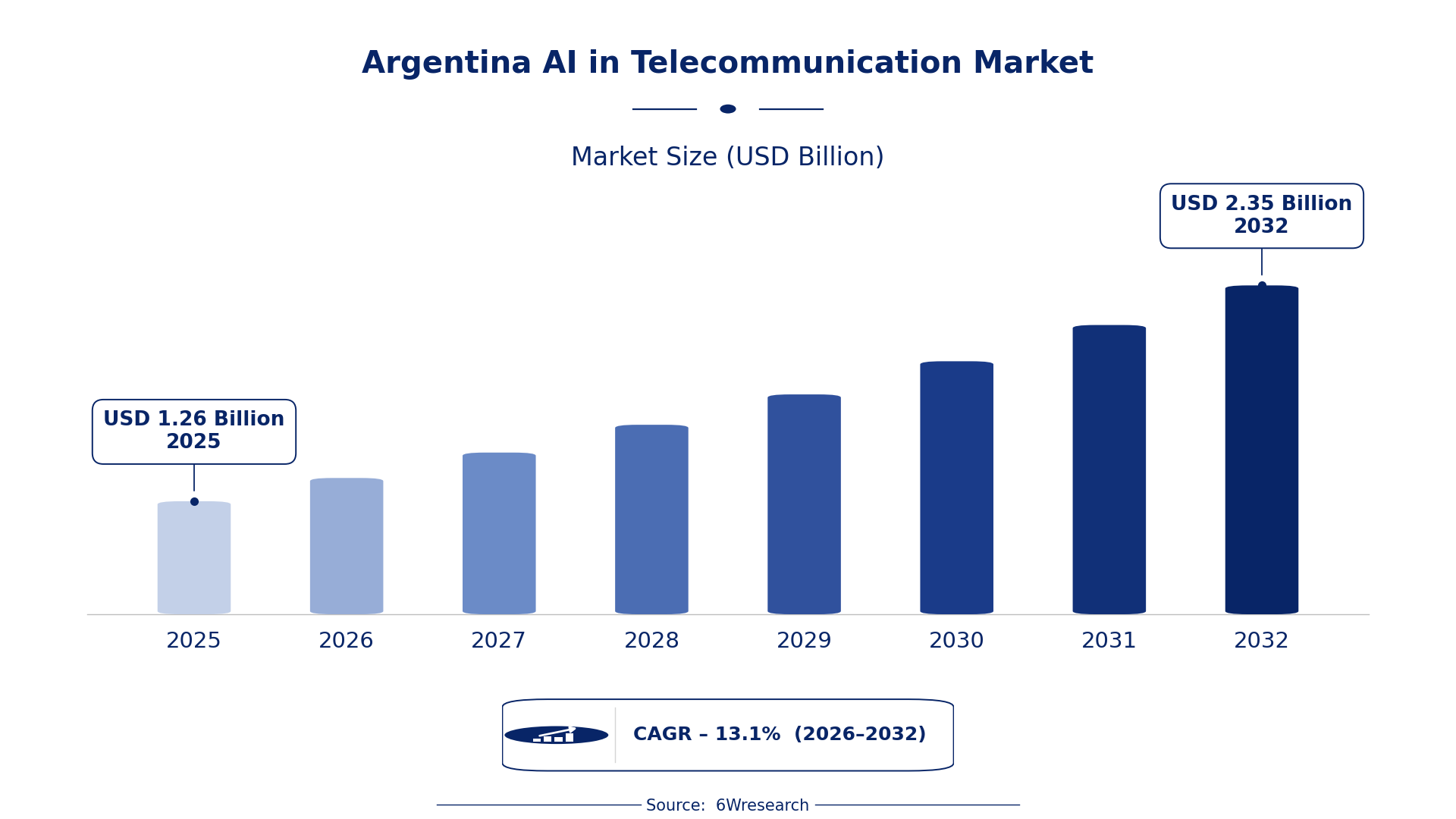
The Argentina AI in Telecommunication Market was estimated at USD 1261 Million in 2025 and is projected to reach USD 2345 Million by 2032, growing at a CAGR of 13.1% from 2026 to 2032.
Argentina AI in Telecommunication Market Synopsis
The Argentina AI in Telecommunication Market is on an upward trajectory, marked by significant investments and technological advancements. However, the current phase reveals a clear urgency for telecom companies to integrate AI to streamline operations and enhance customer satisfaction.
As AI technologies take center stage, telecom operators are evolving from traditional models towards innovative solutions. The emphasis on 5G rollout and increased demand for personalized services underscores the pressing need for AI-driven transformation in this sector.
Argentina AI in Telecommunication Market Year-wise Growth Rate and Key Drivers
This graph illustrates the annual growth rates of the Argentina AI in Telecommunication Market from 2021 to 2032, highlighting a steady upward trajectory and projected expansion over the forecast period.
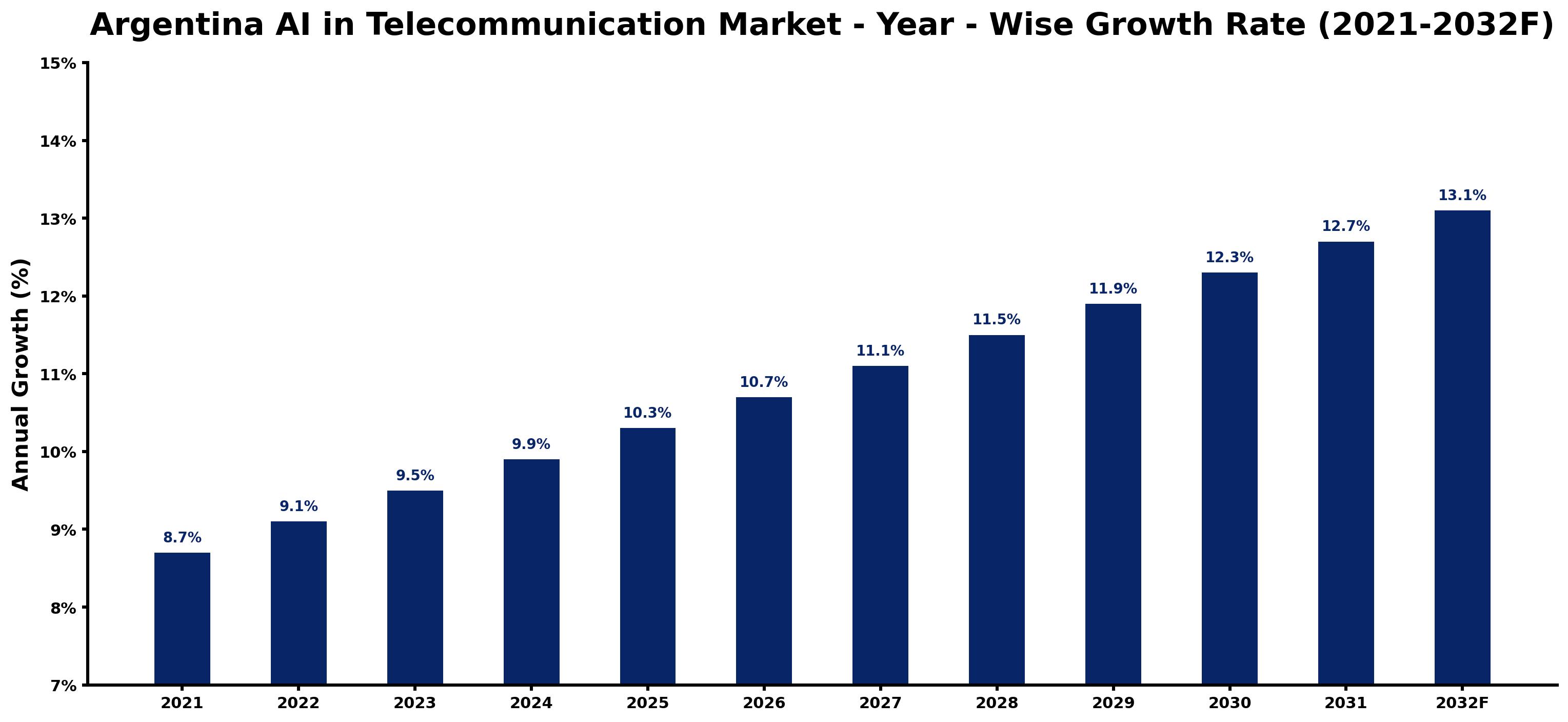
The table below presents the year‑wise growth rates along with the key drivers influencing the market
| Year | Growth Rate | Major Drivers |
| 2021 | 8.7% | Regulatory support from AFTIC for telecom innovations |
| 2022 | 9.1% | Increased demand for AI-driven customer service solutions |
| 2023 | 9.5% | Adoption of 5G spurring AI integration in networks |
| 2024 | 9.9% | Government initiatives promoting smart city telecommunications |
| 2025 | 10.3% | Investment in AI analytics for network optimization |
| 2026 | 10.7% | Rising competition among telecom operators enhancing AI usage |
| 2027 | 11.1% | Deployment of AI for fraud detection in telecom |
| 2028 | 11.5% | Collaborations with tech startups boosting AI applications |
| 2029 | 11.9% | Increased focus on cybersecurity in telecom through AI |
| 2030 | 12.3% | Expanding internet access driving AI in telecommunications |
| 2031 | 12.7% | Telecom laws encouraging AI for service improvement |
| 2032 | 13.1% | Growing consumer preference for personalized telecom AI solutions |
Note: Market size estimations and growth projections presented in this report are based on 6Wresearch's proprietary forecasting methodology, utilizing the latest available industry data, government publications, and primary research inputs.
Argentina AI in Telecommunication Market Key Takeaways
Below are some of the specific key takeaways from the market, including:
- AI technologies are revolutionizing network management and customer interactions in Argentina's telecom sector.
- Investment in AI-driven customer service tools is enhancing user experience and operational efficiency.
- The collaboration between telecom operators and AI solution providers is fostering innovation in the market.
- Regulatory frameworks are evolving to support the safe implementation of AI while addressing data privacy concerns.
- The growing penetration of 5G technology is expected to escalate AI applications across various telecom functions.
Evaluation of Restraints in Argentina AI in Telecommunication Market
A notable limitation in the Argentina AI in Telecommunication Market is the scarcity of skilled professionals who can bridge the gap between AI and telecommunications expertise. This skill gap can impede the pace at which companies can adopt AI technologies. Furthermore, regulatory constraints and data privacy challenges remain significant hurdles, causing hesitation in the implementation of robust AI solutions. The complexities involved in integrating these new AI systems with existing infrastructure can further stall progress, particularly for smaller firms with limited resources.
Argentina AI in Telecommunication Market Trends
Current trends reflect a growing reliance on AI technologies to enhance customer service through chatbots and virtual assistants, allowing companies to respond swiftly to customer inquiries. Network optimization efforts, powered by AI algorithms, are becoming commonplace, enabling operators to predict maintenance needs before issues arise.
Telecom companies are increasingly turning to personalized marketing strategies through AI analytics, which help tailor services to consumer preferences. This trend not only drives engagement but also fosters brand loyalty in a highly competitive market.
Argentina AI in Telecommunication Market Opportunities
The future looks bright for investment in Argentina's AI in Telecommunication Market. Companies can capitalize on the demand for efficient communication services, particularly through AI-enhanced solutions for customer support and network management. Additionally, government initiatives aimed at improving connectivity infrastructure present ample opportunities for partnerships and collaborations. The rise of AI startups dedicated to telecom innovations is also an inviting landscape for potential investors.
Government Initiatives in the Argentina AI in Telecommunication Market
The Argentine government is actively fostering the growth of AI in the telecommunications sector, with policies designed to enhance competitiveness and innovation. By promoting initiatives that encourage the adoption of cutting-edge technologies, the government is setting a solid foundation for future advancements in telecommunications.
- A National Artificial Intelligence Strategy was launched in 2025 to spur innovation across key sectors, including telecommunications.
- Current efforts involve rolling out a 5G network framework expected to bolster AI application capabilities within the industry.
- Recent regulations have been introduced to strengthen data privacy protections in AI-driven telecom services.
- A planned public-private initiative aims to enhance rural connectivity through AI-enabled infrastructure improvements by 2027.
- The government is exploring collaboration with international organizations to facilitate knowledge transfer in AI and telecom technologies.
Future Insights of the Argentina AI in Telecommunication Market
Looking ahead to 2026-2032, the Argentina AI in Telecommunication Market is set for substantial growth. The integration of AI technologies is expected to streamline operations, optimize customer engagement, and improve network reliability. With government backing for digital transformation initiatives, telecom companies will increasingly innovate to meet rising consumer expectations. The evolution of AI applications in telecommunications will continue to redefine industry standards, pushing companies towards greater efficiency and competitive advantage.
Argentina AI in Telecommunication Market Latest Developments
Recent months have seen a surge in activity within the Argentina AI in Telecommunication Market, as companies strive to enhance their operational capabilities and customer service offerings. The commitment to technological advancement is palpable, with various initiatives being rolled out or planned.
- A leading telecom operator launched an AI-driven customer support chatbot in Q1 2025, resulting in a significant reduction in response times.
- In early 2025, a partnership between telecom firms and local AI startups was established to develop customized network optimization solutions, currently ongoing.
- A pilot program for predictive maintenance powered by AI is set to begin in mid-2026, aimed at minimizing network downtimes.
- By late 2026, a rollout of enhanced AI analytics tools for targeted advertising campaigns is expected to improve marketing effectiveness.
- A technology vendor has announced plans for an upcoming conference in early 2027 to showcase AI innovations in telecommunications, fostering industry collaboration.
Argentina AI in Telecommunication Market - Key Attractiveness of the Report
- 10 Years of Market Numbers
- Historical Data Starting from 2022 to 2025
- Base Year: 2025
- Forecast Data until 2032
- Key Performance Indicators Impacting the Market
- Major Upcoming Developments and Projects
Key Highlights of the Report:
- Argentina AI in Telecommunication Market Outlook
- Market Size of Argentina AI in Telecommunication Market, 2025
- Forecast of Argentina AI in Telecommunication Market, 2032
- Historical Data and Forecast of Argentina AI in Telecommunication Revenues & Volume for the Period 2022-2032F
- Argentina AI in Telecommunication Market Trend Evolution
- Argentina AI in Telecommunication Market Drivers and Challenges
- Argentina AI in Telecommunication Price Trends
- Argentina AI in Telecommunication Porter's Five Forces
- Argentina AI in Telecommunication Industry Life Cycle
- Historical Data and Forecast of Argentina AI in Telecommunication Market Revenues & Volume By Application for the Period 2022-2032F
- Historical Data and Forecast of Argentina AI in Telecommunication Market Revenues & Volume By Customer analytics for the Period 2022-2032F
- Historical Data and Forecast of Argentina AI in Telecommunication Market Revenues & Volume By Network security for the Period 2022-2032F
- Historical Data and Forecast of Argentina AI in Telecommunication Market Revenues & Volume By Network optimization for the Period 2022-2032F
- Historical Data and Forecast of Argentina AI in Telecommunication Market Revenues & Volume By Self-diagnostics for the Period 2022-2032F
- Historical Data and Forecast of Argentina AI in Telecommunication Market Revenues & Volume By Virtual assistance for the Period 2022-2032F
- Historical Data and Forecast of Argentina AI in Telecommunication Market Revenues & Volume By Others (contact center analytics and marketing campaign analytics) for the Period 2022-2032F
- Historical Data and Forecast of Argentina AI in Telecommunication Market Revenues & Volume By Component for the Period 2022-2032F
- Historical Data and Forecast of Argentina AI in Telecommunication Market Revenues & Volume By Solutions for the Period 2022-2032F
- Historical Data and Forecast of Argentina AI in Telecommunication Market Revenues & Volume By Services for the Period 2022-2032F
- Historical Data and Forecast of Argentina AI in Telecommunication Market Revenues & Volume By Deployment Mode for the Period 2022-2032F
- Historical Data and Forecast of Argentina AI in Telecommunication Market Revenues & Volume By Cloud for the Period 2022-2032F
- Historical Data and Forecast of Argentina AI in Telecommunication Market Revenues & Volume By On-premises for the Period 2022-2032F
- Historical Data and Forecast of Argentina AI in Telecommunication Market Revenues & Volume By Technology for the Period 2022-2032F
- Historical Data and Forecast of Argentina AI in Telecommunication Market Revenues & Volume By Machine learning and deep learning for the Period 2022-2032F
- Historical Data and Forecast of Argentina AI in Telecommunication Market Revenues & Volume By Natural Language Processing (NLP) for the Period 2022-2032F
- Argentina AI in Telecommunication Import Export Trade Statistics
- Market Opportunity Assessment By Application
- Market Opportunity Assessment By Component
- Market Opportunity Assessment By Deployment Mode
- Market Opportunity Assessment By Technology
- Argentina AI in Telecommunication Top Companies Market Share
- Argentina AI in Telecommunication Competitive Benchmarking By Technical and Operational Parameters
- Argentina AI in Telecommunication Company Profiles
- Argentina AI in Telecommunication Key Strategic Recommendations






































