Hungary AI in Telecommunication Market Size & Growth Rate (2026-2032)
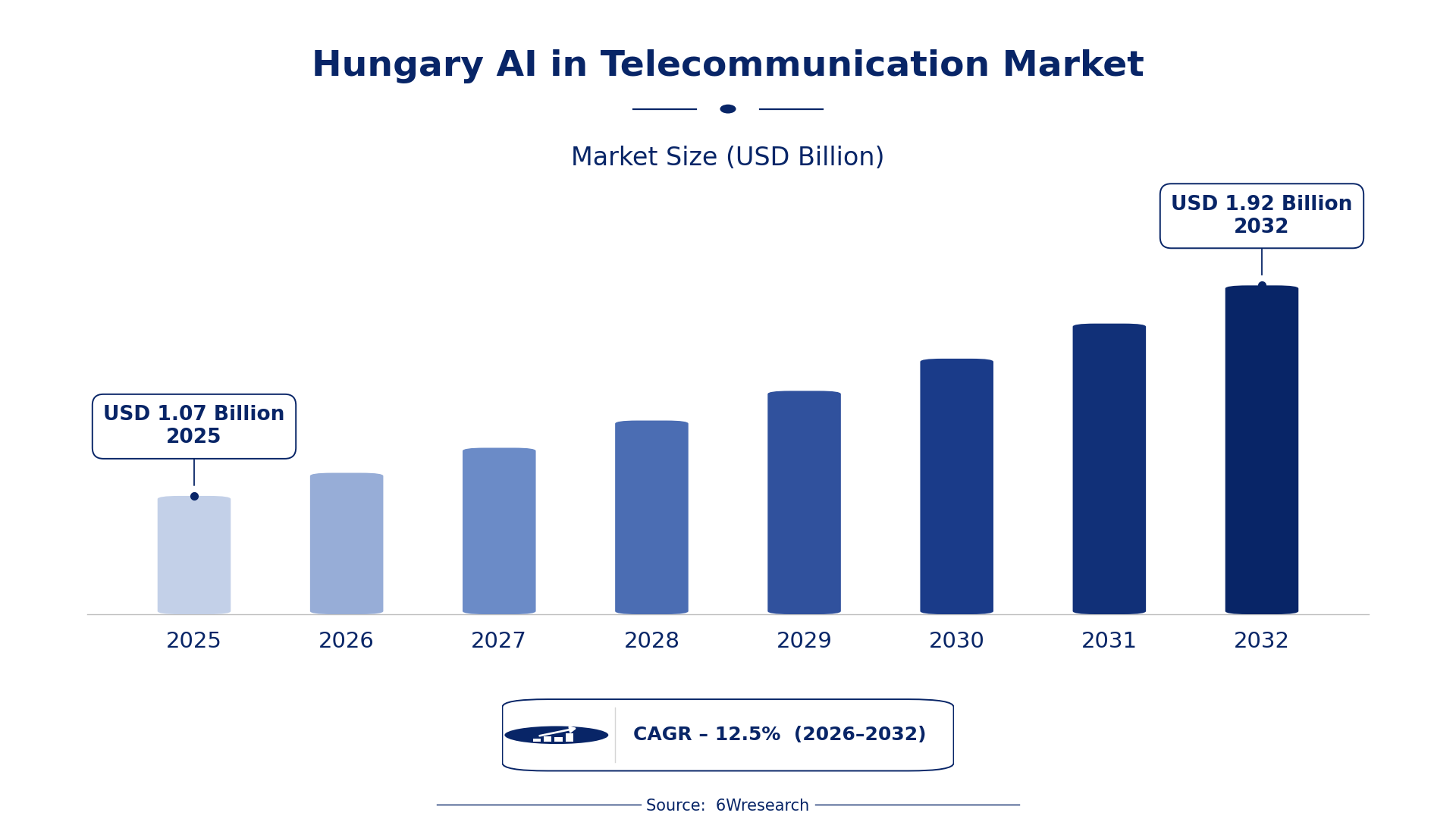
The Hungary AI in Telecommunication Market was estimated at USD 1067 Million in 2025 and is projected to reach USD 1921 Million by 2032, growing at a CAGR of 12.5% from 2026 to 2032.
Hungary AI in Telecommunication Market Synopsis
The most powerful force driving the Hungary AI in Telecommunication Market is the rapid integration of advanced AI technologies by telecom companies. With increasing competition and consumer demand for enhanced services, operators are investing heavily in AI solutions, such as chatbots and predictive analytics, to streamline operations and improve customer engagement.
Telecommunication firms in Hungary are focusing on network optimization and security to meet modern demands. The growing necessity for seamless connectivity and innovative customer solutions further fuels market expansion, making AI a cornerstone for future advancements in the industry.
Hungary AI in Telecommunication Market Year-wise Growth Rate and Key Drivers
This graph illustrates the annual growth rates of the Hungary AI in Telecommunication Market from 2021 to 2032, highlighting a steady upward trajectory and projected expansion over the forecast period.
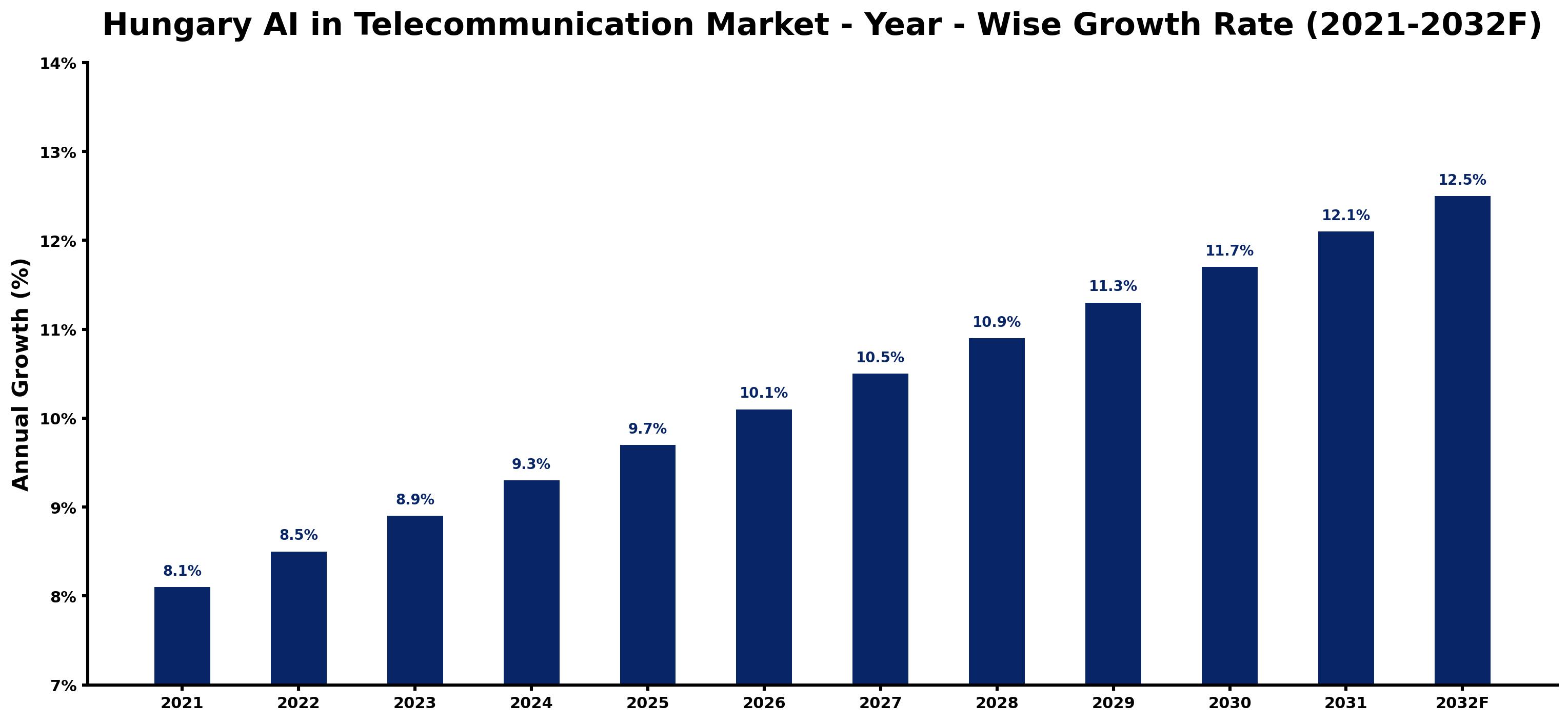
The table below presents the year‑wise growth rates along with the key drivers influencing the market
| Year | Growth Rate | Major Drivers |
| 2021 | 8.1% | Hungarian government promotes AI startups in telecom sector. |
| 2022 | 8.5% | Telecom providers increasing focus on AI-driven customer service. |
| 2023 | 8.9% | National AI Strategy supports telecommunications innovation investments. |
| 2024 | 9.3% | Regulatory incentives for telecom AI adoption drive growth. |
| 2025 | 9.7% | Increased competition pushes AI solutions in telecom services. |
| 2026 | 10.1% | Partnerships between telcos and universities boost AI research. |
| 2027 | 10.5% | Consumer demand for personalized telecom experiences drives AI. |
| 2028 | 10.9% | Investment in AI cybersecurity solutions for telecom networks. |
| 2029 | 11.3% | Smart city initiatives integrate telecom AI technologies. |
| 2030 | 11.7% | Integration of IoT devices demands advanced AI telecom solutions. |
| 2031 | 12.1% | Government funding boosts AI projects in telecom infrastructure. |
| 2032 | 12.5% | Telecom companies adopt AI for operational efficiency improvements. |
Note: Market size estimations and growth projections presented in this report are based on 6Wresearch's proprietary forecasting methodology, utilizing the latest available industry data, government publications, and primary research inputs.
Hungary AI in Telecommunication Market Key Takeaways
Below are some of the specific key takeaways from the market, including:
- AI technologies are crucial for enhancing operational efficiency within telecom companies.
- Investment in AI-powered solutions is increasingly focusing on customer experience improvements.
- Predictive maintenance and fraud detection are becoming essential components of AI deployment.
- Challenges remain around skilled workforce shortages and data privacy regulations.
- Future growth is supported by ongoing government initiatives to enhance digital infrastructure.
Evaluation of Restraints in Hungary AI in Telecommunication Market
Despite the promising outlook for the Hungary AI in Telecommunication Market, several restraints hinder its progress. A notable concern is the acute shortage of skilled professionals adept in both AI and telecommunications, making it difficult for companies to implement advanced solutions effectively. High initial costs associated with AI deployment are another significant barrier, often discouraging smaller players from entering the market. Data privacy and compliance issues are ever-present, as the integration of AI into customer interactions raises concerns around user data protection. Lastly, the fast pace of technological changes demands continuous learning and adaptation, challenging firms to keep their strategies aligned with the latest trends and tools.
Hungary AI in Telecommunication Market Trends
Current trends indicate a marked shift towards automation in customer service, with AI-driven chatbots becoming mainstream for handling inquiries and improving response times. Additionally, telecom operators are investing in machine learning algorithms for data analytics, allowing for more informed decision-making. There’s also a noticeable push towards personalized customer experiences, driven by AI technologies that tailor services to individual user preferences. As the industry progresses, the deployment of AI for fraud detection and predictive maintenance is gaining traction, setting the stage for smarter network management.
Hungary AI in Telecommunication Market Opportunities
The Hungary AI in Telecommunication Market is rife with investment opportunities. Companies that invest in AI technologies, such as advanced analytics for network optimization and customer service automation, stand to gain competitive advantages. Collaborations with local telecom operators and technology vendors can further enhance market entry strategies and facilitate innovation. The rising demand for seamless connectivity and enhanced network management presents opportunities for businesses that can deliver AI-driven solutions tailored to specific needs within the telecom sector.
Government Initiatives in the Hungary AI in Telecommunication Market
The Hungarian government is actively fostering the growth of AI technologies within the telecommunications sector. Recent initiatives have focused on establishing a supportive regulatory environment that promotes innovation while ensuring consumer rights. Enhanced digital infrastructure projects are underway, aiming to facilitate the integration of AI technologies in telecom services.
- A national digital infrastructure upgrade programme now in its rollout phase aims to enhance connectivity and support AI implementations.
- The National Artificial Intelligence Strategy, recently launched, focuses on promoting innovation in telecommunications through AI.
- A regulatory framework introduced in 2025 mandates transparency in billing practices among telecom providers.
- Current initiatives include ongoing collaborations between telecom companies and government agencies to ensure compliance with data privacy regulations.
- Planned public-private partnerships expected to expand access to advanced telecom infrastructure by 2028.
Future Insights of the Hungary AI in Telecommunication Market
Looking ahead to 2026-2032, the Hungary AI in Telecommunication Market is on track for substantial growth. The continuing demand for improved customer experiences and operational efficiencies will solidify AI’s position in the sector. With significant investment in AI research and development, the collaborative efforts between telecom operators and technology vendors are anticipated to spur innovation. The government’s commitment to enhancing digital infrastructure will further facilitate the integration of AI solutions, setting the stage for a dynamic and competitive market landscape.
Hungary AI in Telecommunication Market Latest Developments
Recent developments in the Hungary AI in Telecommunication Market have illustrated a growing focus on technological advancements and strategic partnerships. Telecom companies are actively pursuing AI integration to stay ahead of the competition and cater to increasing consumer expectations.
- A major technology vendor announced the launch of a new AI-driven customer service platform in early 2025, improving response times significantly.
- Ongoing collaborations between regional telecom operators and AI solution providers aim to enhance network optimization and security.
- A rollout expected to begin in the second half of 2026 will introduce AI-powered predictive maintenance tools to major networks.
- Recent pilot programs have shown promise for AI applications in fraud detection, currently in their testing phase with several telecom companies.
- A planned investment initiative for 2027 aims to fund start-ups focusing on innovative AI solutions within telecommunications.
Hungary AI in Telecommunication Market - Key Attractiveness of the Report
- 10 Years of Market Numbers
- Historical Data Starting from 2022 to 2025
- Base Year: 2025
- Forecast Data until 2032
- Key Performance Indicators Impacting the Market
- Major Upcoming Developments and Projects
Key Highlights of the Report:
- Hungary AI in Telecommunication Market Outlook
- Market Size of Hungary AI in Telecommunication Market, 2025
- Forecast of Hungary AI in Telecommunication Market, 2032
- Historical Data and Forecast of Hungary AI in Telecommunication Revenues & Volume for the Period 2022-2032F
- Hungary AI in Telecommunication Market Trend Evolution
- Hungary AI in Telecommunication Market Drivers and Challenges
- Hungary AI in Telecommunication Price Trends
- Hungary AI in Telecommunication Porter's Five Forces
- Hungary AI in Telecommunication Industry Life Cycle
- Historical Data and Forecast of Hungary AI in Telecommunication Market Revenues & Volume By Application for the Period 2022-2032F
- Historical Data and Forecast of Hungary AI in Telecommunication Market Revenues & Volume By Customer analytics for the Period 2022-2032F
- Historical Data and Forecast of Hungary AI in Telecommunication Market Revenues & Volume By Network security for the Period 2022-2032F
- Historical Data and Forecast of Hungary AI in Telecommunication Market Revenues & Volume By Network optimization for the Period 2022-2032F
- Historical Data and Forecast of Hungary AI in Telecommunication Market Revenues & Volume By Self-diagnostics for the Period 2022-2032F
- Historical Data and Forecast of Hungary AI in Telecommunication Market Revenues & Volume By Virtual assistance for the Period 2022-2032F
- Historical Data and Forecast of Hungary AI in Telecommunication Market Revenues & Volume By Others (contact center analytics and marketing campaign analytics) for the Period 2022-2032F
- Historical Data and Forecast of Hungary AI in Telecommunication Market Revenues & Volume By Component for the Period 2022-2032F
- Historical Data and Forecast of Hungary AI in Telecommunication Market Revenues & Volume By Solutions for the Period 2022-2032F
- Historical Data and Forecast of Hungary AI in Telecommunication Market Revenues & Volume By Services for the Period 2022-2032F
- Historical Data and Forecast of Hungary AI in Telecommunication Market Revenues & Volume By Deployment Mode for the Period 2022-2032F
- Historical Data and Forecast of Hungary AI in Telecommunication Market Revenues & Volume By Cloud for the Period 2022-2032F
- Historical Data and Forecast of Hungary AI in Telecommunication Market Revenues & Volume By On-premises for the Period 2022-2032F
- Historical Data and Forecast of Hungary AI in Telecommunication Market Revenues & Volume By Technology for the Period 2022-2032F
- Historical Data and Forecast of Hungary AI in Telecommunication Market Revenues & Volume By Machine learning and deep learning for the Period 2022-2032F
- Historical Data and Forecast of Hungary AI in Telecommunication Market Revenues & Volume By Natural Language Processing (NLP) for the Period 2022-2032F
- Hungary AI in Telecommunication Import Export Trade Statistics
- Market Opportunity Assessment By Application
- Market Opportunity Assessment By Component
- Market Opportunity Assessment By Deployment Mode
- Market Opportunity Assessment By Technology
- Hungary AI in Telecommunication Top Companies Market Share
- Hungary AI in Telecommunication Competitive Benchmarking By Technical and Operational Parameters
- Hungary AI in Telecommunication Company Profiles
- Hungary AI in Telecommunication Key Strategic Recommendations






































