India AI in Telecommunication Market Size & Growth Rate (2026-2032)
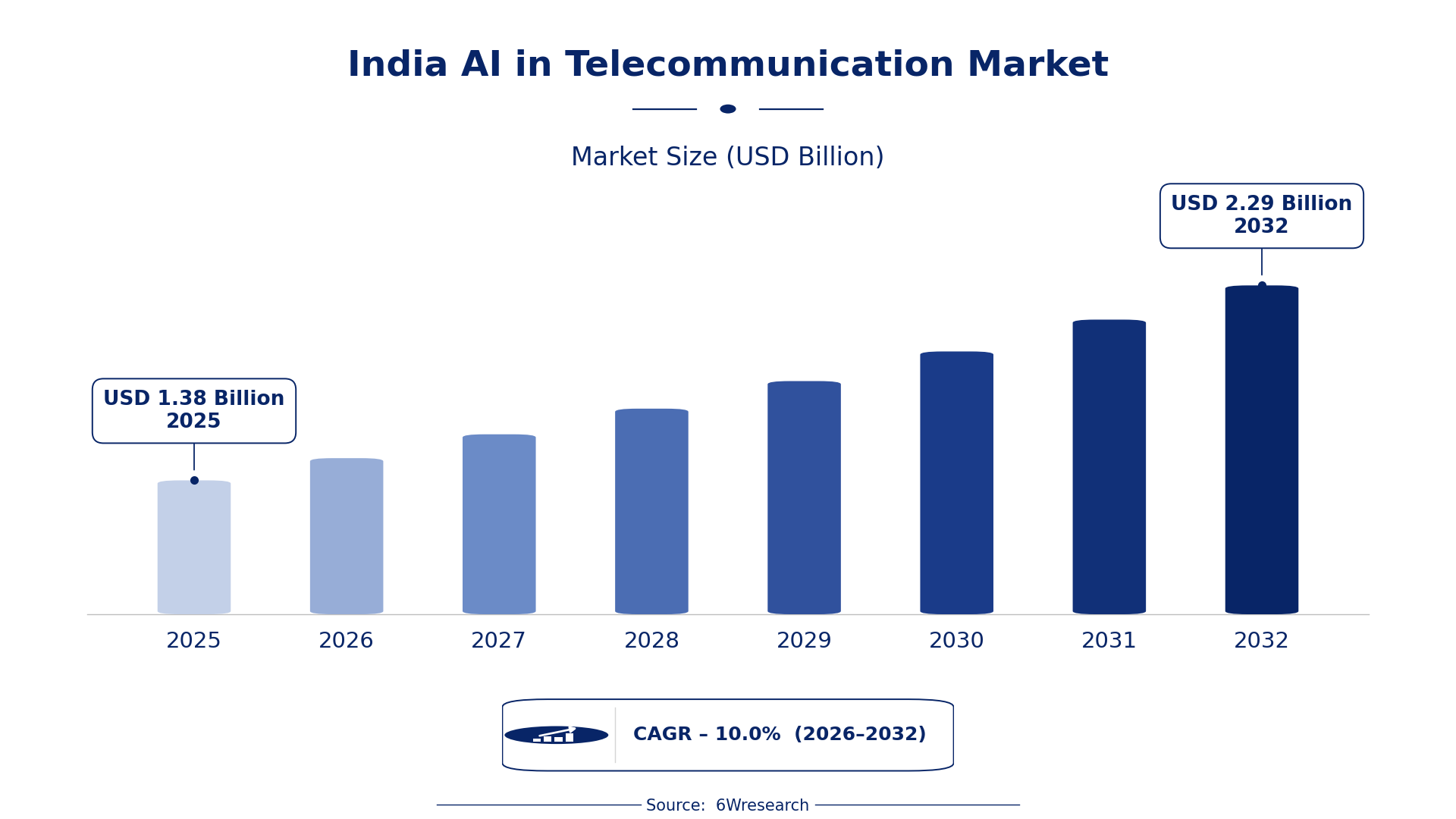
The India AI in Telecommunication Market was estimated at USD 1384 Million in 2025 and is projected to reach USD 2291 Million by 2032, growing at a CAGR of 10.0% from 2026 to 2032.
India AI in Telecommunication Market Synopsis
The current momentum within the India AI in Telecommunication Market is remarkable, showcasing a rapid integration of AI technologies in network operations and customer service. As telecom companies adapt to the increasing demands of connectivity and data services, AI stands at the forefront, transforming traditional practices into intelligent, data-driven strategies.
Looking ahead, the market is set for continued expansion, driven by the rollout of 5G networks and an insatiable demand for improved customer experiences. AI’s capabilities will only become more central to ensuring efficient and reliable communication services, establishing a vital link between technological advancement and user satisfaction.
India AI in Telecommunication Market Year-wise Growth Rate and Key Drivers
This graph illustrates the annual growth rates of the India AI in Telecommunication Market from 2021 to 2032, highlighting a steady upward trajectory and projected expansion over the forecast period.
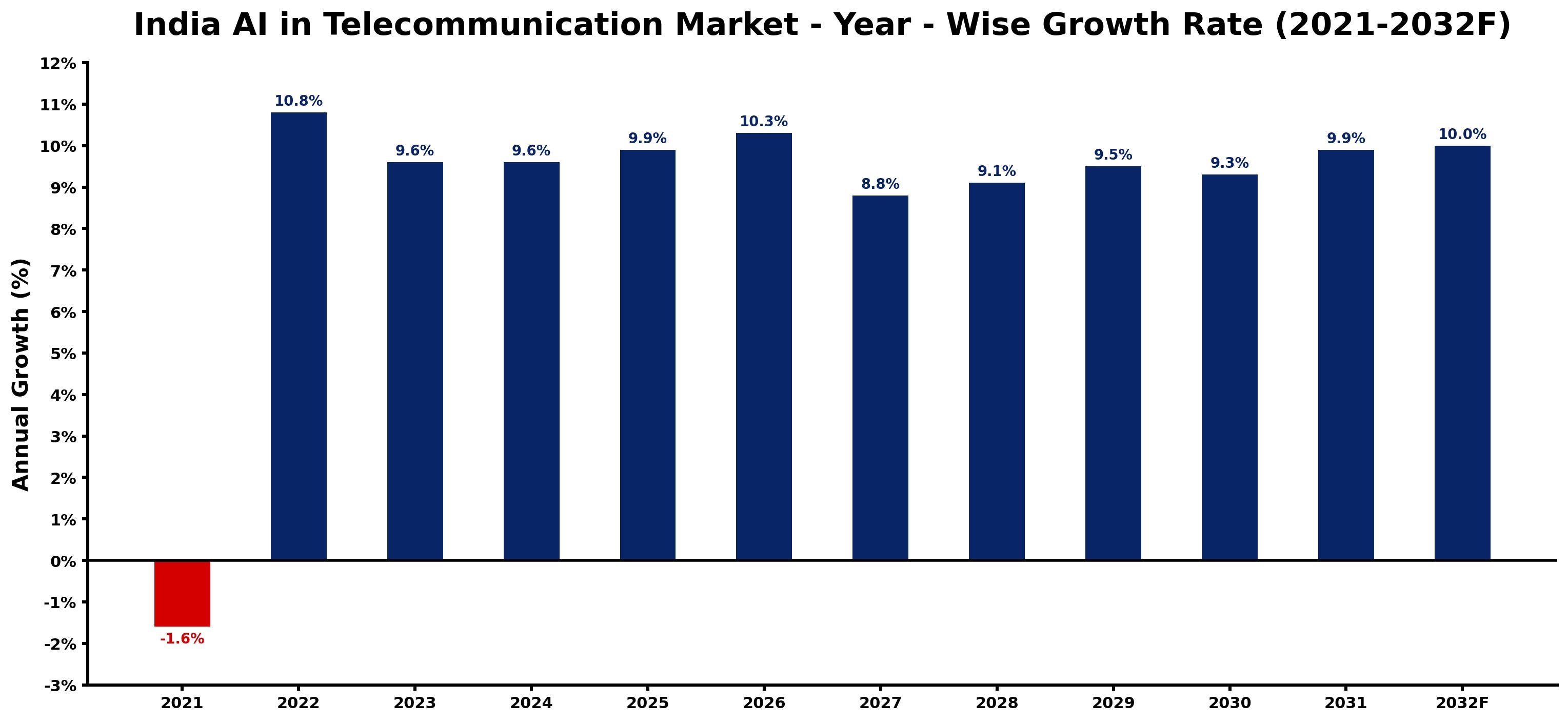
The table below presents the year‑wise growth rates along with the key drivers influencing the market
| Year | Growth Rate | Major Drivers |
| 2021 | -1.6% | TRAI's new data protection regulations hindered AI deployment. |
| 2022 | 10.8% | 5G rollout accelerating AI-driven network optimizations. |
| 2023 | 9.6% | Telecom regulatory policies favoring AI technology integration. |
| 2024 | 9.6% | Growing smartphone penetration elevating AI usage in telecom. |
| 2025 | 9.9% | Surge in data traffic spurring AI network management solutions. |
| 2026 | 10.3% | Increased investment in AI startups by Indian telecom companies. |
| 2027 | 8.8% | Government initiatives promoting AI research in telecommunications sector. |
| 2028 | 9.1% | Collaboration between telecom firms and AI technology providers. |
| 2029 | 9.5% | Rising need for fraud detection systems in communication. |
| 2030 | 9.3% | Data privacy regulations requiring enhanced AI compliance technologies. |
| 2031 | 9.9% | Adoption of AI-driven customer service chatbots in telecom. |
| 2032 | 10.0% | AI-enabled network security measures addressing cyber threats. |
Note: Market size estimations and growth projections presented in this report are based on 6Wresearch's proprietary forecasting methodology, utilizing the latest available industry data, government publications, and primary research inputs.
India AI in Telecommunication Market Key Takeaways
Below are some of the specific key takeaways from the market, including:
- AI is enhancing network management and customer service in the telecommunication sector.
- The shift towards 5G technology is accelerating AI adoption within telecommunications.
- Telecom operators are automating routine tasks through AI, significantly improving operational efficiency.
- Data analytics and predictive maintenance are becoming crucial for preventing network outages.
- Consumer expectations for personalized services are driving innovation in AI applications.
Evaluation of Restraints in India AI in Telecommunication Market
Integrating AI technologies into existing telecom infrastructures presents significant challenges. Many legacy systems are incompatible with advanced AI solutions, leading to costly upgrades that not all companies can afford. Furthermore, the sensitive nature of customer data raises serious concerns regarding privacy and security, making it imperative for operators to ensure compliance while also delivering personalized services. These factors combine to create a cautious approach to AI adoption within the sector.
India AI in Telecommunication Market Trends
One prevailing trend is the increased reliance on AI-driven chatbots and virtual assistants to handle customer queries and service issues, improving response times and satisfaction rates. Concurrently, predictive analytics are being employed to manage network traffic and optimize resources, thereby enhancing service reliability. Another emerging trend involves the deployment of machine learning algorithms to fine-tune data management, enabling telecom companies to analyze user behavior and anticipate future demands.
India AI in Telecommunication Market Opportunities
Investment opportunities are plentiful as telecom companies seek to enhance their AI capabilities. With the anticipated growth of 5G technology, there’s an increasing demand for AI solutions that can optimize network performance and ensure seamless connectivity. Furthermore, developing AI-driven analytics services could present lucrative opportunities as telecom operators strive for deeper insights into consumer preferences and behaviors.
Government Initiatives in the India AI in Telecommunication Market
Government policy is shaping the India AI in Telecommunication Market through a range of initiatives aimed at enhancing digital infrastructure and promoting AI integration in telecom services. The current regulatory environment encourages investments in next-generation technology while ensuring consumer protection and data privacy. As the sector evolves, these government initiatives are crucial in fostering an ecosystem conducive to sustainable growth.
- A recent initiative launched a national digital infrastructure upgrade program focusing on 5G connectivity.
- Ongoing efforts include a policy framework that aims to enhance telecom service quality through AI-powered solutions.
- Planned initiatives involve public-private partnerships that will support innovation in AI applications within telecommunications, set to commence by 2027.
- Upcoming regulations will mandate increased transparency in AI-driven customer service applications.
- In 2025, a framework was introduced to enhance data protection in AI applications across telecom networks.
Future Insights of the India AI in Telecommunication Market
As we look toward 2026-2032, the India AI in Telecommunication Market is positioned for profound changes. The confluence of AI and 5G technology will catalyze innovative services and solutions, fundamentally altering customer experiences. Telecom operators are likely to invest heavily in AI capabilities, seeking to differentiate their offerings and streamline operations. This focus on AI will not only enhance efficiency but also pave the way for smarter, more responsive telecom infrastructure across the nation.
India AI in Telecommunication Market Latest Developments
The past 12-14 months have been marked by significant progress in the integration of AI within the Indian telecommunication sector. Companies are increasingly adopting innovative AI-driven solutions to address both operational challenges and enhance customer satisfaction. As the demand for seamless connectivity intensifies, the industry is embracing AI technologies as essential components of their strategic planning.
- A major technology vendor announced the successful rollout of a network optimization tool using AI, initiated in early 2025 and completed by mid-2025.
- A regional operator has begun an initiative leveraging AI for predictive maintenance, which remains underway as of now.
- Plans for a new AI-based customer analytics platform are set to launch in late 2026, aimed at tailoring services to individual consumer needs.
- A collaboration between telecom providers and AI developers commenced in Q1 2025, focusing on enhancing AI capabilities in customer support.
- A comprehensive upgrade of AI chatbots across various service channels is currently in progress, with an expected completion by the end of 2025.
India AI in Telecommunication Market - Key Attractiveness of the Report
- 10 Years of Market Numbers
- Historical Data Starting from 2022 to 2025
- Base Year: 2025
- Forecast Data until 2032
- Key Performance Indicators Impacting the Market
- Major Upcoming Developments and Projects
Key Highlights of the Report:
- India AI in Telecommunication Market Outlook
- Market Size of India AI in Telecommunication Market, 2025
- Forecast of India AI in Telecommunication Market, 2032
- Historical Data and Forecast of India AI in Telecommunication Revenues & Volume for the Period 2022-2032F
- India AI in Telecommunication Market Trend Evolution
- India AI in Telecommunication Market Drivers and Challenges
- India AI in Telecommunication Price Trends
- India AI in Telecommunication Porter's Five Forces
- India AI in Telecommunication Industry Life Cycle
- Historical Data and Forecast of India AI in Telecommunication Market Revenues & Volume By Application for the Period 2022-2032F
- Historical Data and Forecast of India AI in Telecommunication Market Revenues & Volume By Customer analytics for the Period 2022-2032F
- Historical Data and Forecast of India AI in Telecommunication Market Revenues & Volume By Network security for the Period 2022-2032F
- Historical Data and Forecast of India AI in Telecommunication Market Revenues & Volume By Network optimization for the Period 2022-2032F
- Historical Data and Forecast of India AI in Telecommunication Market Revenues & Volume By Self-diagnostics for the Period 2022-2032F
- Historical Data and Forecast of India AI in Telecommunication Market Revenues & Volume By Virtual assistance for the Period 2022-2032F
- Historical Data and Forecast of India AI in Telecommunication Market Revenues & Volume By Others (contact center analytics and marketing campaign analytics) for the Period 2022-2032F
- Historical Data and Forecast of India AI in Telecommunication Market Revenues & Volume By Component for the Period 2022-2032F
- Historical Data and Forecast of India AI in Telecommunication Market Revenues & Volume By Solutions for the Period 2022-2032F
- Historical Data and Forecast of India AI in Telecommunication Market Revenues & Volume By Services for the Period 2022-2032F
- Historical Data and Forecast of India AI in Telecommunication Market Revenues & Volume By Deployment Mode for the Period 2022-2032F
- Historical Data and Forecast of India AI in Telecommunication Market Revenues & Volume By Cloud for the Period 2022-2032F
- Historical Data and Forecast of India AI in Telecommunication Market Revenues & Volume By On-premises for the Period 2022-2032F
- Historical Data and Forecast of India AI in Telecommunication Market Revenues & Volume By Technology for the Period 2022-2032F
- Historical Data and Forecast of India AI in Telecommunication Market Revenues & Volume By Machine learning and deep learning for the Period 2022-2032F
- Historical Data and Forecast of India AI in Telecommunication Market Revenues & Volume By Natural Language Processing (NLP) for the Period 2022-2032F
- India AI in Telecommunication Import Export Trade Statistics
- Market Opportunity Assessment By Application
- Market Opportunity Assessment By Component
- Market Opportunity Assessment By Deployment Mode
- Market Opportunity Assessment By Technology
- India AI in Telecommunication Top Companies Market Share
- India AI in Telecommunication Competitive Benchmarking By Technical and Operational Parameters
- India AI in Telecommunication Company Profiles
- India AI in Telecommunication Key Strategic Recommendations






































