China AI in Telecommunication Market Size & Growth Rate (2026-2032)

The China AI in Telecommunication Market was estimated at USD 188 Million in 2025 and is projected to reach USD 250 Million by 2032, growing at a CAGR of 6.5% from 2026 to 2032.
China AI in Telecommunication Market Synopsis
The China AI in Telecommunication Market is on an upward trajectory, reflecting a strong blend of emerging technologies and strategic investments. As telecommunications companies increasingly integrate AI solutions, they are enhancing operational efficiencies and improving customer experiences.
Looking ahead, the market's growth will be underpinned by advancements in 5G networks and IoT applications. However, while the momentum appears promising, challenges such as regulatory hurdles and talent shortages could temper the pace of adoption.
China AI in Telecommunication Market Year-wise Growth Rate and Key Drivers
This graph illustrates the annual growth rates of the China AI in Telecommunication Market from 2021 to 2032, highlighting a steady upward trajectory and projected expansion over the forecast period.
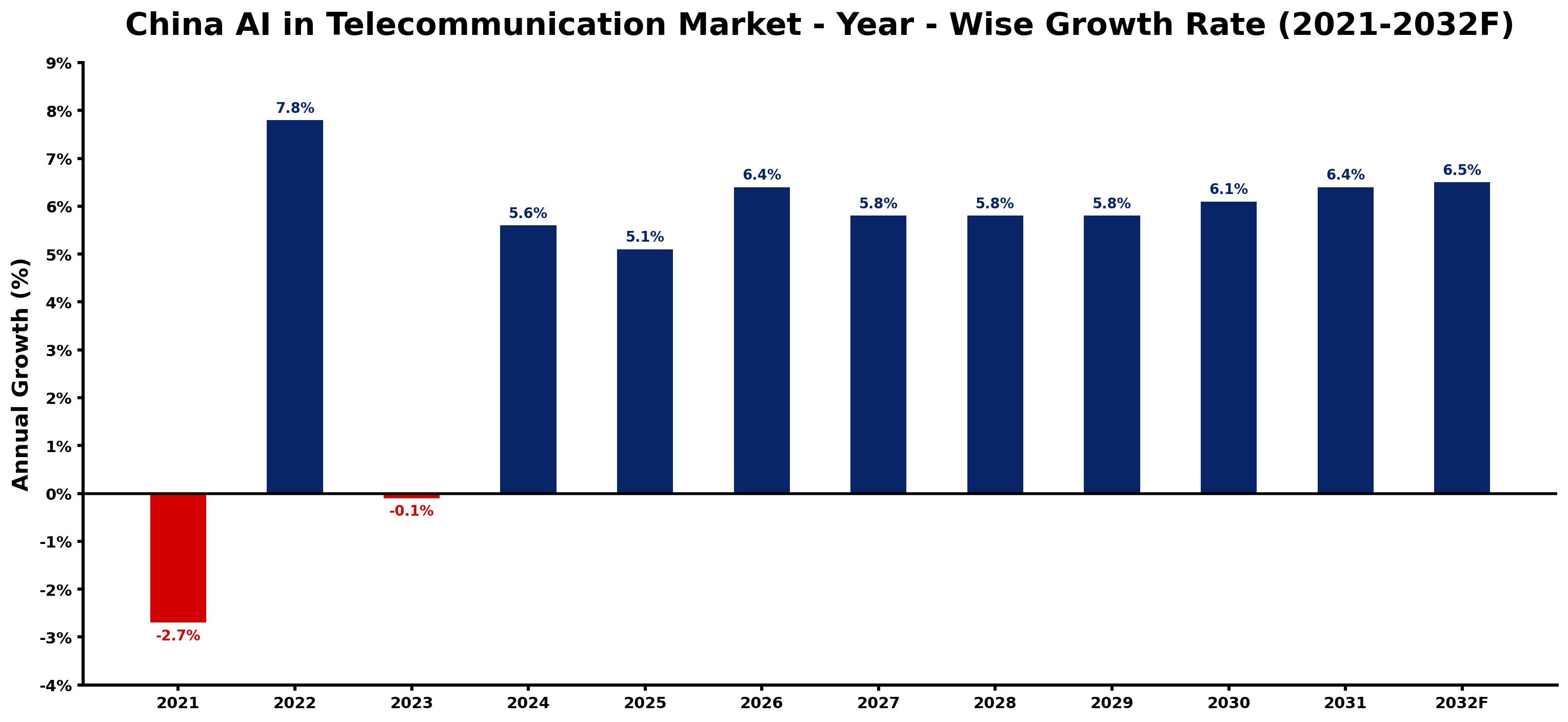
The table below presents the year‑wise growth rates along with the key drivers influencing the market
| Year | Growth Rate | Major Drivers |
| 2021 | -2.7% | Regulatory changes by MIIT restricting AI deployment |
| 2022 | 7.8% | 5G rollout boosting AI implementation in telecom services |
| 2023 | -0.1% | Reduced investment due to declining telecom infrastructure upgrades |
| 2024 | 5.6% | Government funding for AI research in telecommunication sector |
| 2025 | 5.1% | Increase in AI-driven customer service automation adoption |
| 2026 | 6.4% | Local demand for smart telecom solutions surging significantly |
| 2027 | 5.8% | Telecom operators integrating AI for network optimization purposes |
| 2028 | 5.8% | Growing public data privacy regulations enhancing AI necessity |
| 2029 | 5.8% | Telecom industry focusing on reducing operational costs with AI |
| 2030 | 6.1% | Rising IoT device deployment requiring advanced AI capabilities |
| 2031 | 6.4% | Increased competition driving AI innovation among telecom providers |
| 2032 | 6.5% | AI technology adoption supporting personalized customer experiences |
Note: Market size estimations and growth projections presented in this report are based on 6Wresearch's proprietary forecasting methodology, utilizing the latest available industry data, government publications, and primary research inputs.
China AI in Telecommunication Market Key Takeaways
Below are some of the specific key takeaways from the market, including:
- AI applications in network management are reducing operational costs for telecom providers.
- Customer service automation through AI tools is enhancing user engagement.
- Government policies are increasingly supporting AI technology integration in telecom.
- Investment opportunities exist in AI-driven cybersecurity measures to protect data integrity.
- The shift toward personalized telecom services is driving AI adoption among operators.
Evaluation of Restraints in China AI in Telecommunication Market
Several key factors are limiting the growth potential of the China AI in Telecommunication Market. Data privacy concerns remain at the forefront, particularly as user data collection escalates. Regulatory constraints are tightening, creating challenges for compliance. Additionally, a notable shortage of skilled professionals with expertise in both AI and telecommunications is hampering the development and rollout of innovative solutions. Lastly, the rapid pace of technology evolution means that firms must constantly invest in infrastructure upgrades to support AI applications effectively, further stretching available resources.
China AI in Telecommunication Market Trends
Current trends are strongly influenced by advancements in 5G technology, which is unlocking new possibilities for AI applications. Telecom operators are leveraging AI-driven solutions for network optimization and predictive maintenance, significantly enhancing service quality. The move towards customer-centric approaches is evident, as companies are utilizing AI chatbots and virtual assistants to streamline interactions. Cybersecurity remains a top priority, with AI solutions being developed to safeguard networks against increasingly sophisticated cyber threats.
China AI in Telecommunication Market Opportunities
The market is ripe with opportunities, particularly for investments in AI-powered customer service platforms and network optimization tools. The increasing demand for advanced data analytics presents a clear path for telecom companies to improve operational efficiency and enhance service delivery. Collaborations with AI technology providers and strategic acquisitions are also avenues through which firms can expand their market reach. As the industry evolves, there will be a surge in demand for personalized services that AI can efficiently deliver.
Government Initiatives in the China AI in Telecommunication Market
Government policy is a critical driver for growth in the China AI in Telecommunication Market. The Chinese government has recognized the potential of AI in telecommunications and is implementing initiatives to foster innovation. These efforts are aimed at ensuring network security while promoting ethical data use and resource optimization.
- A national digital infrastructure upgrade programme recently launched focuses on enhancing telecommunications resilience through AI solutions.
- Current initiatives include a regulatory framework designed to improve data privacy protections in AI applications within telecommunications.
- Ongoing research and development funding is being directed towards AI technologies that support 5G network advancements.
- A planned public-private partnership expected to expand access to telecom infrastructure is set for rollout in 2027.
Future Insights of the China AI in Telecommunication Market
As we move towards 2026 and beyond, the China AI in Telecommunication Market is likely to experience substantial growth, driven by increased integration of AI technologies. The ongoing rollout of 5G networks will catalyze further innovations, opening doors for enhanced network performance and new service offerings. With strong government backing and a market that is adjusting to the complexities of AI, we expect to see a pronounced shift towards more efficient and personalized telecommunications solutions.
China AI in Telecommunication Market Latest Developments
Recent industry activity has highlighted a keen focus on AI integration within the telecommunications sector in China. Companies are rapidly adopting AI technologies to optimize operations and improve customer experiences. This trend is underscored by various new initiatives and partnerships that have emerged over the last year.
- A leading regional operator launched an AI-driven network optimization tool in early 2025, which has improved service efficiency.
- A major technology vendor initiated a partnership with telecom providers in Q1 2025 to develop advanced AI cybersecurity solutions.
- Ongoing trials for AI-powered customer service chatbots are being tested across multiple networks, with a full rollout expected by late 2025.
- Upcoming initiatives to expand AI capabilities in predictive maintenance are set to begin in mid-2026, enhancing operational reliability.
China AI in Telecommunication Market - Key Attractiveness of the Report
- 10 Years of Market Numbers
- Historical Data Starting from 2022 to 2025
- Base Year: 2025
- Forecast Data until 2032
- Key Performance Indicators Impacting the Market
- Major Upcoming Developments and Projects
Key Highlights of the Report:
- China AI in Telecommunication Market Outlook
- Market Size of China AI in Telecommunication Market, 2025
- Forecast of China AI in Telecommunication Market, 2032
- Historical Data and Forecast of China AI in Telecommunication Revenues & Volume for the Period 2022-2032F
- China AI in Telecommunication Market Trend Evolution
- China AI in Telecommunication Market Drivers and Challenges
- China AI in Telecommunication Price Trends
- China AI in Telecommunication Porter's Five Forces
- China AI in Telecommunication Industry Life Cycle
- Historical Data and Forecast of China AI in Telecommunication Market Revenues & Volume By Application for the Period 2022-2032F
- Historical Data and Forecast of China AI in Telecommunication Market Revenues & Volume By Customer analytics for the Period 2022-2032F
- Historical Data and Forecast of China AI in Telecommunication Market Revenues & Volume By Network security for the Period 2022-2032F
- Historical Data and Forecast of China AI in Telecommunication Market Revenues & Volume By Network optimization for the Period 2022-2032F
- Historical Data and Forecast of China AI in Telecommunication Market Revenues & Volume By Self-diagnostics for the Period 2022-2032F
- Historical Data and Forecast of China AI in Telecommunication Market Revenues & Volume By Virtual assistance for the Period 2022-2032F
- Historical Data and Forecast of China AI in Telecommunication Market Revenues & Volume By Others (contact center analytics and marketing campaign analytics) for the Period 2022-2032F
- Historical Data and Forecast of China AI in Telecommunication Market Revenues & Volume By Component for the Period 2022-2032F
- Historical Data and Forecast of China AI in Telecommunication Market Revenues & Volume By Solutions for the Period 2022-2032F
- Historical Data and Forecast of China AI in Telecommunication Market Revenues & Volume By Services for the Period 2022-2032F
- Historical Data and Forecast of China AI in Telecommunication Market Revenues & Volume By Deployment Mode for the Period 2022-2032F
- Historical Data and Forecast of China AI in Telecommunication Market Revenues & Volume By Cloud for the Period 2022-2032F
- Historical Data and Forecast of China AI in Telecommunication Market Revenues & Volume By On-premises for the Period 2022-2032F
- Historical Data and Forecast of China AI in Telecommunication Market Revenues & Volume By Technology for the Period 2022-2032F
- Historical Data and Forecast of China AI in Telecommunication Market Revenues & Volume By Machine learning and deep learning for the Period 2022-2032F
- Historical Data and Forecast of China AI in Telecommunication Market Revenues & Volume By Natural Language Processing (NLP) for the Period 2022-2032F
- China AI in Telecommunication Import Export Trade Statistics
- Market Opportunity Assessment By Application
- Market Opportunity Assessment By Component
- Market Opportunity Assessment By Deployment Mode
- Market Opportunity Assessment By Technology
- China AI in Telecommunication Top Companies Market Share
- China AI in Telecommunication Competitive Benchmarking By Technical and Operational Parameters
- China AI in Telecommunication Company Profiles
- China AI in Telecommunication Key Strategic Recommendations






































