Brazil AI in Telecommunication Market Size & Growth Rate (2026-2032)
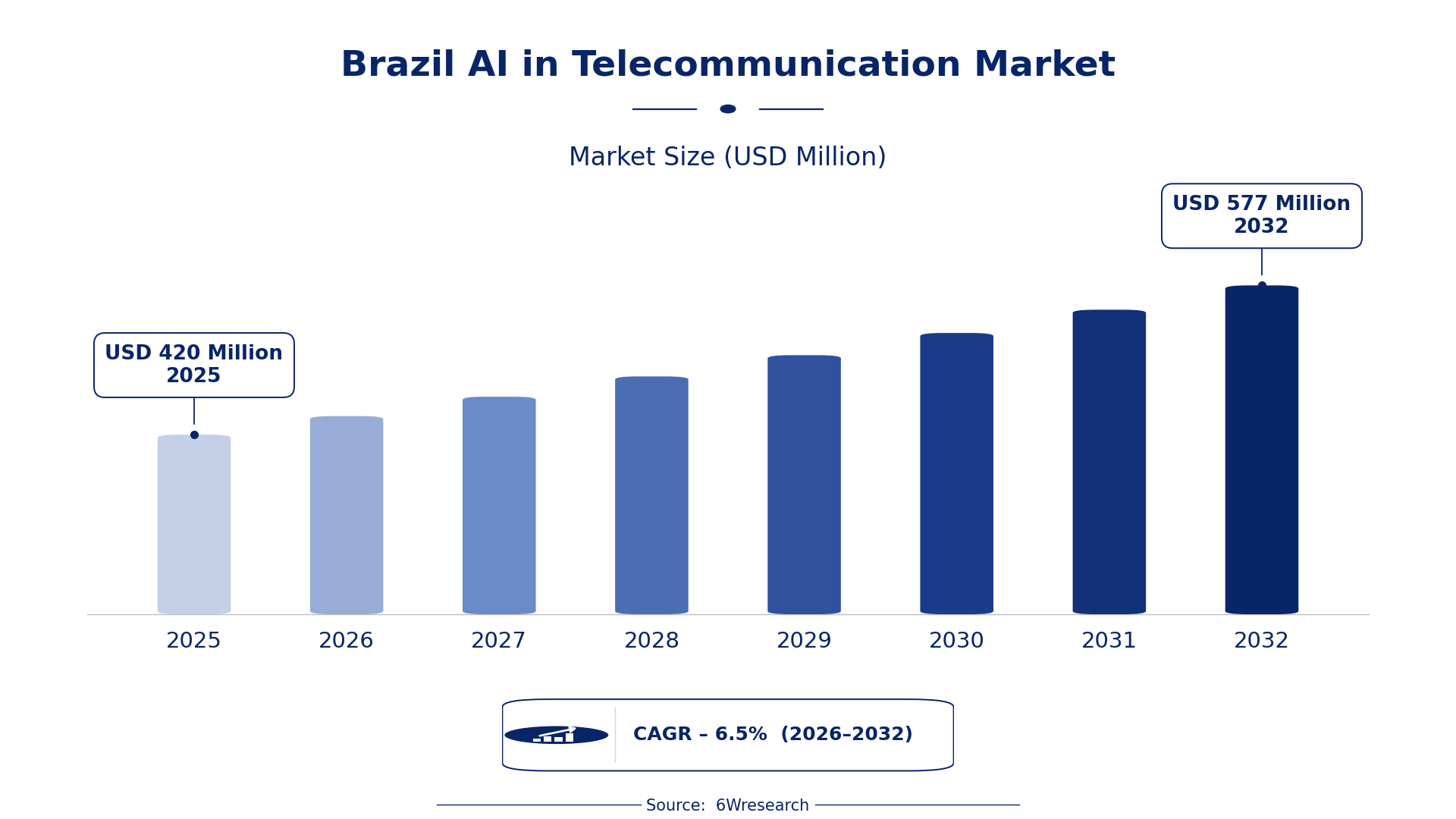
The Brazil AI in Telecommunication Market was estimated at USD 420 Million in 2025 and is projected to reach USD 577 Million by 2032, growing at a CAGR of 6.5% from 2026 to 2032.
Brazil AI in Telecommunication Market Synopsis
The demand for enhanced network management is the driving force behind the Brazil AI in Telecommunication market. As companies strive for efficiency, they are increasingly adopting AI technologies to streamline operations and improve customer interactions.
Telecommunications firms are leveraging AI for predictive maintenance and personalized service delivery. This transformation is not just a trend; it's becoming a necessity as consumers expect faster and more reliable services.
Brazil AI in Telecommunication Market Year-wise Growth Rate and Key Drivers
This graph illustrates the annual growth rates of the Brazil AI in Telecommunication Market from 2021 to 2032, highlighting a steady upward trajectory and projected expansion over the forecast period.
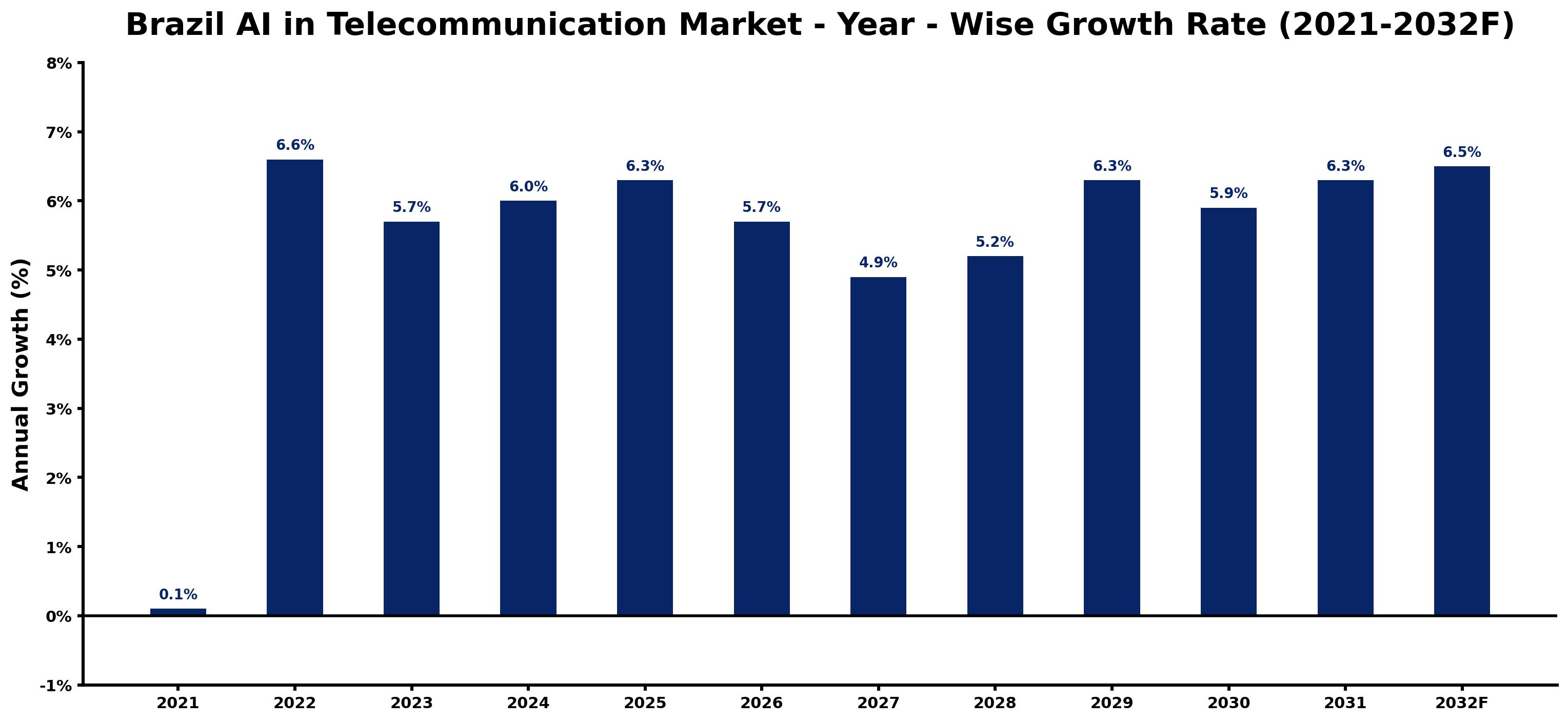
The table below presents the year‑wise growth rates along with the key drivers influencing the market
| Year | Growth Rate | Major Drivers |
| 2021 | 0.1% | Telecom regulatory framework encouraging AI integration. |
| 2022 | 6.6% | Significant investments by local telecom operators in AI. |
| 2023 | 5.7% | Adoption of digital customer service solutions in telecom. |
| 2024 | 6.0% | Government support for AI-driven telecom innovations. |
| 2025 | 6.3% | Increase in mobile internet penetration across Brazil. |
| 2026 | 5.7% | Emergence of AI startups focusing on telecommunications. |
| 2027 | 4.9% | Increased demand for personalized telecom services via AI. |
| 2028 | 5.2% | Telecom companies leveraging AI for network optimization. |
| 2029 | 6.3% | Rise in AI-powered customer analytics tools in telecom. |
| 2030 | 5.9% | Collaboration between telecom firms and AI tech providers. |
| 2031 | 6.3% | Growing need for fraud detection in telecom via AI. |
| 2032 | 6.5% | Strategic partnerships driving AI initiatives in telecommunications. |
Note: Market size estimations and growth projections presented in this report are based on 6Wresearch's proprietary forecasting methodology, utilizing the latest available industry data, government publications, and primary research inputs.
Brazil AI in Telecommunication Market Key Takeaways
Below are some of the specific key takeaways from the market, including:
- The integration of AI technologies is reshaping customer service paradigms within the telecommunications sector.
- Predictive analytics is becoming a vital tool for minimizing downtime and enhancing operational performance.
- Regulatory considerations are becoming increasingly complex as AI adoption grows.
- Investment in skilled professionals remains essential to navigate the challenges posed by AI integration.
- The push for high-speed connectivity is creating new avenues for AI applications in network optimization.
Evaluation of Restraints in Brazil AI in Telecommunication Market
The market faces notable challenges that hinder its growth. High initial investment costs present a significant barrier for many telecom companies looking to implement AI solutions. Additionally, regulatory complexities related to data protection and ethical AI usage create a cautious environment for potential adopters. Integrating new AI systems with existing infrastructure can also be cumbersome and requires a skilled workforce, which is currently in short supply. These restraints necessitate collaboration between telecom providers and technology developers to build a supportive framework for AI adoption.
Brazil AI in Telecommunication Market Trends
AI-driven chatbots and virtual assistants are becoming commonplace in customer service operations, allowing companies to handle queries more efficiently. Furthermore, machine learning algorithms are increasingly used for predictive network maintenance, offering insights that help avoid service disruptions. As consumer expectations shift towards personalized experiences, telecommunications firms are enhancing their service offerings through AI analytics, which provide a deeper understanding of user behavior and preferences.
Brazil AI in Telecommunication Market Opportunities
Opportunities in this market are plentiful, particularly in the realms of infrastructure optimization and customer experience enhancement. Telecom companies can harness AI for real-time data analysis to improve decision-making processes. As 5G technology becomes more widespread, the demand for innovative AI applications will escalate, especially in areas like IoT integration and smart city developments. Collaborative partnerships between telecoms and tech firms could pave the way for groundbreaking solutions tailored to the Brazilian market.
Government Initiatives in the Brazil AI in Telecommunication Market
The Brazilian government is actively promoting digital transformation within the telecommunications sector, recognizing its critical role in national development. Recent policies aim to foster innovation and encourage the adoption of AI technologies. However, navigating regulatory frameworks regarding data privacy and AI ethics remains a priority for policymakers, as they seek to balance growth with consumer protection.
- A national digital infrastructure upgrade program was recently launched to enhance connectivity and support AI integration.
- Current initiatives focus on developing guidelines for ethical AI use in telecommunications, ensuring consumer rights are upheld.
- Ongoing projects include a public-private partnership designed to improve access to advanced telecommunications services in rural areas.
- A planned regulatory framework is expected to be introduced in 2026, mandating transparency in AI-driven customer interactions.
Future Insights of the Brazil AI in Telecommunication Market
From 2026 to 2032, the Brazil AI in Telecommunication market is set to expand significantly. The increasing adoption of AI for efficient network management and customer service automation will drive this growth. As companies invest in advanced technologies to enhance user experiences, the synergy between AI and telecommunications will only deepen. Continued government support and a clearer regulatory environment will further incentivize investment, paving the way for innovation and competitiveness in this vital sector.
Brazil AI in Telecommunication Market Latest Developments
In the past year, the Brazil AI in Telecommunication market has witnessed an uptick in activity as companies accelerate their AI initiatives. Operators are increasingly investing in advanced analytics to boost operational efficiency and customer satisfaction. This push reflects broader trends in technological advancement and customer expectation management.
- A leading telecommunications provider launched an AI-driven predictive maintenance tool in Q1 2025, significantly reducing service disruptions.
- An initiative to implement AI-based customer support systems is currently underway, with a pilot program scheduled for late 2025.
- Plans are in motion for a nationwide AI training program designed to build a skilled workforce, expected to commence by mid-2026.
- A collaboration between regional telecom companies to enhance shared AI capabilities was announced in early 2025 and is in the implementation phase.
Brazil AI in Telecommunication Market - Key Attractiveness of the Report
- 10 Years of Market Numbers
- Historical Data Starting from 2022 to 2025
- Base Year: 2025
- Forecast Data until 2032
- Key Performance Indicators Impacting the Market
- Major Upcoming Developments and Projects
Key Highlights of the Report:
- Brazil AI in Telecommunication Market Outlook
- Market Size of Brazil AI in Telecommunication Market, 2025
- Forecast of Brazil AI in Telecommunication Market, 2032
- Historical Data and Forecast of Brazil AI in Telecommunication Revenues & Volume for the Period 2022-2032F
- Brazil AI in Telecommunication Market Trend Evolution
- Brazil AI in Telecommunication Market Drivers and Challenges
- Brazil AI in Telecommunication Price Trends
- Brazil AI in Telecommunication Porter's Five Forces
- Brazil AI in Telecommunication Industry Life Cycle
- Historical Data and Forecast of Brazil AI in Telecommunication Market Revenues & Volume By Application for the Period 2022-2032F
- Historical Data and Forecast of Brazil AI in Telecommunication Market Revenues & Volume By Customer analytics for the Period 2022-2032F
- Historical Data and Forecast of Brazil AI in Telecommunication Market Revenues & Volume By Network security for the Period 2022-2032F
- Historical Data and Forecast of Brazil AI in Telecommunication Market Revenues & Volume By Network optimization for the Period 2022-2032F
- Historical Data and Forecast of Brazil AI in Telecommunication Market Revenues & Volume By Self-diagnostics for the Period 2022-2032F
- Historical Data and Forecast of Brazil AI in Telecommunication Market Revenues & Volume By Virtual assistance for the Period 2022-2032F
- Historical Data and Forecast of Brazil AI in Telecommunication Market Revenues & Volume By Others (contact center analytics and marketing campaign analytics) for the Period 2022-2032F
- Historical Data and Forecast of Brazil AI in Telecommunication Market Revenues & Volume By Component for the Period 2022-2032F
- Historical Data and Forecast of Brazil AI in Telecommunication Market Revenues & Volume By Solutions for the Period 2022-2032F
- Historical Data and Forecast of Brazil AI in Telecommunication Market Revenues & Volume By Services for the Period 2022-2032F
- Historical Data and Forecast of Brazil AI in Telecommunication Market Revenues & Volume By Deployment Mode for the Period 2022-2032F
- Historical Data and Forecast of Brazil AI in Telecommunication Market Revenues & Volume By Cloud for the Period 2022-2032F
- Historical Data and Forecast of Brazil AI in Telecommunication Market Revenues & Volume By On-premises for the Period 2022-2032F
- Historical Data and Forecast of Brazil AI in Telecommunication Market Revenues & Volume By Technology for the Period 2022-2032F
- Historical Data and Forecast of Brazil AI in Telecommunication Market Revenues & Volume By Machine learning and deep learning for the Period 2022-2032F
- Historical Data and Forecast of Brazil AI in Telecommunication Market Revenues & Volume By Natural Language Processing (NLP) for the Period 2022-2032F
- Brazil AI in Telecommunication Import Export Trade Statistics
- Market Opportunity Assessment By Application
- Market Opportunity Assessment By Component
- Market Opportunity Assessment By Deployment Mode
- Market Opportunity Assessment By Technology
- Brazil AI in Telecommunication Top Companies Market Share
- Brazil AI in Telecommunication Competitive Benchmarking By Technical and Operational Parameters
- Brazil AI in Telecommunication Company Profiles
- Brazil AI in Telecommunication Key Strategic Recommendations






































