Peru AI in Telecommunication Market Size & Growth Rate (2026-2032)
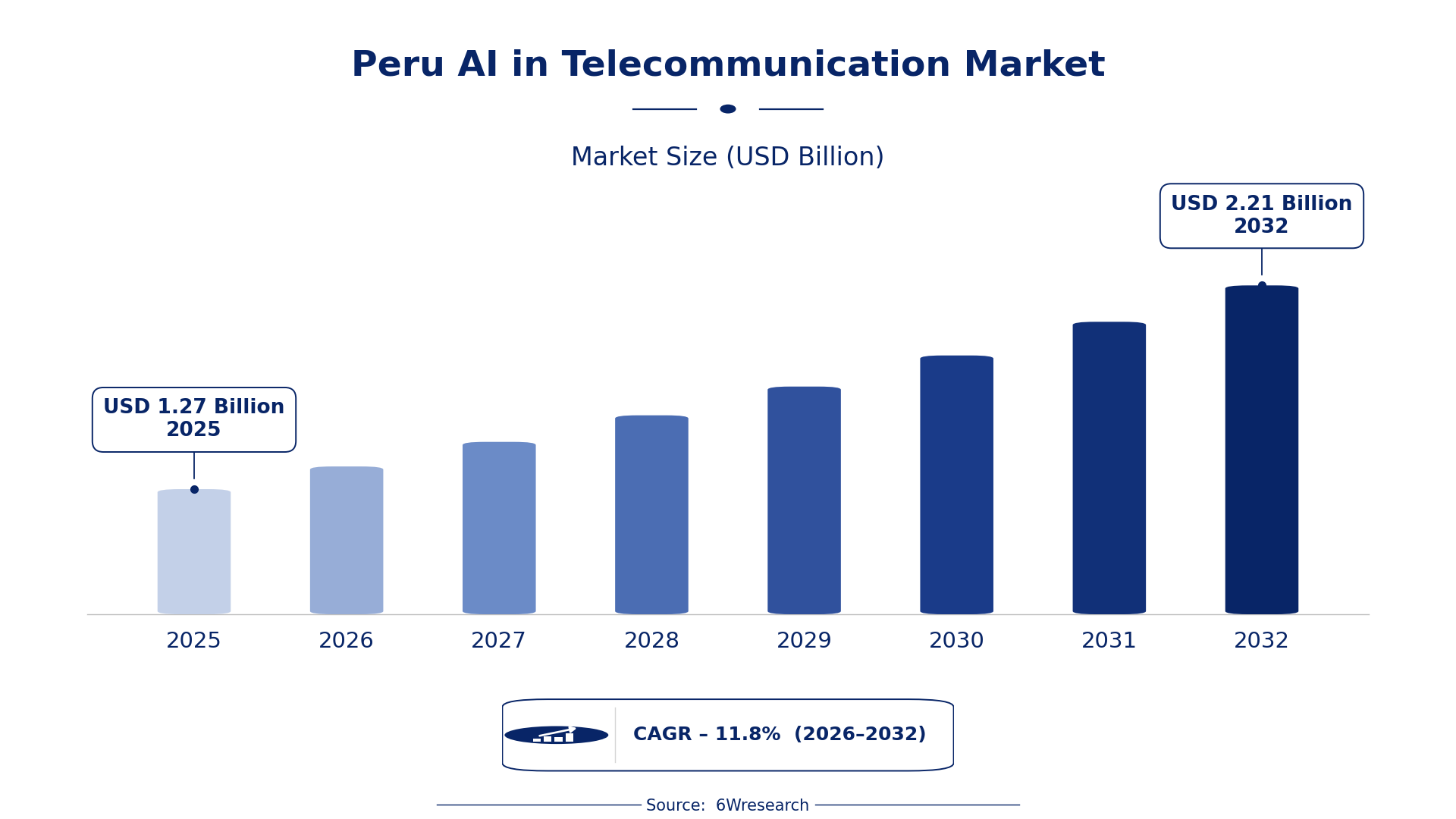
The Peru AI in Telecommunication Market was estimated at USD 1274 Million in 2025 and is projected to reach USD 2208 Million by 2032, growing at a CAGR of 11.8% from 2026 to 2032.
Peru AI in Telecommunication Market Synopsis
The Peru AI in Telecommunication Market is currently witnessing a surge fueled by rapid technological advancements and increasing telecom investments in AI solutions. As companies strive to enhance service quality and operational efficiency, the potential for AI integration into telecommunication is expanding significantly.
Looking ahead, the market is set to evolve with a greater emphasis on personalized customer interactions and network optimization. This trajectory indicates a strong alignment with global trends while also addressing local market dynamics, making Peru a focal point for AI adoption in telecommunications within the region.
Peru AI in Telecommunication Market Year-wise Growth Rate and Key Drivers
This graph illustrates the annual growth rates of the Peru AI in Telecommunication Market from 2021 to 2032, highlighting a steady upward trajectory and projected expansion over the forecast period.
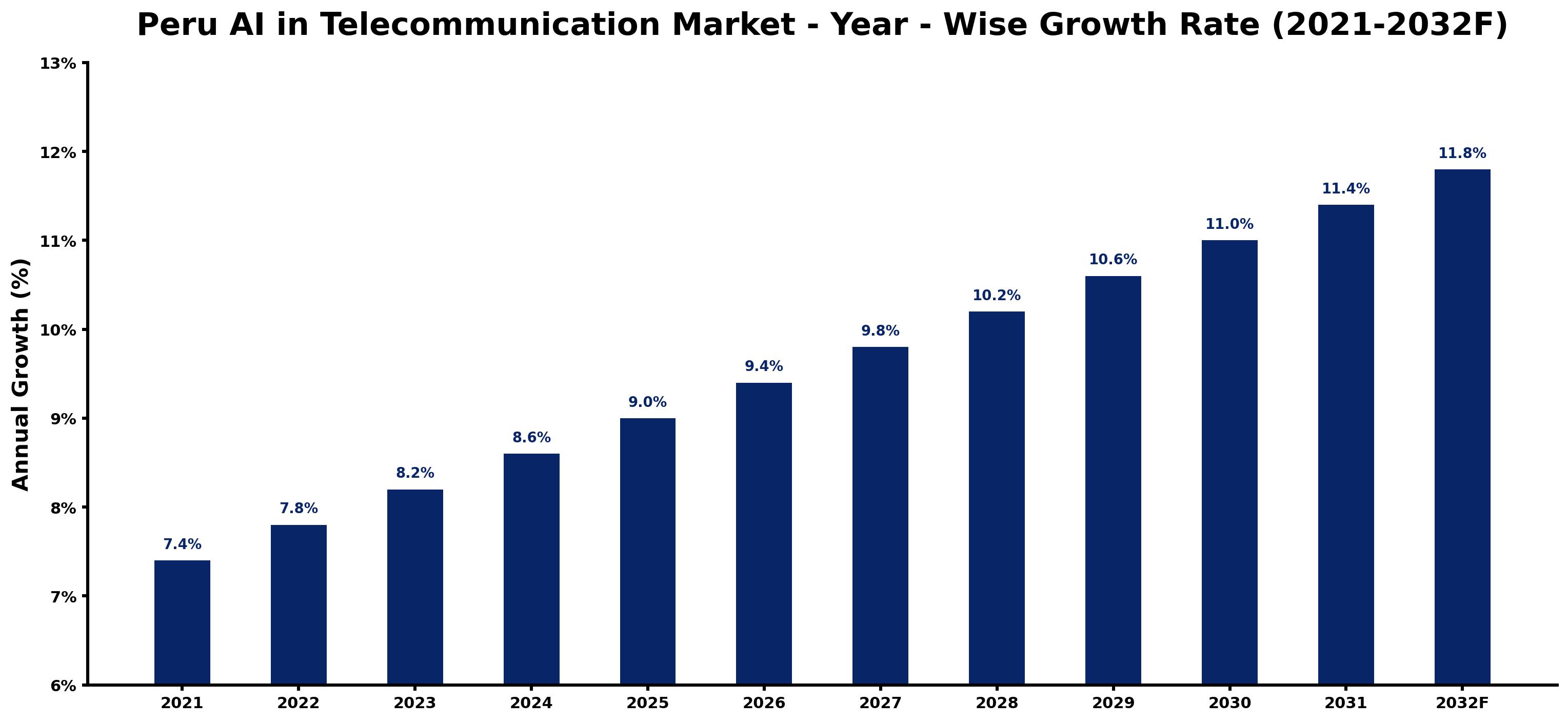
The table below presents the year‑wise growth rates along with the key drivers influencing the market
| Year | Growth Rate | Major Drivers |
| 2021 | 7.4% | Telecoms upgrading networks for better AI service delivery. |
| 2022 | 7.8% | Increasing smartphone penetration among urban populations drives demand. |
| 2023 | 8.2% | Government-backed AI initiatives boost telecom innovation programs. |
| 2024 | 8.6% | Regulatory support for AI use cases in telecommunications. |
| 2025 | 9.0% | Rising investment in digital transformation by local telecom firms. |
| 2026 | 9.4% | Emergence of smart city projects enhancing telecom AI applications. |
| 2027 | 9.8% | Growing need for automated customer service in telecom sector. |
| 2028 | 10.2% | Collaboration between telecom operators and AI startups increases. |
| 2029 | 10.6% | Surge in data consumption drives AI analytics adoption. |
| 2030 | 11.0% | National plans for 5G deployment enhance AI telecom services. |
| 2031 | 11.4% | Increased focus on cybersecurity in telecommunications due to digitization. |
| 2032 | 11.8% | Local demand for personalized telecom services leverages AI technology. |
Note: Market size estimations and growth projections presented in this report are based on 6Wresearch's proprietary forecasting methodology, utilizing the latest available industry data, government publications, and primary research inputs.
Peru AI in Telecommunication Market Key Takeaways
Below are some of the specific key takeaways from the market, including:
- The increasing deployment of AI-driven chatbots is transforming customer service experiences.
- Telecom companies are adopting predictive analytics for optimizing network performance.
- Investment in AI for personalized marketing strategies is gaining traction among operators.
- Regulatory support is driving innovation and investment in AI technologies.
- As 5G technology rolls out, AI's role in enhancing customer service will become even more critical.
Evaluation of Restraints in Peru AI in Telecommunication Market
Despite the positive growth trajectory, several real challenges persist. Regulatory hurdles around data privacy and security remain significant barriers for AI adoption in telecommunications. Companies also struggle with a shortage of skilled professionals who can adeptly manage AI technologies. Furthermore, integrating AI solutions with existing systems requires substantial financial investment, making it a daunting task for smaller firms. Continuous training is essential, yet it adds to operational complexities and costs. These factors collectively hinder the speed of AI adoption across the sector.
Peru AI in Telecommunication Market Trends
The Peru AI in Telecommunication Market is witnessing critical trends shaping its growth. Notably, the integration of AI-powered chatbots for enhancing customer service and support is prevalent. Predictive analytics is being increasingly utilized to streamline network optimization and improve service reliability.
Another trend is the application of machine learning algorithms to detect fraud, ensuring better security measures. Companies are also focusing on personalized marketing campaigns driven by AI insights, allowing for more tailored customer retention strategies.
Peru AI in Telecommunication Market Opportunities
Investment opportunities abound in the Peru AI in Telecommunication Market. There is a growing demand for solutions focused on network optimization, which presents a clear pathway for tech firms specializing in AI. Companies that can deliver predictive maintenance solutions will find a receptive audience as telecoms seek efficiency gains.
Furthermore, the market shows promise for AI-driven customer engagement tools, including chatbots and virtual assistants, which can significantly enhance user experiences. With rising cybersecurity concerns, investments in AI-driven security frameworks are also becoming increasingly crucial.
Government Initiatives in the Peru AI in Telecommunication Market
Government policy in Peru is actively shaping the AI landscape within telecommunications, creating an environment conducive to innovation and investment. With a strong focus on enhancing national digital capabilities, the government aims to boost connectivity and ensure robust data privacy regulations, essential for instilling confidence among users and investors alike.
- A regulatory framework established in 2021 mandates clear guidelines for AI usage, particularly concerning data protection.
- Currently, the Ministry of Production is funding tech incubators to foster local AI startup growth in the telecom sector.
- A national digital infrastructure upgrade programme is underway, targeting improved connectivity across rural and urban areas.
- In 2025, there are plans for a public-private partnership designed to enhance telecommunication infrastructure through advanced AI technologies.
- A recently completed initiative focused on training and certifying professionals in AI applications specific to telecommunications.
Future Insights of the Peru AI in Telecommunication Market
The future of the Peru AI in Telecommunication Market looks optimistic as ongoing demand for advanced technological solutions propels growth. The integration of AI is expected to become deeply embedded within telecom operations, particularly as the adoption of 5G technology rises. This shift is likely to pave the way for more personalized services and a robust digital transformation across the sector.
Regulatory initiatives aimed at enhancing infrastructure and connectivity are expected to create additional opportunities for AI providers. As firms continuously strive to improve customer experiences and streamline their services, the role of AI will undoubtedly become increasingly vital in the years to come.
Peru AI in Telecommunication Market Latest Developments
In the past year, the Peru AI in Telecommunication Market has experienced notable advancements as firms aggressively pursue AI-driven solutions. This push reflects both a response to growing customer expectations and a need for operational efficiency.
- A leading regional operator launched a new AI-powered customer service platform in early 2023, designed to provide real-time support and feedback.
- An initiative began in late 2022 to integrate AI into existing network infrastructure, with phases expected to continue through 2023.
- A major technology vendor announced plans to introduce AI-based predictive maintenance tools for telecom operators, slated for rollout by mid-2024.
- A pilot program was implemented in Q1 2023, utilizing AI for targeted marketing campaigns across various customer segments.
- Upcoming efforts include a nationwide training program, scheduled for late 2023, aimed at upskilling telecom employees in AI technologies.
Peru AI in Telecommunication Market - Key Attractiveness of the Report
- 10 Years of Market Numbers
- Historical Data Starting from 2022 to 2025
- Base Year: 2025
- Forecast Data until 2032
- Key Performance Indicators Impacting the Market
- Major Upcoming Developments and Projects
Key Highlights of the Report:
- Peru AI in Telecommunication Market Outlook
- Market Size of Peru AI in Telecommunication Market, 2025
- Forecast of Peru AI in Telecommunication Market, 2032
- Historical Data and Forecast of Peru AI in Telecommunication Revenues & Volume for the Period 2022-2032F
- Peru AI in Telecommunication Market Trend Evolution
- Peru AI in Telecommunication Market Drivers and Challenges
- Peru AI in Telecommunication Price Trends
- Peru AI in Telecommunication Porter's Five Forces
- Peru AI in Telecommunication Industry Life Cycle
- Historical Data and Forecast of Peru AI in Telecommunication Market Revenues & Volume By Application for the Period 2022-2032F
- Historical Data and Forecast of Peru AI in Telecommunication Market Revenues & Volume By Customer analytics for the Period 2022-2032F
- Historical Data and Forecast of Peru AI in Telecommunication Market Revenues & Volume By Network security for the Period 2022-2032F
- Historical Data and Forecast of Peru AI in Telecommunication Market Revenues & Volume By Network optimization for the Period 2022-2032F
- Historical Data and Forecast of Peru AI in Telecommunication Market Revenues & Volume By Self-diagnostics for the Period 2022-2032F
- Historical Data and Forecast of Peru AI in Telecommunication Market Revenues & Volume By Virtual assistance for the Period 2022-2032F
- Historical Data and Forecast of Peru AI in Telecommunication Market Revenues & Volume By Others (contact center analytics and marketing campaign analytics) for the Period 2022-2032F
- Historical Data and Forecast of Peru AI in Telecommunication Market Revenues & Volume By Component for the Period 2022-2032F
- Historical Data and Forecast of Peru AI in Telecommunication Market Revenues & Volume By Solutions for the Period 2022-2032F
- Historical Data and Forecast of Peru AI in Telecommunication Market Revenues & Volume By Services for the Period 2022-2032F
- Historical Data and Forecast of Peru AI in Telecommunication Market Revenues & Volume By Deployment Mode for the Period 2022-2032F
- Historical Data and Forecast of Peru AI in Telecommunication Market Revenues & Volume By Cloud for the Period 2022-2032F
- Historical Data and Forecast of Peru AI in Telecommunication Market Revenues & Volume By On-premises for the Period 2022-2032F
- Historical Data and Forecast of Peru AI in Telecommunication Market Revenues & Volume By Technology for the Period 2022-2032F
- Historical Data and Forecast of Peru AI in Telecommunication Market Revenues & Volume By Machine learning and deep learning for the Period 2022-2032F
- Historical Data and Forecast of Peru AI in Telecommunication Market Revenues & Volume By Natural Language Processing (NLP) for the Period 2022-2032F
- Peru AI in Telecommunication Import Export Trade Statistics
- Market Opportunity Assessment By Application
- Market Opportunity Assessment By Component
- Market Opportunity Assessment By Deployment Mode
- Market Opportunity Assessment By Technology
- Peru AI in Telecommunication Top Companies Market Share
- Peru AI in Telecommunication Competitive Benchmarking By Technical and Operational Parameters
- Peru AI in Telecommunication Company Profiles
- Peru AI in Telecommunication Key Strategic Recommendations






































