Malaysia AI in Telecommunication Market Size & Growth Rate (2026-2032)
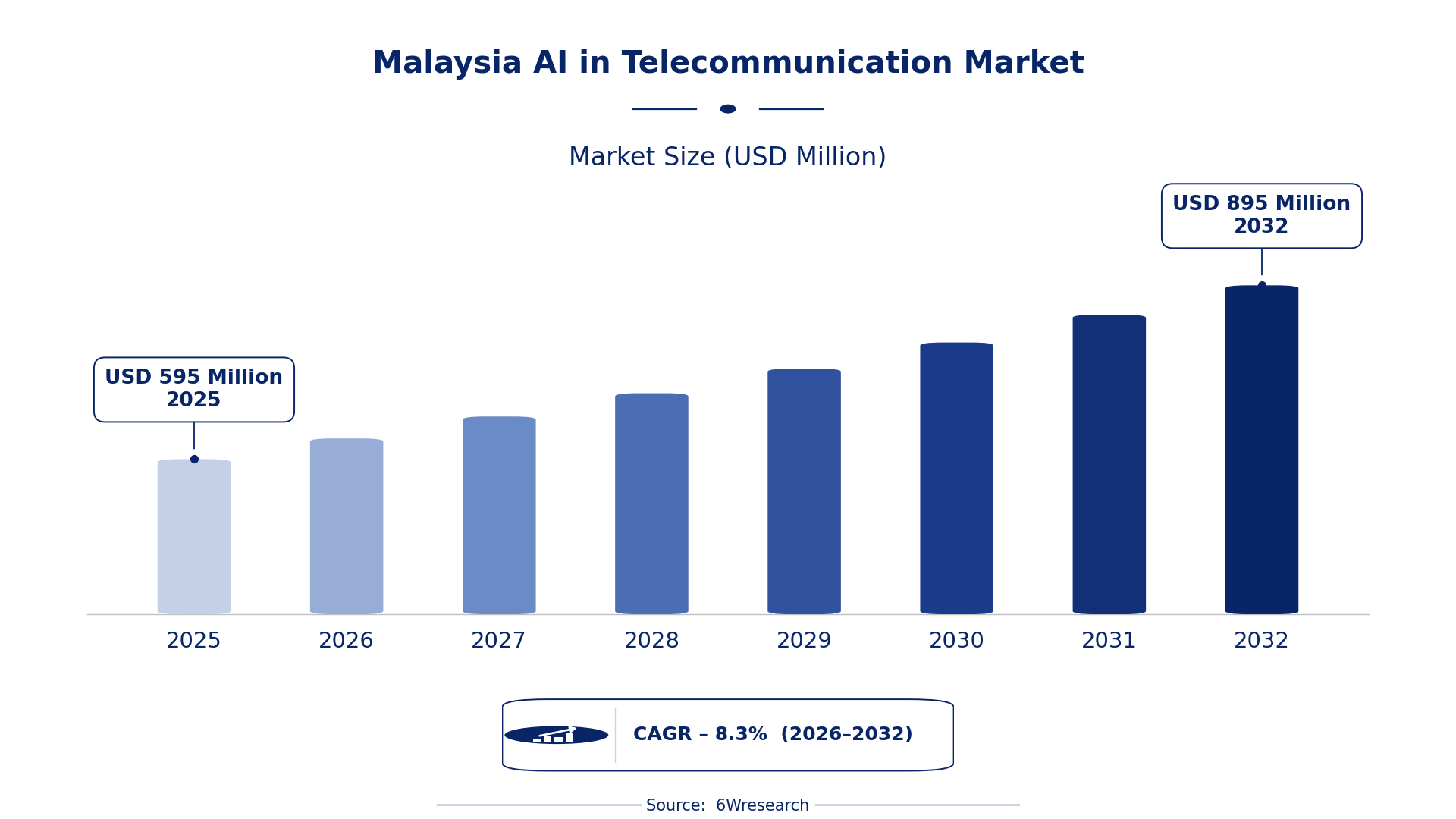
The Malaysia AI in Telecommunication Market was estimated at USD 595 Million in 2025 and is projected to reach USD 895 Million by 2032, growing at a CAGR of 8.3% from 2026 to 2032.
Malaysia AI in Telecommunication Market Synopsis
The Malaysian telecom sector is embracing artificial intelligence, focusing on optimizing network performance and enhancing customer service. With AI-driven analytics, operators can now process vast datasets to make informed decisions that significantly impact operational efficiency.
The push for digitalization, fueled by government support, has accelerated the integration of AI technologies. This enables telecom providers to create personalized offerings, which is essential in an industry characterized by fierce competition and evolving consumer expectations.
Malaysia AI in Telecommunication Market Year-wise Growth Rate and Key Drivers
This graph illustrates the annual growth rates of the Malaysia AI in Telecommunication Market from 2021 to 2032, highlighting a steady upward trajectory and projected expansion over the forecast period.
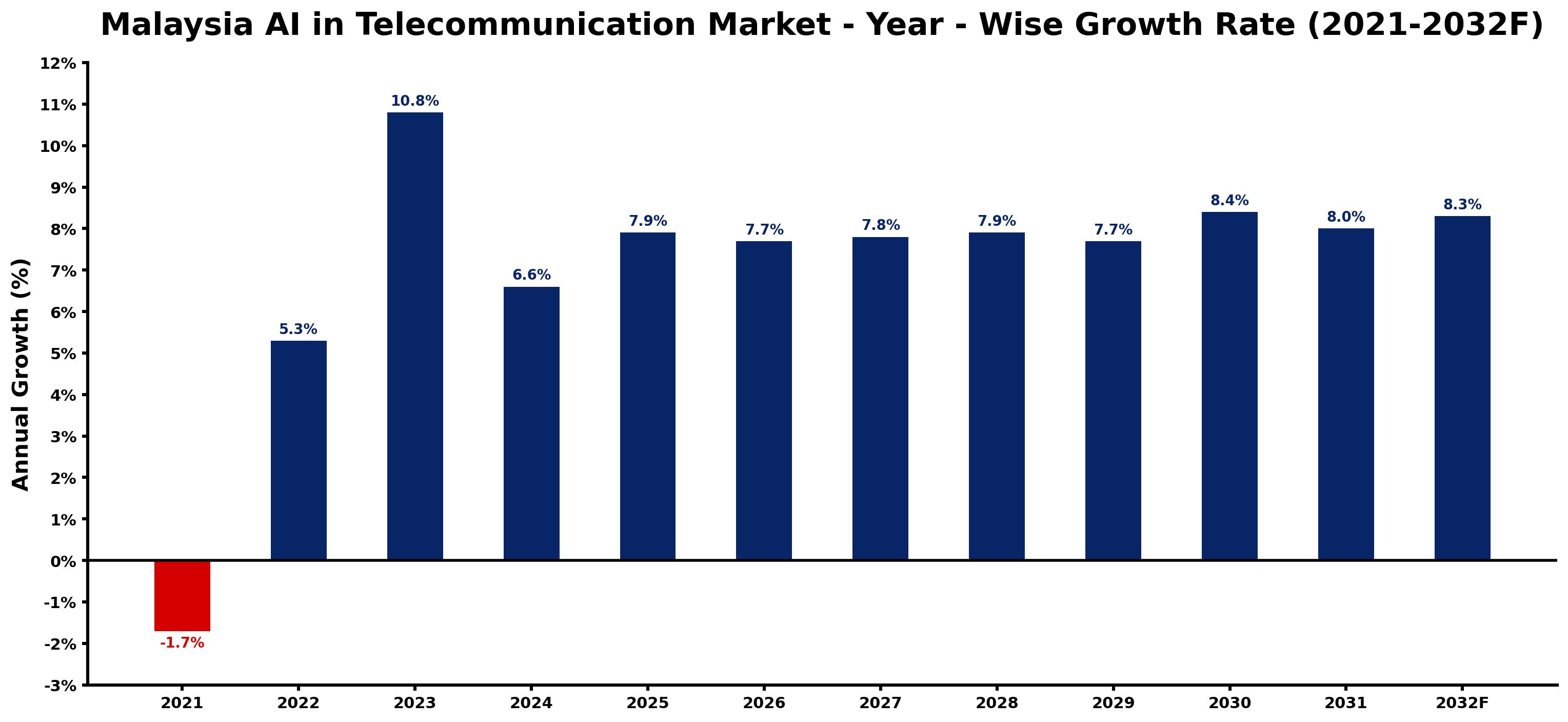
The table below presents the year‑wise growth rates along with the key drivers influencing the market
| Year | Growth Rate | Major Drivers |
| 2021 | -1.7% | Regulatory restrictions from MCMC on AI deployments. |
| 2022 | 5.3% | Government's Digital Economy Blueprint promoting AI adoption. |
| 2023 | 10.8% | Increased smartphone penetration enhancing telecom AI applications. |
| 2024 | 6.6% | Emerging 5G networks driving AI-driven connectivity solutions. |
| 2025 | 7.9% | Regulatory support for AI startups in telecommunication sectors. |
| 2026 | 7.7% | Growing urban population escalating telecom service demands. |
| 2027 | 7.8% | Investment in AI for predictive maintenance in networks. |
| 2028 | 7.9% | Enhanced cybersecurity measures require AI integration in telecom. |
| 2029 | 7.7% | Rise in remote work fueling AI communication tools. |
| 2030 | 8.4% | Partnerships between telecoms and tech firms boost AI projects. |
| 2031 | 8.0% | Growing interest in AI-driven data analytics for telecoms. |
| 2032 | 8.3% | Government incentives for AI research in telecommunications. |
Note: Market size estimations and growth projections presented in this report are based on 6Wresearch's proprietary forecasting methodology, utilizing the latest available industry data, government publications, and primary research inputs.
Malaysia AI in Telecommunication Market Key Takeaways
Below are some of the specific key takeaways from the market, including:
- The integration of AI is fundamentally changing customer engagement strategies within the telecommunications sector.
- Government initiatives are paving the way for a more digitally enabled telecom environment.
- AI technologies are increasingly essential for real-time data processing and predictive maintenance.
- The market's growth trajectory indicates a strong investment potential in AI solutions for telecommunications.
- Operators are utilizing AI to enhance network management and customer service, leading to improved customer retention rates.
Evaluation of Restraints in Malaysia AI in Telecommunication Market
Several barriers are holding back the growth of AI in the Malaysian telecom sector. Integrating AI solutions into existing systems poses significant challenges, often resulting in compatibility issues and operational disruptions. Data privacy and security concerns are paramount, as the telecom industry deals with sensitive consumer information, demanding rigorous safeguards. Moreover, the workforce needs adequate training in AI technologies, which requires substantial investment in education and skill development. Lastly, the competitive landscape leaves little room for error; companies must adapt quickly to leverage AI effectively while navigating these hurdles.
Malaysia AI in Telecommunication Market Trends
Key trends influencing the AI in telecommunications market in Malaysia include a heightened focus on customer personalization and predictive analytics. Operators are increasingly deploying machine learning algorithms for service customization, allowing for targeted marketing and tailored data plans.
Another trend is the growing reliance on AI for fraud detection and cybersecurity measures. With cyber threats evolving, telecom companies are investing heavily in AI systems that enhance their ability to predict and prevent security breaches, ensuring consumer trust and regulatory compliance.
Malaysia AI in Telecommunication Market Opportunities
The market presents substantial opportunities, especially in developing AI-driven customer service platforms and enhancing network management systems. Companies can capitalize on the rising demand for smart city applications, which integrate telecom services with urban infrastructure. Furthermore, there is a clear pathway for growth in partnerships with tech firms that specialize in AI technologies, allowing telecom operators to expand their service portfolios and improve operational efficiencies.
Government Initiatives in the Malaysia AI in Telecommunication Market
Government policy is a critical factor influencing the adoption of AI in the Malaysian telecommunications industry. Recent efforts focus on boosting digital transformation initiatives that align with the national agenda. This includes a strong emphasis on developing a digital economy and smart cities, creating a fertile ground for AI technologies.
- A recently launched initiative aims to upgrade national digital infrastructure to improve connectivity and support AI integration across telecommunications.
- A current programme focuses on fostering partnerships between telecom operators and technology firms to enhance AI capabilities.
- Ongoing efforts to revise regulatory frameworks are being implemented to ensure data protection while promoting innovative AI solutions.
- A planned public-private collaboration is expected to boost investments in AI-driven solutions for network management by 2028.
Future Insights of the Malaysia AI in Telecommunication Market
As the AI in telecommunication market evolves, a shift toward even more intelligent network solutions is anticipated. The trend of hyper-personalization in customer service will likely intensify, driven by data analytics and AI algorithms that can learn and adapt in real-time. Furthermore, the integration of 5G technology will expand the capabilities of AI applications, enabling quicker data processing and seamless connectivity. The market is expected to attract significant investments aimed at enhancing not only operational efficiencies but also the customer experience.
Malaysia AI in Telecommunication Market Latest Developments
Over the past year, the Malaysian AI in telecommunication market has seen dynamic changes. Companies are increasingly rolling out AI-enabled solutions that focus on both customer engagement and operational efficiency. The recent technological advancements have fostered a more innovative environment within the sector.
- A new customer engagement platform utilizing AI chatbots was launched in early 2025 to enhance service interaction.
- An ongoing initiative started in mid-2025 focuses on upgrading network infrastructure to support advanced AI-driven analytics.
- Plans are underway for a comprehensive customer analytics system set to roll out in late 2026, aiming to provide insights for personalized services.
- A partnership between telecom operators and AI specialists has been initiated to develop predictive maintenance tools, currently in the implementation phase.
Malaysia AI in Telecommunication Market - Key Attractiveness of the Report
- 10 Years of Market Numbers
- Historical Data Starting from 2022 to 2025
- Base Year: 2025
- Forecast Data until 2032
- Key Performance Indicators Impacting the Market
- Major Upcoming Developments and Projects
Key Highlights of the Report:
- Malaysia AI in Telecommunication Market Outlook
- Market Size of Malaysia AI in Telecommunication Market, 2025
- Forecast of Malaysia AI in Telecommunication Market, 2032
- Historical Data and Forecast of Malaysia AI in Telecommunication Revenues & Volume for the Period 2022-2032F
- Malaysia AI in Telecommunication Market Trend Evolution
- Malaysia AI in Telecommunication Market Drivers and Challenges
- Malaysia AI in Telecommunication Price Trends
- Malaysia AI in Telecommunication Porter's Five Forces
- Malaysia AI in Telecommunication Industry Life Cycle
- Historical Data and Forecast of Malaysia AI in Telecommunication Market Revenues & Volume By Application for the Period 2022-2032F
- Historical Data and Forecast of Malaysia AI in Telecommunication Market Revenues & Volume By Customer analytics for the Period 2022-2032F
- Historical Data and Forecast of Malaysia AI in Telecommunication Market Revenues & Volume By Network security for the Period 2022-2032F
- Historical Data and Forecast of Malaysia AI in Telecommunication Market Revenues & Volume By Network optimization for the Period 2022-2032F
- Historical Data and Forecast of Malaysia AI in Telecommunication Market Revenues & Volume By Self-diagnostics for the Period 2022-2032F
- Historical Data and Forecast of Malaysia AI in Telecommunication Market Revenues & Volume By Virtual assistance for the Period 2022-2032F
- Historical Data and Forecast of Malaysia AI in Telecommunication Market Revenues & Volume By Others (contact center analytics and marketing campaign analytics) for the Period 2022-2032F
- Historical Data and Forecast of Malaysia AI in Telecommunication Market Revenues & Volume By Component for the Period 2022-2032F
- Historical Data and Forecast of Malaysia AI in Telecommunication Market Revenues & Volume By Solutions for the Period 2022-2032F
- Historical Data and Forecast of Malaysia AI in Telecommunication Market Revenues & Volume By Services for the Period 2022-2032F
- Historical Data and Forecast of Malaysia AI in Telecommunication Market Revenues & Volume By Deployment Mode for the Period 2022-2032F
- Historical Data and Forecast of Malaysia AI in Telecommunication Market Revenues & Volume By Cloud for the Period 2022-2032F
- Historical Data and Forecast of Malaysia AI in Telecommunication Market Revenues & Volume By On-premises for the Period 2022-2032F
- Historical Data and Forecast of Malaysia AI in Telecommunication Market Revenues & Volume By Technology for the Period 2022-2032F
- Historical Data and Forecast of Malaysia AI in Telecommunication Market Revenues & Volume By Machine learning and deep learning for the Period 2022-2032F
- Historical Data and Forecast of Malaysia AI in Telecommunication Market Revenues & Volume By Natural Language Processing (NLP) for the Period 2022-2032F
- Malaysia AI in Telecommunication Import Export Trade Statistics
- Market Opportunity Assessment By Application
- Market Opportunity Assessment By Component
- Market Opportunity Assessment By Deployment Mode
- Market Opportunity Assessment By Technology
- Malaysia AI in Telecommunication Top Companies Market Share
- Malaysia AI in Telecommunication Competitive Benchmarking By Technical and Operational Parameters
- Malaysia AI in Telecommunication Company Profiles
- Malaysia AI in Telecommunication Key Strategic Recommendations






































