Saudi Arabia AI in Telecommunication Market Size & Growth Rate (2026-2032)
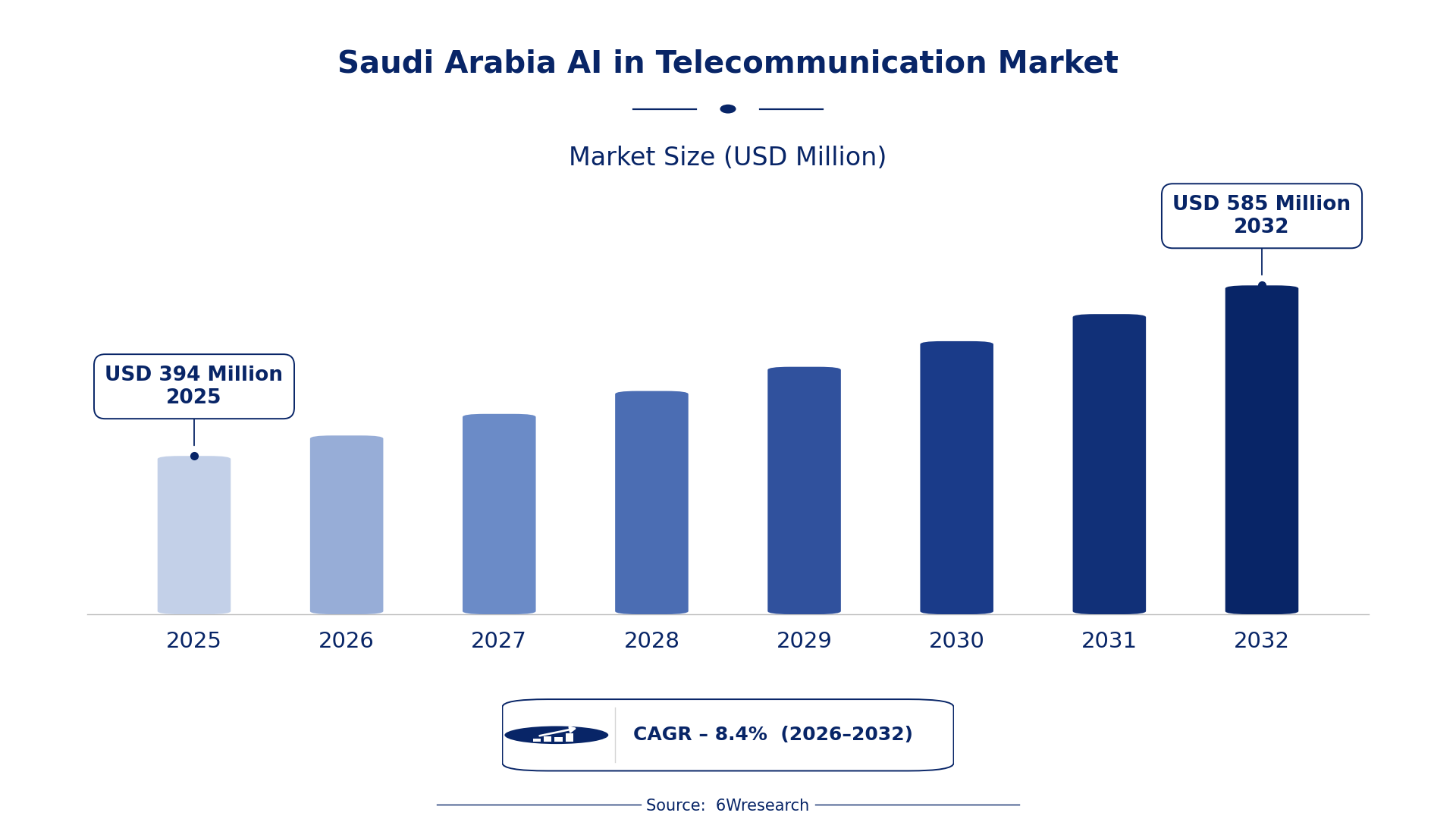
The Saudi Arabia AI in Telecommunication Market was estimated at USD 394 Million in 2025 and is projected to reach USD 585 Million by 2032, growing at a CAGR of 8.4% from 2026 to 2032.
Saudi Arabia AI in Telecommunication Market Synopsis
The driving force behind the Saudi Arabia AI in Telecommunication Market is the increasing deployment of artificial intelligence by telecom operators. These operators are actively seeking solutions to improve network efficiency, enhance customer service, and streamline operations in a landscape characterized by soaring data traffic.
A significant factor contributing to this growth is the government's commitment to digital transformation. By prioritizing AI technologies in telecommunications, the government fosters an environment conducive to innovation, thereby incentivizing operators to adopt these technologies more aggressively.
Saudi Arabia AI in Telecommunication Market Year-wise Growth Rate and Key Drivers
This graph illustrates the annual growth rates of the Saudi Arabia AI in Telecommunication Market from 2021 to 2032, highlighting a steady upward trajectory and projected expansion over the forecast period.
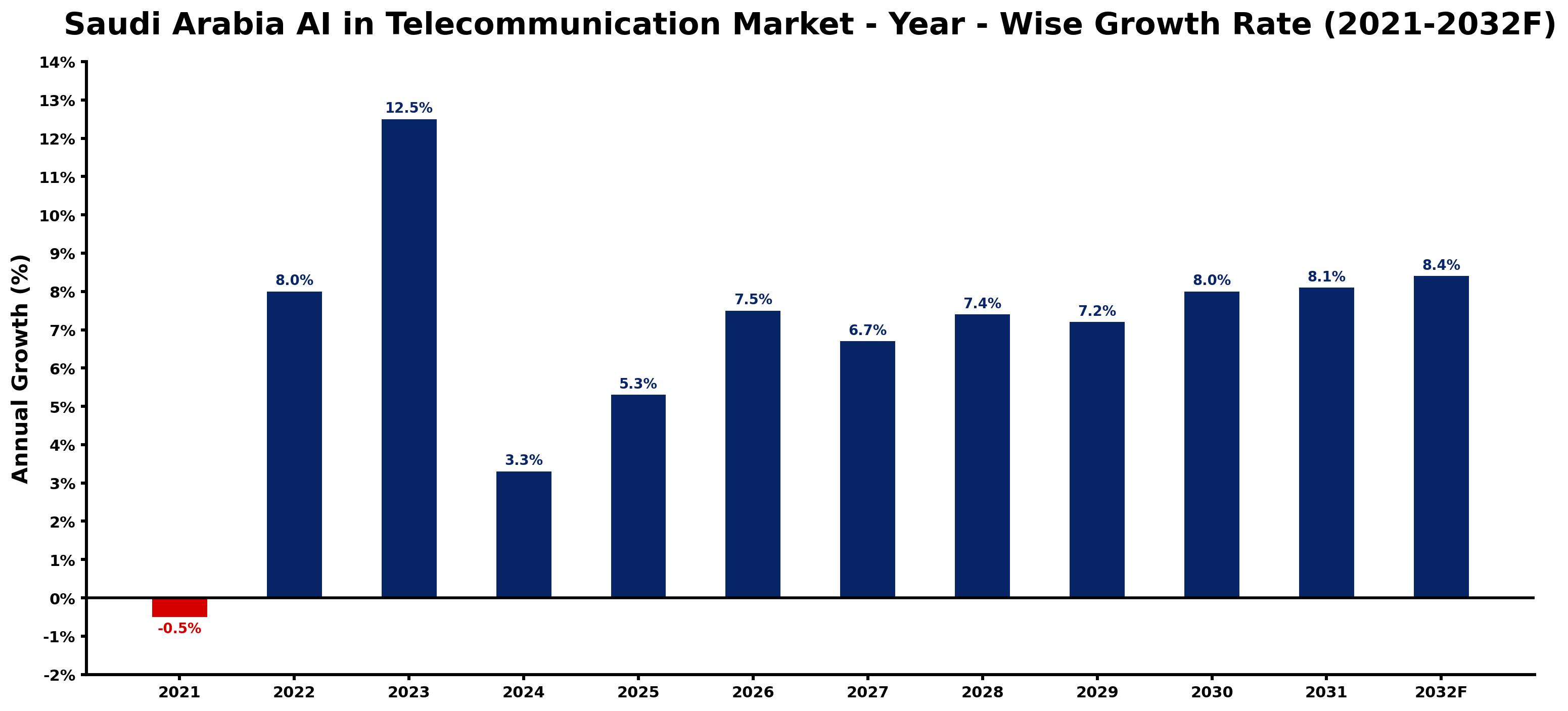
The table below presents the year‑wise growth rates along with the key drivers influencing the market
| Year | Growth Rate | Major Drivers |
| 2021 | -0.5% | Regulatory delays from Saudi Communications and Information Technology Commission |
| 2022 | 8.0% | Saudi Vision 2030 emphasizes AI in communications sector. |
| 2023 | 12.5% | Regulatory support from CITC for AI-driven telecom solutions. |
| 2024 | 3.3% | Increase in 5G infrastructure supporting AI advancements. |
| 2025 | 5.3% | Rising internet penetration driving AI telecom applications. |
| 2026 | 7.5% | Government incentives for AI research in telecommunications sector. |
| 2027 | 6.7% | Telecom firms adopting AI to enhance cybersecurity measures. |
| 2028 | 7.4% | Partnerships between telecom and AI startups increase innovation. |
| 2029 | 7.2% | Surge in mobile data usage driving AI network solutions. |
| 2030 | 8.0% | Focus on AI for efficient network management implementations. |
| 2031 | 8.1% | Demand for AI analytics improves telecom customer service. |
| 2032 | 8.4% | Efforts to harness AI for predictive maintenance in networks. |
Note: Market size estimations and growth projections presented in this report are based on 6Wresearch's proprietary forecasting methodology, utilizing the latest available industry data, government publications, and primary research inputs.
Saudi Arabia AI in Telecommunication Market Key Takeaways
Below are some of the specific key takeaways from the market, including:
- The market is experiencing accelerated growth due to the surge in demand for AI-driven customer service solutions.
- Operators are increasingly relying on predictive maintenance to minimize downtime and improve network reliability.
- Data analytics tools are becoming indispensable for enhancing service quality and personalizing user experiences.
- The government's digital transformation agenda is a key driver behind the adoption of AI technologies in telecommunications.
- Challenges remain in optimizing AI algorithms and addressing data privacy concerns.
Evaluation of Restraints in Saudi Arabia AI in Telecommunication Market
Despite its growth trajectory, the Saudi Arabia AI in Telecommunication Market faces several restraints. A primary concern revolves around the optimization of AI algorithms, which require fine-tuning to meet the specific needs of telecom applications. This process can be resource-intensive and may deter smaller operators from adopting these technologies. Data privacy remains a critical issue as well; customers are increasingly cautious about how their data is used. Furthermore, the integration of AI solutions into existing systems poses significant challenges, potentially slowing down the pace at which these advancements are implemented. Addressing these issues will be crucial for sustaining market momentum.
Saudi Arabia AI in Telecommunication Market Trends
Several trends are shaping the Saudi Arabia AI in Telecommunication Market. Firstly, the use of chatbots for customer service is skyrocketing, enabling operators to handle inquiries more efficiently. Secondly, there’s a noticeable shift towards data analytics that goes beyond mere reporting, allowing for actionable insights that drive decision-making. Moreover, the integration of 5G technology is amplifying the need for AI solutions to manage increased data loads. Lastly, as consumer expectations evolve, telecom providers are being forced to develop more personalized services, which AI can facilitate effectively.
Saudi Arabia AI in Telecommunication Market Opportunities
Opportunities abound in the Saudi Arabia AI in Telecommunication Market. As telecom operators increasingly focus on enhancing customer experiences, there is a growing demand for tailored AI applications. Companies that can offer innovative solutions, such as advanced analytics platforms or customer relationship management systems powered by AI, stand to gain significantly. Additionally, partnerships with tech firms specializing in AI can enhance service offerings, creating competitive advantages. The expansion of 5G networks also opens doors for new services, enabling operators to explore AI applications that were previously unattainable.
Government Initiatives in the Saudi Arabia AI in Telecommunication Market
Government initiatives play a crucial role in shaping the Saudi Arabia AI in Telecommunication Market. By focusing on digital transformation and technology adoption, the government is setting the tone for industry growth. Regulatory frameworks are evolving to support the seamless integration of AI technologies within the telecommunications sector. This proactive approach enhances the market environment, encouraging more players to invest in AI solutions.
- A national digital infrastructure upgrade programme was launched recently to bolster telecommunications capabilities across the kingdom.
- The Ministry of Communications and Information Technology is currently implementing a regulatory framework aimed at enhancing billing transparency in telecom services.
- A planned public-private initiative is expected to expand telecom infrastructure access, focusing on remote and underserved areas by 2028.
- Ongoing efforts are underway to foster partnerships between government and tech companies to accelerate the adoption of AI technologies.
- A newly introduced policy framework focuses on data protection to address consumer privacy concerns, enhancing trust in AI-driven services.
Future Insights of the Saudi Arabia AI in Telecommunication Market
Looking ahead to 2026-2032, the Saudi Arabia AI in Telecommunication Market is expected to see transformative growth driven by technological advancements and policy support. Operators are likely to invest heavily in AI solutions that not only optimize their operations but also elevate customer engagement to unprecedented levels. As 5G technology becomes more entrenched, the need for sophisticated AI tools to manage complexity will increase, enabling operators to offer highly customized services. The continuous push from the government for digital transformation will further accelerate this trend, setting the stage for a dynamic telecommunications environment.
Saudi Arabia AI in Telecommunication Market Latest Developments
In the past year, the Saudi Arabia AI in Telecommunication Market has experienced a wave of activity. Industry players have been busy aligning their strategies with the government's digital transformation agenda while simultaneously rolling out innovative AI solutions. The focus remains on enhancing customer experiences, improving operational efficiencies, and leveraging new technologies to stay competitive.
- A leading telecom operator initiated a rollout of AI-powered customer support systems in early 2025, resulting in improved response times.
- In mid-2025, a major technology vendor began collaborating with several regional operators to develop predictive maintenance tools for network infrastructure.
- An initiative announced in Q3 2025 aims to integrate AI analytics into network management systems, with implementation expected to begin in early 2026.
- A pilot project is set to begin in late 2025, focusing on the use of AI for optimizing service delivery in remote areas.
- Upcoming developments include a strategic partnership slated for Q2 2026 that focuses on enhancing data-driven decision-making capabilities in telecom operations.
Saudi Arabia AI in Telecommunication Market - Key Attractiveness of the Report
- 10 Years of Market Numbers
- Historical Data Starting from 2022 to 2025
- Base Year: 2025
- Forecast Data until 2032
- Key Performance Indicators Impacting the Market
- Major Upcoming Developments and Projects
Key Highlights of the Report:
- Saudi Arabia AI in Telecommunication Market Outlook
- Market Size of Saudi Arabia AI in Telecommunication Market, 2025
- Forecast of Saudi Arabia AI in Telecommunication Market, 2032
- Historical Data and Forecast of Saudi Arabia AI in Telecommunication Revenues & Volume for the Period 2022-2032F
- Saudi Arabia AI in Telecommunication Market Trend Evolution
- Saudi Arabia AI in Telecommunication Market Drivers and Challenges
- Saudi Arabia AI in Telecommunication Price Trends
- Saudi Arabia AI in Telecommunication Porter's Five Forces
- Saudi Arabia AI in Telecommunication Industry Life Cycle
- Historical Data and Forecast of Saudi Arabia AI in Telecommunication Market Revenues & Volume By Application for the Period 2022-2032F
- Historical Data and Forecast of Saudi Arabia AI in Telecommunication Market Revenues & Volume By Customer analytics for the Period 2022-2032F
- Historical Data and Forecast of Saudi Arabia AI in Telecommunication Market Revenues & Volume By Network security for the Period 2022-2032F
- Historical Data and Forecast of Saudi Arabia AI in Telecommunication Market Revenues & Volume By Network optimization for the Period 2022-2032F
- Historical Data and Forecast of Saudi Arabia AI in Telecommunication Market Revenues & Volume By Self-diagnostics for the Period 2022-2032F
- Historical Data and Forecast of Saudi Arabia AI in Telecommunication Market Revenues & Volume By Virtual assistance for the Period 2022-2032F
- Historical Data and Forecast of Saudi Arabia AI in Telecommunication Market Revenues & Volume By Others (contact center analytics and marketing campaign analytics) for the Period 2022-2032F
- Historical Data and Forecast of Saudi Arabia AI in Telecommunication Market Revenues & Volume By Component for the Period 2022-2032F
- Historical Data and Forecast of Saudi Arabia AI in Telecommunication Market Revenues & Volume By Solutions for the Period 2022-2032F
- Historical Data and Forecast of Saudi Arabia AI in Telecommunication Market Revenues & Volume By Services for the Period 2022-2032F
- Historical Data and Forecast of Saudi Arabia AI in Telecommunication Market Revenues & Volume By Deployment Mode for the Period 2022-2032F
- Historical Data and Forecast of Saudi Arabia AI in Telecommunication Market Revenues & Volume By Cloud for the Period 2022-2032F
- Historical Data and Forecast of Saudi Arabia AI in Telecommunication Market Revenues & Volume By On-premises for the Period 2022-2032F
- Historical Data and Forecast of Saudi Arabia AI in Telecommunication Market Revenues & Volume By Technology for the Period 2022-2032F
- Historical Data and Forecast of Saudi Arabia AI in Telecommunication Market Revenues & Volume By Machine learning and deep learning for the Period 2022-2032F
- Historical Data and Forecast of Saudi Arabia AI in Telecommunication Market Revenues & Volume By Natural Language Processing (NLP) for the Period 2022-2032F
- Saudi Arabia AI in Telecommunication Import Export Trade Statistics
- Market Opportunity Assessment By Application
- Market Opportunity Assessment By Component
- Market Opportunity Assessment By Deployment Mode
- Market Opportunity Assessment By Technology
- Saudi Arabia AI in Telecommunication Top Companies Market Share
- Saudi Arabia AI in Telecommunication Competitive Benchmarking By Technical and Operational Parameters
- Saudi Arabia AI in Telecommunication Company Profiles
- Saudi Arabia AI in Telecommunication Key Strategic Recommendations






































