Turkey AI in Telecommunication Market Size & Growth Rate (2026-2032)
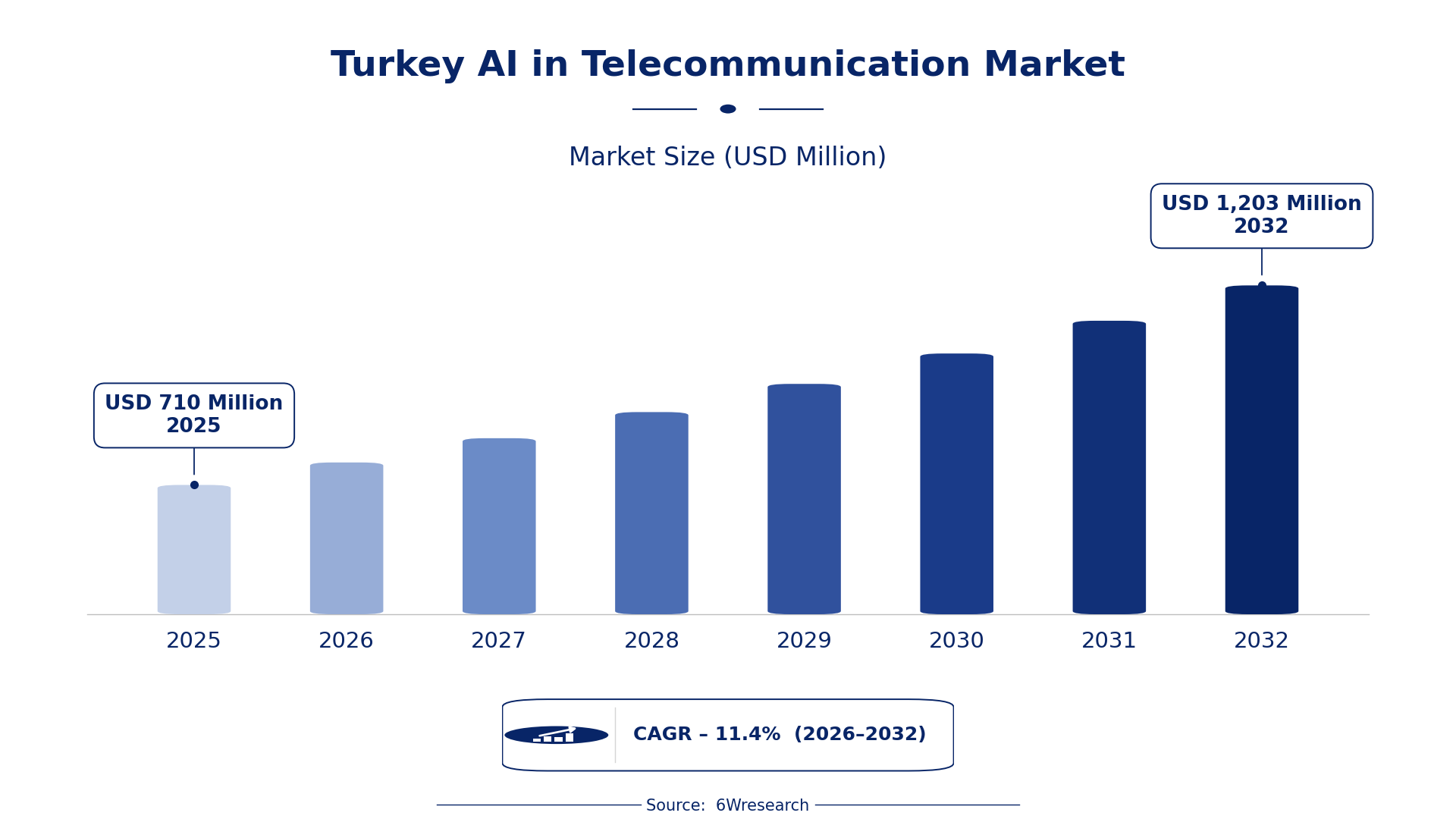
The Turkey AI in Telecommunication Market was estimated at USD 710 Million in 2025 and is projected to reach USD 1203 Million by 2032, growing at a CAGR of 11.4% from 2026 to 2032.
Turkey AI in Telecommunication Market Synopsis
The Turkey AI in Telecommunication market has witnessed notable momentum recently, as telecom companies increasingly recognize the potential of artificial intelligence to enhance their operations. With a focus on customer service, network management, and operational efficiency, the market is on a trajectory towards greater adoption of AI solutions.
Looking ahead, the integration of advanced AI technologies is expected to reshape the industry. Telecom firms are gearing up to invest in predictive analytics, chatbots, and automated customer support, setting the stage for a more intelligent and efficient telecommunications environment in Turkey.
Turkey AI in Telecommunication Market Year-wise Growth Rate and Key Drivers
This graph illustrates the annual growth rates of the Turkey AI in Telecommunication Market from 2021 to 2032, highlighting a steady upward trajectory and projected expansion over the forecast period.
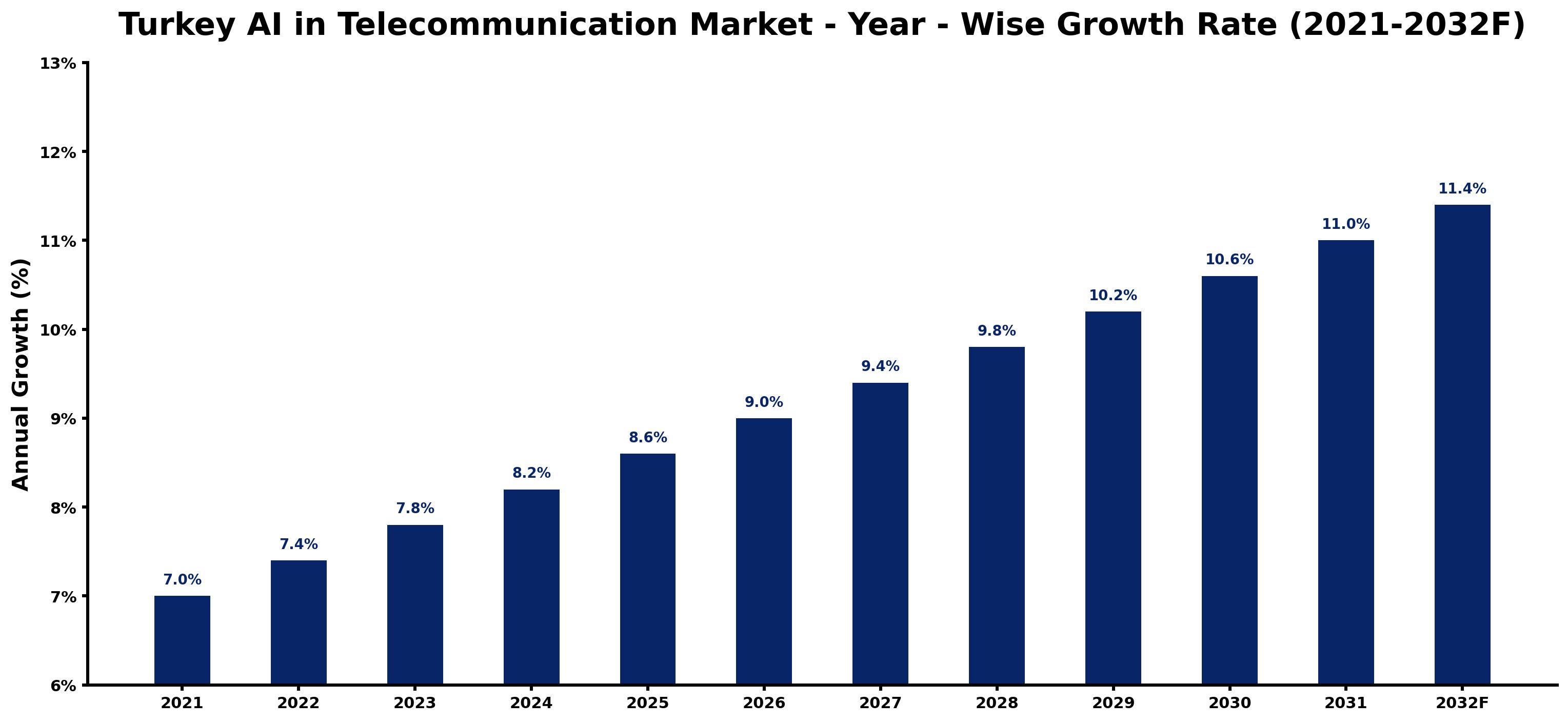
The table below presents the year‑wise growth rates along with the key drivers influencing the market
| Year | Growth Rate | Major Drivers |
| 2021 | 7.0% | Turkish Telecom's AI Innovation Strategy drives sector advancements. |
| 2022 | 7.4% | Government's 5G rollout accelerates AI integration in telecom. |
| 2023 | 7.8% | Increased mobile data consumption fuels AI service development. |
| 2024 | 8.2% | Regulatory support for AI in telecommunications fosters growth. |
| 2025 | 8.6% | Local startups develop unique AI solutions for network management. |
| 2026 | 9.0% | Turkish youth's tech adoption boosts AI-driven telecom services. |
| 2027 | 9.4% | Rising cybersecurity concerns push AI for telecom security. |
| 2028 | 9.8% | Telecom operators invest in AI for operational efficiency gains. |
| 2029 | 10.2% | Partnerships between tech firms enhance AI capabilities for telecom. |
| 2030 | 10.6% | Government incentives promote AI investments in telecommunications. |
| 2031 | 11.0% | Increased competition drives innovative AI telecom service offerings. |
| 2032 | 11.4% | Rising IoT deployments necessitate advanced AI in telecom. |
Note: Market size estimations and growth projections presented in this report are based on 6Wresearch's proprietary forecasting methodology, utilizing the latest available industry data, government publications, and primary research inputs.
Turkey AI in Telecommunication Market Key Takeaways
Below are some of the specific key takeaways from the market, including:
- The Turkish telecom sector is rapidly integrating AI technologies to improve service delivery and operational performance.
- AI-powered tools are increasingly being used for predictive maintenance and network optimization.
- The demand for personalized customer experiences is driving investment in chatbots and virtual assistants.
- Regulatory initiatives from the government are facilitating AI integration across telecommunication services.
- Investment opportunities are burgeoning in AI startups focused on telecom applications.
Evaluation of Restraints in Turkey AI in Telecommunication Market
While the Turkey AI in Telecommunication market shows promise, several significant restraints are impacting growth. Data privacy remains a top concern, particularly as AI solutions rely on large datasets. Regulatory compliance is essential, and telecom companies must ensure they meet stringent data protection standards. Additionally, integration challenges can impede the effective implementation of AI technologies, as many firms struggle to merge these systems with existing infrastructure. The scarcity of skilled professionals adept in both AI and telecommunications further complicates efforts to harness the full potential of AI solutions.
Turkey AI in Telecommunication Market Trends
Several trends are defining the trajectory of the Turkey AI in Telecommunication market. The rise of machine learning algorithms is paving the way for improved predictive analytics, allowing companies to enhance their operational decision-making. The increasing utilization of AI-driven analytics for customer insights is enabling telecom firms to craft targeted marketing strategies that resonate with consumers. Additionally, security applications of AI are gaining traction as telecom companies seek to bolster defenses against cyber threats, a critical concern in today’s digital environment.
Turkey AI in Telecommunication Market Opportunities
The market is ripe with investment opportunities, particularly as the demand for advanced telecommunication services continues to rise. Companies that innovate in AI-powered customer service solutions and predictive maintenance tools stand to benefit significantly. Collaborations between telecom firms and AI startups can lead to groundbreaking advancements in service offerings. Furthermore, there is a pressing need for consultancy services to guide businesses in integrating AI technologies, creating another avenue for growth in this dynamic sector.
Government Initiatives in the Turkey AI in Telecommunication Market
The Turkish government is actively fostering the integration of AI technologies within the telecommunications sector. Recent initiatives aim to bolster research, development, and deployment of AI solutions, recognizing their potential to drive efficiency and innovation. This governmental support is vital for the market, as policies are increasingly aligned with the needs of the industry.
- A National Artificial Intelligence Strategy launched in 2019 aims to position Turkey as a leader in the global AI market, focusing on telecommunications.
- Currently underway is a regulatory framework aimed at streamlining AI integration in telecom services, which includes data protection guidelines.
- Plans for a national digital infrastructure upgrade are set to expand AI capabilities in telecommunications by 2028.
- Initiatives to support talent development in AI and telecommunications are currently being implemented, fostering a skilled workforce.
Future Insights of the Turkey AI in Telecommunication Market
From 2026 to 2032, the Turkey AI in Telecommunication market is expected to see accelerated growth. As AI technologies, including natural language processing and advanced analytics, become more integral to operations, telecom companies will be better equipped to meet customer demands. The rise of 5G networks and the Internet of Things (IoT) will necessitate innovative applications of AI, paving the way for new service offerings and enhanced customer experiences. This ongoing digital transformation is likely to secure Turkey's position as a competitive player in the global telecommunications sector.
Turkey AI in Telecommunication Market Latest Developments
In the past year, the Turkey AI in Telecommunication market has seen several notable developments, as firms actively pursue AI integration to enhance operational efficiency and service delivery. The pace of innovation is accelerating, with telecom companies exploring various applications of AI technology.
- A major regional operator announced the deployment of an AI-driven customer service platform in early 2025, aimed at improving user engagement and support.
- An ongoing initiative to implement AI-based predictive maintenance for network infrastructure is enhancing operational reliability, currently underway since mid-2025.
- A partnership between a technology vendor and a telecom firm focused on developing AI tools for network security is expected to yield results in late 2026.
- A rollout planned for Q3 2026 will introduce AI analytics tools aimed at optimizing telecom marketing strategies.
Turkey AI in Telecommunication Market - Key Attractiveness of the Report
- 10 Years of Market Numbers
- Historical Data Starting from 2022 to 2025
- Base Year: 2025
- Forecast Data until 2032
- Key Performance Indicators Impacting the Market
- Major Upcoming Developments and Projects
Key Highlights of the Report:
- Turkey AI in Telecommunication Market Outlook
- Market Size of Turkey AI in Telecommunication Market, 2025
- Forecast of Turkey AI in Telecommunication Market, 2032
- Historical Data and Forecast of Turkey AI in Telecommunication Revenues & Volume for the Period 2022-2032F
- Turkey AI in Telecommunication Market Trend Evolution
- Turkey AI in Telecommunication Market Drivers and Challenges
- Turkey AI in Telecommunication Price Trends
- Turkey AI in Telecommunication Porter's Five Forces
- Turkey AI in Telecommunication Industry Life Cycle
- Historical Data and Forecast of Turkey AI in Telecommunication Market Revenues & Volume By Application for the Period 2022-2032F
- Historical Data and Forecast of Turkey AI in Telecommunication Market Revenues & Volume By Customer analytics for the Period 2022-2032F
- Historical Data and Forecast of Turkey AI in Telecommunication Market Revenues & Volume By Network security for the Period 2022-2032F
- Historical Data and Forecast of Turkey AI in Telecommunication Market Revenues & Volume By Network optimization for the Period 2022-2032F
- Historical Data and Forecast of Turkey AI in Telecommunication Market Revenues & Volume By Self-diagnostics for the Period 2022-2032F
- Historical Data and Forecast of Turkey AI in Telecommunication Market Revenues & Volume By Virtual assistance for the Period 2022-2032F
- Historical Data and Forecast of Turkey AI in Telecommunication Market Revenues & Volume By Others (contact center analytics and marketing campaign analytics) for the Period 2022-2032F
- Historical Data and Forecast of Turkey AI in Telecommunication Market Revenues & Volume By Component for the Period 2022-2032F
- Historical Data and Forecast of Turkey AI in Telecommunication Market Revenues & Volume By Solutions for the Period 2022-2032F
- Historical Data and Forecast of Turkey AI in Telecommunication Market Revenues & Volume By Services for the Period 2022-2032F
- Historical Data and Forecast of Turkey AI in Telecommunication Market Revenues & Volume By Deployment Mode for the Period 2022-2032F
- Historical Data and Forecast of Turkey AI in Telecommunication Market Revenues & Volume By Cloud for the Period 2022-2032F
- Historical Data and Forecast of Turkey AI in Telecommunication Market Revenues & Volume By On-premises for the Period 2022-2032F
- Historical Data and Forecast of Turkey AI in Telecommunication Market Revenues & Volume By Technology for the Period 2022-2032F
- Historical Data and Forecast of Turkey AI in Telecommunication Market Revenues & Volume By Machine learning and deep learning for the Period 2022-2032F
- Historical Data and Forecast of Turkey AI in Telecommunication Market Revenues & Volume By Natural Language Processing (NLP) for the Period 2022-2032F
- Turkey AI in Telecommunication Import Export Trade Statistics
- Market Opportunity Assessment By Application
- Market Opportunity Assessment By Component
- Market Opportunity Assessment By Deployment Mode
- Market Opportunity Assessment By Technology
- Turkey AI in Telecommunication Top Companies Market Share
- Turkey AI in Telecommunication Competitive Benchmarking By Technical and Operational Parameters
- Turkey AI in Telecommunication Company Profiles
- Turkey AI in Telecommunication Key Strategic Recommendations






































