Germany AI in Telecommunication Market Size & Growth Rate (2026-2032)
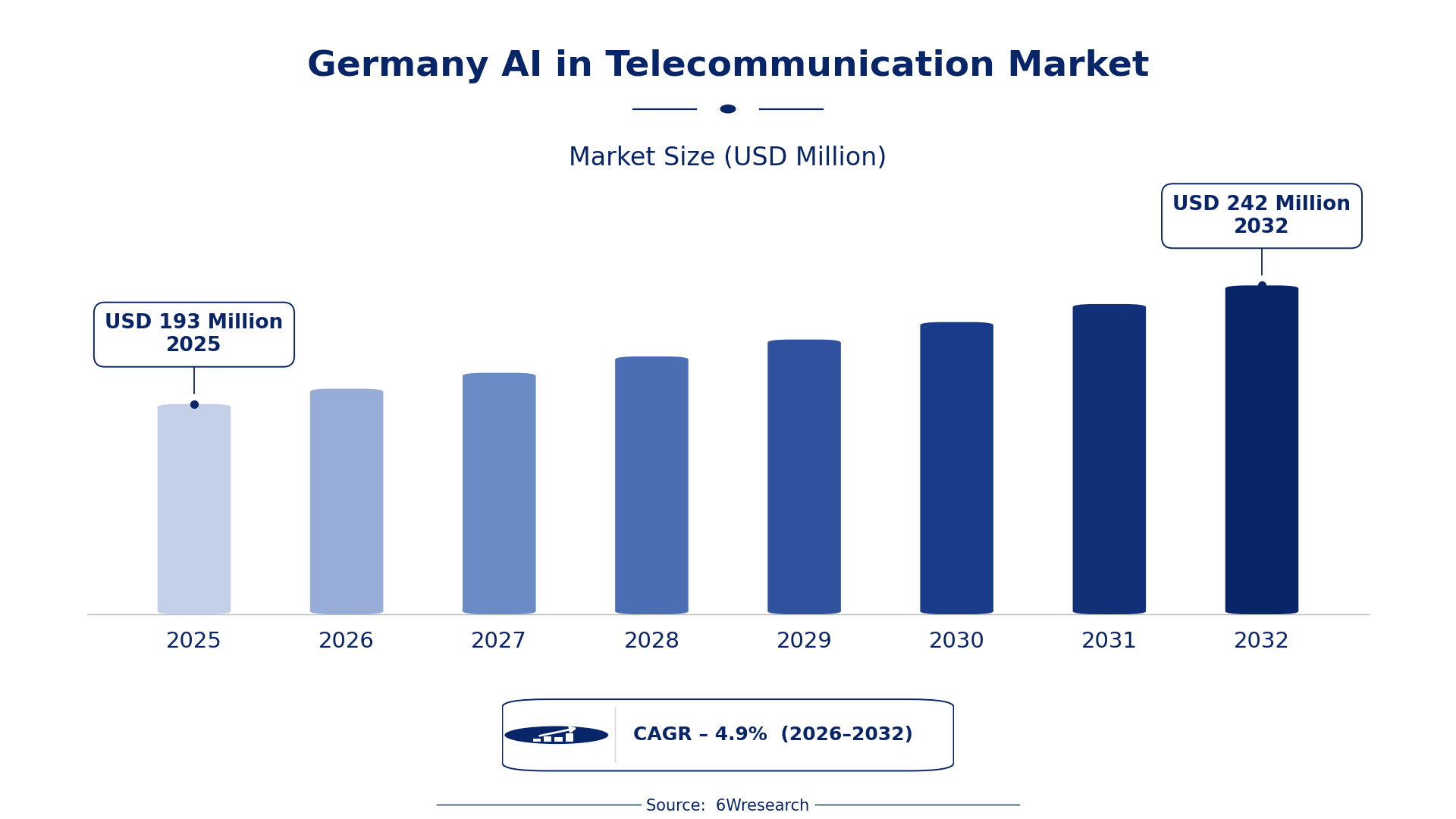
The Germany AI in Telecommunication Market was estimated at USD 193 Million in 2025 and is projected to reach USD 242 Million by 2032, growing at a CAGR of 4.9% from 2026 to 2032.
Germany AI in Telecommunication Market Synopsis
The Germany AI in Telecommunication Market is at a crucial juncture, characterized by rapid advancements in digital technologies. Telecom operators are increasingly adopting AI solutions not just for operational efficiencies, but to enhance customer experiences, positioning themselves competitively in a saturated market.
The integration of AI technologies is reshaping traditional telecom operations. From predictive maintenance to automated customer service interactions, companies are harnessing AI to lower costs and improve service quality, particularly as the rollout of 5G technology advances the need for innovative solutions.
Germany AI in Telecommunication Market Year-wise Growth Rate and Key Drivers
This graph illustrates the annual growth rates of the Germany AI in Telecommunication Market from 2021 to 2032, highlighting a steady upward trajectory and projected expansion over the forecast period.
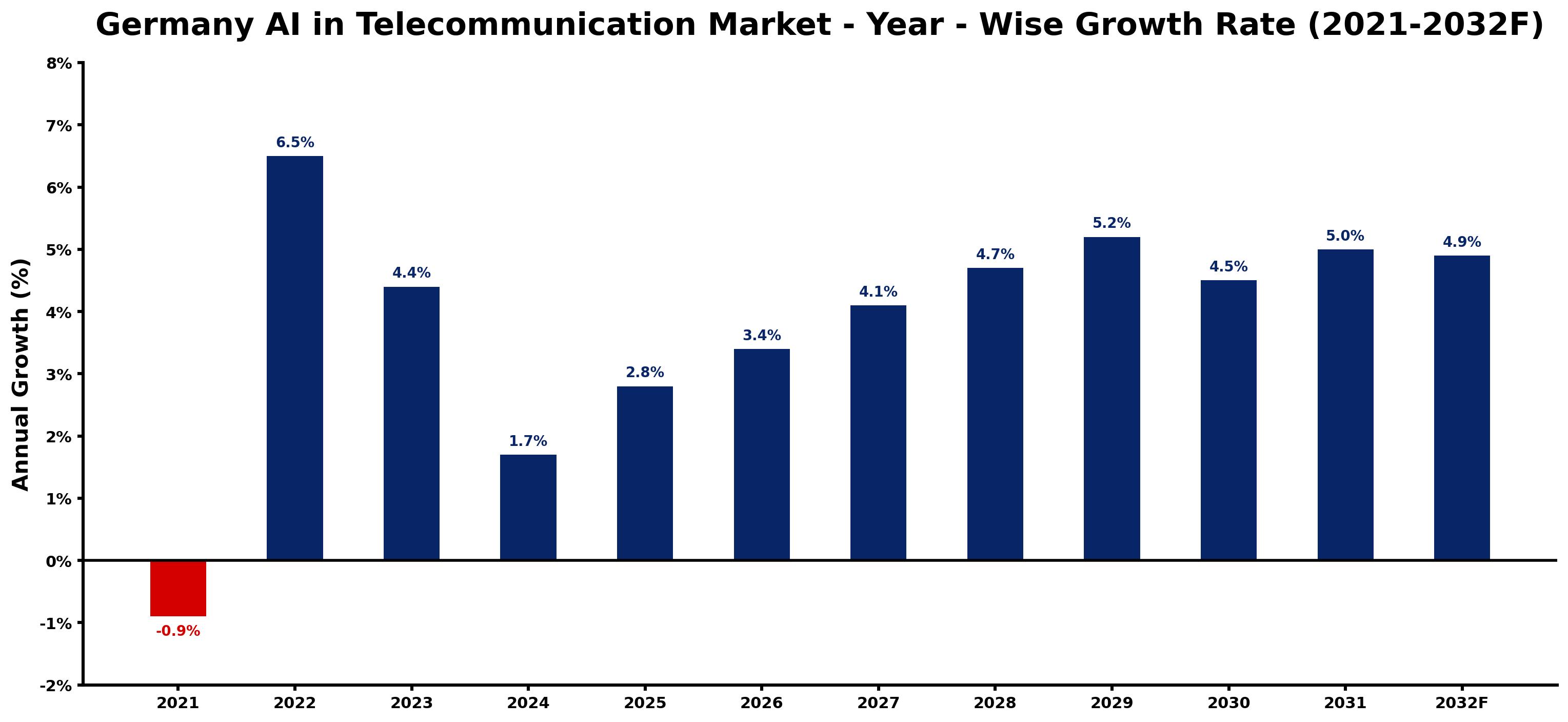
The table below presents the year‑wise growth rates along with the key drivers influencing the market
| Year | Growth Rate | Major Drivers |
| 2021 | -0.9% | EU regulations limiting AI deployment in telecoms. |
| 2022 | 6.5% | 5G rollout accelerating AI-driven telecom innovations. |
| 2023 | 4.4% | EU Digital Markets Act boosting AI deployment in telecom. |
| 2024 | 1.7% | Investment in smart grid technology enhancing telecom efficiencies. |
| 2025 | 2.8% | Increased focus on broadband connectivity spurring AI use. |
| 2026 | 3.4% | Local startups driving AI adoption in telecom services. |
| 2027 | 4.1% | Telecom regulatory changes encouraging AI integration in services. |
| 2028 | 4.7% | Growing cybersecurity threats necessitating AI-driven solutions. |
| 2029 | 5.2% | Rising digitalization trends driving AI applications in telecom. |
| 2030 | 4.5% | Government initiatives promoting AI research for telecom innovations. |
| 2031 | 5.0% | Telecom companies increasing AI collaborations for service improvement. |
| 2032 | 4.9% | Public demand for personalized telecom offerings spurring AI development. |
Note: Market size estimations and growth projections presented in this report are based on 6Wresearch's proprietary forecasting methodology, utilizing the latest available industry data, government publications, and primary research inputs.
Germany AI in Telecommunication Market Key Takeaways
Below are some of the specific key takeaways from the market, including:
- The market is growing, fueled by the demand for advanced telecom solutions and the rollout of 5G technology.
- AI applications in predictive analytics and customer service automation are on the rise.
- Strong R&D investments from industry players are fostering innovation in AI-powered telecommunications solutions.
- Data privacy concerns under GDPR regulations continue to be a barrier for AI adoption.
- Strategic partnerships between telecom providers and AI solution companies are emerging to enhance service delivery.
Evaluation of Restraints in Germany AI in Telecommunication Market
The Germany AI in Telecommunication Market faces several significant restraints that may hinder its progress. Compliance with stringent data privacy laws, particularly the General Data Protection Regulation (GDPR), creates complications for companies eager to deploy AI solutions. Many operators struggle with integrating new AI technologies into existing systems, often relying on legacy infrastructure that lacks compatibility with modern tools. Furthermore, the shortage of skilled professionals adept in AI technologies presents another challenge, making it difficult for telecom firms to fully harness the potential of AI while ensuring ethical practices.
Germany AI in Telecommunication Market Trends
Recent trends in the Germany AI in Telecommunication Market include a marked increase in the use of machine learning algorithms for optimizing network operations. Companies are also adopting natural language processing to improve customer engagement through chatbots and virtual assistants. Another notable trend is the emphasis on predictive maintenance practices that aim to avert service disruptions before they occur. Collaborations between telecom operators and AI developers are becoming commonplace, with initiatives designed to tailor solutions to meet specific market demands.
Germany AI in Telecommunication Market Opportunities
The market offers numerous opportunities for growth, particularly in areas such as network optimization and customer service enhancements. As demand for high-speed connectivity rises, AI solutions that improve network reliability become essential. In customer service, the implementation of AI-driven platforms can dramatically elevate user experiences while reducing operational costs. Predictive maintenance capabilities can further capitalize on these opportunities by proactively managing potential network disruptions and improving resource allocation.
Government Initiatives in the Germany AI in Telecommunication Market
Government policy in Germany is shaping the AI in Telecommunication Market with a focus on innovation, data privacy, and competition. By promoting responsible AI use and investing in digital infrastructure, the government seeks to enhance both technological advancement and consumer trust in AI applications. This balancing act is crucial as telecom operators look to adopt new technologies while adhering to regulatory standards.
- A national digital infrastructure upgrade programme, currently in its rollout phase, aims to enhance telecom capabilities nationwide.
- The Federal Network Agency has established guidelines, recently updated, to ensure fair practices in the deployment of AI technologies in telecommunications.
- Ongoing investment in research and development initiatives supports innovative applications of AI within the telecom sector.
- A planned regulatory framework anticipated in 2025 is expected to further streamline AI implementation across the industry.
Future Insights of the Germany AI in Telecommunication Market
Looking ahead to 2026-2032, the Germany AI in Telecommunication Market is likely to experience transformative growth. The dual forces of digital transformation and 5G expansion will drive telecom companies to adopt AI solutions that streamline operations and enhance customer satisfaction. Predictive analytics will become increasingly crucial as operators seek to minimize downtime and operational costs, positioning AI as a central component of future telecom strategies. The convergence of these factors suggests a dynamic market ripe for innovation and investment.
Germany AI in Telecommunication Market Latest Developments
In the last year, the Germany AI in Telecommunication Market has seen significant activity, with operators actively seeking to refine their AI capabilities. Companies are launching new initiatives aimed at improving network performance and enhancing customer engagement through advanced AI tools. The competitive landscape is evolving, fueled by continuous technological developments and strategic partnerships among key players in the industry.
- A leading regional operator initiated a pilot programme in late 2025 that employs AI for predictive maintenance, expected to enhance network reliability.
- A major technology vendor completed a rollout of an AI-based customer service platform by the end of 2025, aiming to reduce response times and improve user satisfaction.
- An ongoing partnership between telecom providers and AI solution firms is developing innovative tools tailored for specific telecommunications needs.
- A planned service upgrade set to begin in mid-2026 aims to integrate AI with 5G infrastructure to enhance user experiences.
Germany AI in Telecommunication Market - Key Attractiveness of the Report
- 10 Years of Market Numbers
- Historical Data Starting from 2022 to 2025
- Base Year: 2025
- Forecast Data until 2032
- Key Performance Indicators Impacting the Market
- Major Upcoming Developments and Projects
Key Highlights of the Report:
- Germany AI in Telecommunication Market Outlook
- Market Size of Germany AI in Telecommunication Market, 2025
- Forecast of Germany AI in Telecommunication Market, 2032
- Historical Data and Forecast of Germany AI in Telecommunication Revenues & Volume for the Period 2022-2032F
- Germany AI in Telecommunication Market Trend Evolution
- Germany AI in Telecommunication Market Drivers and Challenges
- Germany AI in Telecommunication Price Trends
- Germany AI in Telecommunication Porter's Five Forces
- Germany AI in Telecommunication Industry Life Cycle
- Historical Data and Forecast of Germany AI in Telecommunication Market Revenues & Volume By Application for the Period 2022-2032F
- Historical Data and Forecast of Germany AI in Telecommunication Market Revenues & Volume By Customer analytics for the Period 2022-2032F
- Historical Data and Forecast of Germany AI in Telecommunication Market Revenues & Volume By Network security for the Period 2022-2032F
- Historical Data and Forecast of Germany AI in Telecommunication Market Revenues & Volume By Network optimization for the Period 2022-2032F
- Historical Data and Forecast of Germany AI in Telecommunication Market Revenues & Volume By Self-diagnostics for the Period 2022-2032F
- Historical Data and Forecast of Germany AI in Telecommunication Market Revenues & Volume By Virtual assistance for the Period 2022-2032F
- Historical Data and Forecast of Germany AI in Telecommunication Market Revenues & Volume By Others (contact center analytics and marketing campaign analytics) for the Period 2022-2032F
- Historical Data and Forecast of Germany AI in Telecommunication Market Revenues & Volume By Component for the Period 2022-2032F
- Historical Data and Forecast of Germany AI in Telecommunication Market Revenues & Volume By Solutions for the Period 2022-2032F
- Historical Data and Forecast of Germany AI in Telecommunication Market Revenues & Volume By Services for the Period 2022-2032F
- Historical Data and Forecast of Germany AI in Telecommunication Market Revenues & Volume By Deployment Mode for the Period 2022-2032F
- Historical Data and Forecast of Germany AI in Telecommunication Market Revenues & Volume By Cloud for the Period 2022-2032F
- Historical Data and Forecast of Germany AI in Telecommunication Market Revenues & Volume By On-premises for the Period 2022-2032F
- Historical Data and Forecast of Germany AI in Telecommunication Market Revenues & Volume By Technology for the Period 2022-2032F
- Historical Data and Forecast of Germany AI in Telecommunication Market Revenues & Volume By Machine learning and deep learning for the Period 2022-2032F
- Historical Data and Forecast of Germany AI in Telecommunication Market Revenues & Volume By Natural Language Processing (NLP) for the Period 2022-2032F
- Germany AI in Telecommunication Import Export Trade Statistics
- Market Opportunity Assessment By Application
- Market Opportunity Assessment By Component
- Market Opportunity Assessment By Deployment Mode
- Market Opportunity Assessment By Technology
- Germany AI in Telecommunication Top Companies Market Share
- Germany AI in Telecommunication Competitive Benchmarking By Technical and Operational Parameters
- Germany AI in Telecommunication Company Profiles
- Germany AI in Telecommunication Key Strategic Recommendations






































