Spain AI in Telecommunication Market Size & Growth Rate (2026-2032)
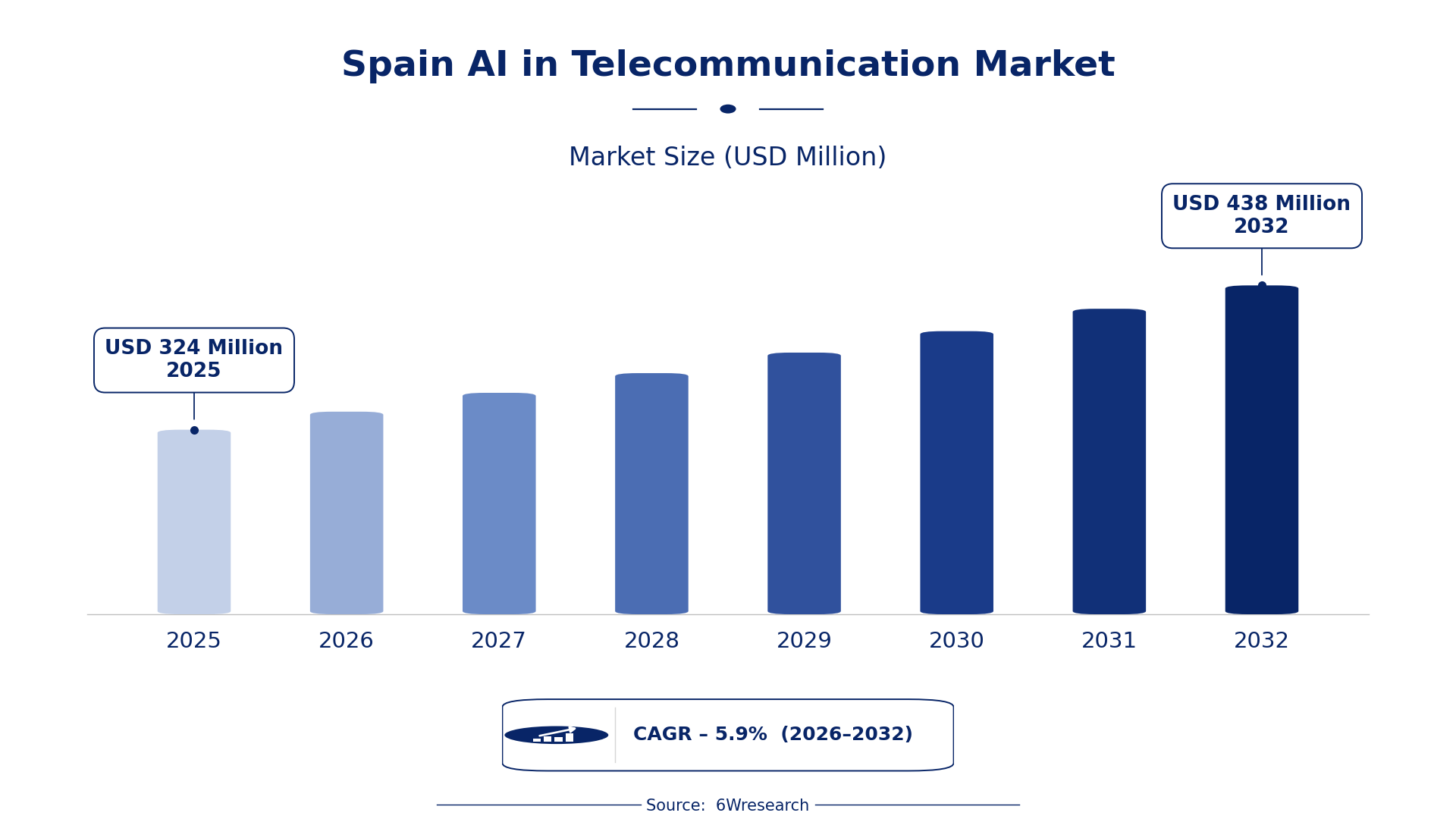
The Spain AI in Telecommunication Market was estimated at USD 324 Million in 2025 and is projected to reach USD 438 Million by 2032, growing at a CAGR of 5.9% from 2026 to 2032.
Spain AI in Telecommunication Market Synopsis
The surge in AI adoption across the telecommunications sector in Spain is primarily driven by the quest for enhanced operational efficiency. Telecom companies are increasingly recognizing AI as a vital tool to optimize network management, improve customer interactions, and bolster security measures.
As these companies invest in AI technologies, they are not only responding to customer demands for better service but also gearing up for a competitive edge in an evolving marketplace. This focus on innovation is fostering a series of collaborations between telecom firms and AI technology providers.
Spain AI in Telecommunication Market Year-wise Growth Rate and Key Drivers
This graph illustrates the annual growth rates of the Spain AI in Telecommunication Market from 2021 to 2032, highlighting a steady upward trajectory and projected expansion over the forecast period.
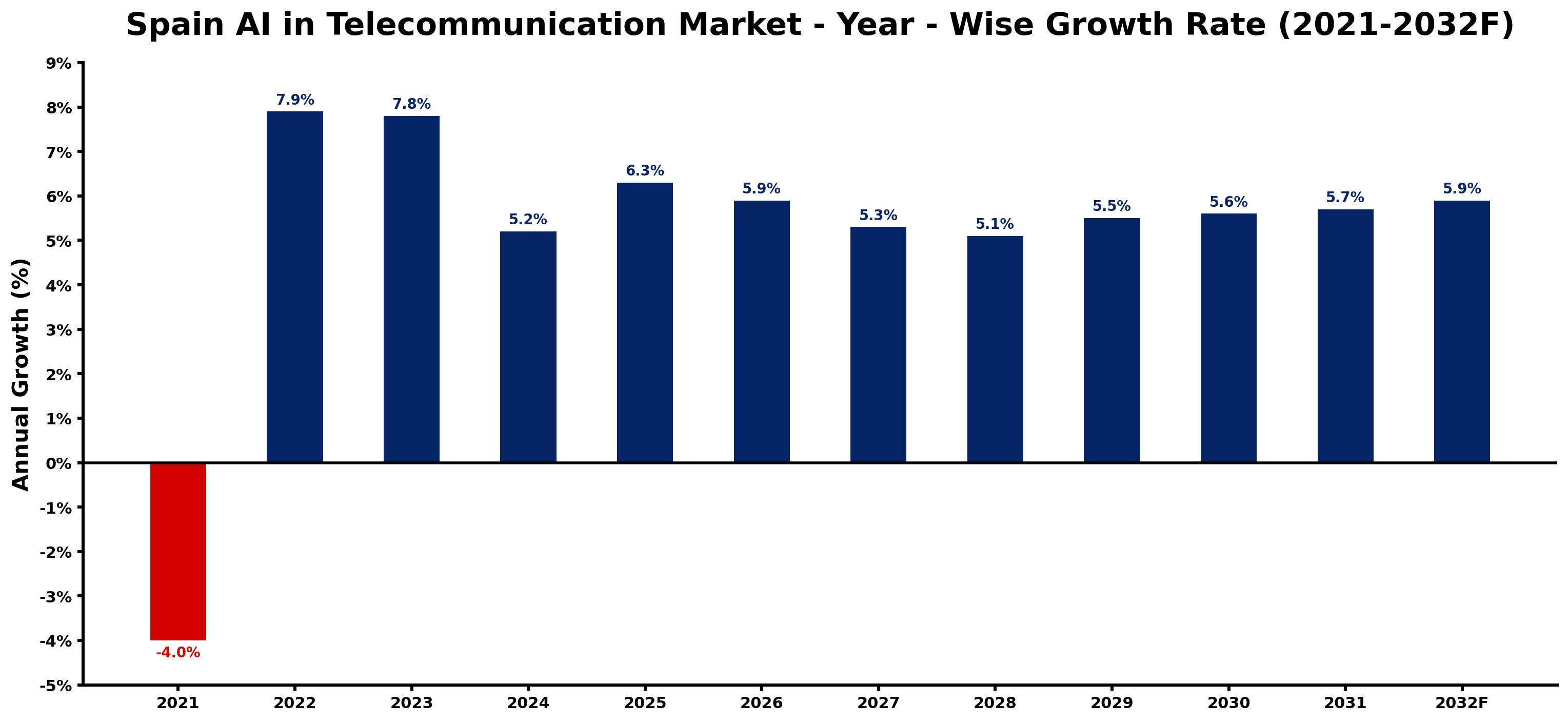
The table below presents the year‑wise growth rates along with the key drivers influencing the market
| Year | Growth Rate | Major Drivers |
| 2021 | -4.0% | 5G deployment delays by CNMC stifled market growth. |
| 2022 | 7.9% | Launch of Spain's AI Strategy by government |
| 2023 | 7.8% | Increased investment from Telefonica in AI capabilities |
| 2024 | 5.2% | Regulations encouraging AI-driven network optimization by AEMPS |
| 2025 | 6.3% | Growing consumer interest in AI-enhanced broadband services |
| 2026 | 5.9% | Emergence of local AI startups targeting telecom solutions |
| 2027 | 5.3% | EU funding for AI research benefiting Spanish telecoms |
| 2028 | 5.1% | Telecom companies leveraging AI for competitive pricing strategies |
| 2029 | 5.5% | Partnerships between universities and telecoms for AI training |
| 2030 | 5.6% | Local demand for AI in 5G network deployment |
| 2031 | 5.7% | Government incentives for AI adoption in telecommunications |
| 2032 | 5.9% | Increase in IoT devices requiring AI-driven telecom support |
Note: Market size estimations and growth projections presented in this report are based on 6Wresearch's proprietary forecasting methodology, utilizing the latest available industry data, government publications, and primary research inputs.
Spain AI in Telecommunication Market Key Takeaways
Below are some of the specific key takeaways from the market, including:
- The market is witnessing a growing demand for AI-powered solutions in customer service and network management.
- Telecom companies are increasingly adopting predictive analytics to enhance operational efficiency.
- Investment in cybersecurity through AI technologies is becoming a top priority for telecom operators.
- Partnerships between telecommunications providers and AI developers are on the rise, focusing on innovation.
- The Spanish government's digital transformation initiatives are driving AI adoption in the sector.
Evaluation of Restraints in Spain AI in Telecommunication Market
Several restraints are shaping the growth of the AI in Telecommunication market in Spain. A major hurdle is the high upfront investment required to build the necessary infrastructure for AI implementation. Additionally, stringent data privacy regulations, particularly the GDPR, pose challenges in deploying AI solutions that handle sensitive customer information. There is also an underlying fear among employees regarding potential job losses due to automation, leading to resistance against AI technologies. Lastly, the technical complexity involved in integrating AI into existing telecommunications systems necessitates skilled professionals, which are currently in short supply.
Spain AI in Telecommunication Market Trends
In recent years, AI-powered chatbots have gained traction in the telecom sector as companies aim to enhance their customer service capabilities. These systems provide efficient, automated responses, allowing firms to handle inquiries more effectively while personalizing customer interactions.
Another key trend is the increasing use of predictive analytics to monitor network health and predict failures before they occur. This shift not only reduces downtime but also optimizes resource allocation, driving significant cost savings for telecom providers.
Spain AI in Telecommunication Market Opportunities
Investment opportunities are flourishing as telecom companies turn towards AI technologies to enhance service delivery. Solutions focusing on network optimization, predictive maintenance, and automated customer support through chatbots are particularly promising. As 5G networks continue to roll out, the integration of AI will become essential for managing new traffic patterns and enhancing user experiences. The government's push for digital innovation further amplifies these opportunities, making it an ideal time for stakeholders to invest in AI solutions tailored to the Spanish telecommunications market.
Government Initiatives in the Spain AI in Telecommunication Market
Government policies are playing a crucial role in shaping the AI in Telecommunication market in Spain. The focus is on fostering innovation while ensuring data protection compliance. A collaborative atmosphere is encouraged, where industry players work alongside research institutions to drive advancements in AI technologies applicable to telecommunications.
- A National Artificial Intelligence Strategy launched recently promotes AI adoption across various sectors, including telecommunications.
- A regulatory framework was introduced in early 2025 to enhance transparency in telecom billing and customer data handling.
- A current initiative focusing on public-private partnerships aims to upgrade Spain's digital infrastructure to support AI technologies.
- Upcoming policies are expected to further incentivize the integration of AI in telecommunications through grants for innovative projects.
Future Insights of the Spain AI in Telecommunication Market
The AI in Telecommunication market in Spain is set for substantial growth through 2032, driven by a combination of advanced communication technologies and AI integration. As the rollout of 5G continues, AI solutions will increasingly become integral for managing complexities in network operations and enhancing customer engagement. The focus on real-time analytics and AI-driven insights is expected to transform how telecommunications companies operate, leading to improved services and customer satisfaction.
Spain AI in Telecommunication Market Latest Developments
The past year has seen dynamic shifts within the Spain AI in Telecommunication market, as various firms rapidly adapt to technological advancements and customer needs. Investment in AI technologies has gained momentum as companies seek innovative ways to streamline their operations and elevate service offerings.
- An ongoing collaboration between a major telecom operator and an AI provider aims to enhance customer service through advanced chatbot implementations, expected to complete in mid-2026.
- A significant network upgrade initiative began in early 2025, incorporating AI analytics for predictive maintenance across major telecom infrastructures.
- In late 2025, a leading operator introduced a new AI-driven platform for analyzing customer data, improving tailored service delivery.
- A planned initiative to deploy AI-based cybersecurity tools is set to roll out by early 2027 to combat increasing cyber threats.
Spain AI in Telecommunication Market - Key Attractiveness of the Report
- 10 Years of Market Numbers
- Historical Data Starting from 2022 to 2025
- Base Year: 2025
- Forecast Data until 2032
- Key Performance Indicators Impacting the Market
- Major Upcoming Developments and Projects
Key Highlights of the Report:
- Spain AI in Telecommunication Market Outlook
- Market Size of Spain AI in Telecommunication Market, 2025
- Forecast of Spain AI in Telecommunication Market, 2032
- Historical Data and Forecast of Spain AI in Telecommunication Revenues & Volume for the Period 2022-2032F
- Spain AI in Telecommunication Market Trend Evolution
- Spain AI in Telecommunication Market Drivers and Challenges
- Spain AI in Telecommunication Price Trends
- Spain AI in Telecommunication Porter's Five Forces
- Spain AI in Telecommunication Industry Life Cycle
- Historical Data and Forecast of Spain AI in Telecommunication Market Revenues & Volume By Application for the Period 2022-2032F
- Historical Data and Forecast of Spain AI in Telecommunication Market Revenues & Volume By Customer analytics for the Period 2022-2032F
- Historical Data and Forecast of Spain AI in Telecommunication Market Revenues & Volume By Network security for the Period 2022-2032F
- Historical Data and Forecast of Spain AI in Telecommunication Market Revenues & Volume By Network optimization for the Period 2022-2032F
- Historical Data and Forecast of Spain AI in Telecommunication Market Revenues & Volume By Self-diagnostics for the Period 2022-2032F
- Historical Data and Forecast of Spain AI in Telecommunication Market Revenues & Volume By Virtual assistance for the Period 2022-2032F
- Historical Data and Forecast of Spain AI in Telecommunication Market Revenues & Volume By Others (contact center analytics and marketing campaign analytics) for the Period 2022-2032F
- Historical Data and Forecast of Spain AI in Telecommunication Market Revenues & Volume By Component for the Period 2022-2032F
- Historical Data and Forecast of Spain AI in Telecommunication Market Revenues & Volume By Solutions for the Period 2022-2032F
- Historical Data and Forecast of Spain AI in Telecommunication Market Revenues & Volume By Services for the Period 2022-2032F
- Historical Data and Forecast of Spain AI in Telecommunication Market Revenues & Volume By Deployment Mode for the Period 2022-2032F
- Historical Data and Forecast of Spain AI in Telecommunication Market Revenues & Volume By Cloud for the Period 2022-2032F
- Historical Data and Forecast of Spain AI in Telecommunication Market Revenues & Volume By On-premises for the Period 2022-2032F
- Historical Data and Forecast of Spain AI in Telecommunication Market Revenues & Volume By Technology for the Period 2022-2032F
- Historical Data and Forecast of Spain AI in Telecommunication Market Revenues & Volume By Machine learning and deep learning for the Period 2022-2032F
- Historical Data and Forecast of Spain AI in Telecommunication Market Revenues & Volume By Natural Language Processing (NLP) for the Period 2022-2032F
- Spain AI in Telecommunication Import Export Trade Statistics
- Market Opportunity Assessment By Application
- Market Opportunity Assessment By Component
- Market Opportunity Assessment By Deployment Mode
- Market Opportunity Assessment By Technology
- Spain AI in Telecommunication Top Companies Market Share
- Spain AI in Telecommunication Competitive Benchmarking By Technical and Operational Parameters
- Spain AI in Telecommunication Company Profiles
- Spain AI in Telecommunication Key Strategic Recommendations






































