Thailand Air Motors Market: Import Trend Analysis
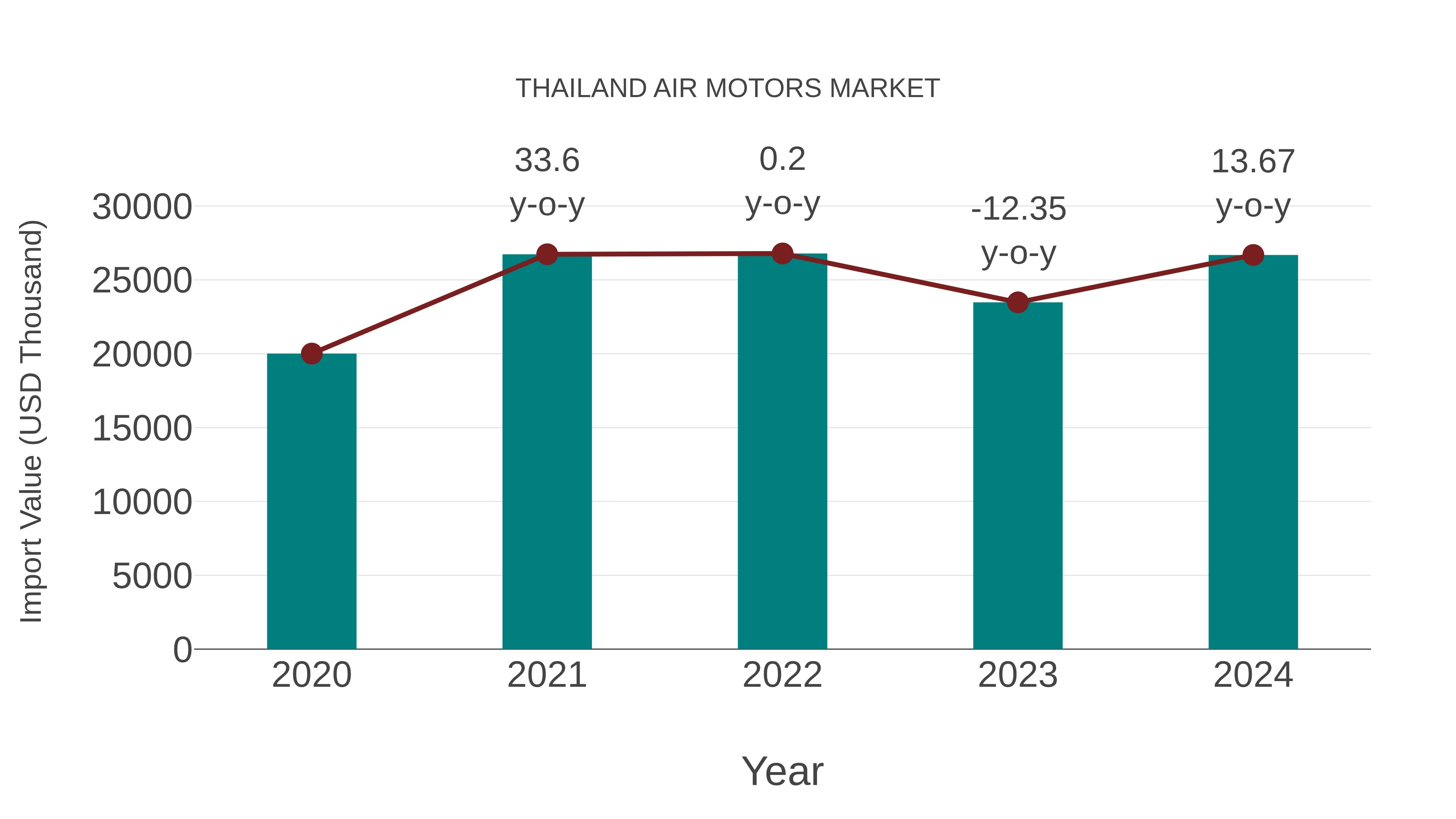
Thailand import trend for the Thailand air motors market saw a notable growth rate of 13.67% from 2023 to 2024, with a compound annual growth rate (CAGR) of 7.46% for the period 2020-2024. This uptrend can be attributed to the increasing demand for air motors in various industries, indicating a positive market stability and sustained demand shift towards air-powered technologies.
Thailand Air Motors Market Synopsis
The air motors market in Thailand has shown significant growth in recent years, driven by the country`s expanding industrial and manufacturing sectors. Air motors are versatile devices that convert compressed air into mechanical energy, making them ideal for various applications, including material handling, assembly, and machining. With the increasing demand for automation and pneumatic tools in industries such as automotive, electronics, and food processing, the market for air motors in Thailand has witnessed a surge in demand.
Market Drivers
Several drivers have contributed to the growth of the air motors market in Thailand. Firstly, the adoption of automation and pneumatic systems in industries has created a need for efficient and reliable air-powered devices, including air motors. Secondly, the increasing focus on energy efficiency and environmental sustainability has led to a preference for air motors over conventional electric motors in certain applications. Additionally, the versatility and compact size of air motors make them suitable for a wide range of industrial processes, further boosting their demand.
Challenges of the Market
Despite the positive market trends, the air motors industry in Thailand faces certain challenges. One of the key challenges is the competition from other types of motors and drive systems, such as electric motors and hydraulic systems, which may offer alternative solutions for specific applications. Moreover, the initial investment required for setting up pneumatic systems, including air compressors and distribution networks, can be a barrier for some businesses. Additionally, ensuring proper maintenance and timely servicing of air motors is essential to maintain their performance and longevity.
Covid-19 Impact on the Market
The outbreak of the Covid-19 pandemic had an impact on the air motors market in Thailand. With the disruptions in supply chains and industrial activities during the early stages of the pandemic, there was a temporary decline in demand for air motors. However, as industries adapted to the new normal and resumed operations, there was a renewed focus on automation and pneumatic solutions to improve productivity and reduce manual labor. The pandemic also emphasized the importance of safe and contactless operations, driving the adoption of air-powered tools in certain applications.
Key Highlights of the Report:
- Thailand Air Motors Market Outlook
- Market Size of Thailand Air Motors Market, 2025
- Forecast of Thailand Air Motors Market, 2032
- Historical Data and Forecast of Thailand Air Motors Revenues & Volume for the Period 2022-2032F
- Thailand Air Motors Market Trend Evolution
- Thailand Air Motors Market Drivers and Challenges
- Thailand Air Motors Price Trends
- Thailand Air Motors Porter's Five Forces
- Thailand Air Motors Industry Life Cycle
- Historical Data and Forecast of Thailand Air Motors Market Revenues & Volume By Type for the Period 2022-2032F
- Historical Data and Forecast of Thailand Air Motors Market Revenues & Volume By Vane Air Motors (Rotary) for the Period 2022-2032F
- Historical Data and Forecast of Thailand Air Motors Market Revenues & Volume By Piston Air Motors for the Period 2022-2032F
- Historical Data and Forecast of Thailand Air Motors Market Revenues & Volume By Gear Air Motors for the Period 2022-2032F
- Historical Data and Forecast of Thailand Air Motors Market Revenues & Volume By Others (Turbine air motors) for the Period 2022-2032F
- Historical Data and Forecast of Thailand Air Motors Market Revenues & Volume By Applications for the Period 2022-2032F
- Historical Data and Forecast of Thailand Air Motors Market Revenues & Volume By Machine Building for the Period 2022-2032F
- Historical Data and Forecast of Thailand Air Motors Market Revenues & Volume By Automotive Industry for the Period 2022-2032F
- Historical Data and Forecast of Thailand Air Motors Market Revenues & Volume By Chemical Industry for the Period 2022-2032F
- Historical Data and Forecast of Thailand Air Motors Market Revenues & Volume By Construction Machinery for the Period 2022-2032F
- Historical Data and Forecast of Thailand Air Motors Market Revenues & Volume By Conveyors for the Period 2022-2032F
- Historical Data and Forecast of Thailand Air Motors Market Revenues & Volume By General Machining for the Period 2022-2032F
- Historical Data and Forecast of Thailand Air Motors Market Revenues & Volume By Hoisting Equipment for the Period 2022-2032F
- Historical Data and Forecast of Thailand Air Motors Market Revenues & Volume By Others for the Period 2022-2032F
- Thailand Air Motors Import Export Trade Statistics
- Market Opportunity Assessment By Type
- Market Opportunity Assessment By Applications
- Thailand Air Motors Top Companies Market Share
- Thailand Air Motors Competitive Benchmarking By Technical and Operational Parameters
- Thailand Air Motors Company Profiles
- Thailand Air Motors Key Strategic Recommendations






































