Thailand Air Traffic Control (ATC) Equipment Market Size, Share & Growth Rate
The Thailand Air Traffic Control (ATC) Equipment Market was estimated at USD 206 Million in 2025 and is projected to reach USD 276 Million by 2032, growing at a CAGR of 4.3% from 2026 to 2032. This growth trajectory reflects Thailand's burgeoning air travel demand, particularly as the country strengthens its position as a pivotal tourism and economic center in Southeast Asia. The ongoing modernization of ATC infrastructure to enhance safety and efficiency will also play a crucial role in shaping this market's future.
Thailand Air Traffic Control (ATC) Equipment Market Year-wise Growth Rate and Key Drivers
This graph highlights how the Thailand Air Traffic Control (ATC) Equipment Market has steadily grown over the years, supported by major growth factors.
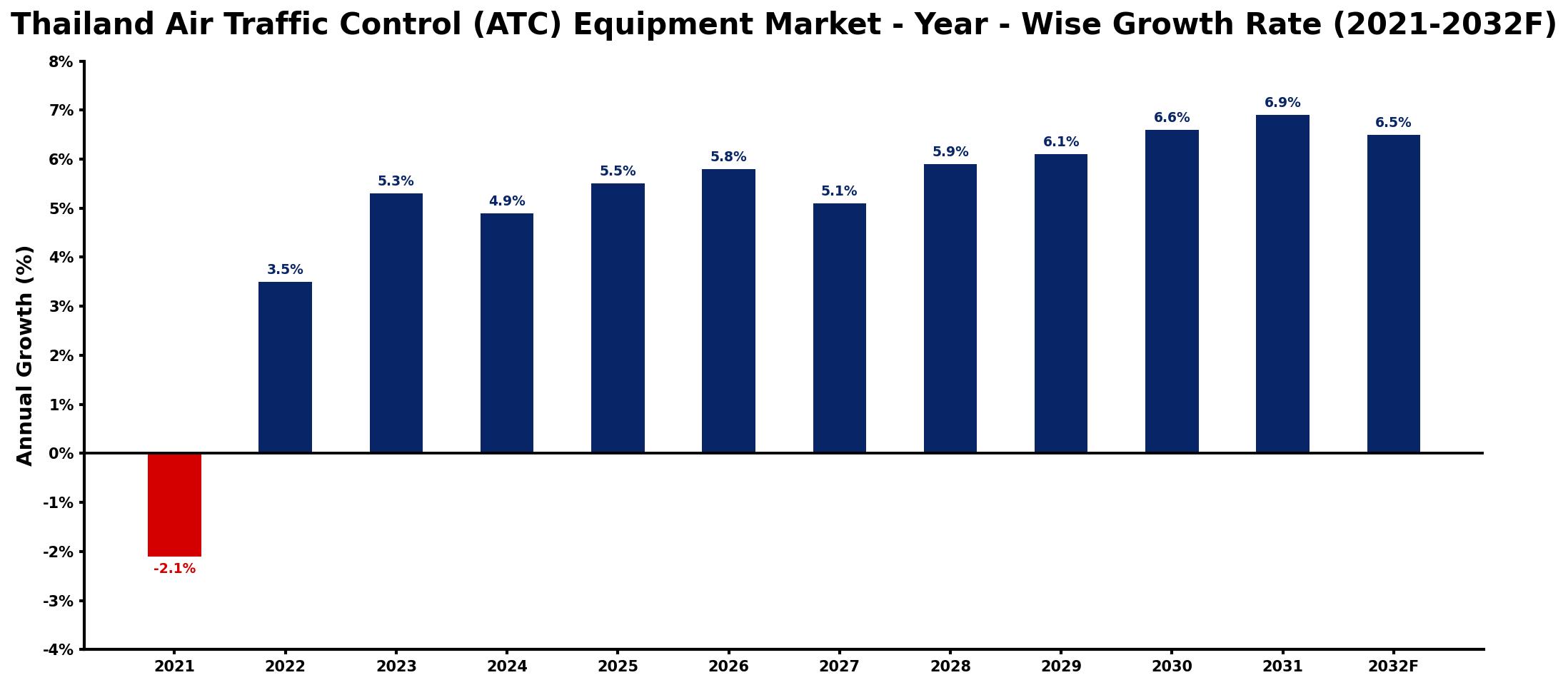
The table below presents the year‑wise growth rates along with the key drivers influencing the market
| Year | Growth Rate | Major Drivers |
| 2021 | -2.1% | decreased infrastructure investments in aviation |
| 2022 | 3.5% | growing passenger travel demand resurgence |
| 2023 | 5.3% | increased government funding for modernization |
| 2024 | 4.9% | increased production capacity utilization |
| 2025 | 5.5% | increased capital investment inflows |
| 2026 | 5.8% | investment in smart technology solutions |
| 2027 | 5.1% | expanding manufacturing base activity |
| 2028 | 5.9% | increased domestic production output |
| 2029 | 6.1% | enhanced safety regulations implementation |
| 2030 | 6.6% | growing demand for sustainable practices |
| 2031 | 6.9% | increased collaboration with private sector |
| 2032 | 6.5% | advancements in digital communication systems |
Note: Market size estimations and growth projections presented in this report are based on 6Wresearch's proprietary forecasting methodology, utilizing the latest available industry data, government publications, and primary research inputs.
Thailand Air Traffic Control (ATC) Equipment Market Synopsis
A significant driver of the Thailand ATC equipment market is the surge in air traffic, driven by increased tourism and trade activities. As the nation's airports expand and airspace becomes more congested, the adoption of sophisticated ATC systems has become imperative for operational efficiency and safety.
Moreover, the push towards sustainability within the aviation sector is reshaping equipment requirements. Advanced technologies that support green operations are increasingly prioritized, fostering further investment in cutting-edge ATC solutions.
Thailand Air Traffic Control (ATC) Equipment Market Key Takeaways
- The market is witnessing robust growth due to rising air traffic and the need for modernized ATC systems.
- Investment in sustainability and green technologies is significantly influencing market dynamics.
- Effective management of airspace congestion is crucial for enhancing operational efficiency.
- Cybersecurity measures are becoming increasingly important to safeguard ATC infrastructure.
- The post-pandemic recovery is presenting unique opportunities for ATC equipment upgrades.
Evaluation of Restraints in Thailand Air Traffic Control (ATC) Equipment Market
The Thailand ATC equipment market faces notable restraints primarily stemming from airspace congestion and the complexities associated with modernization. The high costs associated with upgrading existing systems can deter timely enhancements. Coordination among various stakeholders, including government agencies and airlines, is essential for seamless integration of new technologies. Furthermore, the emerging threat of cybersecurity attacks poses additional concerns, necessitating comprehensive security frameworks to protect critical aviation infrastructure.
Thailand Air Traffic Control (ATC) Equipment Market Trends
Several trends are currently shaping the Thailand ATC equipment market. First, the increasing integration of automation and artificial intelligence technologies is streamlining air traffic management processes. Second, a focus on enhancing safety measures is driving demand for advanced radar and surveillance systems. Lastly, the move towards sustainable aviation is paving the way for the incorporation of green technologies in ATC equipment, addressing environmental concerns while maintaining operational efficiency.
Thailand Air Traffic Control (ATC) Equipment Market Opportunities
The Thailand ATC equipment market is ripe with opportunities for growth and investment. The ongoing modernization of ATC infrastructure provides a landscape for advanced system integration, enhancing air traffic management capabilities. Additionally, the push for sustainability in aviation opens avenues for innovative equipment solutions that minimize environmental impact. Companies that can offer robust, secure, and efficient solutions will find significant opportunities in both upgrading existing systems and developing new technologies.
Government Initiatives in the Thailand Air Traffic Control (ATC) Equipment Market
The Thai government is actively involved in enhancing aviation safety and efficiency through various initiatives. Public spending on upgrading ATC infrastructure is becoming increasingly vital as air traffic grows. Programs aimed at improving airport facilities and implementing advanced ATC systems are being prioritized. Moreover, the government is keen on promoting sustainable aviation practices, which include incentives for adopting green technologies within the ATC framework.
Future Insights of the Thailand Air Traffic Control (ATC) Equipment Market
Looking ahead to 2026-2032, the Thailand ATC equipment market is expected to continue its upward trajectory driven by a combination of factors, including increased air traffic and advancements in technology. The need for improved safety and efficiency will necessitate a shift towards more sophisticated ATC solutions. Additionally, ongoing government support for modernization and sustainability will further enhance the attractiveness of this market, setting the stage for significant growth opportunities in the years to come.
Thailand Air Traffic Control (ATC) Equipment Market Latest Developments (2025 - 2026)
Recent developments in the Thailand ATC equipment market highlight a growing commitment to modernization and technology integration. There is an ongoing focus on adopting automated systems that can enhance efficiency and safety in air traffic management. Additionally, discussions around enhancing cybersecurity measures to protect ATC systems from potential threats are gaining prominence, reflecting the increasing importance of security in this vital infrastructure.
Thailand Air Traffic Control (ATC) Equipment Market - Key Attractiveness of the Report
- 10 Years of Market Numbers
- Historical Data Starting from 2022 to 2025
- Base Year: 2025
- Forecast Data until 2032
- Key Performance Indicators Impacting the Market
- Major Upcoming Developments and Projects
Key Highlights of the Report:
- Thailand Air Traffic Control (ATC) Equipment Market Outlook
- Market Size of Thailand Air Traffic Control (ATC) Equipment Market, 2025
- Forecast of Thailand Air Traffic Control (ATC) Equipment Market, 2032
- Historical Data and Forecast of Thailand Air Traffic Control (ATC) Equipment Revenues & Volume for the Period 2022-2032F
- Thailand Air Traffic Control (ATC) Equipment Market Trend Evolution
- Thailand Air Traffic Control (ATC) Equipment Market Drivers and Challenges
- Thailand Air Traffic Control (ATC) Equipment Price Trends
- Thailand Air Traffic Control (ATC) Equipment Porter's Five Forces
- Thailand Air Traffic Control (ATC) Equipment Industry Life Cycle
- Historical Data and Forecast of Thailand Air Traffic Control (ATC) Equipment Market Revenues & Volume By Product for the Period 2022-2032F
- Historical Data and Forecast of Thailand Air Traffic Control (ATC) Equipment Market Revenues & Volume By Communications Equipment for the Period 2022-2032F
- Historical Data and Forecast of Thailand Air Traffic Control (ATC) Equipment Market Revenues & Volume By Navigation Equipment for the Period 2022-2032F
- Historical Data and Forecast of Thailand Air Traffic Control (ATC) Equipment Market Revenues & Volume By Surveillance Equipment for the Period 2022-2032F
- Historical Data and Forecast of Thailand Air Traffic Control (ATC) Equipment Market Revenues & Volume By Air Traffic Control Equipment Application Outlook (USD Million, 2023-2032) for the Period 2022-2032F
- Historical Data and Forecast of Thailand Air Traffic Control (ATC) Equipment Market Revenues & Volume By Commercial Aircraft for the Period 2022-2032F
- Historical Data and Forecast of Thailand Air Traffic Control (ATC) Equipment Market Revenues & Volume By Private Aircraft for the Period 2022-2032F
- Historical Data and Forecast of Thailand Air Traffic Control (ATC) Equipment Market Revenues & Volume By Military Aircraft for the Period 2022-2032F
- Thailand Air Traffic Control (ATC) Equipment Import Export Trade Statistics
- Market Opportunity Assessment By Product
- Thailand Air Traffic Control (ATC) Equipment Top Companies Market Share
- Thailand Air Traffic Control (ATC) Equipment Competitive Benchmarking By Technical and Operational Parameters
- Thailand Air Traffic Control (ATC) Equipment Company Profiles
- Thailand Air Traffic Control (ATC) Equipment Key Strategic Recommendations






































